
Related: See how automation is changing compliance in AI tax automation in 2026, or jump straight to our free tax calculators and tools.
I was staring at a fresh cup of filter coffee this morning, thinking about how we collectively hate reading legislative notifications. Let's be real. Nobody opens a government Gazette for fun, especially when the text is stuffed with cross-references that require three separate tabs and a dictionary to decode.
But early this May (specifically around May 8 to 9, 2026), the Ministry of Labour and Employment dropped the final Central Rules for the long-delayed New Labour Codes India. Yes, it is finally happening. (If you want to read the official jargon, here is the official government PDF of the Central Rules FAQs).
After years of endless debates, postponements, and state-level dilly-dallying, the administrative gears are turning. Before navigating further, you can explore other essential compliance tools in our Tools Directory or review unified accounts tracking on ReconScribe.com.
So, what is the big deal? The government basically bundled 29 ancient, dusty labour laws into four modern codes: wages (as detailed in the official Code on Wages, 2019), industrial relations, social security (defined in the Code on Social Security, 2020), and occupational safety.
Sounds neat on paper. But for those of us tracking salary slips and corporate bank accounts, the real action is in the wage definition. And that is where the 50% rule kicks in.
Tip: a higher basic raises your PF and gratuity, which lifts your retirement savings but trims your monthly in-hand. To compare tax across regimes use the old vs new regime calculator, check your rent break with the HRA exemption calculator, and see your gratuity.
Basic Salary Changes Under the New Labour Codes India
Here is the simple truth: your basic salary cannot be a joke anymore. For years, companies loved keeping the “Basic Salary” component tiny, sometimes just 30% or 35% of the total cost-to-company (CTC) package.
Why? Because statutory contributions like Provident Fund (PF) and gratuity are calculated as a percentage of Basic. Keep Basic low, and the employer's pocket pinch is minimized (since PF contributions are tied directly to it). The rest of your CTC got padded with HRA, special allowances, travel passes, and other tax-efficient jargon.
Well, the New Labour Codes India say: enough. Your core wages (Basic + Dearness Allowance) must represent at least 50% of your total remuneration.
If your allowances exceed 50%, the excess is automatically deemed to be wages. The math is simple, but the impact is massive: a sudden shift. It requires a major rewrite of employment contracts across the nation, forcing HR departments to scrap their old templates.
Savings Boost vs. Take-Home Pay Under New Labour Codes India
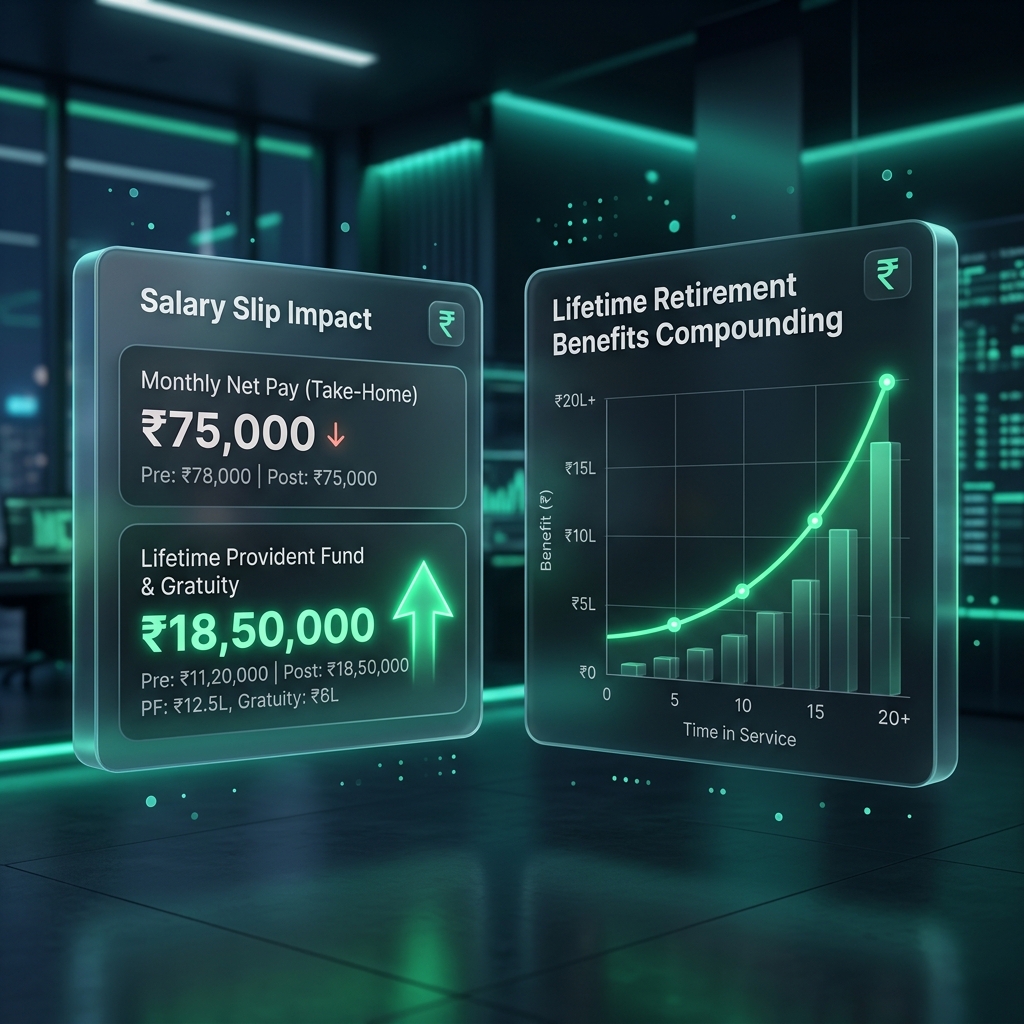
What does this mean for the average salary earner? Let's not sugarcoat it: your monthly take-home pay is probably going to shrink.
Not because you got a pay cut, but because more money is being routed into your PF kitty and gratuity reserve. More savings, less immediate cash. Some people will hate it. Others will appreciate the forced retirement planning. It is a trade-off. A bit of a sting, honestly, but you get a bigger nest egg in the long run.
And while we are talking about long-term money, let's address gratuity. Historically, you had to survive five continuous years at a single company to see a single rupee of gratuity, which felt like an eternity for the modern workforce.
The new Code on Social Security slashes this requirement to just one year for fixed-term and contract employees. A massive shift. It brings much-needed fairness to contract workers who keep the corporate wheels turning.
The Hidden Gem: The 48-Hour Settlement Rule
Oh, and another hidden gem: the 48-hour rule. When you resign, get let go, or retire, the company must settle your final wages within 48 hours of your last working day.
No more waiting 45 days, chasing HR, or sending polite follow-ups that get ignored in the corporate inbox. It is a win for worker rights, though payroll teams are definitely sweating bullets over the operational turnaround.
Check Your Numbers: Interactive CTC Calculator
Let's put some numbers to this. Instead of guessing, use our interactive tool below.
You can slide the percentages and add your company's specific allowance components to see exactly how your salary structure changes under the New Labour Codes India.
Calculator Locked
This interactive salary restructuring dashboard is reserved for registered users. Log in or create a free account to simulate your custom CTC breakdown under the New Labour Codes.
Reality Check: Concurrent Subjects and State-Level Delays
Now, a quick dose of reality to prevent you from storming into your finance department. Don't go yelling at your HR manager just yet.
Labor is technically a concurrent subject under the Constitution of India. What this means in plain English is that the central government can write the New Labour Codes India, but each individual state government (think Maharashtra, Karnataka, Tamil Nadu, Delhi) has to notify its own rules.
Some states are moving quickly; others are moving like glaciers. Until your state notifies the final rules, your company might not change a thing under the New Labour Codes India.
Legal Caveats and Disclaimers
Always remember that this calculator is an illustrative tool. Actual payslips are messy, containing specific components like professional tax, varying HRA calculations, medical benefits, and tax deductions.
This calculator is not formal financial advice, tax consulting, or legal counsel. Before making any lifestyle decisions based on a potential drop in take-home pay under the New Labour Codes India, discuss your specific salary breakdown with a qualified tax accountant or your company's payroll department.
Once your salary structure follows the new wage rules, the practical next step is running it in payroll software; our Zoho Payroll setup guide for India walks through EPF, ESI, PT and TDS configuration step by step.