
Advance tax is the income tax you pay as you earn, instead of waiting until the year ends. If your total tax for the year works out to 10,000 rupees or more after TDS, the law expects you to pay it in installments through the year, not in one lump sum at filing time. Miss the schedule and interest starts ticking under Sections 234B and 234C.
This advance tax installment estimator for FY 2026-27 (AY 2027-28) does the timing math for you. Enter your estimated tax for the year and the TDS already deducted, pick whether you are a regular or presumptive taxpayer, and it shows exactly how much to pay by each due date.
What is advance tax?
Advance tax is the pay as you earn part of Indian income tax. Rather than clearing your whole bill when you file, you pay it in pieces across the financial year as your income builds up. Salaried people meet most of this through TDS, which the employer cuts every month. The gap shows up when you have income that nobody is deducting tax on, such as interest, capital gains, rent, freelance fees or business profit.
Section 208 sets the trigger. If your estimated tax liability for the year, after subtracting TDS and TCS, comes to 10,000 rupees or more, you are expected to pay advance tax. Below that figure, you can simply settle up when you file your return.
How to use the advance tax installment estimator
The calculator keeps things deliberately simple.
- Pick your taxpayer type. Regular taxpayers follow the four installment schedule. Presumptive taxpayers under Section 44AD or 44ADA pay everything in one shot.
- Enter your estimated total tax for the year. This is your full income tax including the 4 percent cess. If you do not know it yet, the Old vs New Regime Calculator will give you the number in a few seconds.
- Enter the TDS or TCS already deducted. The tool subtracts this to find the advance tax you still owe.
The estimator then lays out each installment, the cumulative target percentage, and the running total you should have paid by every due date.
Who has to pay advance tax in FY 2026-27?
You are in the advance tax net if your net tax after TDS is 10,000 rupees or more. That covers most freelancers, consultants, business owners, traders, landlords and anyone with sizeable capital gains or interest income.
There is one helpful exemption. A resident senior citizen aged 60 or above who has no income from business or profession does not have to pay advance tax at all. Such a person can pay the entire tax as self assessment tax when filing. If a senior citizen does run a business or profession, the exemption does not apply.
Advance tax due dates for FY 2026-27
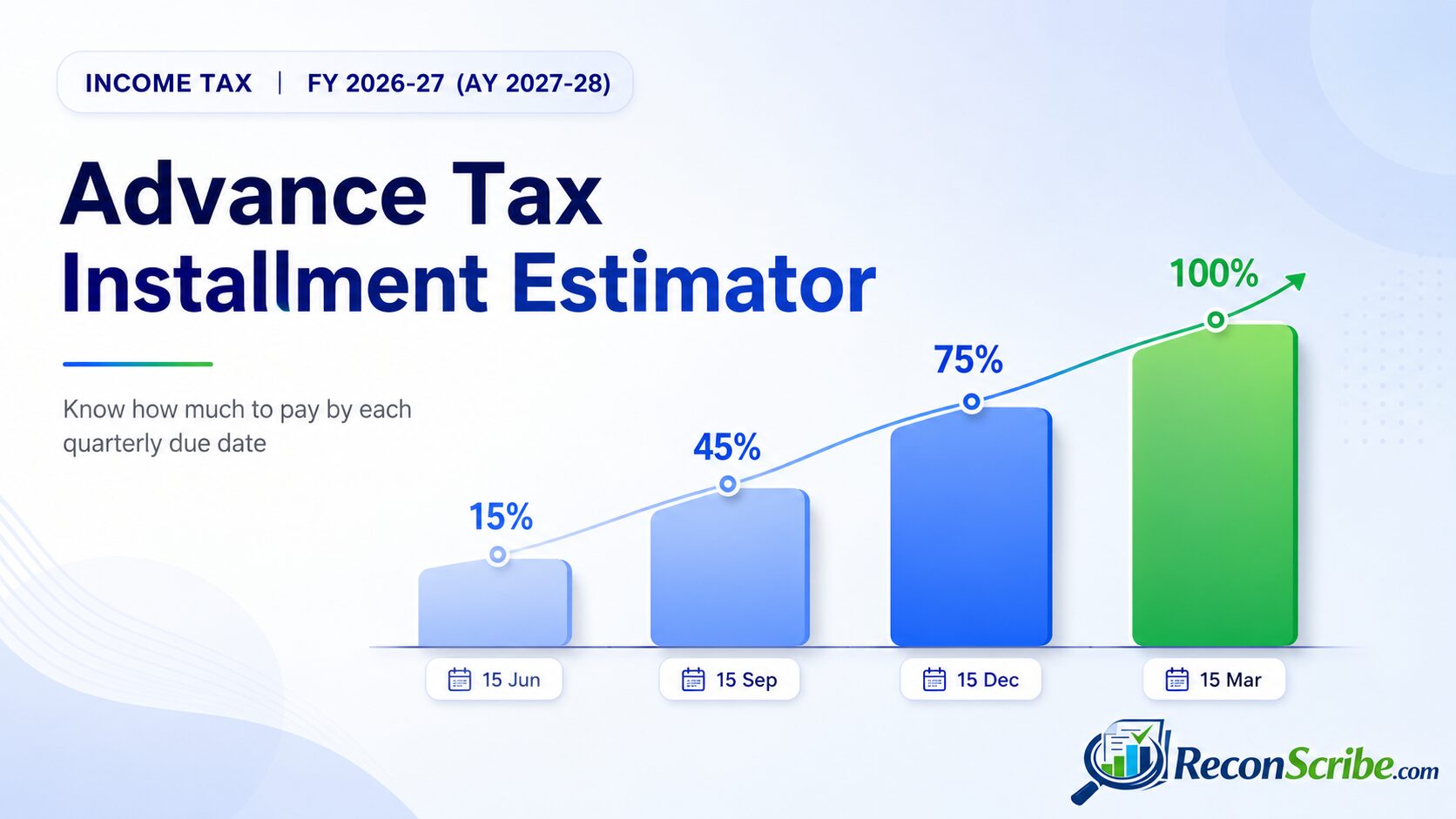
Section 211 fixes four dates for regular taxpayers, and each one carries a cumulative target. The percentages are not per quarter, they are the total you should have paid by that date.
| Due date | Cumulative advance tax | This installment |
|---|---|---|
| 15 June 2026 | 15% | 15% |
| 15 September 2026 | 45% | 30% |
| 15 December 2026 | 75% | 30% |
| 15 March 2027 | 100% | 25% |
The right hand column is the actual cash you part with each time: 15 percent, then 30 percent, then another 30 percent, and finally 25 percent. Any advance tax paid by 31 March still counts as advance tax for the year.
Presumptive taxpayers get a single installment
If you declare income under the presumptive scheme of Section 44AD for small businesses or Section 44ADA for professionals, the rules are kinder. You skip the four part schedule entirely and pay 100 percent of your advance tax in one payment by 15 March 2027. Switch the estimator to presumptive mode and it collapses to that single due date. Not sure of your presumptive income yet? Our 44ADA and 44AD presumptive tax calculator works that out first.
What happens if you miss an installment?
The cost of slipping up comes through two interest sections, and both charge 1 percent per month.
Section 234C deals with late or short installments during the year. If you pay less than the target by any due date, interest runs at 1 percent per month on the shortfall. The law does give a small cushion on the first two dates, where no interest applies if you have paid at least 12 percent by June and 36 percent by September. The December and March targets have no such tolerance.
Section 234B kicks in when your total advance tax for the year falls short of 90 percent of the final assessed tax. It charges 1 percent per month from 1 April of the assessment year until you clear the balance. Paying your installments on time is the clean way to avoid both. To see the exact rupee interest on a shortfall, use our Section 234 interest and late fee calculator.
How to pay advance tax online
Advance tax is paid through the e-Pay Tax service on the Income Tax Department portal. You select the assessment year 2027-28, choose the advance tax head, fill in the amount, and pay by net banking, UPI or card. Keep the challan receipt, since the credit shows up against your PAN in Form 26AS and the Annual Information Statement. You can reach the official facility on the Income Tax Department portal.
Planning your cash through the year helps you hit these dates without scrambling. Our Cash Flow Decision Tool and EMI calculator are handy companions when you are mapping out where the money goes.
A quick worked example
Say your estimated tax for the year is 1,20,000 rupees and your employer or bank has already deducted 20,000 rupees as TDS. Your advance tax works out to 1,00,000 rupees. As a regular taxpayer you would pay 15,000 by 15 June, 30,000 by 15 September, 30,000 by 15 December and the last 25,000 by 15 March. By the final date you have paid the full 1,00,000 and stayed clear of interest. A presumptive taxpayer with the same numbers would simply pay the whole 1,00,000 by 15 March 2027.
See all our free tax calculators and tools
Frequently asked questions
What is advance tax?
Advance tax is income tax paid in installments through the financial year as you earn, rather than as a single payment when you file. It applies when your tax after TDS is 10,000 rupees or more in the year.
Who has to pay advance tax in FY 2026-27?
Anyone whose net tax after TDS is 10,000 rupees or more, which usually means freelancers, business owners, traders, landlords and people with large capital gains or interest income. Resident senior citizens aged 60 and above with no business or professional income are exempt.
What are the advance tax due dates for FY 2026-27?
For regular taxpayers the cumulative targets are 15 percent by 15 June 2026, 45 percent by 15 September 2026, 75 percent by 15 December 2026 and 100 percent by 15 March 2027.
What happens if I miss an advance tax installment?
You pay interest at 1 percent per month. Section 234C charges interest on a shortfall in any installment, and Section 234B charges interest if your total advance tax is below 90 percent of the assessed tax. Paying each installment on time avoids both.
How do presumptive taxpayers pay advance tax?
Taxpayers under Section 44AD or 44ADA pay 100 percent of their advance tax in a single installment by 15 March 2027 instead of following the four part schedule.
How do I pay advance tax online?
Use the e-Pay Tax service on the Income Tax Department portal, select assessment year 2027-28 and the advance tax head, enter the amount and pay by net banking, UPI or card. Keep the challan for your records.
Official reference: Income-tax Act, 2025 (as amended by the Finance Act, 2026), Income Tax Department.