
A forgotten overseas bank account can be worth much more than its closing balance under FAST-DS 2026. The notified valuation rule looks at qualifying deposits over the life of the account. That is one reason to test the facts before assuming the ₹1 lakh route, the ₹1 crore route, or even the scheme itself applies.

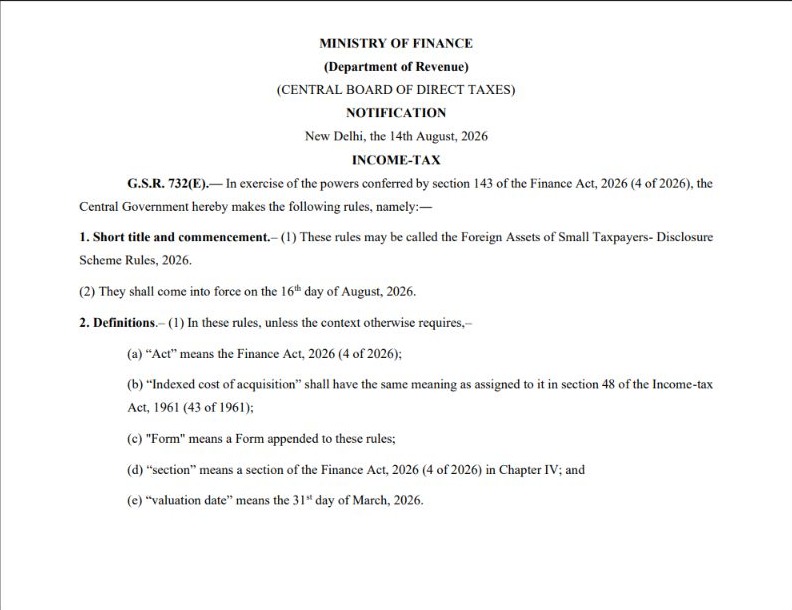
The Finance Act, 2026 contains the scheme. Notification No. 114/2026 notified the rules and Forms 1 to 4. The rules took effect on 16 August 2026, set 31 March 2026 as the valuation date, and set 31 December 2026 as the last date for a declaration.
Section 130(2) says the scheme comes into force on a date separately appointed by Central Government Gazette notification. Notification No. 114/2026 was made under the rule-making power in section 143 and states only that the rules take effect on 16 August. Our review of the official notification index, checked 30 August 2026, did not identify a separate section 130(2) commencement appointment. Confirm that appointment and the live filing service before trying to submit Form 1.
Short answer: FAST-DS 2026 is a voluntary, time-bound scheme for specified small taxpayers to disclose eligible foreign income, foreign assets, or a qualifying failure to report a foreign asset. It offers two very different routes: a tax-and-additional-amount route with a ₹1 crore aggregate ceiling, and a fixed ₹1 lakh route with a ₹5 crore aggregate ceiling. The fixed-fee route is narrower than many summaries make it sound.
This guide translates Chapter IV of the Finance Act and the notified rules into a filing workflow. It is educational information, not a finding that you qualify. A declaration can become invalid if material facts are false or a scheme condition is violated, so do not file only from an online checker.
FAST-DS 2026 in one minute
Category 1
Undisclosed foreign asset or income
Tax is 30% of the eligible asset value and undisclosed income, plus an amount equal to 100% of that tax.
Effective total: 60%
Aggregate value must not exceed ₹1 crore.
Category 2
Specified reporting omission
A fixed ₹1 lakh is payable where the asset came from qualifying NR-period foreign income or income already offered to tax in India, but the required foreign-asset schedule was omitted.
Fixed amount: ₹1 lakh
Aggregate asset value must not exceed ₹5 crore.
The scheme sits in sections 130 to 143 of the Finance Act, 2026. The accompanying rules define valuation, electronic verification and the filing forms. The official Budget 2026 FAQs describe the intended population as small taxpayers with comparatively minor or inadvertent foreign disclosure failures, including situations involving foreign ESOPs or RSUs, old student accounts, foreign savings after returning to India and overseas deputations.
Who can consider the scheme?
Residence is the first gate, but it is not simply a question about where you live today. The enacted provisions cover a person who is or was resident in India in the relevant previous year. A person who is now non-resident or resident but not ordinarily resident may still need the facts examined if the foreign income arose, or the foreign asset was acquired, when that person was resident.
The declaration route can cover eligible foreign income or assets where, broadly:
- the relevant income-tax return was not furnished;
- a return filed before the scheme began omitted the foreign income or asset; or
- the foreign income or asset escaped assessment in reassessment proceedings.
The category, threshold and exclusions still have to be tested. A technically reportable overseas account is not automatically an eligible Category 2 case. Equally, being non-resident today does not automatically end the enquiry.
The two declaration routes: 60% versus ₹1 lakh
Category 1: foreign asset, foreign income, or both
Category 1 applies to eligible undisclosed foreign assets and/or undisclosed foreign income. The aggregate of the foreign-asset value and undisclosed foreign income cannot exceed ₹1 crore.
The amount is calculated in two parts:
- tax at 30% of the foreign asset’s value on 31 March 2026 and 30% of the undisclosed foreign income; and
- an additional amount equal to 100% of that tax.
The combined payment is therefore 60% of the eligible base. It is more accurate to call it 30% tax plus an equal additional amount, rather than “60% tax”.
Official illustration
₹60 lakh bank account plus ₹20 lakh income
The notification illustrates an undisclosed foreign bank account valued at ₹60 lakh and undisclosed foreign income of ₹20 lakh. The aggregate is ₹80 lakh, within the ₹1 crore ceiling. Tax is ₹24 lakh, and the equal additional amount is another ₹24 lakh. Total payment: ₹48 lakh.
Category 2: specified omission from the foreign-asset schedule
Category 2 uses a fixed ₹1 lakh amount, but only for a specified reporting omission. The asset must fit one of these source situations:
- it was acquired from foreign income earned while the person was non-resident, but the relevant foreign-asset schedule was omitted after the person became resident; or
- it was acquired from income already offered to tax in India, but the relevant foreign-asset schedule was omitted.
The aggregate value of the foreign assets covered by this route must not exceed ₹5 crore. Source evidence is central. A person cannot safely choose the ₹1 lakh amount merely because the underlying money was “clean” or the omission was accidental.
Official illustrations
One case fits; another exceeds the ceiling
A ₹3 crore foreign plot acquired from foreign income while non-resident, then omitted after becoming resident, is illustrated as a ₹1 lakh Category 2 case. By contrast, foreign mutual funds worth ₹2.5 crore plus shares worth ₹4 crore total ₹6.5 crore. That exceeds the ₹5 crore ceiling, so the illustration says the person is not eligible for Category 2.
What can be declared, and what needs caution?
The scheme uses broad concepts of foreign income and foreign assets. The valuation rules specifically address bank accounts, bullion, jewellery, precious stones, artistic work, quoted and unquoted securities, immovable property, interests in firms, associations of persons or limited liability partnerships, and other assets.
Common fact patterns may include:
Dormant bank account
An old salary or student account that remained reportable even after the balance became small.
ESOPs or RSUs
Foreign shares or related income that did not make it into the correct return schedules.
Returning resident
Foreign savings, insurance, investments or property retained after residential status changed.
Transferred asset
An asset sold before 31 March 2026 can still require a scheme valuation under the transferred-asset rule.
Do not confuse FAST-DS with routine Schedule FA reporting. The Income Tax Department’s Schedule FA NUDGE page reminds taxpayers that foreign assets and income may also require Schedules FA, FSI and TR, and that ITR-1 and ITR-4 are not suitable where foreign assets must be reported. FAST-DS is a separate statutory route with its own conditions and payment consequences.
How FAST-DS values different foreign assets
The main valuation date is 31 March 2026. The rules often compare acquisition cost with a prescribed market measure and use the higher amount. An indexed-cost fallback appears for several assets if a market valuation is not carried out. The details differ by asset, so one shortcut cannot be applied across a portfolio.
The notified rule generally adds deposits from the account’s opening through 31 March 2026, while excluding deposits sourced from withdrawals from the same account and applying specified relief for amounts already covered by the 2015 disclosure scheme. This can be very different from the balance visible on 31 March.
Key valuation rules in plain language
| Asset | Core notified approach | Practical evidence |
|---|---|---|
| Foreign bank account | Qualifying deposits from opening through the valuation date, subject to the specified exclusions and adjustments. | Complete statements, deposit trail, transfer references and account-opening date. |
| Bullion, jewellery, precious stones | Higher of acquisition cost and open-market price on the valuation date. A valuer report may be obtained; indexed cost is the deemed value if market valuation is not carried out. | Invoices, ownership proof and a qualified valuation report where used. |
| Quoted shares or securities | Higher of acquisition cost and the average of the lowest and highest quoted price on the valuation date. If there was no trade, use the preceding trading date. | Contract notes, broker statements and exchange quotations. |
| Unquoted equity shares | Higher of acquisition cost and the prescribed balance-sheet formula. Indexed cost becomes the deemed value if that calculation is not carried out. | Investee financial statements, cap table and acquisition records. |
| Other unquoted securities | Higher of acquisition cost and open-market value. Indexed cost applies if market valuation is not carried out. | Instrument terms, valuation support and purchase records. |
| Foreign immovable property | Higher of acquisition cost and open-market value on 31 March 2026. A valuer in the property’s jurisdiction may be used; indexed cost applies if market valuation is not carried out. | Purchase deed, improvements, local valuation and ownership documents. |
| Interest in firm, AOP or LLP | A prescribed allocation of the entity’s net assets to the holder’s interest. | Entity balance sheet, ownership percentage and allocation working. |
| Other asset | Higher of acquisition or investment amount and the arm’s-length price on the valuation date. Indexed cost applies if market valuation is not carried out. | Acquisition proof and independent pricing support. |
Assets sold before 31 March 2026
For a transferred asset other than a bank account, the value is generally the higher of acquisition cost and sale price. If the transfer had no consideration or inadequate consideration, the rules look to the higher of acquisition cost and fair market value on the transfer date.
The rules also include an anti-double-counting adjustment. If a withdrawal or the proceeds of one foreign asset were used to acquire another foreign asset, the value of the earlier asset or bank account can be reduced by the amount invested in the new asset, subject to the rule’s conditions and evidence.
Currency conversion
Permitted currencies are converted using the Reserve Bank of India reference rate on the valuation date. For another currency, the rules first translate the local currency to US dollars using the relevant central-bank or regulator rate, then translate US dollars to rupees using the RBI reference rate. Preserve the exact source and date of each rate in the valuation file.
For assets other than bank accounts, a declaration does not become invalid solely because the authority’s fair market value differs from the declared value by no more than 20%. This limited variance safeguard should not be restated as a general 20% discount, and it does not extend to the bank-account valuation rule.
Forms 1 to 4 and the payment timeline
The notified workflow is electronic. The exact portal labels can change, so this article does not invent a menu path. First confirm the separate scheme-commencement notification required by section 130(2), then follow the live e-filing portal and the current official instructions when the filing service is available.
- Submit Form 1 electronically by 31 December 2026. Use a digital signature where your return must be verified by digital signature; otherwise use an electronic verification code.
- Receive Form 2. The designated authority determines the amount payable and sends the order within one month from the end of the month in which the declaration was made.
- Pay the determined amount. Payment is due within two months from the end of the month in which Form 2 is received.
- If needed, use the limited late-payment window. A further period of up to two months is available with simple interest at 1% for every month or part of a month.
- Submit payment proof electronically in Form 3.
- Receive Form 4. The authority issues the certificate within one month from the end of the month in which the payment intimation was submitted.
Because several deadlines run from the end of a month, do not substitute a rough “30-day” or “60-day” count. Record the actual declaration date, Form 2 receipt date, payment date and Form 3 submission date.
What a valid declaration protects, and what it does not
Once the declaration is valid and the required amount is paid, the scheme provides limited protection in relation to the income and foreign asset covered by that declaration. Broadly, there is no further tax or penalty under the Black Money (Undisclosed Foreign Income and Assets) and Imposition of Tax Act, 2015 for the declared item, and no prosecution under that Act for it, for the covered period up to the previous year ending 31 March 2026.
That protection is not a blanket amnesty:
- it does not legalise proceeds of crime or stop an applicable proceeding under another law;
- it does not cover foreign income or assets omitted from the declaration;
- it does not survive a materially false declaration or breach of a scheme condition;
- the amount paid is not refundable; and
- the declaration cannot be used as a general route to revision, rectification, set-off or relief for the declared matter.
Cases that are excluded or need special handling
The enacted exclusions include an asset or income representing proceeds of crime where proceedings under the Prevention of Money-laundering Act, 2002 have been initiated and are pending, and an assessment year for which assessment proceedings under the Black Money Act have already been completed.
A pending Black Money Act assessment is not described in the same way as a completed assessment. The scheme provides for the declaration to be taken into account in pending proceedings. That interaction is fact-sensitive and should be mapped before filing.
Nominee accounts, joint ownership, trusts, beneficial interests, inherited assets, company shares without current financial statements, money-laundering concerns and active tax proceedings need document-level analysis. The interactive checker is not designed to resolve them.
Documents to gather before choosing a category
The checklist is stored only in your browser while the page remains open. It is a preparation aid, not a filing record. Download or retain the underlying evidence separately.
FAST-DS versus a regular return correction
A revised return, updated return, current-year Schedule FA disclosure and FAST-DS declaration solve different problems. Availability can depend on the assessment year, filing history, nature of income, residential status, limitation period and the law applicable to that return.
| Question | FAST-DS | Regular return route |
|---|---|---|
| Purpose | Time-limited disclosure under a special scheme. | Correct or update an income-tax return where the ordinary law permits. |
| Foreign-asset valuation | Uses the special rules notified for FAST-DS. | Depends on the return schedule and the ordinary tax computation. |
| Payment | Category 1 tax plus equal amount, or Category 2 fixed amount, if eligible. | Tax, interest, fee and additional tax depend on the applicable return route. |
| Immunity | Limited statutory protection under the Black Money Act for a valid, paid declaration covering the stated item. | No automatic FAST-DS immunity. |
| Deadline | Declaration by 31 December 2026, followed by the notified Form 2 to Form 4 timetable. | Separate statutory limitation periods apply. |
Do not assume the cheapest-looking route is available. First identify the omitted item, year, residential status, source of funds, value under the correct rule, filing history and proceeding status. Then compare legally available routes.
Need professional help with FAST-DS 2026?
If you want a professional review, complete the form below. Your information and the result from the checker can be sent directly to the ReconScribe team so the first response starts with your facts. Do not include passwords, portal credentials, full account numbers, identity-document scans or other highly sensitive records in this initial form.
Professional review
Send your FAST-DS facts to ReconScribe
We will use the information to understand your likely category, valuation work and next step. Your enquiry is stored as a secure site request and automatically emailed to the ReconScribe team.
- Residential-status and source-of-funds review
- Asset-by-asset valuation checklist
- Category and filing-timeline review
Official sources used for this guide
- Finance Act, 2026, Act No. 4 of 2026, Chapter IV, sections 130 to 143.
- Notification No. 114/2026, G.S.R. 732(E), dated 14 August 2026, containing the FAST-DS Rules, valuation rules and Forms 1 to 4.
- Budget 2026 FAQs published by the Income Tax Department.
- Schedule FA NUDGE guidance on the Income Tax e-Filing portal.
Editorial review date: 30 August 2026. Article by Bhawana. Laws, forms and portal workflows can change; verify the live official material before acting.
Frequently asked questions
Has FAST-DS 2026 legally commenced?
The Finance Act requires the scheme to start on a date separately appointed by Gazette notification. Notification No. 114/2026 starts the rules on 16 August 2026, but our review of the official notification index on 30 August did not identify a separate section 130(2) commencement appointment. Verify the current Gazette position and live filing service before submitting.
What is the FAST-DS 2026 last date?
The notified last date for submitting a FAST-DS declaration is 31 December 2026. Payment happens later, after Form 2, under the separate month-end timetable in the rules.
Is Category 1 simply a 60% tax?
No. The law imposes tax at 30% of the eligible base and an additional amount equal to 100% of that tax. The combined payment is effectively 60%, but only half is the stated tax.
Can every foreign-asset reporting omission be settled for ₹1 lakh?
No. The fixed ₹1 lakh Category 2 route is limited to specified assets acquired from qualifying non-resident-period foreign income or income already offered to tax in India. The aggregate value must also stay within ₹5 crore.
Is a foreign bank account valued at its 31 March closing balance?
No. The notified rule generally uses qualifying deposits from the account’s opening through 31 March 2026, with specified exclusions and adjustments. Complete statements and the flow of funds are therefore important.
Can a person who is non-resident now use FAST-DS?
Possibly. The enacted provisions look at whether the person is or was resident in India in the relevant previous year. Current status alone does not decide the point, so map residence against the year of income and acquisition.
Can an asset sold before 31 March 2026 still be declared?
Potentially. The rules contain a separate valuation method for transferred assets other than bank accounts, generally comparing acquisition cost with sale price or, in specified cases, fair market value on the transfer date.
Is a FAST-DS payment refundable?
No. The scheme states that an amount paid under it is not refundable. Category, value, exclusions and source evidence should be checked before payment.
Does FAST-DS give immunity from every law?
No. The protection is limited to the declared foreign income or asset under the Black Money Act, subject to a valid declaration and full payment. It is not a general immunity from other laws or for items left out.