ReconScribe
Back to Compliance Hub
Text Size:
Published Last updated 25 min read
Applies to FY 2026-27 | MSMED Act Sections 15-24

MSME Delayed Payment Interest Calculator 2026

MSME delayed payment interest calculator showing the 15-day and 45-day payment rules

/* rc-center-h1 */@media(min-width:768px){body.single-post .reader-body>h1,body.page-template-default .reader-body>h1{text-align:center}}.msme-guide{color:#172033}.msme-guide p,.msme-guide li{line-height:1.72}.msme-guide a{font-weight:600}.msme-guide .msme-callout{margin:22px 0;padding:18px 22px;background:#f1f5f9;border-left:4px solid #0f766e;border-radius:0 12px 12px 0}.msme-guide .msme-callout p{margin:0 0 9px}.msme-guide .msme-callout p:last-child{margin-bottom:0}.msme-guide .msme-grid3{display:grid;grid-template-columns:repeat(3,1fr);gap:12px;margin:20px 0}.msme-guide .msme-mini{padding:17px;background:#fff;border:1px solid #e2e8f0;border-radius:12px}.msme-guide .msme-mini strong{display:block;color:#0f766e;font-size:20px;margin-bottom:4px}.msme-guide .msme-mini span{font-size:13.5px;color:#475569;line-height:1.5}.msme-guide .msme-table{overflow-x:auto;margin:20px 0}.msme-guide .msme-table table{width:100%;border-collapse:collapse;font-size:14.5px}.msme-guide .msme-table th{background:#f1f5f9;color:#0f172a;text-align:left}.msme-guide .msme-table th,.msme-guide .msme-table td{padding:11px 12px;border:1px solid #dbe3ed;vertical-align:top}.msme-guide .msme-figure{margin:28px 0;text-align:center}.msme-guide .msme-figure img{width:100%;max-width:820px;height:auto;border-radius:14px;border:1px solid #e2e8f0}.msme-guide .msme-figure figcaption{max-width:760px;margin:8px auto 0;color:#64748b;font-size:13px;line-height:1.5}.msme-guide .msme-steps{counter-reset:msme-step;list-style:none;padding:0;margin:20px 0}.msme-guide .msme-steps li{counter-increment:msme-step;position:relative;padding:0 0 18px 48px}.msme-guide .msme-steps li:before{content:counter(msme-step);position:absolute;left:0;top:1px;width:32px;height:32px;border-radius:50%;display:grid;place-items:center;background:#e6f6f4;color:#0f766e;font-weight:800}.msme-guide .msme-source-list{padding-left:20px}.msme-guide .msme-source-list li{margin-bottom:10px}.msme-guide .msme-news{margin:32px 0 10px;padding:24px;background:#f8fafc;border:1px solid #dbe3ed;border-radius:14px}.msme-guide .msme-news h2{margin-top:0}.msme-guide .msme-news-form{display:flex;gap:10px;max-width:650px}.msme-guide .msme-news-form input{flex:1;min-width:0;padding:12px 14px;border:1px solid #cbd5e1;border-radius:9px;font-size:15px}.msme-guide .msme-news-form button{border:0;border-radius:9px;background:#0f766e;color:#fff;font-weight:700;padding:12px 18px;cursor:pointer}.msme-guide .msme-news-msg{margin:10px 0 0;font-size:13.5px;color:#475569}.msme-guide .msme-disclaimer{margin:28px 0 0;padding:16px 18px;background:#fffbeb;border:1px solid #fde68a;border-radius:10px;color:#713f12;font-size:13.5px}.msmec *{box-sizing:border-box}.msmec{max-width:920px;margin:28px auto;color:#0f172a}.msmec .msmec-card{background:#fff;border:1px solid #e2e8f0;border-radius:14px;padding:22px;box-shadow:0 10px 30px rgba(15,23,42,.06)}.msmec .msmec-title{margin:0 0 5px;font-size:22px;font-weight:800;color:#0f172a}.msmec .msmec-sub{margin:0 0 19px;color:#64748b;font-size:14px;line-height:1.55}.msmec .msmec-grid{display:grid;grid-template-columns:1fr 1fr;gap:14px}.msmec .msmec-field{display:flex;flex-direction:column;gap:6px}.msmec .msmec-field label{font-size:13px;font-weight:700;color:#334155}.msmec .msmec-field small{color:#64748b;line-height:1.4}.msmec input,.msmec select{width:100%;padding:10px 12px;border:1px solid #cbd5e1;border-radius:9px;background:#fff;color:#0f172a;font-size:15px}.msmec input:focus,.msmec select:focus{outline:none;border-color:#0f766e;box-shadow:0 0 0 3px rgba(15,118,110,.13)}.msmec .msmec-section{grid-column:1/-1;margin:8px 0 0;padding-top:14px;border-top:1px solid #eef2f7}.msmec .msmec-section strong{display:block;font-size:14.5px;margin-bottom:3px}.msmec .msmec-section span{display:block;color:#64748b;font-size:13px;line-height:1.5}.msmec .msmec-error,.msmec .msmec-cap{display:none;margin-top:14px;padding:11px 13px;border-radius:9px;font-size:13.5px;line-height:1.55}.msmec .msmec-error{background:#fef2f2;border:1px solid #fecaca;color:#991b1b}.msmec .msmec-cap{background:#fffbeb;border:1px solid #fde68a;color:#78350f}.msmec .msmec-results{margin-top:18px;background:#f8fafc;border:1px solid #e2e8f0;border-radius:12px;padding:18px}.msmec .msmec-result-grid{display:grid;grid-template-columns:repeat(2,1fr);gap:0 22px}.msmec .msmec-row{display:flex;justify-content:space-between;gap:12px;padding:10px 0;border-bottom:1px solid #e9eef5;font-size:14.5px}.msmec .msmec-key{color:#475569}.msmec .msmec-value{font-weight:750;color:#0f172a;text-align:right}.msmec .msmec-total{grid-column:1/-1;display:grid;grid-template-columns:1fr 1fr;gap:12px;margin-top:16px}.msmec .msmec-total>div{padding:15px;background:#fff;border:1px solid #dbe3ed;border-radius:10px}.msmec .msmec-total span{display:block;color:#64748b;font-size:12.5px;margin-bottom:4px}.msmec .msmec-total strong{font-size:24px;color:#0f766e}.msmec .msmec-review{margin-top:15px;padding-top:14px;border-top:1px solid #dbe3ed}.msmec .msmec-review p{margin:5px 0;font-size:13.5px;line-height:1.55}.msmec .msmec-note{margin-top:13px;color:#64748b;font-size:12.5px;line-height:1.55}.msmec .msmec-actions{display:flex;justify-content:flex-end;margin-top:14px}.msmec .msmec-reset{border:1px solid #cbd5e1;background:#fff;color:#334155;border-radius:8px;padding:9px 13px;font-weight:700;cursor:pointer}@media(max-width:720px){.msme-guide .msme-grid3,.msmec .msmec-grid,.msmec .msmec-result-grid,.msmec .msmec-total{grid-template-columns:1fr}.msmec .msmec-section,.msmec .msmec-total{grid-column:1}.msmec .msmec-card{padding:17px}.msme-guide .msme-news-form{flex-direction:column}}

A Rs 10 lakh invoice that crosses the MSME payment deadline is no longer just an accounts-payable item. At the current 5.50% RBI Bank Rate, the statutory interest rate is 16.50% a year with monthly rests. If the principal is still unpaid at tax-year end, the buyer may also have an actual-payment deduction issue under Section 37 of the Income-tax Act, 2025.

This MSME delayed payment interest calculator brings those checks together. Enter the acceptance date, written credit term, unpaid amount and payment date to see the last on-time date, estimated interest, Section 37 review and MSME Form I flag.

Jump straight to the calculator

The practical hook: one late invoice can create three separate jobs: supplier interest under Section 16 of the MSMED Act, an income-tax deduction review under Section 37, and a half-yearly MSME Form I check for company buyers.

The tool does not decide whether a supplier is legally eligible. It makes that check visible so the finance team knows what to verify before relying on the result.

15 daysDefault period when there is no written payment agreement.
45 daysMaximum written credit period from acceptance or deemed acceptance.
3 x Bank RateSection 16 rate, compounded with monthly rests.

MSME Delayed Payment Interest Calculator 2026

Estimate the statutory deadline and interest on one unpaid invoice. The method uses actual days divided by 365, with compounding on monthly anniversaries from the interest start date.

Use the principal that remains unpaid.
Use delivery or service acceptance after considering any written objection raised within 15 days.
Yes, written credit termNo written agreement
The statute caps the period at 45 days even if the contract says more.
If still unpaid, use the date through which you want an estimate.
Default checked against RBI current rates on 12 August 2026. Change it if the applicable rate period differs.
Supplier eligibility checkSections 15 to 24 protect qualifying micro and small suppliers. The calculator will warn when the selected facts need separate review.
Micro or small, manufacturing or serviceMicro or small trader, NIC 45, 46 or 47Medium enterpriseNot sure
Valid and verifiedTiming or status unclearNo Udyam registration
Tax and company-law reviewThese fields do not calculate tax payable. They flag the principal amount and filing question that need review.
Enter zero if fully paid before the selected tax-year end.
YesNoNot sureMSME Form I is a Companies Act return.
Last on-time payment date
Interest starts
Section 16 annual rate
Days after deadline
Estimated compound interest
Estimated principal plus interest

Monthly-rest method:

Eligibility:

Section 37 review:

MSME Form I:

Estimate only. Section 16 specifies compound interest with monthly rests but does not prescribe one universal day-count convention. This tool uses actual days divided by 365 and monthly anniversary rests. Split the working where the RBI Bank Rate changes, and have disputed dates, partial payments or legal claims reviewed.

(function (root, factory) { var api = factory(); if (typeof module === “object”) { if (module.exports) { module.exports = api; } } root.ReconMSME = api; if (root.document) { if (root.document.readyState === “loading”) { root.document.addEventListener(“DOMContentLoaded”, api.init); } else { api.init(); } } })(typeof window !== “undefined” ? window : globalThis, function () { “use strict”; var DAY_MS = 86400000; function parseDate(value) { var parts = String(value || “”).split(“-“); if (parts.length !== 3) return null; var year = Number(parts[0]); var month = Number(parts[1]); var day = Number(parts[2]); var date = new Date(Date.UTC(year, month – 1, day)); if ( date.getUTCFullYear() !== year || date.getUTCMonth() !== month – 1 || date.getUTCDate() !== day ) { return null; } return date; } function addDays(date, days) { return new Date(date.getTime() + days * DAY_MS); } function daysBetween(start, end) { return Math.max(0, Math.round((end.getTime() – start.getTime()) / DAY_MS)); } function addMonthsFrom(anchor, count) { var first = new Date(Date.UTC(anchor.getUTCFullYear(), anchor.getUTCMonth() + count, 1)); var lastDay = new Date( Date.UTC(first.getUTCFullYear(), first.getUTCMonth() + 1, 0) ).getUTCDate(); return new Date( Date.UTC( first.getUTCFullYear(), first.getUTCMonth(), Math.min(anchor.getUTCDate(), lastDay) ) ); } function formatIso(date) { return date.toISOString().slice(0, 10); } function estimateInterest(principal, interestStart, throughDate, annualRate) { var endExclusive = addDays(throughDate, 1); if (endExclusive <= interestStart || principal <= 0 || annualRate endExclusive) break; var periodDays = daysBetween(cursor, nextRest); var periodInterest = balance * (annualRate / 100) * (periodDays / 365); interest += periodInterest; balance += periodInterest; cursor = nextRest; fullMonths += 1; } var partialDays = daysBetween(cursor, endExclusive); interest += balance * (annualRate / 100) * (partialDays / 365); return { interest: interest, fullMonths: fullMonths, partialDays: partialDays, totalDays: daysBetween(interestStart, endExclusive), }; } function eligibilityStatus(supplierType, udyamStatus) { if (supplierType === “mse”) { if (udyamStatus === “valid”) { return { eligible: true, label: “Micro or small manufacturing or service enterprise with verified Udyam status”, note: “The statutory estimate can be used as a working check, subject to the transaction facts.”, }; } } if (supplierType === “trader”) { return { eligible: false, label: “Trading activity needs separate review”, note: “Current Ministry guidance excludes NIC 45, 46 and 47 trading activities from the delayed-payment provisions. The interest shown is illustrative only.”, }; } if (supplierType === “medium”) { return { eligible: false, label: “Medium enterprise is outside Chapter V delayed-payment protection”, note: “Sections 15 to 24 apply to micro and small enterprise suppliers, not medium enterprises. The interest shown is illustrative only.”, }; } if (udyamStatus === “none”) { return { eligible: false, label: “Udyam status not verified”, note: “Do not treat the result as a statutory claim until the supplier’s registration and transaction eligibility are confirmed.”, }; } return { eligible: false, label: “Eligibility needs verification”, note: “Check the supplier’s Udyam certificate, enterprise class, activity and transaction date before relying on the statutory outputs.”, }; } function calculate(input) { var errors = []; var principal = Number(input.principal); var acceptanceDate = parseDate(input.acceptanceDate); var throughDate = parseDate(input.throughDate); var taxYearEnd = parseDate(input.taxYearEnd); var bankRate = Number(input.bankRate); var taxUnpaid = Number(input.taxUnpaid || 0); var hasAgreement = input.agreement === “written”; var enteredCreditDays = hasAgreement ? Number(input.creditDays) : 15; if (!(principal > 0)) errors.push(“Enter an unpaid invoice amount greater than zero.”); if (!acceptanceDate) errors.push(“Enter a valid acceptance or deemed-acceptance date.”); if (!throughDate) errors.push(“Enter a valid payment or calculation date.”); if (!taxYearEnd) errors.push(“Enter a valid tax-year end date.”); if (bankRate 25) errors.push(“Enter an RBI Bank Rate between 0% and 25%.”); if (!(taxUnpaid >= 0)) errors.push(“The amount unpaid at tax-year end cannot be negative.”); if (hasAgreement) { if (enteredCreditDays 365) { errors.push(“Enter written credit days between 1 and 365.”); } } if (acceptanceDate) { if (throughDate) { if (throughDate 45 : false; var taxDeadlinePassed = taxYearEnd >= interestStart; var taxAtRisk = eligibility.eligible ? (taxDeadlinePassed ? taxUnpaid : 0) : 0; var formAgeDate = addDays(acceptanceDate, 46); var formThresholdPassed = throughDate >= formAgeDate; var formReview; if (!eligibility.eligible) { formReview = “Verify supplier eligibility first”; } else if (input.companyBuyer === “yes”) { if (formThresholdPassed) { if (principal > 0) { formReview = “Review MSME Form I for the relevant half year”; } else { formReview = “No pending principal is flagged for MSME Form I”; } } else { formReview = “No more-than-45-day pending amount is flagged yet”; } } else if (input.companyBuyer === “no”) { formReview = “Buyer is not a company, so MSME Form I is not triggered”; } else if (input.companyBuyer === “unknown”) { formReview = “Confirm whether the buyer is a company”; } else { formReview = “No more-than-45-day pending amount is flagged yet”; } return { errors: [], principal: principal, acceptanceDate: formatIso(acceptanceDate), dueDate: formatIso(dueDate), interestStart: formatIso(interestStart), throughDate: formatIso(throughDate), statutoryCreditDays: statutoryCreditDays, enteredCreditDays: enteredCreditDays, agreementCapped: agreementCapped, annualRate: annualRate, daysLate: Math.max(0, daysBetween(dueDate, throughDate)), interest: estimate.interest, totalDue: principal + estimate.interest, fullMonths: estimate.fullMonths, partialDays: estimate.partialDays, accruedDays: estimate.totalDays, eligibility: eligibility, taxDeadlinePassed: taxDeadlinePassed, taxAtRisk: taxAtRisk, taxUnpaid: taxUnpaid, formReview: formReview, }; } function init() { var rootElement = document.getElementById(“msme-interest-calculator”); if (!rootElement || rootElement.getAttribute(“data-ready”) === “1”) return; rootElement.setAttribute(“data-ready”, “1”); var ids = [ “msme-principal”, “msme-acceptance”, “msme-agreement”, “msme-credit-days”, “msme-through”, “msme-bank-rate”, “msme-supplier-type”, “msme-udyam”, “msme-tax-unpaid”, “msme-tax-year-end”, “msme-company-buyer”, ]; var elements = {}; ids.forEach(function (id) { elements[id] = document.getElementById(id); }); function money(value) { return “Rs ” + new Intl.NumberFormat(“en-IN”, { maximumFractionDigits: 0 }).format(Math.round(value)); } function dateLabel(value) { var date = parseDate(value); return date ? new Intl.DateTimeFormat(“en-IN”, { day: “numeric”, month: “short”, year: “numeric”, timeZone: “UTC”, }).format(date) : “Not available”; } function setText(id, value) { var element = document.getElementById(id); if (element) element.textContent = value; } function values() { return { principal: elements[“msme-principal”].value, acceptanceDate: elements[“msme-acceptance”].value, agreement: elements[“msme-agreement”].value, creditDays: elements[“msme-credit-days”].value, throughDate: elements[“msme-through”].value, bankRate: elements[“msme-bank-rate”].value, supplierType: elements[“msme-supplier-type”].value, udyamStatus: elements[“msme-udyam”].value, taxUnpaid: elements[“msme-tax-unpaid”].value, taxYearEnd: elements[“msme-tax-year-end”].value, companyBuyer: elements[“msme-company-buyer”].value, }; } function render() { var written = elements[“msme-agreement”].value === “written”; document.getElementById(“msme-credit-wrap”).style.display = written ? “flex” : “none”; var result = calculate(values()); var errorBox = document.getElementById(“msme-errors”); var resultBox = document.getElementById(“msme-results”); if (result.errors.length) { errorBox.textContent = result.errors.join(” “); errorBox.style.display = “block”; resultBox.style.display = “none”; return; } errorBox.style.display = “none”; resultBox.style.display = “block”; setText(“msme-out-due”, dateLabel(result.dueDate)); setText(“msme-out-start”, dateLabel(result.interestStart)); setText(“msme-out-rate”, result.annualRate.toFixed(2) + “% a year”); setText(“msme-out-days”, result.daysLate + (result.daysLate === 1 ? ” day” : ” days”)); setText(“msme-out-interest”, money(result.interest)); setText(“msme-out-total”, money(result.totalDue)); setText( “msme-out-method”, result.accruedDays === 0 ? “No statutory interest period is reached on the selected date.” : result.fullMonths + ” full monthly rest” + (result.fullMonths === 1 ? “” : “s”) + ” and ” + result.partialDays + ” remaining day” + (result.partialDays === 1 ? “” : “s”) + “.” ); setText(“msme-out-eligibility”, result.eligibility.label); setText(“msme-out-eligibility-note”, result.eligibility.note); var taxText; if (!result.eligibility.eligible) { taxText = “Verify supplier eligibility before applying Section 37.”; } else if (!result.taxDeadlinePassed) { taxText = “The selected statutory deadline has not passed by this tax-year end.”; } else if (result.taxUnpaid <= 0) { taxText = "No unpaid amount was entered for the tax-year end."; } else { taxText = money(result.taxAtRisk) + " needs actual-payment review under Section 37."; } setText("msme-out-tax", taxText); setText("msme-out-form", result.formReview); var cap = document.getElementById("msme-cap-note"); if (result.agreementCapped) { cap.textContent = "The entered term is " + result.enteredCreditDays + " days, but this estimate applies the statutory 45-day maximum."; cap.style.display = "block"; } else { cap.style.display = "none"; } } ids.forEach(function (id) { elements[id].addEventListener("input", render); elements[id].addEventListener("change", render); }); document.getElementById("msme-reset").addEventListener("click", function () { elements["msme-principal"].value = "1000000"; elements["msme-acceptance"].value = "2026-07-01"; elements["msme-agreement"].value = "written"; elements["msme-credit-days"].value = "45"; elements["msme-through"].value = "2026-09-30"; elements["msme-bank-rate"].value = "5.50"; elements["msme-supplier-type"].value = "mse"; elements["msme-udyam"].value = "valid"; elements["msme-tax-unpaid"].value = "1000000"; elements["msme-tax-year-end"].value = "2027-03-31"; elements["msme-company-buyer"].value = "yes"; render(); }); render(); } return { addDays: addDays, addMonthsFrom: addMonthsFrom, calculate: calculate, daysBetween: daysBetween, estimateInterest: estimateInterest, init: init, parseDate: parseDate, }; });

What this MSME delayed payment interest calculator checks

The calculator is designed as an accounts-payable and audit working, not as a one-line interest widget. It connects the same invoice to the four rules that usually sit in different files.

Question Rule used What the result means
When was payment due? Section 15 of the MSMED Act 15 days without a written agreement, or the written term capped at 45 days.
When does interest begin? Sections 2 and 16 The day immediately after the applicable payment deadline.
What rate applies? Section 16 Three times the RBI Bank Rate, with monthly rests.
What principal needs tax review? Section 37(2)(g) of the Income-tax Act, 2025 An eligible amount that remains unpaid after the Section 15 time limit may be allowed only on actual payment.
Does MSME Form I need review? MCA’s 2024 amendment order A company with qualifying MSE payments pending for more than 45 days should check the half-yearly return.

The 15-day and 45-day rule in plain English

Section 15 does not give every buyer a standard 45-day credit period. It creates two routes.

  • No written payment agreement: payment must be made before the appointed day. The Act defines the appointed day as the day immediately after 15 days from acceptance or deemed acceptance.
  • Written payment agreement: the agreed date applies, but the written period cannot exceed 45 days from acceptance or deemed acceptance.

A purchase order saying 60 or 90 days does not extend the statutory ceiling. The calculator accepts the contractual term but caps the Section 15 working at 45 days and shows a warning.

Acceptance and deemed acceptance matter as much as the invoice date

The clock runs from acceptance or deemed acceptance, not automatically from invoice creation. Under Section 2, acceptance is generally the day goods are delivered or services are rendered. If the buyer raises a written objection within 15 days, acceptance can move to the day the supplier removes that objection. If no written objection is made within that period, deemed acceptance follows the actual delivery or service date.

That is why a reliable vendor ledger should retain the goods-receipt note, service-entry sheet, written quality objection and closure evidence. An invoice date alone may not prove the legal starting point.

A quick date example

Assume services are accepted on 1 July 2026.

  • With no written term, the calculator treats 16 July as the last on-time date and starts interest on 17 July.
  • With a written 30-day term, the last on-time date is 31 July and interest starts on 1 August.
  • With a written 60-day term, the statutory ceiling still puts the last on-time date at 15 August and starts interest on 16 August.
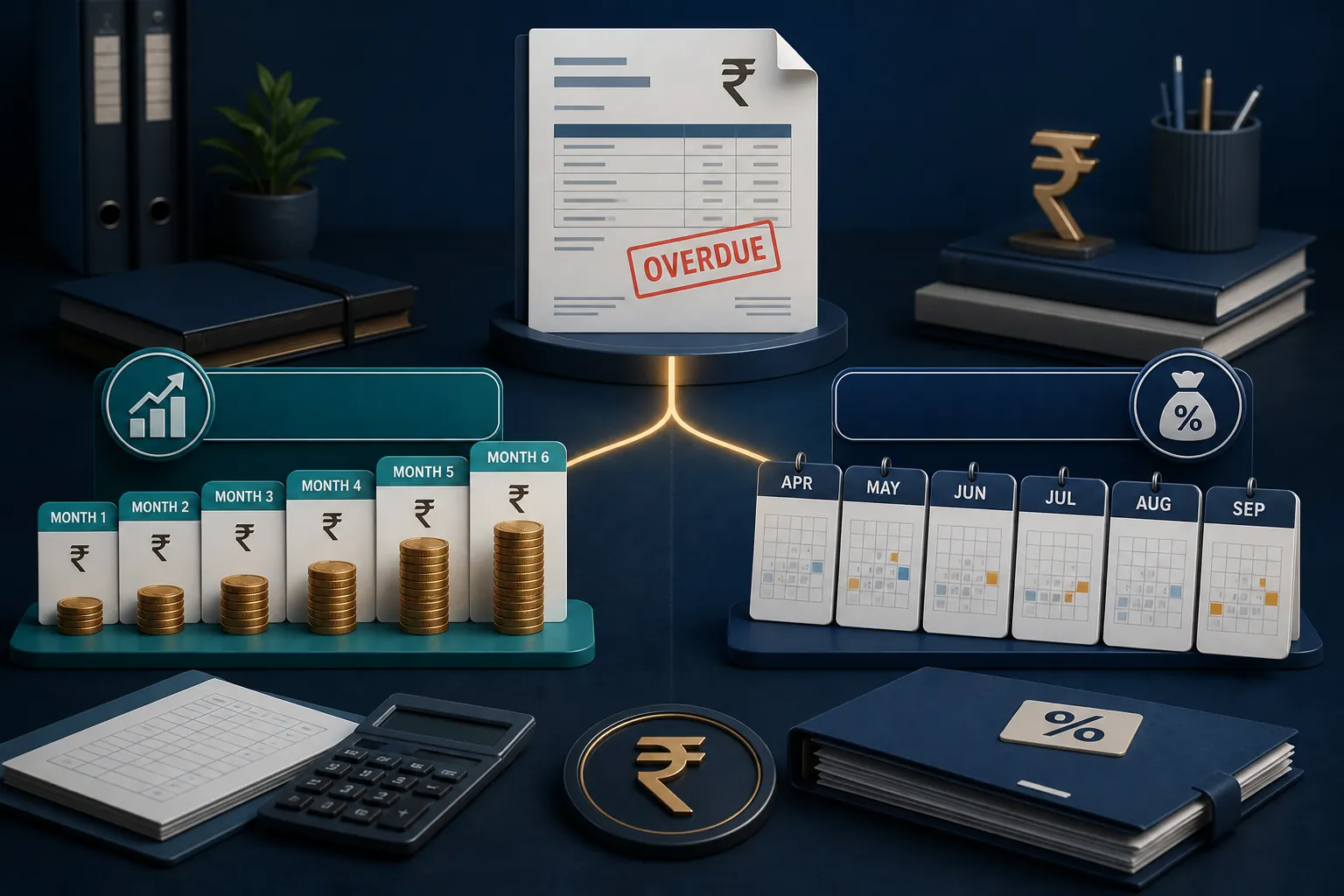
Overdue MSME invoice creating monthly compound interest and an income-tax deduction review
One overdue invoice can affect supplier interest, tax deduction timing and reporting. Original ReconScribe illustration.

How Section 16 interest works

Section 16 makes the buyer liable for compound interest with monthly rests at three times the RBI Bank Rate. The obligation overrides a contrary contract. With the RBI Bank Rate at 5.50% on the publication date, the working annual rate is 16.50%.

Current working rate: 5.50% RBI Bank Rate x 3 = 16.50% a year.

The Bank Rate is editable because RBI policy rates can change. For a delay spanning a rate change, split the calculation into the relevant rate periods or obtain a reviewed working.

The method used in this calculator

The Act states the rate and monthly rests, but it does not prescribe one universal online-calculator convention for day count and broken months. ReconScribe therefore shows its method instead of hiding it:

  1. Calculate interest from the statutory interest-start date through the selected payment or calculation date.
  2. Use actual calendar days divided by 365.
  3. Capitalise accrued interest on each monthly anniversary of the interest-start date.
  4. Apply simple daily accrual for the final broken month.

This is a transparent estimate, not an MSEFC award. For partial payments, disputed acceptance dates or a long period with Bank Rate changes, prepare a transaction-level schedule and have the allocation reviewed.

Worked MSME delayed-payment examples

Example 1: no written credit term

A micro service supplier has a verified Udyam registration. The buyer accepts a Rs 10 lakh service on 1 July 2026 and there is no written payment term. The statutory working uses a 15-day period, so the last on-time date is 16 July and interest starts on 17 July. If the amount remains unpaid, every extra month adds interest and the monthly rest compounds what has already accrued.

Example 2: purchase order says 60 days

The same invoice has a written 60-day term. Section 15 does not allow the statutory period to exceed 45 days. The calculator therefore uses 15 August as the last on-time date, starts interest on 16 August and separately warns that the contract exceeds the statutory ceiling.

Example 3: paid late but before 31 March

Suppose an eligible invoice crosses the Section 15 deadline in January but is actually paid on 20 March. Section 16 interest can still arise for the delayed period. However, the principal is not left unpaid at 31 March, so the amount-unpaid-at-year-end field should be zero. The supplier-interest question and the tax-year-end deduction question are related, but they are not the same calculation.

Section 37 and the old Section 43B(h)

From 1 April 2026, the Income-tax Act, 2025 replaced the Income-tax Act, 1961. The delayed-MSE payment rule now appears in Section 37(2)(g). Search results and older audit files may still call it Section 43B(h), which was the corresponding provision under the 1961 Act.

The new Section 37 rule keeps the same practical point: an amount payable to a micro or small enterprise beyond the Section 15 time limit is allowed on actual payment. The return-filing due-date relaxation in Section 37(3) expressly excludes this MSE clause.

What the calculator flags: if the selected Section 15 deadline has passed by the tax-year end, it shows the principal amount you entered as needing actual-payment review.

It does not calculate the final tax cost. That depends on the deduction otherwise being allowable, the assessee’s facts, payments made before year end, and the applicable tax position.

There is a separate rule in Section 23 of the MSMED Act: the interest payable under Section 16 is not allowed as an income-tax deduction. Keep principal, statutory interest and ordinary purchase expense in separate ledger fields so the audit trail remains clear.

MSME Form I after the 2024 amendment

MSME Form I is a half-yearly Companies Act return. The Ministry of Corporate Affairs amended the order on 15 July 2024. The new proviso says only specified companies having payments pending to a micro or small enterprise for more than 45 days from acceptance or deemed acceptance must furnish the information.

Once the return is triggered, the revised web form captures broader transaction buckets, including amounts paid within 45 days, paid after 45 days, outstanding for 45 days or less, and outstanding for more than 45 days. This is why a buyer should not reduce the working to one overdue total.

Half-year Regular due date Practical cut-off file
April to September 31 October Supplier-wise transactions and reasons for delay through 30 September.
October to March 30 April Supplier-wise transactions and reasons for delay through 31 March.

The calculator’s Form I output is deliberately worded as a review flag. It checks whether the buyer is a company and whether an eligible amount is still pending more than 45 days from acceptance. The final filing population should be reconciled to the live MCA V3 form and the company’s books.

Who qualifies for MSMED Act delayed-payment protection?

Chapter V of the MSMED Act is for micro and small enterprise suppliers. A medium enterprise is an MSME for classification purposes, but it is not covered by these delayed-payment sections.

The current Ministry guidance for MSEFC delayed-payment claims also says that the eligible enterprise should be registered under manufacturing or service activity in Udyam. It excludes trading activities under NIC codes 45, 46 and 47 from these provisions. Retail and wholesale traders can register on Udyam for limited benefits, but that registration should not be assumed to create a Section 16 claim.

The official Udyam Registration portal shows the classification effective from 1 April 2025:

Class Investment ceiling Turnover ceiling Chapter V delayed-payment calculator
Micro Rs 2.5 crore Rs 10 crore Potentially applicable after activity and Udyam checks.
Small Rs 25 crore Rs 100 crore Potentially applicable after activity and Udyam checks.
Medium Rs 125 crore Rs 500 crore Not covered by Sections 15 to 24.

For every supplier, retain a dated Udyam certificate or verified portal extract, the enterprise class, activity code and the transaction acceptance evidence. If registration timing or classification changed, mark the record for professional review instead of forcing the calculator to decide a legal question it cannot see.

A seven-step buyer control before an invoice becomes overdue

  1. Verify the vendor master. Capture the Udyam number, class, activity and effective status rather than relying on the letters “MSME” in an email signature.
  2. Record acceptance. Store the goods-receipt or service-entry date and any written objection raised within 15 days.
  3. Read the written term. Keep the purchase order term but add a statutory due date capped at 45 days.
  4. Age to the legal date. A standard 30, 60 or 90-day AP bucket is not enough for MSE compliance.
  5. Escalate before the deadline. Route unresolved approvals, quantity mismatches and cash blocks while payment can still be on time.
  6. Reconcile at 30 September and 31 March. Build the MSME Form I population and the tax-year-end actual-payment file from the same invoice data.
  7. Separate principal and interest. Preserve Section 16 interest as a distinct, non-deductible item and keep the supplier correspondence.

A good starting point is ReconScribe’s accounts payable automation guide and the free accounts payable Excel template. Add Udyam status, acceptance date, statutory due date and Form I bucket to the existing tracker instead of maintaining a disconnected compliance sheet.

What a supplier can do when payment is delayed

Start with a complete invoice file: Udyam evidence, purchase order, delivery or service proof, acceptance correspondence, invoice, ledger confirmation and a clear interest working. A precise file usually gets a faster internal response than a generic overdue reminder.

If the amount remains unresolved, Section 18 permits a reference to the Micro and Small Enterprises Facilitation Council. The Ministry’s MSME Samadhaan guidance explains the delayed-payment route. The newer MSE Online Dispute Resolution scheme is intended to support an end-to-end online process for eligible MSEs.

MSME supplier payment recovery workflow from verified documents to online dispute resolution
Prepare the evidence before escalation: registration, invoice, acceptance, ledger and a transparent interest working. Original ReconScribe illustration.

Two statutory points matter during escalation:

  • Section 18 allows a reference for the principal and Section 16 interest.
  • Under Section 19, a buyer challenging an MSEFC decree, award or order must deposit 75% of the amount before the court entertains the application, subject to the statutory process.

Forum, limitation, registration timing and evidence can affect a real claim. Use the calculator to organise the working, not to replace legal advice.

Accounts, audit and disclosure checks

Section 22 requires buyers whose annual accounts are audited to disclose specified principal and interest information relating to micro and small suppliers. A year-end AP confirmation should therefore answer more than “how much is outstanding?” It should identify:

  • principal and interest remaining unpaid at year end;
  • interest paid under Section 16 during the year;
  • payments made after the appointed day and the related interest position;
  • interest accrued and remaining due in later periods; and
  • the principal population considered under Section 37 and MSME Form I.

For finance teams mapping the new tax law, ReconScribe’s Income-tax Act 2025 section mapping tool helps connect older Section 43B references to the 2025 Act.

MSME delayed payment calculator FAQs

Is the MSME payment limit always 45 days?

No. Without a written payment agreement, the appointed-day rule uses 15 days from acceptance or deemed acceptance. A written agreement can extend the period, but not beyond 45 days.

Does a 90-day purchase order override the MSMED Act?

No for the statutory working. Section 15 caps the written period at 45 days. The calculator therefore applies 45 days and shows that the entered contract term was capped.

What is the MSME interest rate in August 2026?

Section 16 uses three times the RBI Bank Rate. With the Bank Rate at 5.50% on 12 August 2026, the working annual rate is 16.50%. Always recheck the RBI current-rates page for a live matter.

Is MSME interest simple or compound?

It is compound interest with monthly rests. This calculator capitalises interest on monthly anniversaries and uses actual days divided by 365 for a broken month.

Does the calculator support partial payments?

Use the principal that remains unpaid for a simple current estimate. For multiple partial payments, prepare a date-wise tranche schedule because the allocation between principal and accrued interest can affect the result.

Is this MSME delayed payment interest calculator legally binding?

No. It is a transparent working estimate. An MSEFC, court, auditor or tax adviser may need different evidence or a different method for disputed dates, rate changes and partial payments.

Does Section 37 replace Section 43B(h)?

For tax years from 1 April 2026, the Income-tax Act, 2025 applies and the rule appears in Section 37(2)(g). Section 43B(h) is the older 1961 Act reference that remains common in historical records and search terms.

Can a medium enterprise claim Section 16 interest?

Chapter V delayed-payment protection applies to micro and small enterprise suppliers, not medium enterprises.

Are retail and wholesale traders covered?

Current Ministry MSEFC guidance excludes trading activities under NIC 45, 46 and 47 from the delayed-payment provisions. Verify the activity and current official position before relying on a claim.

When is MSME Form I due?

The regular half-yearly due dates are 31 October for April to September and 30 April for October to March.

Does every company have to file MSME Form I?

The 2024 amendment says only specified companies with payments pending to micro or small enterprises for more than 45 days from acceptance or deemed acceptance must furnish the information. If triggered, reconcile the broader buckets required by the revised form.

Can Section 16 interest be claimed as an income-tax deduction?

No. Section 23 of the MSMED Act says interest payable under or in accordance with the Act is not allowed as a deduction for income-tax purposes.

Official government sources

The MSME delayed payment interest calculator and guide were checked on 12 August 2026 against these primary government sources:

Interested in similar free compliance calculators?

Get new ReconScribe calculators, finance templates and practical filing guides by email.

Free updates only. Unsubscribe whenever you want.

(function(){var form=document.getElementById(‘msme-news-form’);if(!form)return;form.addEventListener(‘submit’,function(event){event.preventDefault();var email=document.getElementById(‘msme-news-email’).value.trim();var message=document.getElementById(‘msme-news-msg’);if(!email){message.textContent=’Enter a valid email address.’;return;}message.textContent=’Submitting…’;fetch(‘/wp-json/reconscribe/v1/submit_newsletter’,{method:’POST’,headers:{‘Content-Type’:’application/json’},body:JSON.stringify({email:email})}).then(function(response){if(!response.ok)throw new Error(‘request’);return response.json();}).then(function(){message.textContent=’You are on the list. Thank you.’;form.reset();}).catch(function(){message.textContent=’The signup could not be completed. Please try again.’;});});})();

Important: This calculator is an educational working tool, not legal, tax or accounting advice. It does not decide supplier eligibility, registration timing, acceptance disputes, payment appropriation or the amount an MSEFC may award. Verify the live law, RBI rate, MCA form and transaction evidence before filing, booking interest or starting recovery action.