
Professional tax looks like a rounding error on a payslip, but it is one of the few deductions in Indian payroll that has no single national answer. The same salary can attract Rs 200 a month in one state, Rs 175 in another, and nothing at all in Delhi or Uttar Pradesh. It depends entirely on where you work.
Professional Tax Calculator FY 2026-27
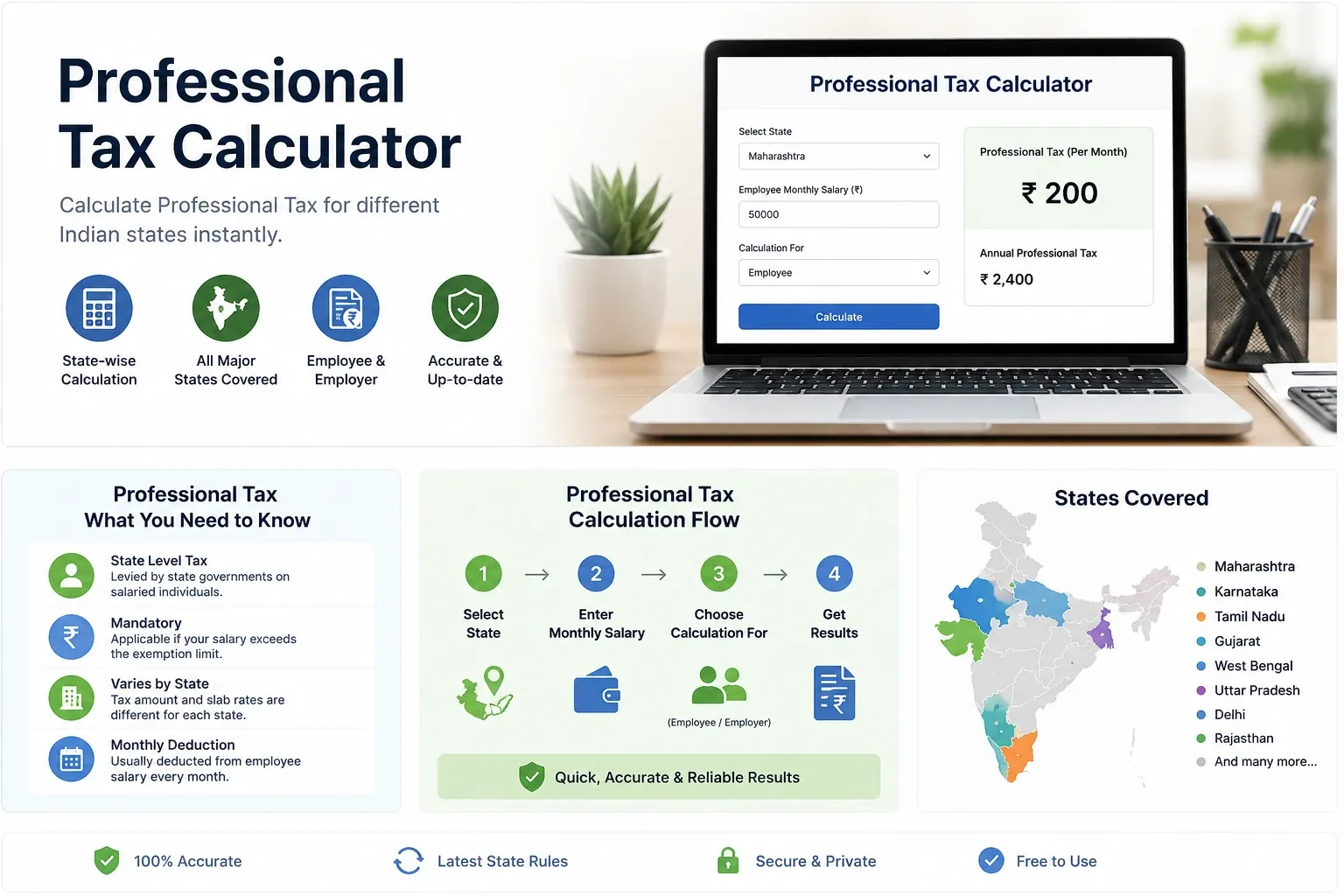
Pick your work state, enter your monthly gross salary, and see the professional tax for the month along with the yearly total. Every state and union territory is listed, including the ones that do not charge professional tax at all.
That is because professional tax is a state levy, not a central one. Each state writes its own schedule, sets its own exemption limit, and picks its own basis, monthly, yearly or half yearly. Use the professional tax calculator above to get the amount for your own state and salary, then read on for the reasoning behind the number.
What changed for FY 2026-27: Odisha abolished professional tax from 1 April 2026, subject to earlier-period liabilities. West Bengal notification 1607-F.T. dated 16 September 2026 made the new schedule final. From 1 October 2026 salaried employees pay nil up to Rs 20,000 a month, then Rs 100, Rs 140, Rs 170 or Rs 208 a month by salary band. Use the earlier West Bengal rates for September 2026 payroll and the new slabs from October 2026 payroll onward. Our West Bengal professional tax guide has the old and new tables side by side and the employer due dates.
Punjab is often left out of professional tax tables because its levy is called the State Development Tax. It is still a tax on professions under Article 276 and it still costs Rs 200 a month.
Professional tax at a glance
Before the detail, here is the shape of the thing the professional tax calculator is working with.
| Who charges it | State governments, and local bodies in Kerala, Tamil Nadu and Puducherry |
| Does it apply everywhere | No. Twenty jurisdictions charge it, sixteen do not |
| Is it only for professionals | No. Salaried employees are the largest group paying it |
| What drives the amount | Your work state, your salary slab, and sometimes your gender or the month |
| Is there a ceiling | Yes. Article 276(2) caps it at Rs 2,500 per person per year |
| Who deducts it | Your employer, who then pays it to the state |
| Can you deduct it from taxable salary | Only under the old regime. The default new regime does not allow it |
What professional tax actually is
Professional tax is a tax on professions, trades, callings and employment. Despite the name it has little to do with being a professional. If you draw a salary in a state that charges it, your employer deducts it and pays it across on your behalf.
Article 276 of the Constitution is what permits it, and it also limits it: no state or local authority can take more than Rs 2,500 per person per year. That single number explains most of what looks arbitrary about professional tax. Rs 200 a month comes to Rs 2,400 a year, which fits just under the cap, and that is why so many states settled on Rs 200. Karnataka and Maharashtra go one step further and charge Rs 300 in February so the year lands on Rs 2,500 exactly.
Can you claim it as a deduction?
This is where a lot of published advice is out of date, and it matters more than the rate itself.
Section 19 of the Income-tax Act, 2025 does allow the entire amount of tax on employment as a deduction from salary. That is the successor to Section 16(iii) of the old 1961 Act. But Section 202 of the same Act, which is the new regime and is the default, requires total income to be computed without that deduction.
So for most salaried people the honest answer is: your employer still withholds professional tax from your pay either way, that part never changes, but you cannot claim it as a deduction against your taxable income unless you have specifically opted for the old regime. Any article telling you professional tax reduces your taxable salary, without mentioning the regime, is describing a situation that no longer applies to the majority of taxpayers.
Why the amount changes from state to state
There is no central rate, so five separate things vary.
The exemption limit
Karnataka charges nothing below Rs 25,000 a month. Gujarat starts at Rs 12,000. Maharashtra starts men at Rs 7,500. Nagaland starts at Rs 4,000. An employee earning Rs 20,000 pays nothing in Karnataka and Rs 200 in Gujarat.
The basis
Most states work off monthly salary. Bihar, Jharkhand and Madhya Pradesh use yearly income. Kerala uses a half-yearly basis. Manipur and Meghalaya need a current state schedule check; Tamil Nadu and Puducherry need an applicable local-body check. This is why you cannot simply take one state's monthly figure and multiply by twelve to compare.
The February adjustment
Karnataka and Maharashtra charge Rs 300 in February rather than Rs 200, purely so the annual total reaches the Rs 2,500 ceiling. Madhya Pradesh does something similar in March, and its monthly split is written into the Schedule itself rather than being a payroll convention.
Personal circumstances
Maharashtra gives women a much higher starting point, Rs 25,000 a month against Rs 7,500 for men. Several states carry exemptions for age, disability or specific categories of employment. Two colleagues on identical pay can legitimately show different deductions.
Local bodies
In Kerala, Tamil Nadu and Puducherry the levy runs through municipalities and panchayats, so the scale can differ between two towns in the same state. Puducherry's Schedule IV sets maximum amounts and leaves each council to fix the actual figure inside them. Any tool claiming one statewide number for Tamil Nadu is overselling its precision.
Professional tax slabs for FY 2026-27
These are the employee schedules the professional tax calculator above runs on. They cover salary and wage earners only. Self employed professionals, firms, directors and traders are assessed under separate enrolment schedules that often work out quite differently.
| State or UT | Basis | Employee rule for FY 2026-27 |
|---|---|---|
| Andhra Pradesh | Monthly salary | Up to Rs 15,000: Nil; Rs 15,001 to Rs 20,000: Rs 150 a month; Above Rs 20,000: Rs 200 a month |
| Assam | Monthly salary | Up to Rs 15,000: Nil; above Rs 15,000 but below Rs 25,000: Rs 180 a month; Rs 25,000 and above: Rs 208 a month |
| Bihar | Yearly salary | Up to Rs 3,00,000: Nil; Rs 3,00,001 to Rs 5,00,000: Rs 1,000 a year; Rs 5,00,001 to Rs 10,00,000: Rs 2,000 a year; Above Rs 10,00,000: Rs 2,500 a year |
| Gujarat | Monthly salary | Up to Rs 12,000: Nil; Above Rs 12,000: Rs 200 a month |
| Jharkhand | Yearly salary | Up to Rs 3,00,000: Nil; Rs 3,00,001 to Rs 5,00,000: Rs 1,200 a year; Rs 5,00,001 to Rs 8,00,000: Rs 1,800 a year; Rs 8,00,001 to Rs 10,00,000: Rs 2,100 a year; Above Rs 10,00,000: Rs 2,500 a year |
| Karnataka | Monthly salary | Up to Rs 24,999: Nil; Above Rs 24,999: Rs 200 a month (Rs 300 in February) |
| Kerala | Half yearly salary | Up to Rs 11,999: Nil; Rs 12,000 to Rs 17,999: Rs 320 a half year; Rs 18,000 to Rs 29,999: Rs 450 a half year; Rs 30,000 to Rs 44,999: Rs 600 a half year; Rs 45,000 to Rs 99,999: Rs 750 a half year; Rs 1,00,000 to Rs 1,24,999: Rs 1,000 a half year; Above Rs 1,24,999: Rs 1,250 a half year |
| Madhya Pradesh | Yearly salary | Up to Rs 2,25,000: Nil; Rs 2,25,001 to Rs 3,00,000: Rs 1,500 a year; Rs 3,00,001 to Rs 4,00,000: Rs 2,000 a year; Above Rs 4,00,000: Rs 2,500 a year |
| Maharashtra | Monthly salary | Up to Rs 7,500: Nil; Rs 7,501 to Rs 10,000: Rs 175 a month; Above Rs 10,000: Rs 200 a month (Rs 300 in February). Women: Nil up to Rs 25,000 a month, then Rs 200 a month with Rs 300 in February |
| Manipur * | Manual review | The 2020 amendment replaced the earlier schedule. Confirm the operative employee rate with the state taxation department. |
| Meghalaya * | Manual review | The 2022 amendment removed the Schedule from the Act. Confirm the current notified rate with Meghalaya Taxation. |
| Mizoram | Monthly salary | Up to Rs 5,000: Nil; Rs 5,001 to Rs 8,000: Rs 75 a month; Rs 8,001 to Rs 10,000: Rs 120 a month; Rs 10,001 to Rs 12,000: Rs 150 a month; Rs 12,001 to Rs 15,000: Rs 180 a month; Rs 15,001 to Rs 20,000: Rs 195 a month; Above Rs 20,000: Rs 208 a month |
| Nagaland | Monthly salary | Up to Rs 3,999: Nil; Rs 4,000 to Rs 4,999: Rs 35 a month; Rs 5,000 to Rs 6,999: Rs 75 a month; Rs 7,000 to Rs 8,999: Rs 110 a month; Rs 9,000 to Rs 11,999: Rs 180 a month; Above Rs 11,999: Rs 208 a month |
| Puducherry | Set by local body | Council fixes the scale within the maximum set by Schedule IV |
| Punjab | Monthly, if taxable | Rs 200 a month for people whose income is taxable |
| Sikkim | Monthly salary | Up to Rs 20,000: Nil; Rs 20,001 to Rs 30,000: Rs 125 a month; Rs 30,001 to Rs 40,000: Rs 150 a month; Above Rs 40,000: Rs 200 a month |
| Tamil Nadu * | Manual review | The half-yearly scale is set by the applicable local body. Check the current scale with your corporation, municipality or town panchayat. |
| Telangana | Monthly salary | Up to Rs 15,000: Nil; Rs 15,001 to Rs 20,000: Rs 150 a month; Above Rs 20,000: Rs 200 a month |
| Tripura | Monthly salary | Up to Rs 7,500: Nil; Rs 7,501 to Rs 15,000: Rs 150 a month; Above Rs 15,000: Rs 208 a month |
| West Bengal | Monthly salary | From 1 October 2026: up to Rs 20,000: Nil; Rs 20,001 to Rs 30,000: Rs 100 a month; Rs 30,001 to Rs 50,000: Rs 140 a month; Rs 50,001 to Rs 1,00,000: Rs 170 a month; above Rs 1,00,000: Rs 208 a month. Up to 30 September 2026: up to Rs 10,000: Nil; Rs 10,001 to Rs 15,000: Rs 110; Rs 15,001 to Rs 25,000: Rs 130; Rs 25,001 to Rs 40,000: Rs 150; above Rs 40,000: Rs 200 a month |
* About manual-review states. We do not publish a numeric estimate for Manipur, Meghalaya or Tamil Nadu because the operative schedule or applicable local-body rate needs confirmation. Puducherry also requires a local-council check. Confirm the current rate before payroll or filing.
States and union territories with no professional tax
Sixteen jurisdictions do not take professional tax from salary in FY 2026-27. Pick any of them in the professional tax calculator and it will correctly return zero. If you work in one of them, the correct deduction is zero, and a payslip showing professional tax deserves a question.
To see professional tax next to PF, ESIC, labour welfare fund and gratuity in a complete structure, for one employee or several locations, use our salary structure calculator.
| State or UT | Position | What it means for payroll |
|---|---|---|
| Odisha | Repealed from 1 April 2026 | Repealed with effect from 1 April 2026 by the Odisha State Tax on Professions, Trades, Callings and Employments (Repeal) Ordinance, 2026, published in Odisha Gazette Extraordinary No. 1496 dated 21 April 2026. Amounts already due for periods up to 31 March 2026 still have to be paid, because the repeal carries a savings clause. |
| Chhattisgarh | Act exists, salary exempt | The Chhattisgarh Professional Tax Act, 1995 is still on the statute book, but salary and wage earners have been exempt since 1 April 2011, so there is no deduction to make. |
| Delhi | No professional tax law | Delhi has never levied professional tax, so there is nothing to deduct from salary. |
| Uttar Pradesh | No professional tax law | Uttar Pradesh does not levy professional tax. |
| Rajasthan | No professional tax law | Rajasthan does not levy professional tax. |
| Haryana | No professional tax law | Haryana does not levy professional tax. |
| Uttarakhand | No professional tax law | Uttarakhand does not levy professional tax. |
| Himachal Pradesh | No professional tax law | Himachal Pradesh does not levy professional tax. |
| Goa | No professional tax law | Goa does not levy professional tax. |
| Arunachal Pradesh | No professional tax law | Arunachal Pradesh does not levy professional tax. |
| Jammu and Kashmir | No professional tax law | Jammu and Kashmir does not levy professional tax. |
| Ladakh | No professional tax law | Ladakh does not levy professional tax. |
| Chandigarh | No professional tax law | Chandigarh does not levy professional tax. |
| Andaman and Nicobar Islands | No professional tax law | The Andaman and Nicobar Islands do not levy professional tax. |
| Lakshadweep | No professional tax law | Lakshadweep does not levy professional tax. |
| Dadra and Nagar Haveli and Daman and Diu | No professional tax law | This union territory does not levy professional tax. |
Worked examples
Five cases, each one showing why a professional tax calculator has to ask which state you work in before it can answer.
Priya, Bengaluru, Rs 60,000 a month
Priya is above Karnataka's Rs 25,000 threshold, so she pays Rs 200 in an ordinary month. In February she pays Rs 300. Over the year that is Rs 200 times eleven months plus Rs 300, which is Rs 2,500, exactly the constitutional ceiling.
Arun, Mumbai, Rs 9,000 a month
Arun sits in Maharashtra's middle band for men, between Rs 7,501 and Rs 10,000, so he pays Rs 175 a month, or Rs 2,100 across the year. Note that the February top up does not apply to this band, only to the slab above Rs 10,000. A calculator that applies the Rs 2,500 ceiling to every Maharashtra slab is wrong.
Meera, Pune, Rs 22,000 a month
Meera earns more than Arun and pays nothing. Maharashtra exempts women up to Rs 25,000 a month. This is the clearest illustration of why a single national professional tax figure is meaningless.
Rakesh, Bhopal, Rs 35,000 a month
Madhya Pradesh works off yearly salary. Rakesh's Rs 4,20,000 a year puts him in the top band at Rs 2,500 for the year. The Schedule prescribes the split as Rs 208 a month for eleven months and Rs 212 in the adjustment month.
Sunita, Bhubaneswar, Rs 75,000 a month
Sunita pays nothing from April 2026, because Odisha repealed the levy. Her employer should still settle anything outstanding for periods up to 31 March 2026, since the repeal preserves past liabilities.
What employers have to do
A professional tax calculator answers the employee's question. The employer's question is larger. For a salaried employee the liability is the employee's, but the compliance burden is the employer's. That split is why professional tax quietly creates work for payroll teams. Several states add a second state-level payroll deduction, the Labour Welfare Fund, which our Labour Welfare Fund calculator works out.
- Two registrations in most states. One to deduct and pay for employees, and one for the entity's own liability. Maharashtra calls these PTRC and PTEC, and having one does not excuse you from the other.
- Register per state, not per company. A business with offices in Bengaluru, Mumbai and Hyderabad needs to deal with three separate authorities on three separate schedules.
- Payment and return frequency varies. Some states want monthly payment, some quarterly, some annual, and the threshold that decides which is usually based on the amount you deduct.
- Late payment carries interest and penalty. Rates and mechanics differ by state, and unlike the tax itself these are not capped at Rs 2,500.
- Employer paid professional tax is a perquisite. If the company bears the cost rather than deducting it, the amount forms part of the employee's salary.
If you are setting this up inside a payroll system, our Zoho Payroll setup guide for India walks through where state deductions are configured. To see professional tax alongside the other deductions on a payslip, try the take home salary calculator.
Professional tax compared with income tax
People often reach a professional tax calculator expecting it to behave like an income tax calculator. The two work quite differently.
| Professional tax | Income tax | |
|---|---|---|
| Levied by | States and local bodies | Central government |
| Depends on | Where you work | Your total income |
| Applies everywhere | No, twenty of thirty six jurisdictions | Yes |
| Annual ceiling | Rs 2,500 under Article 276(2) | None |
| Deducted through payroll | Yes, as professional tax | Yes, as TDS |
Why these rates need rechecking, and how often
A professional tax calculator can be arithmetically perfect and still give you the wrong answer, because the risk is not the maths. It is the rate table going stale.
There is no single national update date for professional tax. Any of the twenty levying jurisdictions can change its schedule through a Budget, an amending Act, an ordinance or a departmental notification, and each change takes effect on its own date. Odisha's repeal arrived by ordinance in April 2026. West Bengal's new schedule, made final on 16 September 2026, starts on 1 October 2026. Meghalaya removed its schedule from the Act in 2022 and the replacement is hard to trace even now.
This is why the professional tax calculator on this page carries the date its rates were checked, rather than implying they are permanent. Official portals lag too. Odisha's own commercial tax pages still displayed pre repeal rates months after the repeal took effect. A stale government page is not authority, but it is a very easy trap.
So treat every figure here, and on any other site, as correct on the date it was checked rather than correct forever. The rates on this page were checked on 7 August 2026. Before you run a pay cycle, file a return, or act on a disputed amount, confirm the position against your state's own notification or take professional advice.
Professional tax calculator: frequently asked questions
What is a professional tax calculator?
A professional tax calculator works out the tax on employment that applies to your salary using the rules of the state or union territory where you work. Because professional tax is a state levy, the same salary can produce a different amount in two states, and no amount at all in several of them.
Is professional tax applicable in Delhi?
No. Delhi does not levy professional tax, so nothing is deducted from a Delhi salary on this account. Uttar Pradesh, Rajasthan, Haryana, Uttarakhand, Himachal Pradesh, Goa, Arunachal Pradesh, Jammu and Kashmir, Ladakh, Chandigarh, the Andaman and Nicobar Islands, Lakshadweep, and Dadra and Nagar Haveli and Daman and Diu also do not levy it.
Which states charge professional tax in FY 2026-27?
Twenty jurisdictions levy employee professional tax in FY 2026-27: Andhra Pradesh, Assam, Bihar, Gujarat, Jharkhand, Karnataka, Kerala, Madhya Pradesh, Maharashtra, Manipur, Meghalaya, Mizoram, Nagaland, Punjab, Sikkim, Tamil Nadu, Telangana, Tripura, West Bengal, and the union territory of Puducherry.
What is the maximum professional tax in India?
Article 276(2) of the Constitution caps the levy at Rs 2,500 per person per year. Several state schedules reach that figure at higher salaries. This is why Rs 200 a month is such a common rate: twelve months at Rs 200 comes to Rs 2,400, which sits just inside the cap.
Is professional tax applicable in Odisha in FY 2026-27?
No. Odisha repealed its professional tax law with effect from 1 April 2026 through the Odisha State Tax on Professions, Trades, Callings and Employments (Repeal) Ordinance, 2026, published in Odisha Gazette Extraordinary No. 1496 dated 21 April 2026. Amounts that fell due for periods up to 31 March 2026 still have to be paid, because the repeal carries a savings clause.
Can I claim professional tax as a deduction from my salary?
Only if you are taxed under the old regime. Section 19 of the Income-tax Act, 2025 allows the whole amount of tax on employment as a deduction from salary, but Section 202, which is the new regime and the default one, requires total income to be computed without that deduction. So if you stay on the default new regime, your employer still withholds professional tax from your pay exactly as before, but you cannot claim it as a deduction against your taxable income.
What is professional tax in Karnataka for FY 2026-27?
Karnataka charges nothing below Rs 25,000 a month. From Rs 25,000 the deduction is Rs 200 a month, with Rs 300 in February, so the year adds up to exactly Rs 2,500.
What is professional tax in Maharashtra?
Maharashtra sets a different starting point for men and women. For men, nothing up to Rs 7,500 a month, Rs 175 a month between Rs 7,501 and Rs 10,000, and Rs 200 a month above Rs 10,000 with Rs 300 in February. For women, nothing up to Rs 25,000 a month, and the top slab above that.
Why is professional tax higher in February?
Karnataka and Maharashtra deliberately charge Rs 300 in February instead of Rs 200 so the twelve month total lands on the Rs 2,500 ceiling rather than Rs 2,400. It is a rounding device, not a penalty.
Is professional tax calculated on basic salary or gross salary?
It depends on how the state schedule is worded. Most employee schedules refer to salary or wages rather than basic pay alone, which in practice means gross salary. Check the wording for your state if the difference moves you across a slab boundary.
Does professional tax depend on where I live or where I work?
Where you work. The levy follows the jurisdiction in which the employment is liable to the tax, not your permanent address. Someone living in Delhi but employed at a Bengaluru office is dealt with under Karnataka rules.
Do freelancers and self-employed people use the same rates?
Not usually. Most states run separate enrolment schedules for self-employed professionals, firms, traders and companies, often as a fixed yearly amount. The calculator on this page is built for salaried employees.
How often do professional tax rates change?
There is no single national update date. Any state can change its Act, schedule or rules through a Budget, an amending Act or a notification, and those changes take effect on their own dates. Treat any professional tax table, including this one, as correct on the date it was checked rather than permanently correct.
Official sources
Every figure on this page should be checked against the state's own published material before you file a return or run a pay cycle. These are the primary sources we used.
- Constitution of India, Article 276 (taxes on professions, trades, callings and employments)
- Income-tax Act, 2025 (Section 19 deductions from salaries, Section 202 new regime)
- Assam Tax Department notification list, eCF No. 169350/124
- Karnataka professional tax portal
- Maharashtra GST Department, profession tax rate schedules
- Gujarat Commercial Tax Department
- Telangana Commercial Taxes, professional tax schedule
- Bihar Commercial Tax Department
- Jharkhand Commercial Taxes Department
- West Bengal profession tax portal
- Odisha Finance Department, profession tax notifications
- Tamil Nadu Directorate of Town Panchayats
- Meghalaya Taxation Department
Disclaimer. This professional tax calculator is an informational payroll aid, not advice. Professional tax rates, exemption limits, local body scales, effective dates and employer obligations change frequently and without much publicity. Figures were checked on 7 August 2026 for FY 2026-27 and cover salaried employees only. For filing, or for any disputed liability, confirm the current notification with the relevant state or local authority.
More from ReconScribe: free finance calculators, TDS rate calculator, gratuity calculator.
West Bengal’s final schedule (notification 1607-F.T., 16 September 2026) applies from 1 October 2026, so a full-year FY 2026-27 estimate mixes six months at each rate. The annual estimate assumes the selected schedule continues for the year.
Sources: West Bengal notification 1607-F.T. (final schedule, 16 September 2026); earlier draft 1407-F.T.; West Bengal official notifications.