
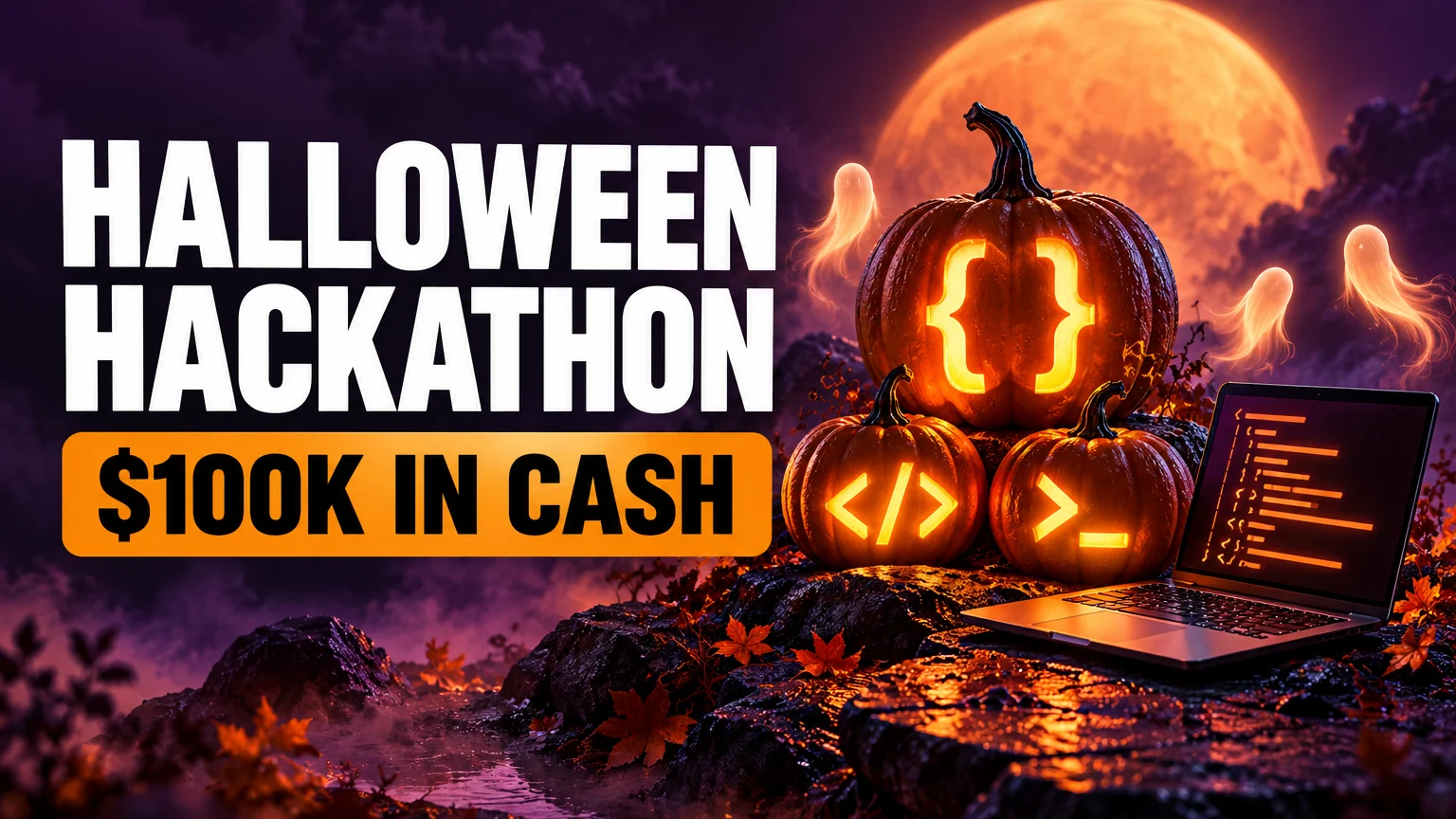
Kiroween 2026 is Kiro’s $100,000 Halloween hackathon, and adults in almost every country can enter. You build a brand-new app with Kiro between 30 October 2026 at 1:00 pm PDT (20:00 UTC) and 4 December 2026 at 2:00 pm PST (22:00 UTC), and the dates table shows both moments in your local time. The cash pool is $100,000, the prize split is due on 30 October, and winners are due on 28 January 2027 at 2:00 pm PST (22:00 UTC).
The 2026 Official Rules are not posted yet; they are due before submissions open. So this guide keeps two kinds of fact apart: what the 2026 pages on Devpost, the website that runs the contest, said on 17 October 2026, and what the 2025 rules said, which we label as last year’s rule so you can plan without guessing.
The most important rule is already public: only new projects created during the submission period are eligible. Register now, sharpen your idea, and keep your code editor closed until submissions open at 1:00 pm PDT on 30 October (20:00 UTC, shown in your local time in the dates table).
Kiroween 2026: the short answer
What is Kiroween 2026?
Kiroween 2026 is the annual Halloween-themed hackathon run by Kiro, the AI IDE and agent from Amazon Web Services (AWS). A hackathon is a contest where you build a working software project against a deadline and submit it for judging. An IDE, or integrated development environment, is the app you write code in, and Kiro adds an AI agent that can plan, write and change code when you describe what you want. The tagline sets the mood: “Build something wicked and git commit to the darkness”.
The Kiroween hackathon runs online on Devpost, the website that handles registration, the submission form, the project gallery and announcements. The Kiroween 2026 Devpost page lists Kiro as the host and says the event is managed by Devpost. The 2026 sponsor’s legal name will appear in the Official Rules; for reference, the 2025 rules named Amazon Web Services as Sponsor and Devpost, Inc. as Administrator. Devpost tags the event Beginner Friendly, Machine Learning/AI and Open Ended. On 17 October 2026 it showed 396 registered participants, against 4,967 on the 2025 page.
The overview says the theme categories are the same as last year. Resurrection asks you to bring a favourite dead technology back to life, reimagining obsolete tech with today’s innovations or using it to solve tomorrow’s problems. Frankenstein asks you to stitch a chimera of technologies into one app, combining elements that seem incompatible into something unexpectedly powerful. Skeleton Crew asks for a skeleton code template, which is a starter codebase other projects can be built on, lean enough to be clear but flexible enough for many uses, and proven with two distinct applications built on it. Costume Contest lets you build any app, as long as its interface is haunting, polished and unforgettable, with spooky design elements that improve how the app works.
Bonus challenges are part of the 2026 edition too, but the overview says they will be announced on 30 October 2026, together with the full rules, submission requirements, judging criteria and prize breakdown. Until then, treat any specific 2026 requirement you read elsewhere with caution and check the official pages yourself. This Kiro hackathon is open and public. You can enter alone or with a team, and the build window lasts about five weeks.
Key dates and deadlines in UTC and your local time
Every Kiroween 2026 time on the official schedule page is in US Pacific Time. That matters because US daylight saving time ends on 1 November 2026, in the middle of the build window: submissions open on PDT (Pacific Daylight Time, UTC-7) and close on PST (Pacific Standard Time, UTC-8). So unless your own clocks also change on 1 November, as they do in most of the US and Canada, the gap between Pacific Time and your clock changes by an hour partway through the build window, which is why each row below is converted on its own.
UTC, or Coordinated Universal Time, is the world reference clock that every time zone is measured from, and it never changes for daylight saving. Each row below shows the date as the organiser states it, then the same moment in UTC, and the table converts every exact time into your local time automatically.
| What | As the rules state it | UTC | Your local time |
|---|---|---|---|
| Registration (already open) | “Registration is open now.” No closing date is stated. | Already open. No close time stated. | No fixed date |
| Full rules, judging criteria, prize breakdown and bonus challenges released | Friday, October 30, 2026, when submissions formally open. No clock time is given, and the rules page says the rules will be posted before the hackathon starts. | Fri 30 Oct 2026, time not stated; expected by 20:00 UTC | No fixed date |
| Submission period opens (building may begin) | October 30 at 1:00pm PDT | Fri 30 Oct 2026, 20:00 UTC | Worked out by your browser |
| Submission deadline | Friday, December 4, 2026 at 2:00 PM Pacific Time (December 04 at 2:00pm PST) | Fri 4 Dec 2026, 22:00 UTC | Worked out by your browser |
| Judging begins | January 11 at 9:00am PST (2027, per the page data) | Mon 11 Jan 2027, 17:00 UTC | Worked out by your browser |
| Judging ends | January 22 at 5:00pm PST (2027, per the page data) | Sat 23 Jan 2027, 01:00 UTC | Worked out by your browser |
| Winners announced | January 28 at 2:00pm PST (2027, per the page data) | Thu 28 Jan 2027, 22:00 UTC | Worked out by your browser |
The schedule page does not print a year next to the judging and winner dates, but the page’s machine-readable date data places them in January 2027, which is also the only reading that fits after a December deadline.
The deadline that counts is 22:00 UTC on Friday 4 December 2026, and what that means on your clock depends on where you live. Across the Americas it falls between Friday midday and Friday evening (2:00 pm in Los Angeles, 5:00 pm in New York, 7:00 pm in Buenos Aires), in Western and Central Europe it is late Friday evening, and in time zones of UTC+2 and further east, which covers Eastern Europe, the Middle East, Asia, Australia and New Zealand, it falls at or after midnight, on Saturday 5 December. Whatever your zone, uploads, video processing and slow connections all eat time, so aim to submit by Thursday 3 December in your own time zone and treat the last few hours before the cutoff as an emergency buffer, not working time.
Registration has no stated closing date, but do not rely on that. Register early so announcements reach you: the Updates page says organisers will post news there and also email registered participants.
Prizes
The overview promises $100,000 in cash prizes for Kiroween 2026. How that money is split into different prizes is not published yet. On 17 October 2026 the prize section read “Prizes TBD”, and the breakdown is due on 30 October 2026.
For context only, here is how the 2025 edition split the same $100,000: 1st place $30,000, 2nd place $20,000, 3rd place $10,000, four category prizes of $5,000 each, Best Startup Project $10,000, Most Creative $2,500, two Influencer Judges’ Choice prizes of $1,000, five Social Blitz prizes of $100 and 50 Blog Post prizes of $100. None of that is confirmed for 2026.
Last year also capped how much one entry could win: one Overall prize plus up to two Post prizes, or one Category prize plus one Bonus prize plus up to two Post prizes. If 2026 brings back small prizes for blog or social posts, they can be a realistic extra target for first-time entrants, so look for them in the 30 October breakdown.
Who can enter, and from which countries
The 2026 Devpost eligibility box says entrants must be “Above legal age of majority in country of residence”. The age of majority is the age at which the law treats you as an adult, and it differs between countries, so check the age that applies where you live. No restriction on students or working professionals is stated.
The event is open to all countries and territories, excluding what Devpost calls standard exceptions. The tooltip lists them as Brazil, Crimea, Cuba, Iran, North Korea, Quebec and Russia. In 2025 the rules also excluded Syria and other countries designated by OFAC, the US Treasury office that runs sanctions programmes, so check the 2026 rules for a similar line when they are posted.
Employee exclusions are not stated for 2026 yet. In 2025, employees, agents and immediate family or household members of the Sponsor, the Administrator and other promotion entities could not enter, and neither could judges and their employers. To register at all you need a Devpost account and a valid Kiro user ID or AWS account ID. A Discussions thread on the Devpost page asks about the age range and about mixing college and non-university teammates; it had no official answer on 17 October 2026.
Teams and solo entries
You can enter alone or with a team, and the overview says you can decide that later. The overview suggests browsing the Participants tab on the Devpost page to find a team, and says this is optional.
No 2026 team size limit is stated yet. For context, the 2025 Official Rules allowed a maximum of 3 participants per team, let one person join more than one team and also enter solo, and required each team or organization to appoint one Representative. The Representative submitted the project, received any prize and was responsible for splitting it among the members.
If you team up, agree early on who submits, who builds which part, and how any prize would be shared, because last year the money went to one person. Whether organizations can enter in 2026 is not stated; they could in 2025.
How to enter Kiroween 2026, step by step
Here is the full path from zero to a submitted entry, based on the official Devpost and Kiro pages. Steps 1 to 5 can be done before the rules are posted. Step 6 happens as soon as the Official Rules appear, before submissions open. Steps 7 to 9 wait for the submission period, which opens at 1:00 pm PDT on 30 October 2026 (20:00 UTC; the dates table shows it in your local time).
What you must submit
The 2026 submission requirements are not published yet; the overview says they will be released on 30 October 2026. The list below is what the 2025 Official Rules required, so you can plan your time. Treat each item as last year’s rule until the 2026 rules confirm it.
In plain terms: vibe coding means describing what you want in chat and letting the agent write the code; specs are structured plans for a feature that Kiro works through step by step; agent hooks are automations that run an agent task when something happens in your project, such as saving a file; steering docs are files that give Kiro standing instructions about your project; and MCP, the Model Context Protocol, is an open standard that lets an AI agent connect to outside tools and data. A few other terms need a plain explanation too. An OSI licence is an open source licence approved by the Open Source Initiative, such as MIT or Apache 2.0, and it tells others how they may reuse your code. The .gitignore file lists files that Git, the version control tool, should leave out of the repository, which is why hiding the /.kiro folder there would hide the evidence of how you used Kiro.
Two more 2025 rules are worth knowing. You could submit more than one project if each was substantially different, and everything had to be in English or translated into English. If the 2026 rules keep the free testing requirement, budget for keeping your app online until judging ends at 5:00 pm PST on 22 January 2027 (01:00 UTC on Saturday 23 January).
How entries are judged
The 2026 overview lists the judging criteria as TBD. Judges are described as a qualified panel, and judge applications are not being accepted. The criteria are due on 30 October 2026.
Last year’s process is the best guide to what the panel values. In 2025, Stage One was a pass or fail check of whether each project reasonably fitted the theme and reasonably used the required tools. Stage Two scored three equally weighted criteria. Ties were broken by the higher score on the first criterion, then the next criterion, then a judges’ vote.
Tools, APIs and what they cost
Kiro is the tool at the heart of Kiroween 2026, and you need a valid Kiro user ID or AWS account ID just to register. The 2026 pages do not yet spell out that projects must be built with Kiro, but this is Kiro’s own hackathon and the 2025 rules required a working application that uses Kiro through vibe coding, agent hooks, steering docs, MCP or specs. Each of those features is explained in the submission section above.
Kiro has a perpetual free tier at $0 a month with 50 credits. Credits are Kiro’s usage units: spec tasks, vibe prompts and agent hook runs all consume them. Free tier users who signed up with a social login (signing in with an account you already have on another service) or an AWS Builder ID (Amazon’s free personal profile for its developer tools) get access to open weight models, which are AI models whose trained weights are published openly, and Claude Sonnet 4.5, subject to rate limits, which cap how much you can use in a given period. The free tier is not offered in Kiro Enterprise or AWS GovCloud (US) Regions. Paid plans on the Kiro pricing page are Pro at $20, Pro+ at $40, Pro Max at $100 and Power at $200 per user per month, with add-on credits at $0.04 each. A first upgrade to a paid plan earns a $20 credit for social login or AWS Builder ID users, and Kiro keeps a list of billing countries for paid plans, so check that yours is on it before you plan to upgrade.
Free hackathon credits are not stated for 2026. In 2025, participants received the equivalent of the Kiro Pro+ paid plan for the submission period, so read the 30 October announcements before paying for anything. Beyond Kiro, budget for whatever your app needs to stay online for judges: if the 2025 rule on free, unrestricted testing access returns, your hosting has to keep running until judging ends in January 2027. If you stay on the free tier, spend your credits on the work that matters most, such as specs for your core features, and make small edits by hand.
Rules that trip people up
These are the details most likely to catch out a first-time entrant, based on the 2026 pages and last year’s rules.
Ownership, prize payment and tax
Ownership, prize payment and tax terms for 2026 are not stated yet, because the Official Rules are not posted. Here is what the 2025 rules said, for context only. Submissions remained the intellectual property of the entrants, so you kept ownership of your work. The Sponsor received a fully paid, non-exclusive licence to use entries for judging; non-exclusive means the permission does not stop you from using or licensing your work elsewhere. The Sponsor and Devpost could promote submissions and use entrants’ names, likeness, voice and image to publicise the hackathon during the event and for three years after. Entries had to be original, solely owned and non-infringing, and open source components were allowed if their licences were followed. Because the repository had to be public under an OSI licence, your code was in practice open sourced.
On payment, 2025 winners had to pass identity and role verification and return a winner affidavit and other Required Forms within 10 business days of the forms being sent. An affidavit is a signed statement confirming that you meet the rules. Prizes then went to the individual, the team Representative or the organization, by mail or bank transfer, within 60 days of the completed forms being received. Winners paid any wiring and currency exchange fees.
On tax, 2025 winners were responsible for their own taxes. US residents could be asked for a W-9, the form US taxpayers use to give their tax details, and non-US residents for a W-8BEN, a US tax form that non-US people use to confirm their foreign status. The Sponsor, Devpost or the prize provider could withhold part of a prize to meet US or local tax law, and winners had to follow their own country’s foreign exchange and banking rules. How a prize from a contest with a US sponsor (Amazon Web Services in 2025) is taxed where you live is a question for a professional, so check with a tax adviser in your country before you file.
Project ideas that fit the brief
These are our own suggestions, not official briefs. Each one is shaped to fit a 2026 category as the overview describes it and to give judges a clear reason to care. Check every idea against the 2026 rules and bonus challenges on 30 October before you commit to it.
Tips to give your entry the best chance
- Register early and keep your Kiro user ID handy. The Updates page says announcements are also emailed to registered participants, so registering is the easiest way not to miss a rule change.
- Block out 30 October to read the Official Rules, judging criteria and bonus challenges before you write any code. Submissions open at 20:00 UTC that day, which is already 31 October in time zones of UTC+4 and further east. Five weeks goes fast, and a misread rule costs more than a late start.
- Plan on paper before the window opens: your idea, your category and your demo story. Keep code, repositories and Kiro project files for after 1:00 pm PDT on 30 October (20:00 UTC), since only new projects created during the submission period are eligible.
- Use a range of Kiro features on purpose and write down why. Last year the Implementation criterion looked at the variety of Kiro features used and the strategic decisions in your workflow, so a short log of your specs, hooks and steering docs gives you ready material for the write-up.
- Commit the .kiro folder from day one and check that .gitignore does not exclude it. Last year that folder was the evidence of how you used Kiro, and hiding it could disqualify you.
- Script and record your demo video in the final week, not the final night. Keep it under three minutes, show the app working on its intended device, and use only music you have the rights to.
- Aim to submit by Thursday 3 December in your own time zone, well ahead of the real cutoff of 2:00 pm PST on Friday 4 December (22:00 UTC). Uploads, video processing and form fields always take longer than you expect.
- Keep your app online and free to test after you submit. If the 2025 rule returns, judges can test until judging ends at 5:00 pm PST on 22 January 2027 (01:00 UTC on Saturday 23 January), and a dead link gives them nothing to score.
Please note: we update this page from time to time, but hackathon dates, prizes and rules can change quickly, and there can be a gap between a change and our update. Check the official rules before you enter or submit. This guide helps you plan; it is not legal or tax advice, and ReconScribe is not responsible for decisions made on it.
Kiroween 2026 frequently asked questions
What is Kiroween 2026?
Kiroween 2026 is Kiro’s annual Halloween-themed online hackathon, hosted on Devpost. You build a brand-new app with Kiro, the AI IDE and agent from Amazon Web Services, in one of four categories. The overview promises $100,000 in cash prizes.
What is the Kiroween 2026 deadline?
The deadline is Friday 4 December 2026 at 2:00 pm PST, which is 22:00 UTC. In time zones of UTC+2 and further east, that moment falls on Saturday 5 December local time. Submissions open on 30 October 2026 at 1:00 pm PDT, which is 20:00 UTC. Aim to submit at least a day early.
Which countries can enter Kiroween 2026?
All countries and territories except Devpost’s standard exceptions: Brazil, Crimea, Cuba, Iran, North Korea, Quebec and Russia. You must be above the legal age of majority in your country of residence. In 2025 the rules also excluded Syria and other OFAC-designated countries, so recheck the Official Rules when they are posted before submissions open on 30 October 2026.
How much prize money does Kiroween 2026 offer?
The overview promises $100,000 in cash prizes. The prize breakdown is due on 30 October 2026. In 2025 the same total was spread across many prizes, from $30,000 for first place down to $100 blog post prizes.
Is Kiro free to use for the hackathon?
Kiro has a perpetual free tier with 50 credits, and paid plans start at $20 per user per month. Free hackathon credits are not stated for 2026. In 2025, participants got the equivalent of the Kiro Pro+ plan for the submission period.
Can I submit an old project to Kiroween 2026?
No. The overview says only new projects created during the submission period will be eligible. That is stricter than 2025, which accepted significantly updated existing projects. Start building only after 1:00 pm PDT on 30 October 2026, which is 20:00 UTC.
How many members can a Kiroween team have?
The 2026 team size limit is not stated yet. In 2025 the maximum was 3 participants per team. You can enter alone or with a team and decide later, and the Participants tab on Devpost helps you find teammates.
Where do I find my Kiro user ID?
Kiro’s billing docs say your User ID is in the Kiro usage dashboard, next to your email and sign-in method, with a copy icon. You need a valid Kiro user ID or AWS account ID to register for Kiroween 2026.
What are the Kiroween 2026 categories?
The four categories are Resurrection (revive a dead technology), Frankenstein (stitch incompatible technologies into one app), Skeleton Crew (a lean code template shown with two distinct apps) and Costume Contest (any app with a haunting, polished interface). Bonus challenges will be announced on 30 October 2026.
Can students join Kiroween 2026?
No restriction on students or professionals is stated; the stated requirement is being above the legal age of majority in your country of residence. A participant has asked on the Devpost Discussions tab about the age range and mixed college and non-university teams, and there was no official answer on 17 October 2026. Check the Official Rules when they are posted.
When will Kiroween 2026 winners be announced?
Winners are due on 28 January 2027 at 2:00 pm PST, which is 22:00 UTC on Thursday 28 January 2027. Judging runs from 11 January to 22 January 2027. Organisers post announcements on the Updates page and email registered participants.
Does my Kiroween project have to be open source?
The 2026 submission requirements are not published yet. In 2025, entries needed a public code repository with an approved OSI open source licence, plus the /.kiro folder at the root. Check the 2026 requirements when they are released on 30 October.
More open hackathons
 Bolt Builders Week hackathon$17,500Enter by Wed 21 Oct 2026, 06:59 UTC
 Meta Global AI Developer Hackathon$1,000,000Enter by Mon 26 Oct 2026, 03:59 UTC
 Nebius x NVIDIA Global AI Hackathon$50,000 cash plus 4 NVIDIA Jetson Orin Nano kitsEnter by Fri 30 Oct 2026, 17:00 UTC
 PayPal AI Hackathon$67,500 cashEnter by Thu 12 Nov 2026, 20:00 UTCMeta VR Start Developer Competition 2026Up to $1,000,000Enter by Wed 18 Nov 2026, 20:00 UTC
 Gemma 4 Developer Agent Competition$100,000Enter by Wed 25 Nov 2026, 23:59 UTC
 NFL Big Data Bowl 2027$100,000Enter by Wed 6 Jan 2027, 23:59 UTCName That LLM: Identify the Model Behind the Text$50,000Enter by Wed 6 Jan 2027, 23:59 UTC
See every open hackathon, with filters and deadlines in your local time
Related reading
- Hackathons 2026: every open hackathon, deadlines in your local time
- Bolt.new free tokens and the Bolt hackathon
- Meta VR Start Developer Competition: complete guide
- Meta AI Developer Hackathon: complete guide
- PayPal AI Hackathon: complete guide
- Free AI API credits and free tiers
- AI leaderboard: every major model ranked
- Claude Code tutorial for building faster
- Free credits and tools for students
Sources
- Kiroween 2026 Devpost overview
- Kiroween 2026 schedule page
- Kiroween 2026 Official Rules page
- Kiroween 2026 Updates page
- Kiroween 2026 Discussions: age restrictions thread
- Kiro pricing page
- Kiro billing docs: related questions
- Kiroween 2025 Official Rules (last year, context only)
- Kiroween 2025 project gallery