
Two employees can take home the same salary but have different PF deductions, ESI coverage and gratuity amounts. The difference often starts with what their employer counts as wages.
The new wage definition looks beyond the basic-pay line on a payslip. It includes regular pay, allows specific exclusions and adds back the excess when qualifying exclusions cross 50% of the remuneration used for the test. It does not simply mean that basic salary must be 50% of CTC.
This guide explains the exclusions, works through salary examples and shows what to check in payroll and at audit time. For the separate September 2026 ceiling change, read our new EPF limit of Rs 25,000 guide.

The 50% wage rule in one minute
- The starting point: Calculate wages under Section 2(y) of the Code on Wages or Section 2(88) of the Social Security Code, as applicable. Do not start by taking half of CTC.
- The 50% test: Add up the qualifying exclusions under clauses (a) to (i). If they exceed half of the remuneration used for the test, add only the excess back to wages.
- Check what each allowance actually pays for: A fixed special allowance normally remains in wages unless an exclusion applies. Genuine annual performance incentives have separate Ministry guidance, discussed below.
- Gratuity: A higher statutory wage base can increase gratuity. The result depends on the existing salary structure, eligibility and applicable limits.
- Impact on ESI: The Rs 21,000 ESI coverage ceiling is tested against statutory wages under Section 2(88), rather than raw gross cash salary, bringing certain higher-gross employees within scheme coverage.
- Interaction with EPF ceiling: While the wage definition determines what counts as wages, the separate EPF wage ceiling of Rs 25,000 under S.O. 5109(E) governs mandatory enrollment caps under Chapter III of the Social Security Code.

Why Indian labour law redefined “Wages”
Prior to the consolidation of 29 central labour laws into four unified Labour Codes, different statutes used different wage definitions and calculation bases:
- Employees’ Provident Funds and Miscellaneous Provisions Act, 1952: Used its own basic-wages definition and contribution provisions. DA was separately included in the contribution base, and calling regular pay an allowance did not automatically exclude it from PF.
- Payment of Gratuity Act, 1972: Used a separate wage definition under Section 2(s), including DA and excluding items such as bonus, commission, HRA and overtime.
- Employees’ State Insurance Act, 1948: Maintained an expansive definition of wages under Section 2(22), including almost all regular cash remuneration but excluding annual statutory bonus.
- Payment of Wages Act, 1936 and Minimum Wages Act, 1948: Each maintained separate definitions of remuneration, exclusions, and deductions.
The different definitions made payroll harder to check. A payment could be treated differently for PF, ESI and gratuity, and calling it an allowance did not by itself settle whether it was excluded.
The Codes now use a substantially common starting definition. That does not make every benefit calculation identical: PF, ESI, gratuity and overtime still have their own coverage conditions, ceilings and calculation rules.
What exactly is “Total Remuneration” under the 50% rule?
For the 50% test, statutory remuneration should be determined using Section 2(y) together with official Ministry guidance rather than being equated automatically with payroll gross or CTC:
- Inclusions in the 50% Test Base: The Ministry of Labour and Employment March 2026 FAQs clarify that for arriving at the 50% calculation, statutory components such as employer PF/pension contributions (Clause c) and statutory bonus (Clause a) are included in the remuneration baseline.
- Exclusions from the 50% Test Base: The Ministry clarified that gratuity, ESI contributions, and other terminal or retirement benefits do not enter the remuneration denominator.
- Remuneration in Kind: Non-cash benefits provided in lieu of wages are evaluated under the 15% remuneration-in-kind proviso.
Therefore, statutory remuneration for this test can differ from the gross salary line on a payslip and from the total CTC figure on an offer letter. When modeling calculations, verify the exact components entering the denominator.
What the new wage definition includes and excludes
The statutory definition in Section 2(y) of the Code on Wages is structured into three distinct parts: inclusions, exclusions, and the 50% add-back proviso.
Part 1: The core inclusions
Under Section 2(y), “wages” means all remuneration (whether by way of salary, allowances or otherwise) expressed in terms of money or capable of being so expressed, payable to a person employed in respect of employment or of work done. It mandatorily includes:
- Basic Pay: The core contracted salary payable for services rendered.
- Dearness Allowance (DA): All cash payments made to compensate for cost-of-living fluctuations.
- Retaining Allowance: Any allowance payable for the time being to an employee of any establishment which is of a seasonal character, during the period when the establishment is not working.
Basic pay, DA and retaining allowance, where payable, are expressly included. Other regular pay can also count as wages, so these three items are not the complete wage base in every salary structure.
Part 2: The 11 statutory exclusions
The definition lists 11 exclusions, clauses (a) to (k). Each has conditions. Check the payment itself, not just its payroll label, and read the Ministry guidance on performance incentives alongside the statutory wording.
| Clause | Statutory payment category | Counts toward 50% exclusion pool? | Statutory condition & description |
|---|---|---|---|
| (a) | Statutory annual bonus under law. | Yes | Any bonus payable under any law for the time being in force, which does not form part of remuneration payable under terms of employment. |
| (b) | Value of house accommodation, light, water, medical attendance. | Yes | House accommodation and the listed supplies; other amenities or services depend on the appropriate government’s general or special order. |
| (c) | Employer contribution to pension, provident fund, and accrued interest. | Yes | Employer pension or provident-fund contributions and interest accrued on them. This is not a blanket exclusion for every social-security payment. |
| (d) | Conveyance allowance or travel concession. | Yes | Conveyance allowance or value of traveling concession. |
| (e) | Special expenses defrayed by nature of employment. | Yes | Sum paid to defray special expenses entailed on employee by nature of duties (uniform, tool allowance, official duty reimbursements). |
| (f) | House Rent Allowance (HRA). | Yes | Cash HRA paid to employee. |
| (g) | Remuneration payable under award or settlement between parties. | Yes | Remuneration under an award, a settlement between the parties, or an order of a court or tribunal. |
| (h) | Overtime allowance. | Yes | Compensation paid specifically for working beyond statutory daily or weekly shift hours. |
| (i) | Commission payable to the employee. | Yes | Sales commissions or commercial transaction fees. |
| (j) | Gratuity payable on termination of employment. | No (Excluded from pool) | Terminal gratuity. Excluded from wages, but does not enter the 50% allowance pool calculation. |
| (k) | Retrenchment compensation, other retirement benefits and ex-gratia paid on termination. | No (Excluded from pool) | Retirement or severance payments. Excluded from wages, but does not enter the 50% allowance pool calculation. |
Part 3: The 50% rule and special provisos
The definition then adds two provisos and an explanation:
- The First Proviso (The 50% Add-Back Rule): For calculating wages under this clause, if the sum total of payments made under clauses (a) to (i) exceeds one-half (50%) of all remuneration calculated under this clause, the excess amount above that 50% threshold is treated as wages.
- The Second Proviso (Equal Wages & Payment of Wages): For the purpose of equal wages to all genders and for the purpose of payment of wages, the amounts specified in clauses (d) conveyance, (f) HRA, (g) court settlements, and (h) overtime shall be taken for calculating wages. You cannot rely on an excluded-allowance structure to justify gender-based wage disparities.
- Pay provided in kind: The explanation covers non-cash remuneration given instead of all or part of wages, with a 15% limit on the value treated as wages under that provision. Do not apply it to every employee perk without checking the terms and the relevant rule.
Performance incentives and variable pay: statutory wording vs MoLE clarification
A fixed monthly allowance and a genuine annual performance incentive are not the same payment. Clause (a) deals with statutory bonus that is not part of contractual remuneration. Separately, the Ministry’s March 2026 FAQ, question 4 says annual performance-based incentives do not form part of wages. Check whether a payment is guaranteed, what conditions apply and what the employment contract actually promises. The FAQ should not be read as excluding every payment labelled variable pay.

| Compensation type | Contractual characteristics | Governing legal & administrative view | Audit & compliance consideration |
|---|---|---|---|
| Statutory Annual Bonus | Mandated under Chapter IV of Code on Wages (8.33% to 20%). | Statutory exclusion under Clause (a). Enters the 50% allowance pool. | Document calculation under allocable surplus rules. |
| Annual Performance Incentive / Variable Pay | Target-linked annual payout dependent on individual or company results. | Administrative MoLE FAQs clarify that genuine performance-based incentives do not form part of wages. | Ensure documentation proves genuine performance linkage rather than disguised regular salary. |
| Guaranteed Monthly “Bonus” / Fixed Monthly Allowance | Fixed monthly amount promised in offer letter without performance condition. | Fails both Clause (a) and genuine variable pay criteria; represents regular monthly remuneration. | Treated as regular remuneration forming part of wages; cannot be excluded as statutory bonus or variable incentive. |
| Sales Commission | Transaction-linked percentage paid to sales professionals. | Expressly excluded under Clause (i); enters the 50% allowance pool for the add-back test. | Reconcile commission records to actual sales agreements. |
Changing the label is not enough. If part of fixed monthly salary is renamed “bonus”, check whether it really meets an exclusion. Keep the offer letter, incentive policy and payout calculation together so the treatment can be explained.
What to check before the payroll audit
This is not only a payroll-setting change. A different wage base can affect contributions, gratuity estimates and the employee-benefit amounts in the accounts.
ICAI published auditor guidance on the Labour Codes on 9 February 2026. EY also discusses the reporting implications in its April 2026 Assurance EYe publication. These support reviewing the impact, not a claim that every audit firm has raised the same finding for every employer.
Four areas to prepare
Keep a clear record of these four checks:
1. Actuarial provision adjustments under Ind AS 19 and AS 15
Review employee-benefit obligations under the accounting standard applicable to the entity, such as Ind AS 19 or AS 15. Check that the gratuity valuation uses the correct wage base. Leave encashment needs its own entitlement and measurement assessment; do not automatically copy the gratuity basis to every benefit.
If the valuation still uses basic pay alone, compare it with the statutory wage calculation and quantify any difference. Share the revised salary components, effective date and assumptions with the person preparing the valuation.
2. Component classification and appointment letter reviews
Reconcile the payroll register with offer letters and allowance policies. For each exclusion, keep the clause relied on and supporting evidence. If the review changes PF or ESI treatment, assess the affected periods and correction process rather than assuming every difference has the same outcome.
3. Recognition and disclosure of any shortfall
If the review identifies a shortfall or uncertainty, assess whether a liability, provision or disclosure is needed under the relevant standard. Ind AS 19 or AS 15 applies to employee benefits; Ind AS 37 or AS 29 may be relevant to other provisions or contingencies. An unresolved payroll question does not automatically mean that disclosure alone is sufficient.
4. Contractor and staffing vendor due diligence under Section 43 & OSHWC Code Section 55
Section 43 of the Code on Wages, 2019 addresses responsibility for amounts payable under that Code. Separately, Section 55 of the Occupational Safety, Health and Working Conditions Code, 2020 (OSHWC Code) expressly addresses payment of wages to contract labour: the contractor is primarily responsible for payment, while the principal employer must make good unpaid or short-paid wages if the contractor defaults, with a right of recovery from the contractor. Provident fund, ESI, and other social security contributions for contract workers are governed under the Code on Social Security and its applicable schemes. Audit teams reviewing outsourced service arrangements (security, housekeeping, IT support) are verifying whether third-party vendors adhere to statutory wage minimums and the 50% rule.
Detailed worked examples: step-by-step arithmetic
The three examples below show why the answer is not always 50% of gross salary. Each uses stated assumptions. Add the other relevant components before applying the method to a real payroll.
Worked example 1: A fixed special allowance stays in wages
Calculation Assumption: Apart from the salary components listed in the table below, there is no employer PF/pension contribution, bonus provision, or other non-cash benefit required to be included in total remuneration for this illustration.
Employee: Rohan, a software developer. His monthly gross salary is Rs 70,000. He receives no commissions, perquisites, or statutory bonus. His salary structure is divided as follows:
- Basic Pay: Rs 21,000 (30.0% of gross)
- House Rent Allowance (HRA): Rs 18,000 (25.7% of gross)
- Conveyance Allowance: Rs 4,000 (5.7% of gross)
- Special Allowance: Rs 27,000 (38.6% of gross)
- Total Gross Salary / Assumed Remuneration: Rs 70,000
| Step | Calculation breakdown | Amount | Statutory explanation |
|---|---|---|---|
| 1. Total Remuneration | Assumed cash salary components | Rs 70,000 | Starting baseline under Section 2(y). |
| 2. Included Core Wages | Basic Pay | Rs 21,000 | Mandatory inclusion under Section 2(y)(i). |
| 3. Non-Excluded Earnings | Special Allowance | Rs 27,000 | Not listed in clauses (a) to (k). Automatically remains inside wages. |
| 4. Qualifying Excluded Pool | HRA (Rs 18,000) + Conveyance (Rs 4,000) | Rs 22,000 | Eligible exclusions under clauses (f) and (d). |
| 5. 50% Ceiling on Remuneration | Rs 70,000 * 50% | Rs 35,000 | Maximum permissible exclusion limit. |
| 6. Excess Exclusion Add-back | Higher of zero or (Rs 22,000 minus Rs 35,000) | Rs 0 | Exclusions (Rs 22,000) are below the Rs 35,000 ceiling; no add-back required. |
| 7. Final Statutory Wages | Basic (Rs 21,000) + Special Allowance (Rs 27,000) | Rs 48,000 | Wages are Rs 48,000 because special allowance is not an authorized exclusion. |
The takeaway: Rohan’s statutory wages are not Rs 35,000 (50% of Rs 70,000). Because “Special Allowance” is not an authorized statutory exclusion under clauses (a) to (k), it cannot be placed in the exclusion pool. It remains part of wages. Rohan’s statutory wages are Rs 48,000 (68.6% of his gross pay).
To run this test on your own salary structure, with PF, ESIC, gratuity, bonus, professional tax and labour welfare fund worked out on the result, use our salary structure calculator. It handles several employees and locations and downloads to PDF or Excel.
Worked Example 2: The 50% add-back trigger with genuine exclusions
Calculation Assumption: Apart from the salary components listed in the table below, there is no employer PF/pension contribution or other component required to be included in total remuneration for this illustration.
Employee: Priya, an operations executive, receives Rs 60,000 for the illustrated month. Basic pay is included; the other payments are assumed to meet the stated exclusions. Assume an establishment outside EPF coverage and no other components entering this test:
- Basic Pay: Rs 18,000 (30% of remuneration)
- House Rent Allowance (HRA): Rs 24,000 (40% of remuneration, Clause f)
- Conveyance Allowance: Rs 6,000 (10% of remuneration, Clause d)
- Genuine travel concession: Rs 12,000 in the illustrated month (20% of remuneration, clause d). This is not an assumed fixed monthly allowance merely labelled LTC.
- Total Assumed Remuneration: Rs 60,000
| Step | Calculation breakdown | Amount | Statutory explanation |
|---|---|---|---|
| 1. Included Wages before test | Basic Pay | Rs 18,000 | Core inclusion under Section 2(y)(i). |
| 2. Qualifying Excluded Pool | HRA (Rs 24,000) + Conveyance (Rs 6,000) + LTC (Rs 12,000) | Rs 42,000 | HRA falls under clause (f); conveyance and the travel concession fall under clause (d). Total exclusions: Rs 42,000. |
| 3. 50% Ceiling Limit | Rs 60,000 * 50% | Rs 30,000 | Statutory threshold under the first proviso. |
| 4. Excess Add-back | Rs 42,000 minus Rs 30,000 | Rs 12,000 | Exclusions exceed half of statutory remuneration by Rs 12,000. |
| 5. Final Statutory Wages | Rs 18,000 (Basic) + Rs 12,000 (Add-back) | Rs 30,000 | Statutory wages increase to Rs 30,000 for benefit calculations. |
Priya’s cash pay is still Rs 60,000, but the wage figure for this illustration is Rs 30,000 rather than basic pay of Rs 18,000. That does not, by itself, establish PF liability: this example assumes an establishment outside EPF coverage. In a covered establishment, check membership history and the applicable scheme alongside the Rs 25,000 EPF ceiling.
Worked Example 3: Remuneration with employer PF contribution
Calculation Assumption: This example illustrates the inclusion of employer-side contributions under Clause (c) of Section 2(y) in statutory remuneration.
Employee: Amit, an engineering manager. His cash gross salary is Rs 50,000, and his employer makes an independently confirmed PF contribution of Rs 4,000. He receives no bonus or commission:
- Basic Pay: Rs 25,000
- HRA: Rs 20,000 (Clause f)
- Conveyance: Rs 5,000 (Clause d)
- Employer PF Contribution: Rs 4,000 (Clause c)
- Gross Cash Salary: Rs 50,000
- Total Statutory Remuneration for Test: Rs 54,000 (Cash Rs 50,000 + Employer PF Rs 4,000)
The calculation:
- Qualifying Exclusions Pool: HRA (Rs 20,000) + Conveyance (Rs 5,000) + Employer PF (Rs 4,000) = Rs 29,000.
- 50% Ceiling of Statutory Remuneration: Rs 54,000 * 50% = Rs 27,000.
- Excess Exclusions to Add Back: Rs 29,000 minus Rs 27,000 = Rs 2,000.
- Final Statutory Wages: Basic (Rs 25,000) + Add-Back (Rs 2,000) = Rs 27,000.
Notice that the denominator is Rs 54,000, not Rs 50,000. Employer PF entered both the remuneration base and the exclusion pool, producing an add-back of Rs 2,000.
How it changes ESI calculations now
For ESI, check the wage figure used for coverage rather than relying on the payslip’s gross-total line. Even under the earlier ESI Act, statutory wages and gross cash paid were not always the same.
A gross-only shortcut can give the wrong answer. The comparison below illustrates that shortcut, not the legal definition under the old ESI Act.

The ESIC Circular of 11 December 2025
On 11 December 2025, the Employees’ State Insurance Corporation (ESIC) issued a circular confirming that the definition of wages under Section 2(88) of the Code on Social Security, 2020 applies to ESI wage computation with effect from 21 November 2025. The circular instructed employers to review employee wage structures and evaluate coverage under the new statutory definition.
How employees above Rs 21,000 Gross can fall into ESI coverage
The statutory wage ceiling for mandatory ESI coverage remains Rs 21,000 per month (and Rs 25,000 per month for employees with disabilities). However, under the Social Security Code, this Rs 21,000 ceiling is tested against Statutory Wages under Section 2(88), not raw gross salary.
For a simplified example, assume Rs 25,000 in cash payments for the month, an establishment within ESI coverage but outside EPF coverage, and no statutory bonus or other amounts entering the remuneration test. The duty reimbursement is assumed to meet clause (e):
- Basic Pay: Rs 11,000
- House Rent Allowance (HRA): Rs 10,000 (qualifying exclusion under clause f)
- Conveyance Allowance: Rs 2,500 (qualifying exclusion under clause d)
- Official Duty Reimbursement: Rs 1,500 (special expense under clause e)
- Total Gross Salary / Assumed Remuneration: Rs 25,000
| Parameter | Gross-only shortcut, not the old legal definition | Statutory compliance (Section 2(88) Test) |
|---|---|---|
| Wage figure tested against ceiling | Gross Salary: Rs 25,000 | Statutory Wages: Rs 12,500 (Basic + 50% add-back) |
| Applicable ESI ceiling | Rs 21,000 per month | Rs 21,000 per month |
| Coverage determination | Treated as Exempt (Rs 25,000 exceeds Rs 21,000) | Potentially within the ESI wage ceiling; coverage must be determined under applicable ESI provisions. (Rs 12,500 is below Rs 21,000) |
| If covered: Employee ESI deduction (0.75%) | Rs 0 | Rs 94 for the illustrated month: Rs 93.75 rounded up to the next rupee. |
| If covered: Employer ESI contribution (3.25%) | Rs 0 | Rs 407 for the illustrated month: Rs 406.25 rounded up to the next rupee. |
| Compliance exposure | Risk of non-enrollment notice if challenged | Coverage and enrolment must be confirmed under applicable ESI provisions and contribution-period rules. |
In this example, exclusions total Rs 14,000 and half of remuneration is Rs 12,500. Add back the Rs 1,500 excess to basic pay of Rs 11,000, giving wages of Rs 12,500. That is below the ordinary Rs 21,000 coverage ceiling. Confirm establishment coverage, employee eligibility and contribution-period rules before enrolling or deducting. The contribution amounts shown are rounded up separately under rule 19 of the Social Security (Central) Rules, 2026.
Under Section 127 of the Code on Social Security, 2020, read with S.O. 2698(E) dated 29 May 2026, an employer is liable to simple interest at 12% per annum on overdue social security contributions from the date on which the amount became due until actual payment. Damages and recovery proceedings are governed separately by Sections 128 and 129 and the applicable scheme provisions. Employers should reassess employees whose ESI coverage could change after wages are recomputed under Section 2(88), rather than applying a fixed gross-salary band.
How it changes Gratuity calculations now
While ESI adjustments primarily affect entry-level and mid-level wage bands, changes to gratuity calculations impact all employees covered under the gratuity provisions of the Code on Social Security.
The shift from Basic Pay to Statutory Wages
The earlier Payment of Gratuity Act also used last-drawn wages, not automatically gross salary. Its definition included DA and excluded specified payments such as bonus, commission, HRA and overtime. Basic pay plus DA was a common payroll basis, but the statutory wording still governed the calculation.
Under Chapter V of the Code on Social Security, 2020, gratuity is computed on “wages” as defined under Section 2(88). Because of the first proviso (the 50% rule), an employee’s statutory wage base for gratuity cannot fall below 50% of their statutory remuneration.
The Gratuity formula
For a monthly-rated employee in the ordinary non-seasonal case, the calculation is:
Gratuity = (15 / 26) * Last Drawn Statutory Wages * Completed Years of Service
Where:
- 15: Represents 15 days of wages for every completed year of service.
- 26: Represents the standard number of working days in a month.
- Last Drawn Statutory Wages: The monthly wage computed under the Section 2(88) definition, including the applicable add-back.
- Completed Years of Service: Number of years served, with any period in excess of 6 months counted as a full year.
Financial comparison: legacy basis vs statutory wage floor
Consider a monthly-rated employee who qualifies for gratuity after 10 completed years. For this illustration, remuneration is Rs 1,00,000, basic pay is Rs 30,000, DA is nil and the remaining Rs 70,000 consists entirely of qualifying exclusions under clauses (a) to (i). Assume no further amounts enter the test. This gives a Rs 20,000 add-back and statutory wages of Rs 50,000. If some allowances are not excluded, the wage figure could be higher.
| Calculation component | Legacy Basis (Basic Pay only) | New Statutory Basis (50% Wage Floor) | Absolute increase |
|---|---|---|---|
| Monthly Remuneration | Rs 1,00,000 | Rs 1,00,000 | Rs 0 |
| Wage base used for formula | Basic Pay: Rs 30,000 (30%) | Statutory Wages: Rs 50,000 (50%) | +Rs 20,000 (+66.7%) |
| Service tenure | 10 completed years | 10 completed years | Same |
| Gratuity formula applied | (15 / 26) * 30,000 * 10 | (15 / 26) * 50,000 * 10 | – |
| Total Gratuity Payable | Rs 1,73,077 | Rs 2,88,462 | +Rs 1,15,385 (+66.7%) |
The increase is 66.7% in this example, not for every employee. Actual entitlement also depends on service, eligibility, the applicable ceiling and any more favourable terms. Use our gratuity calculator to explore a service-period estimate, after checking the wage base it uses.
Fixed-term employees and pro-rata gratuity
Fixed-term employees are employees directly engaged by an employer under a written contract for a fixed period. They should not be confused with contract labour supplied through a contractor. Under Section 53 of the Code on Social Security, 2020, fixed-term employees are entitled to pro-rata gratuity if they render service under the contract for a period of one year. Employers engaging fixed-term professionals on fixed-duration contracts must account for gratuity on the statutory wage base upon contract completion.
Effect on take-home pay, lifetime benefits, and employee communication
Higher statutory wages may increase employee deductions and employer social-security costs in some cases. The actual effect on take-home pay, PF accumulation, ESI contributions and gratuity depends on coverage, applicable ceilings and the employer’s salary structure.
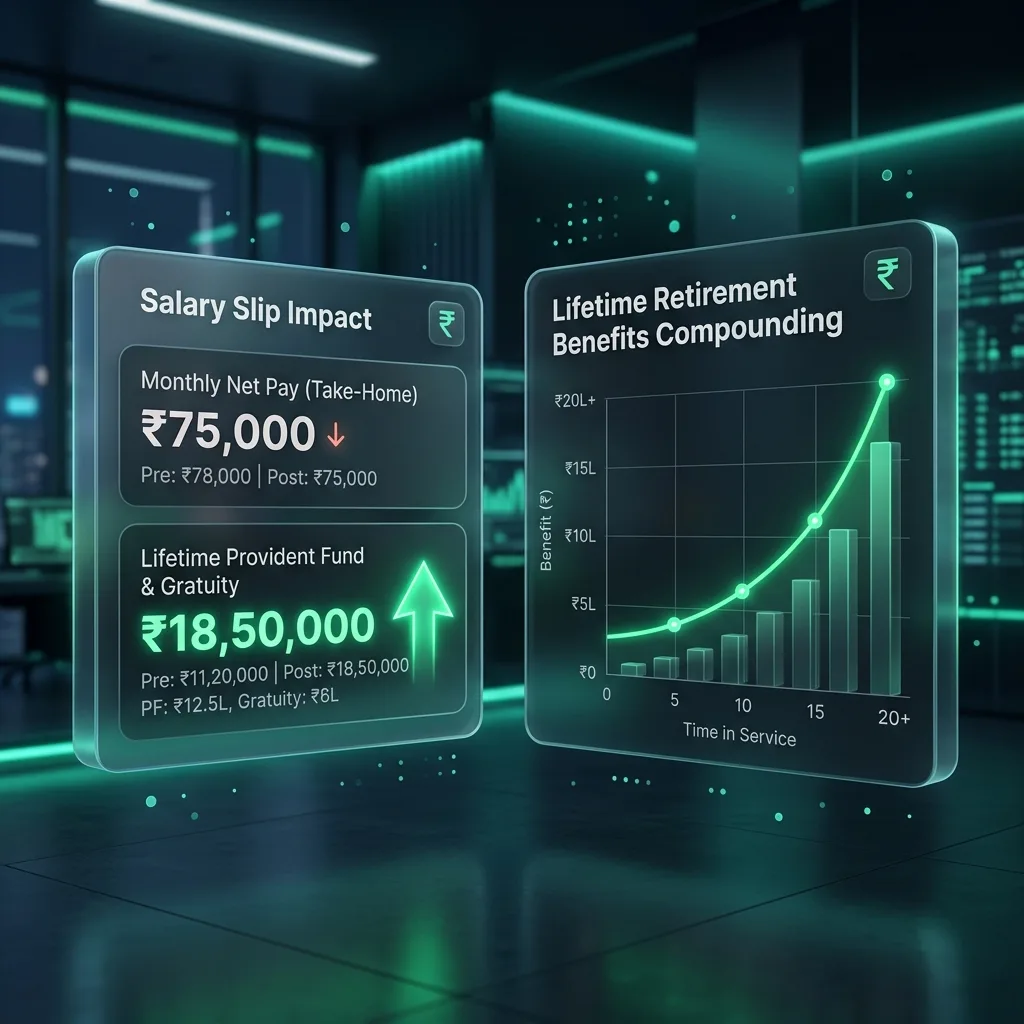
Where PF is paid on actual wages, a higher contribution base can increase deductions. If the employee was already above an unchanged contribution cap, a wage-definition change alone may not alter the capped amount. The September EPF ceiling increase is a separate change, so compare both the old and new bases and caps with our EPF calculator. Gratuity also needs its own calculation.
Payroll checks before the next salary run
- Audit current payroll master files: Identify employees for whom qualifying exclusions under clauses (a) to (i) exceed the permitted 50% threshold, and separately identify regular non-excluded allowances that may have been incorrectly kept outside statutory wages.
- Record the reason for each exclusion: Match the actual payment to the statutory wording and applicable official guidance. Do not rely on the component name alone.
- Recheck ESI eligibility: Review employees at or below the applicable statutory wage ceiling, including contribution-period continuity rules.
- Align with new EPF ceilings: Review your workforce against both the new wage definition and the New EPF Limit of Rs 25,000 to establish where contribution caps apply.
- Update employee-benefit estimates: Give the valuation preparer the revised wage calculation. Assess gratuity and leave obligations separately under the applicable accounting standard.
- Vendor and contractor due diligence: Review outsourced service providers and staffing contracts under Section 43 of the Code on Wages and Section 55 of the OSHWC Code to ensure contractors compute statutory wages accurately.
- Draft transparent employee communications: Explain how salary restructuring affects monthly take-home pay and retirement benefits to manage employee expectations.
Need to check a benefit separately?
Use our gratuity calculator or statutory bonus calculator, with the correct wage base and eligibility details. A calculator estimate is not a substitute for checking the rules that apply to your payroll.
Frequently Asked Questions (FAQs)
Does the 50% rule mean my basic salary must always be exactly 50% of CTC?
No. The Code does not require Basic Pay, Dearness Allowance, and Retaining Allowance by themselves to equal 50% of CTC or remuneration. Those components are expressly included in core wages, but other regular payments that do not fall within a statutory exclusion (such as special allowances) also remain part of wages. The 50% mechanism primarily limits how much of the qualifying exclusions under clauses (a) to (i) can remain outside wages; any excess exclusions beyond 50% of statutory remuneration are added back.
Does the new wage definition change the calculation of House Rent Allowance (HRA) tax exemption?
No. The Labour Code wage definition does not alter the separate income tax treatment of HRA. Under the Income-tax Act, 2025 read with Rule 279 of the Income-tax Rules, 2026, where the HRA exemption is available, the exempt amount is the least of: (1) actual HRA received, (2) rent paid minus 10% of salary, or (3) 50% of salary for Mumbai, Kolkata, Delhi, Chennai, Hyderabad, Pune, Ahmedabad, and Bengaluru, and 40% of salary elsewhere. For Rule 279, salary includes dearness allowance where it is provided for under the terms of employment and excludes other allowances and perquisites. The availability of the HRA exemption also depends on the tax regime selected by the employee. You can estimate the exemption using our HRA Exemption Calculator.
Can an employer retroactively recover the employer share of EPF from the employee?
The employer’s PF contribution cannot be recovered from the employee’s wages. Do not turn an employer-side shortfall into a retrospective salary deduction. Any recovery relating to the employee’s own share is a separate question and must follow the applicable scheme and deduction rules.
How does the new wage definition affect overtime pay?
Section 14 provides for overtime at not less than twice the normal rate for eligible employees. The Ministry’s March 2026 FAQ explains that an employee whose minimum wage rate is fixed under the Code is eligible. Check the applicable normal-rate calculation, working-hour limits and Central or State rules. The second proviso to Section 2(y), dealing with equal wages and payment of wages, should not be presented as a standalone overtime formula.
How does the new wage definition interact with the new EPF limit of Rs 25,000?
The wage definition tells you which payments count as wages. The Rs 25,000 EPF ceiling addresses a different question. Calculate the wage figure, then review establishment coverage, the employee’s membership history and applicable scheme conditions. Do not treat pay above the ceiling as an automatic exemption for an existing member, or assume that the ceiling notification alone settles every EPF/EPS contribution detail.
Can commission paid to sales staff be excluded from wages?
Commission payable to an employee is specifically listed as an exclusion under clause (i) of Section 2(y). Therefore, commission is initially excluded from wages. However, like HRA and conveyance, commission enters the 50% allowance pool. If the total of all exclusions including commission exceeds 50% of total remuneration, the excess amount is added back to wages.
Key dates and rules, checked 20 September 2026
- Current status as of 20 September 2026: The Labour Codes took effect on 21 November 2025. Final Central Rules under the Code on Wages (G.S.R. 343(E)) and Code on Social Security (G.S.R. 344(E)) were notified in May 2026. State-specific rules and implementation requirements should be checked with the applicable appropriate government.
- Statutory Framework: Section 2(y) of the Code on Wages, 2019 and Section 2(88) of the Code on Social Security, 2020 define the unified statutory wage base.
- Social Security & EPF: ESIC circular dated 11 December 2025 confirmed that the Section 2(88) wage definition applies for ESI calculations from 21 November 2025. S.O. 5109(E) established the updated EPF wage ceiling of Rs 25,000 effective 17 September 2026. S.O. 2698(E) notified 12% simple interest on delayed contributions under Section 127 of the Code on Social Security.
Official references and statutory sources
- Code on Wages, 2019 (Act No. 29 of 2019): Section 2(y) (definition of wages), Section 2(k) (definition of employee), Section 14 (overtime), Section 43 (responsibility for payment of dues), and Chapter IV (payment of bonus).
- Code on Social Security, 2020 (Act No. 36 of 2020): Section 2(88) (definition of wages), Section 2(89) (wage ceiling), Chapter IV (ESI), Chapter V (gratuity), and Section 127 (interest on delayed contributions).
- Code on Wages (Central) Rules, 2026 : G.S.R. 343(E): May 2026 notification establishing wage calculation and administrative rules in the central sphere.
- Social Security (Central) Rules, 2026: G.S.R. 344(E): May 2026 notification for social security procedures, registration, and scheme operations.
- S.O. 2698(E) (29 May 2026): Notification prescribing 12% simple interest per annum on delayed social security contributions under Section 127 of the Code on Social Security, 2020.
- PIB Press Release (PRID 2192463): Government of India confirmation of the rationalization of 29 central labour laws into four Labour Codes.
- ESIC Headquarters Circular, 11 December 2025: Confirmation of Section 2(88) wage definition implementation effective 21 November 2025.
- Ministry of Labour and Employment FAQs on New Labour Codes (16 March 2026): Official administrative guidance on wage computation, bonus treatment, overtime eligibility, and social security ceilings.
- Income-tax Rules, 2026 : Rule 279: Statutory HRA exemption formula, definition of salary, and the eight specified 50% metro areas (Mumbai, Kolkata, Delhi, Chennai, Hyderabad, Pune, Ahmedabad, Bengaluru).
- Occupational Safety, Health and Working Conditions Code, 2020: Section 55 (statutory responsibility for payment of wages to contract labour).
- ICAI AASB Guidance on New Labour Codes (9 February 2026): Audit and financial reporting guidance for statutory auditors.
- EY Assurance EYe (April 2026): Technical analysis on wage definitions, gratuity actuarial valuations, and financial statement disclosures.
- Related ReconScribe tools and guides: New EPF Limit Rs 25,000 and Salary Impact, Gratuity Calculator 2026, and Statutory Bonus Calculator.
Before changing payroll: These examples explain the method, not an individual employee’s final liability. Check the current notification, applicable rules, employment terms and payroll period. Keep professional advice on file where classification or past-period adjustments are uncertain.