
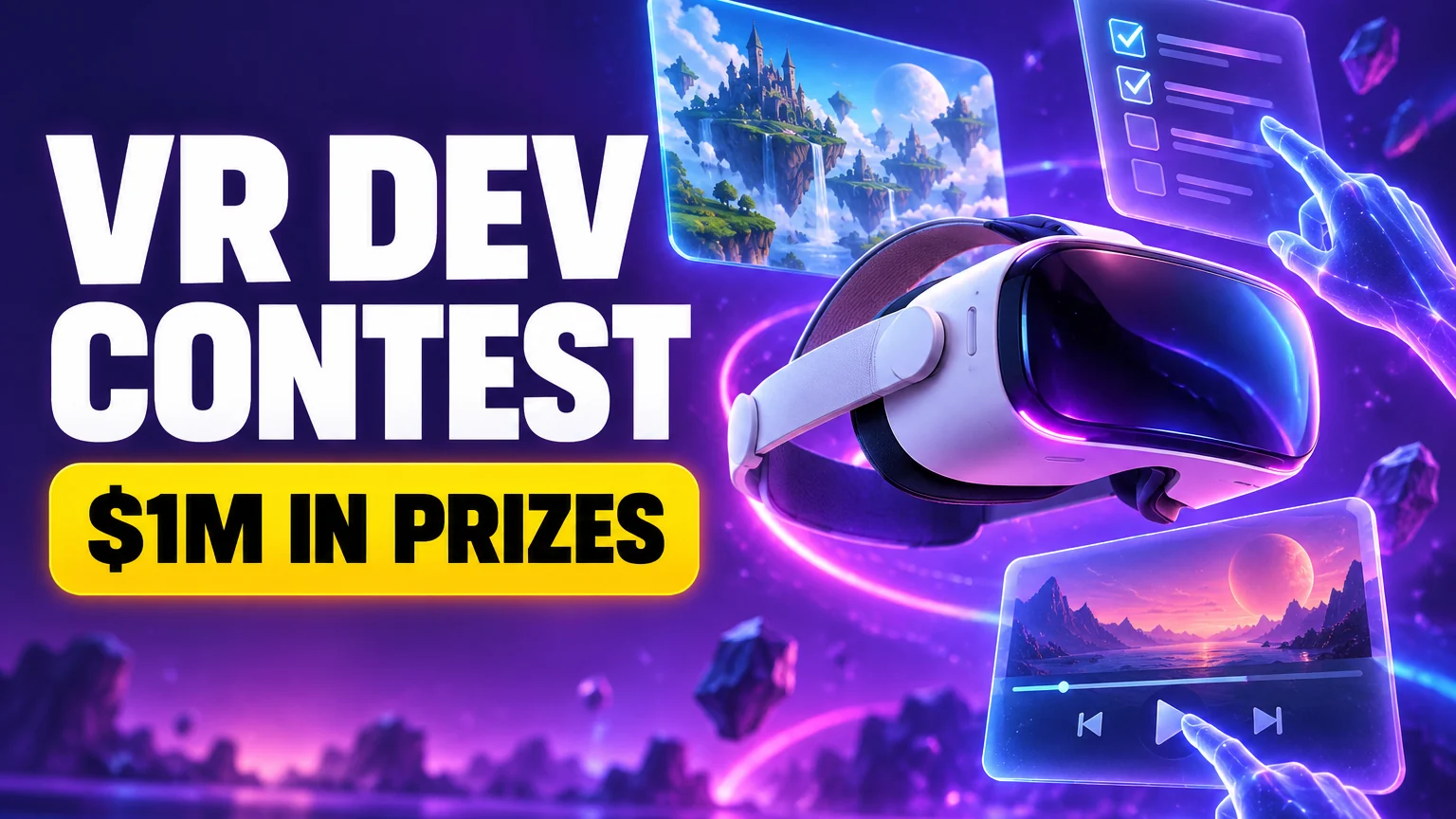
The Meta VR Start Developer Competition 2026 offers up to USD 1,000,000 in cash for VR apps that work with your hands alone, and adults in most countries can enter. Meta is paying out 20 cash prizes, with USD 100,000 for each Gaming and Entertainment winner and USD 70,000 for each Productivity winner. Entries close on Wednesday 18 November 2026 at 12:00 PM Pacific Time (PST), which is 20:00 UTC; the dates table shows that moment in your local time. The main catch: whoever submits must be a Meta VR Start member by then.
It is a Meta Quest hackathon with serious money behind it, open to solo builders, teams and studios, and it runs entirely online. You do not need to own a headset to compete, a web build is allowed, and adults in most countries qualify on the same terms; the exclusions are Brazil, Quebec, areas under comprehensive international sanctions and any country or person designated by the US Treasury’s Office of Foreign Assets Control (OFAC).
This guide covers what to build, how to join the Start program, how to get a playable build in front of the judges, how scoring works and what happens with tax if you win, whether you live in the US or anywhere else. Every rule, date and amount below comes from the official contest pages and the Official Rules as of 17 October 2026.
Meta VR Start Developer Competition: the short answer
What is Meta VR Start Developer Competition?
The Meta VR Start Developer Competition is an eight-week online build challenge from Meta Platforms, Inc., run on Devpost. Devpost is a website that hosts hackathons and handles sign-ups, submission forms and judging. The entry period opened on 24 September 2026, and the brief is easy to say and hard to do well: build a hands-first app for Meta VR devices. Hands-first means the headset’s cameras track your hands, so a person can finish the entire experience by pinching, grabbing and pointing, without ever pairing a controller. Controller support is allowed as an extra, but it can never be needed.
You can build a VR app (virtual reality, where you are inside a fully digital world) or an MR app (mixed reality, where digital objects sit inside your real room). MR relies on passthrough, which is the headset showing you a live camera view of your surroundings. Meta’s overview mentions both Meta VR Glasses and Meta Quest, but the FAQ says every build must be playable on Meta Quest 3 and 3S, and judges review apps on a Meta Quest 3 or Quest 3S.
Every entry picks at least one track and one division. The three tracks are Entertainment (lean-back media such as spatial cinema, interactive video, music visualisation, immersive storytelling, spatial audio and media companion apps), Gaming (puzzle, strategy, casual, social and narrative games that thrive seated and without controllers) and Productivity (multi-panel workspaces, task management, creative tools and habits tied to a daily moment such as a morning routine, a commute or winding down). The two divisions are New Experience, for projects conceived and built inside the competition window that started on 24 September 2026 with no older code, and Adapted / Significantly Updated Experience, for any build, prototype or published app that existed earlier and gains a meaningful new feature, mode or platform integration during the window. Meta may move an entry to a different track or division.
Meta also sets three design tests. The airplane seat test asks whether every interaction works in a small seated space of about two feet (the overview says a two-foot radius, the FAQ says about 2ft in diameter). The one bus stop test asks whether a session is satisfying in 10 minutes or less. The take it away test asks whether there is still a project if you remove the third-party service, because thin wrappers around platforms such as YouTube or ChatGPT are highly discouraged. These are guidelines, not hard rules, but the scoring rewards seated, hands-first design. Devpost showed 3,329 registered participants on 17 October 2026, and the full legal terms sit in the Official Rules.
Key dates and deadlines in UTC and your local time
The Official Rules state times in Pacific Time (PT). US clocks go back on 1 November 2026, so the September and October dates use PDT (UTC-7) and the November and December dates use PST (UTC-8). The table gives each time as the organiser states it, the same moment in UTC (Coordinated Universal Time, the reference clock every time zone is measured from) and the matching time in your own time zone, shown automatically.
The webinars are open to registered Start members logged in to the Meta Developer Forum. Most run in two slots: an EMEA slot (Europe, Middle East and Africa) at 3:00 PM Central European time and a North America slot at 10:00 AM PT, and some run only in the North America slot. In UTC, the EMEA slot is 13:00 up to 22 October and 14:00 from 26 October, and the North America slot is always 17:00. The table lists each session on its own row, so you can see both slots in your local time.
| What | As the rules state it | UTC | Your local time |
|---|---|---|---|
| Entry period opens (start of the competition window) | September 24, 2026 at 10:00:00 AM PT (PDT) | Thu 24 Sep 2026, 17:00 UTC | Worked out by your browser |
| Webinar, EMEA slot: Monday Unblock: Playable Prototype | Mon Oct 19, 2026, 3:00 PM CEST | Mon 19 Oct 2026, 13:00 UTC | Worked out by your browser |
| Webinar, North America slot: Monday Unblock: Playable Prototype | Mon Oct 19, 2026, 10:00 AM PT | Mon 19 Oct 2026, 17:00 UTC | Worked out by your browser |
| Webinar, EMEA slot: First Build Review | Tue Oct 20, 2026, 3:00 PM CEST | Tue 20 Oct 2026, 13:00 UTC | Worked out by your browser |
| Webinar, North America: Agentic Workflows for New & Existing Apps | Tue Oct 20, 2026, 10:00 AM PT | Tue 20 Oct 2026, 17:00 UTC | Worked out by your browser |
| Webinar, North America: Show Your Workflow: How VR Developers Actually Build | Wed Oct 21, 2026, 10:00 AM PT | Wed 21 Oct 2026, 17:00 UTC | Worked out by your browser |
| Webinar, EMEA slot: First Build Review | Thu Oct 22, 2026, 3:00 PM CEST | Thu 22 Oct 2026, 13:00 UTC | Worked out by your browser |
| Webinar, North America slot: First Build Review | Thu Oct 22, 2026, 10:00 AM PT | Thu 22 Oct 2026, 17:00 UTC | Worked out by your browser |
| Webinar, EMEA slot: Monday Unblock: Building and Testing | Mon Oct 26, 2026, 3:00 PM Berlin time (Devpost labels it CEST) | Mon 26 Oct 2026, 14:00 UTC | Worked out by your browser |
| Webinar, North America slot: Monday Unblock: Building and Testing | Mon Oct 26, 2026, 10:00 AM PT | Mon 26 Oct 2026, 17:00 UTC | Worked out by your browser |
| Webinar, EMEA slot: Playtest & React | Tue Oct 27, 2026, 3:00 PM Berlin time (Devpost labels it CEST) | Tue 27 Oct 2026, 14:00 UTC | Worked out by your browser |
| Webinar, North America slot: Playtest & React | Tue Oct 27, 2026, 10:00 AM PT | Tue 27 Oct 2026, 17:00 UTC | Worked out by your browser |
| Webinar, EMEA slot: Playtest & React | Thu Oct 29, 2026, 3:00 PM Berlin time (Devpost labels it CEST) | Thu 29 Oct 2026, 14:00 UTC | Worked out by your browser |
| Webinar, North America slot: Playtest & React | Thu Oct 29, 2026, 10:00 AM PT | Thu 29 Oct 2026, 17:00 UTC | Worked out by your browser |
| Submission deadline (last moment to edit the form, track, division or build) | November 18, 2026 at 12:00:00 PM PT (PST) | Wed 18 Nov 2026, 20:00 UTC | Worked out by your browser |
| Scored judging begins (the no-changes freeze already started at the deadline) | Devpost schedule: November 23 at 9:00am PST. Rules: judging runs from on or around November 18, 2026 | Mon 23 Nov 2026, 17:00 UTC | Worked out by your browser |
| Scored judging ends | Devpost schedule: December 09 at 7:00pm PST. Rules: on or around December 9, 2026 | Thu 10 Dec 2026, 03:00 UTC | Worked out by your browser |
| Winners announced | Devpost schedule: December 11 at 10:00am PST. Rules: on or around December 11, 2026 | Fri 11 Dec 2026, 18:00 UTC | Worked out by your browser |
| Last day to request the winners list by email | No later than three months after the end of the contest, by email to MetaHorizonStart@meta.com | No exact date stated | No fixed date |
The line that matters most is the deadline: 12:00 PM PT on Wednesday 18 November 2026, which is 20:00 UTC. Check the local time in the table and treat a few hours before it as your real deadline, because a slow upload or a broken Invite URL in the final hour leaves no time to fix anything. East of UTC+4, which covers much of Asia and all of Australia and New Zealand, the deadline falls on Thursday 19 November local time (at UTC+4 itself it is exactly midnight), so do not plan around a full Wednesday there. The official Devpost schedule lists every phase.
The freeze starts at the deadline, not when scored judging begins. The schedule shows judging from 23 November to 9 December, but the FAQ tells you not to make any updates from 12:00 PM PST on 18 November until winners are announced. Your app must also stay available and free of charge to judges until the winner announcement, which the schedule lists for 11 December at 10:00 AM PST (18:00 UTC) and the rules describe as on or around 11 December 2026.
One small trap on the Webinars & Office Hours page: the 26, 27 and 29 October EMEA sessions are labelled 3:00 PM CEST, but Central Europe moves to winter time (CET, UTC+1) on 25 October 2026. The linked Zoom registration pages use Berlin local time, so those three sessions start at 14:00 UTC, not 13:00 UTC, and the table above uses the corrected time.
Prizes
The rules put the total approximate retail value (ARV, the rules’ term for the stated value of each prize) at up to USD 1,000,000, and every prize is cash. There are 20 prizes: a winner and a runner-up for each of the three tracks in each of the two divisions, six special awards and two Judge’s Choice awards.
Each entry can win only one prize. If your project is in line for more than one, the FAQ says you receive the one with the highest value.
By track, Entertainment and Gaming each carry USD 300,000 and Productivity carries USD 210,000 across the two divisions. The six special awards add USD 150,000 and Judge’s Choice adds USD 40,000, which brings the total to exactly USD 1,000,000.
The special awards are open to both divisions and all three tracks, so a small Productivity app can still compete for Best First Five Minutes or Best Accessibility Forward Experience. Read the full descriptions on the official Special Awards page before you decide what to emphasise.
Prize money goes to one person per entry, and US tax may be withheld before it reaches you. The ownership, prize payment and tax section below explains the forms and what to check.
Who can enter, and from which countries
As of the start of the entry period, every entrant (each solo entrant, and every member of a team or organisation) must be at least 18 and have reached the age of majority where they live. Entrants cannot be residents of, or organisations based in, Brazil, Quebec (Canada) or any area under comprehensive international sanctions, such as Crimea, Russia, Cuba, Iran, North Korea and Syria, or any country or person designated by OFAC (the US Treasury’s Office of Foreign Assets Control), including countries with banking or wire transfer restrictions.
By the time you submit, you need an active Meta account with Developer Access enabled, and the Representative or person submitting must be a member of the Meta VR Start program. Meta VR Start is Meta’s developer program, formerly called Meta Horizon Start, which offers members community mentorship, software credits and go-to-market guidance. The FAQ confirms that joining Start or enabling Developer Access after 24 September 2026 is fine, as long as it happens before you submit. Meta’s separate Start Program Terms also ask members for a valid email, the age of majority and a registered developer Organization in good standing; the competition pages do not explain how a solo builder meets that last point, so read the terms carefully when you apply.
The contest is not limited to students or professionals. Companies, nonprofits, LLCs and partnerships can enter, but politically affiliated organisations cannot. Government and political officials are excluded, as are employees, officers and agents of Meta and of anyone involved in running the contest, their affiliates and agencies, their family and household members, and anyone with a conflict of interest. Apps that received or are receiving direct Meta funding, such as request for proposals (RFP) funding, are ineligible. Developers who have a Meta Launch or Partner Manager can enter only if the submitted app is not in development with financial support from Meta and significant updates were made to it during the competition. Being a tax resident of an excluded country does not by itself rule you out if you live and bank in an eligible country and use that address on all your documents, though proof of legal status may be requested.
Teams and solo entries
You can enter alone, as a Team (two or more eligible people who have not formed a legal entity) or as an Organization (a legally existing company or other entity that is not politically affiliated). There is no maximum team size, but every single member must meet the eligibility rules on their own.
Each Team or Organization appoints one Representative. That person submits the entry, receives all communication from Meta and receives any prize, then splits the money with teammates without Meta’s involvement. Our advice: agree the split in writing before you start, because the rules leave it entirely to you.
Each person gets one Entry. You can submit either one solo Entry or one Entry as a Team Representative, never both. You can still be a non-Representative member of any number of other teams, because that does not count as submitting an Entry. Each Team submits only one project, and the form asks for the name, email and role of every member.
Looking for teammates? The 29 September kickoff session included live matchmaking, and the organiser’s weekly updates point Start members to ways of finding people to build with.
How to enter Meta VR Start Developer Competition, step by step
Here is the full path from no account to a submitted entry, in the order the official pages describe it. Do steps 1 and 2 first, because Start membership can take more than a day to show up and nothing else matters without it.
What you must submit
Your entry has two parts: a playable project the judges can install or open, and a set of materials on the Devpost form. Here is everything the rules and the overview ask for.
A code repository is not required, and the rules do not ask you to open source anything. Publishing to the Meta store is not required either; what matters is a working release channel Invite URL, or a URL for a web build.
Testing access must be good enough for Meta and the judges to view, use and test the project on Meta Quest 3 or 3S. Content must follow the Meta VR Developer Content Guidelines for a 10+, 13+ or 18+ rating and all Meta developer policies, and the project must stay available and free of charge until the winner announcement.
One FAQ answer is worth knowing in advance. If you cannot generate an Invite URL, or your accessible build is past what the official FAQ calls a 90-day limit, Meta suggests creating a new project with a different name and a private Alpha channel, or as a fallback submitting your public Meta Quest Store link, with no updates during judging. The official pages do not explain the 90-day limit further, so if you are reusing an older project in the Adapted division, generate and test your Invite URL early.
How entries are judged
Judging runs in two stages. Stage One is a pass or fail viability check. Entries that pass move to Stage Two, where Meta and third-party judges score them on four criteria worth 25% each, testing on Meta Quest 3 or Quest 3S.
Ties are broken by a judges’ vote. The rules say AI tools may help with judging, but human judges make the final decisions, possibly over one or more rounds. The full wording is on the official Judging page.
Tools, APIs and what they cost
Besides a free Devpost account to register and submit, the required accounts are an active Meta account with Developer Access and, for the person submitting, Meta VR Start membership. Neither the Start program page nor the Start Program Terms mention a membership fee, though neither says outright that membership is free. The Start terms say participants bear their own hardware, software, internet, transport and lodging costs beyond the benefits Meta specifies. The Start program page lists software credits among member resources, but no credits specific to this contest are stated, and the rules do not state any engine or hosting costs.
You choose the build path, and the choice does not affect prize eligibility: Unity, Unreal, Godot, Native/Android, the Immersive Web SDK or another engine. An SDK (software development kit) is a package of ready-made code and tools for one platform. The overview suggests four starting points: Unity with Meta’s XR SDKs (the All-in-One package), Unreal Engine 5.8 with the Oculus Integration SDK v207 or later, Android apps built with React Native/Expo or Jetpack Compose using the Meta VR Plugin for Android Studio, and the Immersive Web SDK, which needs Node.js v20.19.0 or higher and starts with the command npm create @iwsdk@latest. Node.js is a free program that runs JavaScript on your computer, and npm is the package tool that comes with it. Non-Meta options such as Unity XR Interaction Toolkit with XR Hands or other OpenXR solutions are allowed, but Meta recommends its own Interaction SDK and judges score technical use of hands-first platform features. OpenXR is the open industry standard for VR and AR (augmented reality) apps. Any 3D tool such as Blender or Maya is fine if properly licensed. Only publicly released or Start-released Meta tools are allowed; unreleased Meta SDKs or features are not.
On hardware, you do not need to own a Meta Quest, and your video can come from the XR Simulator or an emulator, but the build must be playable on Quest 3 and 3S, and the Start program does not provide devkits or hardware. Backward compatibility with Quest 2 or Quest Pro is allowed but not judged, and your app must not require third-party, non-Meta devices such as Bluetooth accessories. For AI-assisted building, the official resources list the Meta VR CLI, Meta XR Operator, Unity CLI and the meta-quest agentic-tools repository on GitHub; a CLI (command-line interface) is a tool you run by typing commands.
Rules that trip people up
These are the rules most likely to catch you out. Each one comes straight from the Official Rules or the FAQ, and each can sink an otherwise strong entry.
Ownership, prize payment and tax
You keep ownership: the rules say all entries and projects remain the intellectual property of the individuals or organisations that built them. By entering, though, you grant Meta and the other released parties an irrevocable, transferable, sublicensable right to use, edit, modify, copy, reproduce and distribute your entry, in whole or in part, worldwide and in perpetuity, in any medium and language, for judging, running the contest and any marketing or promotion, without further payment. You also license your and your app’s names, trademarks and logos and your Meta usernames and profiles, give a publicity release over your name, voice, face and likeness, and waive moral rights claims and injunctive relief against Meta’s use. The FAQ calls this a limited license, but the Official Rules wording is broader, and the rules say Meta resolves any inconsistency. No open source licence or public repository is required, but your project must be original, public domain or Meta-provided, every third-party asset must be properly licensed, and Meta may ask for written proof.
Prizes go to the solo entrant, or to the Representative of a winning team or organisation, who is responsible for splitting the money. Payment happens only after the winner returns the Winner Documents, which are forms confirming you followed the rules and may include a government-issued ID or ID number, plus any other required forms. A valid bank account may be required for prizes of USD 1,000 or more, and winners may need to provide a mailing address, bank details or an account with an electronic payment provider chosen by Meta. Winners who do not respond or cannot be reached may be disqualified and an alternate chosen, and Meta need not pursue more than two alternate winners. The rules do not say how long after the announcement prizes are paid.
All taxes are the winner’s responsibility, and Meta may withhold amounts required under US federal, state, local or foreign tax law. US residents who win USD 2,000 or more receive IRS Form 1099-MISC. Winners outside the US receive IRS Form 1042-S (the US tax form that reports payments made to non-US persons) for the total ARV, and prizes paid outside the US may be subject to US federal income tax withholding, so the amount that reaches you may be less than the stated prize. The rules do not mention tax treaty rates or Form W-8BEN by name and say nothing about how your home country taxes the prize, so check with a tax adviser where you live before you plan around the full amount.
Project ideas that fit the brief
These four ideas are ours, not Meta’s. Each one is built around the hands-first rule and the seated, short-session guidelines, and each points at a track, with some also aiming at a special award. Treat them as starting points and make the concept your own, because originality carries a quarter of the score.
Tips to give your entry the best chance
- Apply to Meta VR Start and turn on Developer Access before you write any code. Flair can take more than 24 hours to show, and you cannot fix a membership problem in the final hours before the deadline.
- Run a controller-free test every week: put the controllers in another room and ask someone who has never seen your app to finish it with hands alone while you stay silent.
- Build seated by default. Play your whole app sitting in a chair within about two feet of reach, because judges weigh seated, hands-first design under Experience Design.
- Watch performance from the first week, not the last. Aim for at least 60 fps on Quest 3 and 3S hardware, since judges score performance and bugs under Technical Implementation.
- Set up the Competition release channel and Invite URL early, then test the link from a different Meta account so you know a judge can actually install the build.
- Plan the video before you finish the app: under three minutes, real footage from a headset or the XR Simulator, your best moment first, and no AI-generated video standing in for gameplay.
- If you are in the Adapted division, keep a dated changelog with screenshots of each new feature, since the form asks for a summary of what you added during the window.
- Submit a complete first version days before the deadline. You can keep editing the form, track, division and build until 12:00 PM PT on 18 November (20:00 UTC), so an early submission costs you nothing.
Please note: we update this page from time to time, but hackathon dates, prizes and rules can change quickly, and there can be a gap between a change and our update. Check the official rules before you enter or submit. This guide helps you plan; it is not legal or tax advice, and ReconScribe is not responsible for decisions made on it.
Meta VR Start Developer Competition frequently asked questions
Which countries can enter the Meta VR Start Developer Competition?
Most countries can. The Official Rules exclude residents of, or organisations based in, Brazil, Quebec (Canada) and areas under comprehensive international sanctions such as Crimea, Russia, Cuba, Iran, North Korea and Syria, plus any country or person designated by OFAC. Everyone else must be 18 or older, have a Meta account with Developer Access, and the person submitting must be a Meta VR Start member before submitting.
What time is the Meta VR Start Developer Competition deadline?
The deadline is Wednesday 18 November 2026 at 12:00 PM Pacific Time (PST, UTC-8), which is 20:00 UTC. Anywhere east of UTC+4, that is already Thursday 19 November in local time; at UTC+4 it is exactly midnight. The dates table on this page shows the exact moment in your time zone; aim to submit a few hours early to leave a safety margin.
Do I need a Meta Quest headset to take part?
No. The FAQ says you do not need to own a Meta Quest headset, and your demo video can be recorded in the XR Simulator or an emulator. The build must still be playable on Quest 3 and 3S, judges review apps on a Meta Quest 3 or Quest 3S, and the Start program does not supply hardware.
Is Meta VR Start the same as Meta Horizon Start?
Yes. The FAQ says Meta VR Start is the updated name of the program formerly known as Meta Horizon Start. If you joined under the old name, check for the Start Member or Start Partner flair on the Meta Developer Forum to confirm your membership.
Does it cost anything to join Meta VR Start?
Neither the Start program page nor the Start Program Terms mention a fee, though neither says outright that membership is free. The terms say participants pay their own hardware, software, internet and travel costs beyond the benefits Meta specifies. Registering for the contest itself uses a free Devpost account.
How much prize money is there?
The total pool is up to USD 1,000,000 in cash across 20 prizes. Track winners get USD 100,000 in Gaming and Entertainment or USD 70,000 in Productivity, runners-up get USD 50,000 or USD 35,000, six special awards pay USD 25,000 each and two Judge’s Choice awards are listed at USD 20,000. Each entry can win only one prize.
Can I submit a game or app I already built?
Yes, in the Adapted / Significantly Updated Experience division, as long as you ship a meaningful new feature, mode or platform integration during the competition window that began on 24 September 2026. Bug fixes, minor UI tweaks, cosmetic changes and performance work without new user-facing features do not count. Games ported from other platforms also go in this division.
Can players use controllers in my app?
Controller support is optional, but the entire experience must be fully usable with hands from start to finish. The test Meta sets is whether someone can complete everything without ever pairing a controller.
Can I just upload my APK file?
No. Upload the APK to the Meta VR Developer Dashboard under a new release channel named Competition and submit the Invite URL; the FAQ says APKs alone will not be considered. Web builds made with the Immersive Web SDK submit a public link instead.
How long can the demo video be?
Under three minutes. It must show the project running on a Meta Quest device, the XR Simulator or an equivalent emulator, and it must be publicly visible on YouTube or Vimeo. Judges do not have to watch past three minutes, so put your best material first.
Is there a maximum team size?
No, there is no maximum team size. Every member must meet the eligibility rules, one Representative submits the entry and receives any prize, and each person can submit only one Entry, either solo or as a Team Representative.
Do I keep the rights to my project?
Yes, entries remain the intellectual property of the people or organisations who built them. By entering, though, you give Meta a broad, irrevocable, worldwide licence to use and modify your entry for judging, running the contest and marketing. No open source licence or public code repository is required.
More open hackathons
 Bolt Builders Week hackathon$17,500Enter by Wed 21 Oct 2026, 06:59 UTCMeta Global AI Developer Hackathon$1,000,000Enter by Mon 26 Oct 2026, 03:59 UTC
 Nebius x NVIDIA Global AI Hackathon$50,000 cash plus 4 NVIDIA Jetson Orin Nano kitsEnter by Fri 30 Oct 2026, 17:00 UTC
 PayPal AI Hackathon$67,500 cashEnter by Thu 12 Nov 2026, 20:00 UTC
 Gemma 4 Developer Agent Competition$100,000Enter by Wed 25 Nov 2026, 23:59 UTC
 Kiroween 2026$100,000 in cashEnter by Fri 4 Dec 2026, 22:00 UTC
 NFL Big Data Bowl 2027$100,000Enter by Wed 6 Jan 2027, 23:59 UTCName That LLM: Identify the Model Behind the Text$50,000Enter by Wed 6 Jan 2027, 23:59 UTC
See every open hackathon, with filters and deadlines in your local time
Related reading
- Hackathons 2026: every open hackathon, deadlines in your local time
- Bolt.new free tokens and the Bolt hackathon
- Meta AI Developer Hackathon: complete guide
- Kiroween 2026: complete guide
- PayPal AI Hackathon: complete guide
- Free AI API credits and free tiers
- AI leaderboard: every major model ranked
- Claude Code tutorial for building faster
- Free credits and tools for students
Sources
- Official overview (Devpost)
- Official Rules
- Official FAQ
- Official schedule and dates
- Official Judging page
- Official Special Awards page
- Official Webinars & Office Hours page
- Official Resources page
- Meta VR Start program page
- Meta Horizon Start Program Terms