
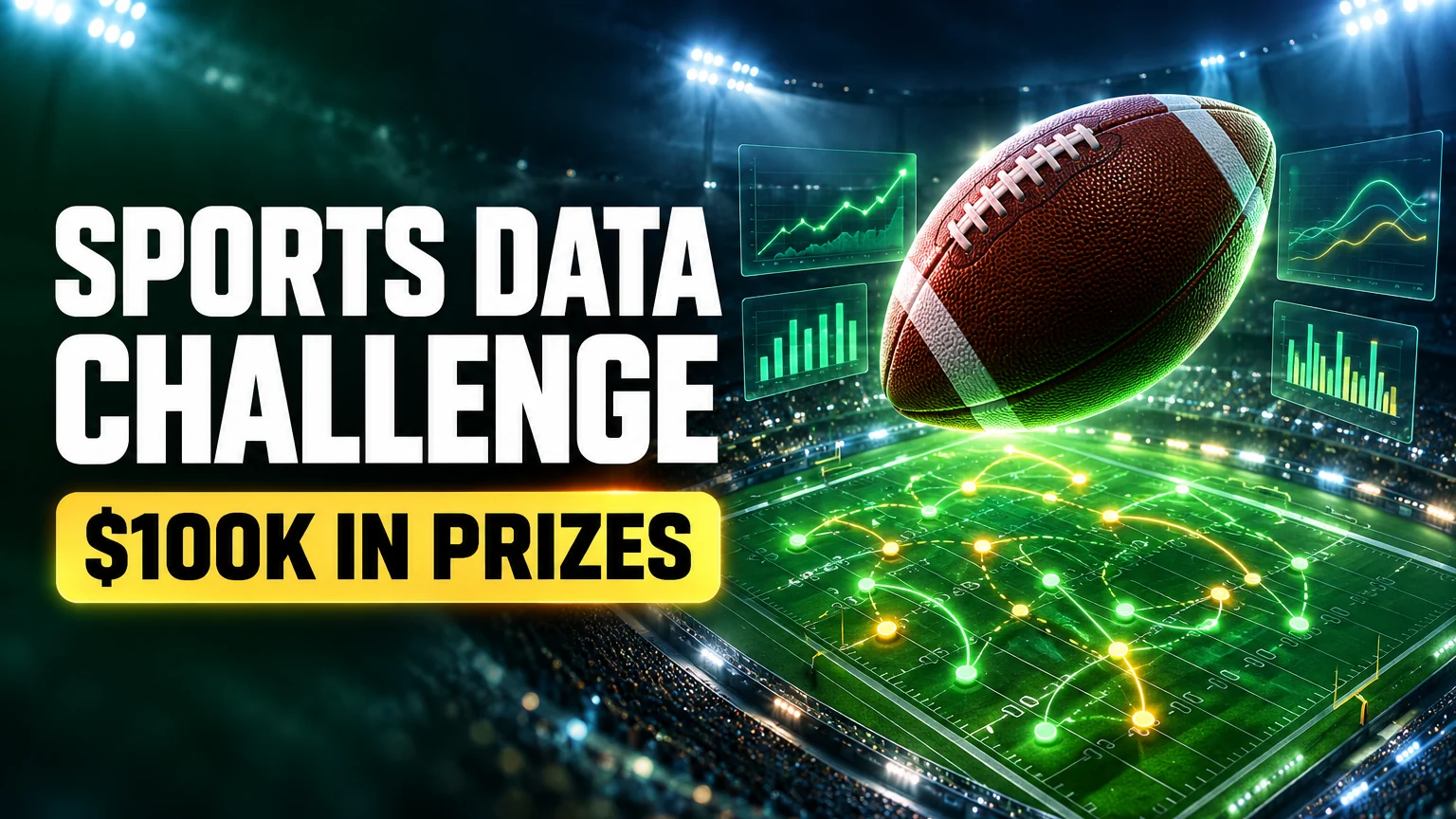
The NFL Big Data Bowl 2027 is a free Kaggle hackathon with $100,000 in prizes for the sharpest analyses of how Combine movement turns into NFL game performance. The Open Track and the undergraduate-only University Track pay $45,000 each, and one finalist wins an extra $10,000 Grand Prize after presenting in person at the 2027 NFL Scouting Combine in Indianapolis. The final deadline is 11:59 pm UTC on Wednesday 6 January 2027, and the timeline below shows that moment in your local time. Entry is open worldwide, apart from a short list of sanctioned regions, for teams of up to five.
This guide takes you from a blank Kaggle account to a submitted entry. It covers the timeline in UTC with your own local time alongside, who can enter from where in the world, who fits each track, the two pass/fail gates that knock out careless entries, how the four judging scores are weighted, and what happens with code ownership and prize tax if you win.
Interest is already high. On 17 October 2026 the Kaggle page showed about 7,400 entrants, 284 participants and 279 teams, even though the competition only opened on 6 October. With one submission per team and a written report judged by analysts from NFL teams and tracking vendors, reading the brief carefully matters as much as clever modelling.
NFL Big Data Bowl 2027: the short answer
What is NFL Big Data Bowl 2027?
The NFL Big Data Bowl 2027 is the ninth annual Big Data Bowl, a sports analytics competition run by NFL Football Operations and hosted on Kaggle. Kaggle is a website where people enter data science competitions, download datasets and run code in their browser. Kaggle Inc. acts as the administrator rather than a party to the contest, and the NFL describes the program as powered by Amazon Web Services (AWS). The competition opened on 6 October 2026, and the NFL’s Big Data Bowl page says it gives participants three months to submit their work.
The 2027 theme is “Combine to NFL Performance”. The NFL Scouting Combine is the league’s annual pre-draft event where prospects run drills in front of NFL teams. At the 2023, 2024 and 2025 Combines, Zebra tracking chips recorded those drills at 10 Hz, which means ten position readings every second. Your job is to build an analytical framework that links this Combine sensor data to how the same players later performed in regular-season NFL games. The NFL says the dataset focuses on five position groups: wide receivers, tight ends, defensive backs, offensive linemen and defensive linemen.
The Overview gives examples, which are not a complete list. Route running and coverage looks at change of direction, deceleration and acceleration against in-game separation. Trench play looks at first-step quickness and burst for linemen against pass-rush or run-blocking results. Drill translation compares sensor metrics with traditional drill times. Position-specific mechanics covers body control, acceleration profiles and pursuit angles against rookie performance. The organisers encourage you to focus on one small aspect, one position group or one drill rather than trying to explain everything at once.
This is a Kaggle “Featured Hackathon”, not a prediction contest. A Kaggle hackathon has no leaderboard, the live ranking table that prediction competitions use: instead of scoring predictions automatically, a panel reads your Writeup, which is a written report with charts plus an attached notebook, and scores it against a published rubric. The host said there are no plans to launch a separate prediction competition this year, and this one awards no Kaggle points or medals. What draws many entrants is visibility: the NFL says more than 75 Big Data Bowl participants have landed sports analytics roles at NFL teams, winning ideas have fed into official Next Gen Stats metrics, the NFL’s player-tracking statistics, and the 2026 winner was Lucca Ferraz, a Rice University student.
Key dates and deadlines in UTC and your local time
The official competition Timeline sets every deadline at 11:59 pm UTC on the day shown, unless noted otherwise. UTC (Coordinated Universal Time) is the fixed world reference clock that every time zone is measured from. If your time zone is ahead of UTC, a deadline late on a UTC evening falls on the next calendar day for you. If you are behind UTC, as everywhere in the Americas, it falls in the afternoon or evening of the same day.
Because the rules use UTC rather than a US time zone, the US change from daylight saving time on 1 November 2026 does not move any of these deadlines. The table shows each date as the organiser states it, then in UTC, and converts every exact time into your own local time automatically.
| What | As the rules state it | UTC | Your local time |
|---|---|---|---|
| Competition opened | October 6, 2026, Start Date | Tue 6 Oct 2026, 19:43 UTC | Worked out by your browser |
| New entries and team mergers close | Not listed separately on the Timeline | Wed 6 Jan 2027, 23:59:59 UTC (Kaggle platform setting) | Worked out by your browser |
| Final Submission Deadline | January 6, 2027, Final Submission Deadline (11:59 PM UTC) | Wed 6 Jan 2027, 23:59 UTC | Worked out by your browser |
| Judging period ends (subject to change) | January 7, 2027 to January 25, 2027, Judging Period | Thu 7 Jan to Mon 25 Jan 2027 (start time not stated; ends Mon 25 Jan, 23:59 UTC if the 11:59 pm UTC rule applies) | Worked out by your browser |
| Anticipated results announcement | January 26, 2027, Anticipated Results Announcement | Tue 26 Jan 2027, time not stated | No fixed date |
| Finalist presentations and Grand Prize, Indianapolis | At the 2027 NFL Scouting Combine, date not stated | Not stated | No fixed date |
| Winner replies to notification email | Within one week of the first notification attempt | Relative deadline, no fixed date | No fixed date |
| Prize documents returned | Within two weeks of notification; prizes awarded about 30 days after receipt | Relative deadline, no fixed date | No fixed date |
The date that matters most is the Final Submission Deadline: 11:59 pm UTC on Wednesday 6 January 2027. For example, that is 6:59 pm EST on Wednesday 6 January in New York and 3:59 pm PST in Los Angeles, while anywhere ahead of UTC it is already Thursday 7 January. Check the moment in your own time zone in the table, treat the session before it as your real last working session, and click Submit with time to spare.
The Timeline does not list a separate entry deadline or team merger deadline. Kaggle’s platform settings for the competition close new entries and team mergers at 23:59:59 UTC on 6 January 2027, seconds after the final deadline, but Rules 3.3a allow the timeline to change, so join and merge early. The judging window, and with it the results date, may move depending on the number of submissions.
The date of the finalist presentations at the 2027 NFL Scouting Combine in Indianapolis is not stated on the Kaggle page or the NFL page. Both say only that finalists will present at the 2027 Combine, so wait for an official date before planning any travel.
Prizes
The total prize pool is $100,000. It is split across two submission tracks worth $45,000 each and a $10,000 Grand Prize that only finalists can compete for. Each track pays three finalists and three runners-up, so there are twelve track prizes in all, plus the single Grand Prize decided at the Combine.
Team prizes are split evenly between eligible team members unless the team unanimously agrees a different split and tells Kaggle before prizes are issued. Prizes cannot be transferred, and the rules use the $ sign without spelling out the currency.
The host said finalist prizes are decided and awarded before Combine travel is planned. A finalist who cannot travel still receives the $10,000 track prize, but the Indianapolis presentation cannot be given remotely, so that team cannot win the Grand Prize.
Who can enter, and from which countries
To enter you need a registered Kaggle account, and you must be at least 18 or the age of majority where you live, whichever is older, unless the sponsor agrees otherwise with parental consent. Residents of Crimea, the so-called Donetsk People’s Republic (DNR), the so-called Luhansk People’s Republic (LNR), Cuba, Iran and North Korea cannot enter, and neither can anyone subject to US export controls or sanctions. Beyond that, the Official Competition Rules open the competition to residents of the United States and worldwide. Local laws may still apply, and a winner located in a country where prizes cannot be awarded is not eligible to receive one.
Rule 2.7b lets people under 18 take part with a parent or guardian’s consent, but they cannot receive a prize. Employees, interns, contractors, officers and directors of the NFL, Kaggle and their parents, subsidiaries and affiliates may participate but cannot win prizes. In the forum the host also ruled that someone who will be an AWS employee by the deadline can take part but cannot win a prize. Each person may use only one Kaggle account.
Your track depends on student status. The Open Track has no eligibility restrictions for entry, so professionals, graduate students and mixed teams all belong there. The University Track is only for teams made up entirely of undergraduate students, with verification for winners. On 17 October 2026 the NFL Operations page described an “Undergraduate/Graduate Track” and an Open Track for people outside college or university, but the host called the graduate wording an error, and Kaggle’s Overview and rules are what you agree to. The host has confirmed in forum replies that students graduating in December 2026, a third-year student on an integrated master’s programme and a student on a five-year engineering degree may enter the University Track. The rules do not say which documents are accepted for student verification.
Teams and solo entries
Everyone competes as a team on Kaggle, even if you work alone, in which case you are a team of one. The maximum team size is five. Each member must be a single person with their own Kaggle account, must register for the competition individually first, and must confirm membership by responding to the team notification sent to their Kaggle account. You can join or form only one team, and the team leader performs mergers.
For this hackathon each team gets one submission only, and any submission a member made before merging into a team is unsubmitted. The Timeline lists no separate merger deadline. The general rule says mergers must finish before the earlier of any merger deadline or the competition deadline, and Kaggle’s platform closes mergers at 23:59:59 UTC on 6 January 2027, so settle your team well before January.
You cannot share code or data privately with anyone outside your team. Code may only be shared publicly on the competition’s Kaggle forum or notebooks, and any code you share there is deemed licensed under an Open Source Initiative (OSI) approved open-source licence that does not limit commercial use. For the University Track the whole team must be undergraduates. To find teammates, Kaggle’s pinned post points to its Team Up feature and the official Kaggle Discord, a free group chat app, though Kaggle staff and the hosts do not monitor Discord.
How to enter NFL Big Data Bowl 2027, step by step
Here is the full path from no account to a submitted entry, in the order the official pages describe it. The admin steps take minutes; give the analysis and the Writeup most of your time.
What you must submit
Your entry is a single Kaggle Writeup. Markdown, which the Writeup uses, is a simple formatting syntax: a line starting with # becomes a heading, and text wrapped in two asterisks becomes bold. A public notebook is one that anyone on Kaggle can open and read. Here is everything the official pages require.
You are encouraged to show statistical code where it helps the reader, but most code should sit in an appendix or the linked notebook. A video is not required. The host said a YouTube video is fine as part of a submission as long as it does not use actual NFL game or Combine film. Kaggle’s docs say external links must not require a login or sit behind a paywall, so judges can open them. The rules do not state a required language for the Writeup.
A demo link or code repository is not required at submission. Winners may later be asked to provide code, documentation and a detailed reproducible methodology with a link to a code repository. Remember that any private Kaggle resource attached to your Writeup is made public automatically after the deadline.
How entries are judged
Judging works in two stages. First, every Writeup must pass two pass/fail gates. Then four components are each scored from 0 (lowest) to 10 (highest), and the scores are combined as a weighted average using the percentages below. Football and data science together carry 60% of the score, so a beautiful report with shaky analysis will struggle.
Judges are analytics staff from the 32 NFL teams or player-tracking vendors that work with NFL teams, and Tom Bliss, Data Scientist at the NFL, is the named judge. The Grand Prize is chosen separately from the finalists who present in person at the 2027 NFL Scouting Combine; the criteria for that round are not stated.
Tools, APIs and what they cost
The NFL Big Data Bowl 2027 needs no paid API or platform. An API is a doorway that lets one program request data from another, and you do not need one here. A free Kaggle account and a public Kaggle Notebook, which runs on Kaggle’s machines inside your browser, are enough. The data covers 510 rookies drafted or signed from 2023 to 2025, 6,310 Combine drill attempts tracked at 10 Hz, and 1,002 NFL regular-season and playoff games. AWS powers the program, but no AWS service is required and the rules do not mention any cloud credits.
Outside data and tools are allowed if they are publicly available and equally accessible to all participants at no cost, or meet the rules’ Reasonableness Standard of minimal cost. The rules give a small subscription to an LLM, a large language model such as an AI chatbot, as an acceptable example, while buying a dataset that costs more than a prize is not acceptable. Kaggle staff confirmed that a private cloud workspace and an AI coding assistant are both fine. The host suggested joining a public source such as nflreadr for extra play context, and AutoML tools, which automate model building, are allowed if you hold an appropriate licence.
Two practical notes. Whether an AI assistant may process the raw competition data, rather than only help write code, had no official answer as of 17 October 2026, and the data licence forbids redistribution, so be cautious about pasting raw files into outside services. On the free side, a pinned forum post says Accenture is giving participants one free month of Udacity’s course catalog with the code NFLDATABOWL2027, with no payment information required and no end date stated for redeeming it.
Rules that trip people up
Each of these rules is easy to miss, and each one can knock an entry out of judging or cost a winner the prize.
Ownership, prize payment and tax
The rules do not transfer ownership of your work to the NFL: you warrant that your Submission is your original work and that you are its sole owner. Winners, however, must license their winning Submission and the source code used to generate it under an Open Source Initiative (OSI) approved licence that does not limit commercial use, with exceptions for commercially available third-party software and for input data or pretrained models with incompatible licences. Winners may be required to provide code, documentation and a detailed reproducible methodology with a link to a code repository, and may be asked to join a recorded or panel call.
Submissions are made public at the end of the hackathon. Code you share publicly on the competition forum or notebooks is deemed licensed under an OSI-approved licence that allows commercial use, and any open-source code you use must carry such a licence too. The NFL, Kaggle and their affiliates may use your name and likeness for promotion without extra pay, unless the law prohibits it.
Potential winners are notified by email and must respond within one week of the first notification attempt, or the prize is forfeited and an alternate is chosen. Prize acceptance documents, including eligibility certifications, licences, releases and US tax forms, must be returned within two weeks: IRS Form W-9 for US residents or IRS Form W-8BEN for foreign residents, the form a non-US person signs to confirm foreign status. Prizes are awarded within about 30 days after the documents arrive, are paid net of any tax the sponsor must legally withhold, and all taxes are the winner’s responsibility; US residents receive IRS Form 1099. The rules do not state the payment method or the withholding rate for winners outside the US, so check with a tax adviser in your own country.
Project ideas that fit the brief
These are our own suggestions, not official prompts. Each one fits the 2027 theme, uses the player tracking data and makes an explicit link from Combine movement to game performance, which addresses the Combine-to-NFL Linkage gate and the tracking data rule. You still need readable markdown, embedded visuals and an attached public Kaggle Notebook to pass the Writeup Completeness gate. Treat them as starting points and narrow them further.
Tips to give your entry the best chance
- Start narrow. One position group and one drill, done well, beats a sprawling study of all five groups, and the organisers explicitly encourage that focus.
- Load the data carefully. In player_play, the string “NA” in lined_up_position marks a play killed by a pre-snap penalty, and pandas, the Python library most people use to load CSV files, reads “NA” as a missing value by default. Do not drop those rows by accident: treat a missing lined_up_position as a pre-snap penalty play on purpose, and if you use keep_default_na=False, set na_values so real blanks in numeric columns stay missing. On 17 October 2026 the Data tab quoted 316,338 player-play records, which participants found does not match the downloaded file; the host said the CSVs contain the full dataset, so trust the files.
- Know the quirks the host flagged. 13 of the 510 players never reached the field, and on BALL rows in combine_tracking the nfl_id is the athlete doing the drill. Decide early how your analysis handles both.
- Plan your figures before you write. You can use at most nine tables or figures, and Data Visualization is worth 20% of the score, so sketch each chart’s single message first and cut anything that does not earn its place.
- Write for a busy team analyst. Football Score asks whether teams or the league office could use your results week to week, and Writeup Score asks whether your motivation is clearly defined. Open with the question, the metric and the answer, then show the evidence.
- Be honest about uncertainty. Data Science Score rewards claims backed by data and models suited to the data. With 510 rookies spread across five position groups, report intervals and limitations instead of overclaiming.
- Make the notebook reproducible. Judges may run it with the Internet on, so restart it and run it end to end before you attach it, and make sure any public outside data loads without a login.
- Submit early and ask in the right place. Click Submit at least a day before 6 January 2027, 11:59 pm UTC, and post rules questions on the Kaggle competition forum, because Kaggle staff and the hosts do not monitor the Kaggle Discord.
Please note: we update this page from time to time, but hackathon dates, prizes and rules can change quickly, and there can be a gap between a change and our update. Check the official rules before you enter or submit. This guide helps you plan; it is not legal or tax advice, and ReconScribe is not responsible for decisions made on it.
NFL Big Data Bowl 2027 frequently asked questions
What is the NFL Big Data Bowl 2027 deadline?
The Final Submission Deadline is 11:59 pm UTC on Wednesday 6 January 2027. That is 6:59 pm EST in New York and 3:59 pm PST in Los Angeles on 6 January, and already Thursday 7 January anywhere ahead of UTC. Your Writeup must be submitted, not just saved as a draft, by then.
Who can enter the NFL Big Data Bowl 2027?
Residents of the United States and worldwide with a Kaggle account, except residents of Crimea, the so-called DNR or LNR, Cuba, Iran and North Korea, and anyone subject to US export controls or sanctions. To win you must be 18 or the age of majority where you live, whichever is older. Under-18s may take part with a parent or guardian’s consent but cannot receive a prize.
How much prize money does the NFL Big Data Bowl 2027 offer?
$100,000 in total. The Open Track and the University Track each pay $45,000: $10,000 to each of three finalists and $5,000 to each of three runners-up. One finalist wins an extra $10,000 Grand Prize after presenting at the 2027 NFL Scouting Combine.
Can graduate students enter the University Track?
No. The University Track is for teams made up entirely of undergraduate students. On 17 October 2026 the NFL Operations page mentioned graduate students, but the host said that is an error. Graduate students can enter the Open Track instead.
Is the NFL Big Data Bowl free to enter?
Yes. You need a free Kaggle account, and the work is done in a free Kaggle Notebook. No paid API, platform or cloud service is required.
Do I have to travel to Indianapolis for the Big Data Bowl?
Only if you are a finalist and want a chance at the $10,000 Grand Prize, which must be presented in person at the 2027 NFL Scouting Combine. The host said the NFL covers finalists’ travel and lodging. A finalist who cannot travel still receives the $10,000 track prize but cannot win the Grand Prize.
How many people can be on an NFL Big Data Bowl team?
Up to five. Each person needs their own Kaggle account and must register for the competition before joining a team. Each team makes one submission only.
What if my analysis finds no link between Combine data and NFL performance?
That can still pass. The host said judges will not grade purely on what specific results are found. Your Writeup still needs an explicit link in its method between Combine tracking data and game performance.
Can I use an AI coding assistant in the NFL Big Data Bowl 2027?
Yes. Kaggle staff said a private cloud workspace and an AI coding assistant are both fine, and the rules give a small LLM subscription as an example of an acceptable low-cost tool. Whether an AI tool may process the raw competition data had no official answer as of 17 October 2026, so keep the no-redistribution data licence in mind.
Is there a prediction competition in the 2027 Big Data Bowl?
The host said there are no plans to launch a prediction competition this year. The 2027 edition is a hackathon: you submit an analysis Writeup and a panel judges it against a rubric.
Does the NFL Big Data Bowl give Kaggle medals or points?
No. This competition awards no Kaggle points or medals, and hackathons have no leaderboard. The rewards are the prize money and, for finalists, the invitation to present at the Combine.
Can I use outside data in the NFL Big Data Bowl 2027?
Yes, if it is publicly available and equally accessible to all participants at no cost, or meets the rules’ Reasonableness Standard of minimal cost. The host suggested joining a public source such as nflreadr for more play context. You must still use the competition’s player tracking data.
More open hackathons
 Bolt Builders Week hackathon$17,500Enter by Wed 21 Oct 2026, 06:59 UTC
 Meta Global AI Developer Hackathon$1,000,000Enter by Mon 26 Oct 2026, 03:59 UTC
 Nebius x NVIDIA Global AI Hackathon$50,000 cash plus 4 NVIDIA Jetson Orin Nano kitsEnter by Fri 30 Oct 2026, 17:00 UTC
 PayPal AI Hackathon$67,500 cashEnter by Thu 12 Nov 2026, 20:00 UTCMeta VR Start Developer Competition 2026Up to $1,000,000Enter by Wed 18 Nov 2026, 20:00 UTC
 Gemma 4 Developer Agent Competition$100,000Enter by Wed 25 Nov 2026, 23:59 UTC
 Kiroween 2026$100,000 in cashEnter by Fri 4 Dec 2026, 22:00 UTCName That LLM: Identify the Model Behind the Text$50,000Enter by Wed 6 Jan 2027, 23:59 UTC
See every open hackathon, with filters and deadlines in your local time
Related reading
- Hackathons 2026: every open hackathon, deadlines in your local time
- Bolt.new free tokens and the Bolt hackathon
- Name That LLM Kaggle Competition: complete guide
- Meta VR Start Developer Competition: complete guide
- Meta AI Developer Hackathon: complete guide
- Free cloud credits for your compute
- AI leaderboard: every major model ranked
- Excel formulas for data work
- Free credits and tools for students
Sources
- Kaggle competition page: NFL Big Data Bowl 2027 Overview, Timeline, Tracks and Evaluation
- Official Competition Rules
- Kaggle Data tab and licence
- NFL Football Operations: Big Data Bowl program page
- Kaggle Docs: Hackathon competitions and Writeups
- Host reply: University Track is undergraduate only
- Host reply: finalist travel, remote presentation and word limits
- Host reply: integrated master's and five-year degree students
- Host reply: null results and game performance
- Kaggle staff reply: AI coding assistants and cloud workspaces
- Host reply: AWS employee prize eligibility
- Host reply: YouTube video and game film
- Host reply: judges run notebooks with Internet on
- Host reply: data description and CSV row counts
- Host reply: no prediction competition planned
- Pinned post: How to Get Started and the official Discord
- Pinned post: free Udacity month from Accenture