
A polished tax answer can still send you to the wrong return. These 16 AI prompts for tax come with sample figures, the answer we received and the checks that matter before you file or pay.
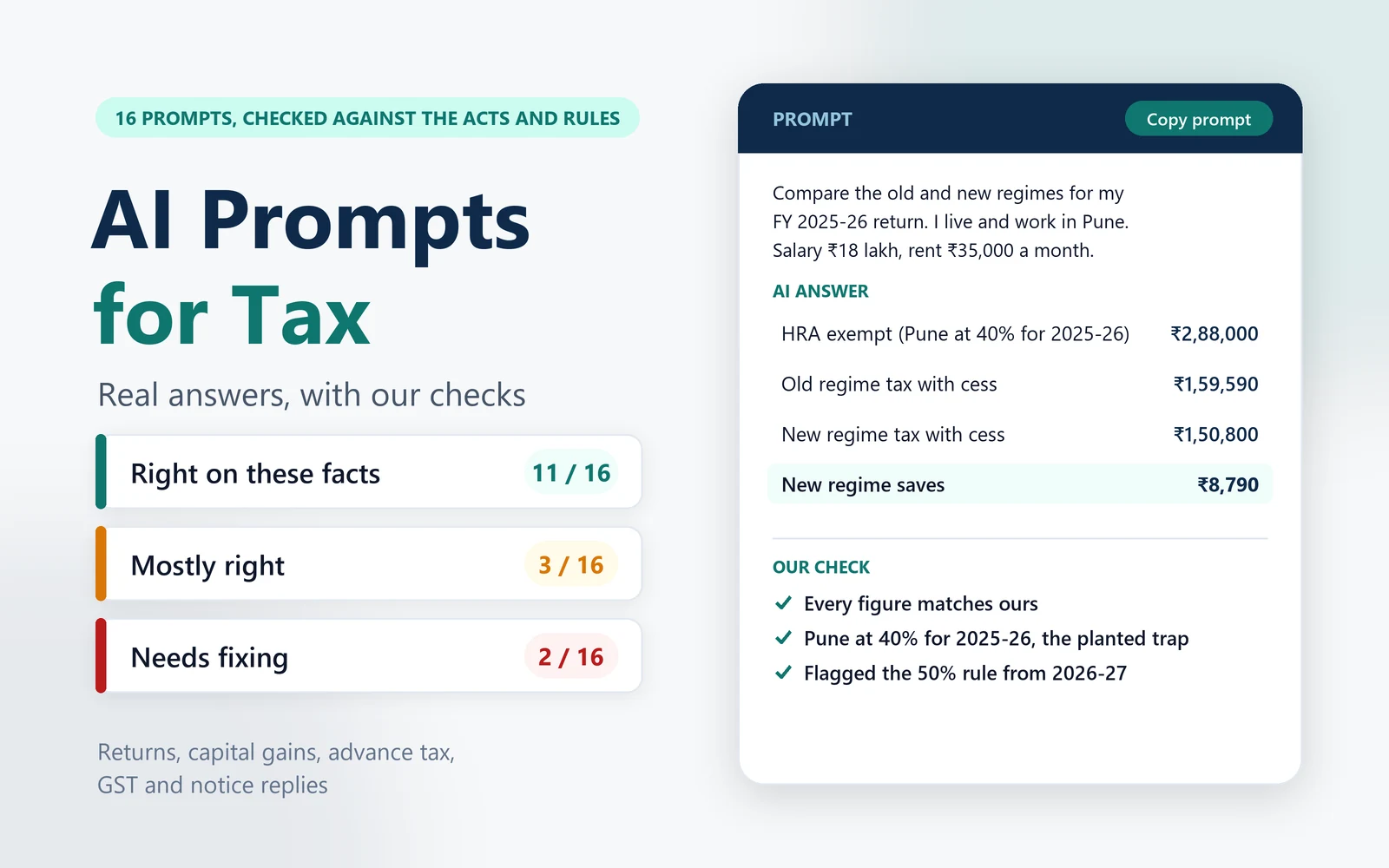
These AI prompts for tax cover the questions Indian taxpayers and practitioners ask most: which ITR form to file, old or new regime, capital gains on shares, mutual funds and property, residential status, gifts, crypto, the AIS, HRA and advance tax under the Income-tax Act, 2025, the presumptive scheme, GST place of supply, input tax credit, e-invoicing, and replies to GST and income tax notices. Each card has the prompt with its facts, the answer Claude Opus 5.5 gave, and our check.
How we tested
- Model: Claude Opus 5.5, in a fresh session for every prompt, with no web search or client documents. Each run received only its prompt. The excerpts below are the original answers, not corrected versions.
- Cases: fictional taxpayers and the same fictional company as our AI prompts for accounting, Acme Traders in Pune. We planted the rules that changed recently: two house properties in ITR-1 for AY 2026-27, the eight-city HRA list from tax year 2026-27, the ₹50,000-a-month rent threshold, the 30-day e-invoice limit and the 14% employer NPS limit in the new regime.
- Check: we recomputed the numerical examples and checked the relevant provisions, notifications and portal guidance. Where the facts do not settle the answer, our check states the missing evidence or assumption. Government sources are linked at the end.
- Dates: answers tested on 28 September 2026; editorial checks reviewed on 2 October 2026. No new model runs were added during that review.
AI prompts for tax: the scorecard
Our review rates 11 answers Right, 3 Mostly right and 2 Needs fixing. The regime comparison and capital-gains examples held up, but the GST credit and notice answers made conclusions the supplied facts did not support. The AIS answer also needed evidence rather than an assumed explanation.
What the labels mean: Right means correct on this fictional case’s stated facts and disclosed assumptions. Mostly right means a useful answer with a qualification or citation to fix. Needs fixing means a material rule or conclusion must change before use. This small sample is not an accuracy rate for tax work or a comparison with other models.
| # | Prompt | Result | What to watch |
|---|---|---|---|
| 1 | Pick the right ITR form for five people | Mostly right | Meera: two house properties are now allowed in ITR-1 |
| 2 | Old or new regime, with HRA, for a Pune employee | Right | Nothing; right first time |
| 3 | Capital gains on shares and mutual funds | Right | Nothing; right first time |
| 4 | Sale of a flat bought in 2012, with the indexation option | Right | Nothing; right first time |
| 5 | Residential status of an NRI who spent 140 days in India | Right | Nothing; it corrected our own key |
| 6 | Which gifts are taxable | Right | Nothing; right first time |
| 7 | Tax on crypto gains and losses | Right | Nothing; right first time |
| 8 | Check the AIS before filing | Mostly right | Verify the FD gap and use current ITR-1 eligibility |
| 9 | HRA exemption for tax year 2026-27 in Pune | Mostly right | The citation: section 11 and Schedule III, not section 19 |
| 10 | Advance tax due by 15 December 2026 | Right | Nothing; right first time |
| 11 | Can they use the presumptive scheme? | Right | Nothing; right first time |
| 12 | Place of supply: IGST or CGST and SGST | Right | Hotel result assumes accommodation resale, not a booking fee |
| 13 | Input tax credit checks before claiming | Needs fixing | Cancellation, rule 37A timing and interest need further facts |
| 14 | E-invoice and e-way bill: which documents need them | Right | GST-inclusive value, earlier turnover and timely IRN generation |
| 15 | Reply to a GST scrutiny notice (ASMT-10) | Needs fixing | No blanket penalty waiver; verify the notice’s actual deadline |
| 16 | Respond to an income tax intimation proposing changes | Right | Nothing; right first time |
How to write AI prompts for tax
Every prompt on this page has the same five parts. Keep them and you can write your own AI prompts for taxes on any return, planning question or notice.
- The year and the Act. “Financial year 2025-26 (assessment year 2026-27), Income-tax Act, 1961” or “tax year 2026-27, Income-tax Act, 2025”. Returns being filed now and planning for this year sit under different Acts.
- The taxpayer. Resident or not, age, city, regime, and the sources of income. Residence, city and regime each change the answer.
- The figures and the dates. Purchase and sale dates, amounts, what was paid when. Holding periods, interest and time limits all run from dates.
- The rule if it changed recently. A threshold, a rate or a list that changed this year. The model may not know it, as our results show.
- The output. The working, the section relied on, the schedule of the return, the draft reply. Ask for the working so you can check it in minutes.
For the accounting side, such as TDS, GST reconciliation and the month-end close, see our AI prompts for accounting.
AI prompts for your tax return (AY 2026-27)
Returns for financial year 2025-26 are filed under the Income-tax Act, 1961. A good AI prompt for a tax return names that year and Act, the taxpayer’s residence and regime, and every figure with its date.
1. Pick the right ITR form for five people
Use it for: choosing the ITR form for each client before filing starts.
I am a tax practitioner in Pune. Tell me which ITR form each of these clients should file for assessment year 2026-27 (financial year 2025-26), and give the one-line reason. All are resident individuals.

1. Meera: salary of ₹14 lakh, one let-out flat and one self-occupied flat, savings bank interest of ₹22,000.
2. Arjun: salary of ₹22 lakh, and long-term capital gains of ₹1,10,000 on listed shares (section 112A). No other capital gains.
3. Sana: salary of ₹16 lakh. Her employer is the Indian subsidiary of a US company, and her restricted stock units vested into a US brokerage account in 2025. She has sold nothing.
4. Kabir: freelance designer declaring income under section 44ADA on receipts of ₹42 lakh. He is also a director of a small private company that pays him nothing.
5. Ramesh, aged 67: pension of ₹6 lakh, fixed deposit interest of ₹3.4 lakh, and agricultural income of ₹12,000 from his village land.
| # | Client | ITR form | One-line reason |
|---|---|---|---|
| 1 | Meera | ITR-2 | She has two house properties (one let-out, one self-occupied), ITR-1 allows only one, and with no business income ITR-2 is the right form. |
| 2 | Arjun | ITR-1 | His section 112A LTCG of ₹1,10,000 is within the ₹1.25 lakh ceiling that ITR-1 has accepted since AY 2025-26 […] |
| 4 | Kabir | ITR-3 | A director of a company at any time during the year cannot use ITR-4 (paid or unpaid) […] |
- ✗ Meera’s eligibility explanation is out of date. For AY 2026-27, CBDT Notification 45/2026 allows up to two house properties in ITR-1. She can use it if she is resident and ordinarily resident, her total income is within ₹50 lakh and she meets the other conditions. Two properties alone no longer require ITR-2.
- ✓ The other four are right: Arjun ITR-1 (section 112A gain within ₹1.25 lakh), Sana ITR-2 (vested foreign RSUs need Schedule FA), Kabir ITR-3 (a director cannot use ITR-4) and Ramesh ITR-2 (agricultural income above ₹5,000).
- ✓ Its checklist is useful: the calendar-year basis of Schedule FA, and the conditions that would still push Arjun to ITR-2.
Prompt tip: Paste this year’s eligibility rules for ITR-1 and ITR-4 into the prompt. The forms change every year, and the model may not have seen this year’s notification. See our ITR forms guide.
2. Old or new regime, with HRA, for a Pune employee
Use it for: the old versus new regime decision, with HRA, for a salaried return.
Compare the old and new tax regimes for my return for financial year 2025-26 (assessment year 2026-27) and tell me which is better, showing the working.

- I am 34, a resident, and I live and work in Pune.
- Salary for the year: basic ₹7,20,000, HRA ₹3,60,000, special allowance ₹7,20,000 (total ₹18,00,000). No other income.
- Rent paid: ₹35,000 a month for the whole year.
- Professional tax deducted: ₹2,500.
- Investments and payments: ₹1,50,000 in PPF and ELSS; health insurance ₹25,000 for myself and ₹50,000 for my parents, who are both over 60; ₹50,000 in my own NPS account (section 80CCD(1B)); ₹48,000 of interest on my education loan.

Round the tax to the nearest ₹10 and include the 4% cess.
For HRA, “salary” means basic plus DA […] Pune is not one of the four metros (Delhi, Mumbai, Kolkata, Chennai), so the 40% limit applies, not 50%.
| Old regime (₹) | New regime (₹) | |
|---|---|---|
| Total income | 11,36,500 | 17,25,000 |
| Tax payable | 1,59,590 | 1,50,800 |
| Saving with the new regime | 8,790 |
[…] the draft rules under the new Income-tax Act, 2025 (in force from FY 2026-27) proposed adding Pune to the 50% HRA list.
- ✓ Every figure matches ours: HRA exemption ₹2,88,000, old-regime tax ₹1,59,590, new-regime tax ₹1,50,800, a saving of ₹8,790.
- ✓ It got the planted trap right: for 2025-26 Pune is still at 40%. At 50% the old regime would have looked cheaper (₹1,40,870), the wrong conclusion.
- ✓ It knew Pune was proposed for the 50% list from tax year 2026-27 and flagged that the answer could flip next year. The final Income-tax Rules, 2026 do include Pune (see prompt 9).
Prompt tip: Name the city and the year. HRA and the regime comparison turn on both, and the city list changed from tax year 2026-27. Compare regimes on your own figures with our old vs new regime calculator.
3. Capital gains on shares and mutual funds
Use it for: capital gains tax on shares and mutual funds, with the schedules of ITR-2.
Work out my capital gains tax for financial year 2025-26 (assessment year 2026-27). I am a resident individual with a salary of ₹25 lakh, so my other income is taxed at 30%. All shares are listed, and STT was paid on every purchase and sale.

1. 500 shares of X Ltd bought on 10-01-2017 at ₹400 each and sold on 15-10-2025 at ₹1,050 each. The highest price on 31-01-2018 was ₹620.
2. Shares of Y Ltd bought on 01-06-2025 for ₹2,55,000 and sold on 20-12-2025 for ₹3,00,000.
3. Units of a debt mutual fund (it invests over 65% in debt) bought on 15-06-2023 for ₹5,00,000 and redeemed on 10-02-2026 for ₹5,60,000.
4. Units of an equity mutual fund bought on 05-03-2024 for ₹3,00,000 and redeemed on 20-03-2026 for ₹4,10,000.

Show the gain and the tax on each item, the total tax with 4% cess, and which schedule of the return each goes in. Ignore surcharge.
- Cost per share is the higher of (a) the actual cost of ₹400 and (b) the lower of the FMV on 31-01-2018 […] and the sale price (₹1,050). That is the higher of ₹400 and ₹620, so ₹620
[…] A fund that invests more than 65% in debt is a “specified mutual fund”, and you bought the units on or after 1 April 2023. So section 50AA treats the gain as short-term no matter how long you held the units.
Total tax: ₹52,000 + health and education cess at 4% (₹2,080) = ₹54,080.
- ✓ The total matches ours, ₹54,080, and so does each item: grandfathered cost of ₹620, the 20% rate on the short-term gain, and 12.5% on section 112A gains above one ₹1.25 lakh exemption.
- ✓ Section 50AA applies to the specified debt fund in this example, acquired on or after 1 April 2023. For AY 2026-27, check the statutory specified-mutual-fund definition, including the more-than-65% debt and money-market test; do not apply this result to every fund described as a debt fund.
- ✓ It mapped each item to its schedule in ITR-2, including the quarter-wise table that drives advance tax interest.
Prompt tip: Give purchase and sale dates for every item. The rate, the holding period and the section 50AA test all run from dates. Check your own figures with our capital gains tax calculator.
4. Sale of a flat bought in 2012, with the indexation option
Use it for: a property sale eligible for the protected old-law tax comparison, with the section 54 exemption.
I am a resident individual. I sold a flat in August 2025 (financial year 2025-26) and bought a new one. Work out the capital gains tax and tell me the best way to report it.

- Bought in May 2012 (financial year 2012-13) for ₹40,00,000.
- New kitchen and flooring in financial year 2016-17: ₹5,00,000.
- Sold in August 2025 for ₹1,20,00,000; brokerage on the sale ₹1,20,000.
- Bought a new flat in March 2026 for ₹60,00,000, in my own name, in India.
- Cost Inflation Index: 2012-13 = 200, 2016-17 = 264, 2025-26 = 376.

Show both ways of computing the tax that the law allows for this sale, the exemption, and the final tax with 4% cess.
You are a resident individual and you bought the flat before 23 July 2024, so the law lets you pay the lower of two amounts: tax at 12.5% without indexation, or tax at 20% with indexation. With indexation your gain is ₹36,47,879. The ₹60 lakh new flat covers all of it under section 54, so the tax is zero. Without indexation you would owe ₹1,79,400.
- ✓ Both computations match ours with the official cost inflation index (200, 264 and 376): ₹73,80,000 without indexation and ₹36,47,879 with it.
- ✓ For this resident individual’s land or building acquired before 23 July 2024, the section 112 protection caps the tax by comparison with the old law. With the stated section 54 purchase, that comparison gives nil against ₹1,79,400. This is not a general right to index every asset or carry forward an indexed loss.
- ✓ It added the checks a practitioner would: stamp duty value under section 50C, the three-year lock-in on the new flat, and TDS under section 194-IA.
Prompt tip: Give the index values in the prompt. The model knew the method, but the figures for the latest year are the part it is most likely to misremember.
5. Residential status of an NRI who spent 140 days in India
Use it for: residential status for an Indian citizen working abroad who visits India.
Work out my residential status for financial year 2025-26 (assessment year 2026-27) and what that means for my Dubai salary.

- I am an Indian citizen. I have worked in Dubai since 2019. The UAE does not tax my salary.
- In financial year 2025-26 I was in India for 140 days in total, on visits.
- In the four years before that I was in India for 410 days in total.
- My Indian income in 2025-26: rent ₹9,00,000, fixed deposit interest ₹4,20,000 and capital gains on Indian shares ₹3,00,000.
- My Dubai salary is about ₹60 lakh a year, received in Dubai.
Step 3: Your Indian income. The test uses total income as computed under the Act and leaves out income from foreign sources. So your Dubai salary is excluded, and rent counts after the 30% standard deduction.
| Item | ₹ |
|---|---|
| Indian income for the ₹15 lakh test | 13,50,000 |
Your gross receipts add up to ₹16.2 lakh, so this is easy to get wrong. On the correct figure you are under ₹15 lakh. The 182-day threshold therefore applies, and 140 days does not meet it.
- ✓ It was right and our answer key was wrong. We had tested the ₹15 lakh limit on gross receipts of ₹16.2 lakh; the law uses total income, so rent counts after the 30% deduction and the figure is ₹13.5 lakh.
- ✓ At ₹13.5 lakh the 182-day test applies, and 140 days falls short: he is a non-resident, and his Dubai salary is not taxable in India.
- ✓ It flagged what would change the answer: working from India on those days, salary paid into an Indian account, or Indian income crossing ₹15 lakh.
Prompt tip: Give each income item separately, not a total. The ₹15 lakh test is applied to income as computed, and the AI can only compute it from the parts.
6. Which gifts are taxable
Use it for: sorting taxable gifts from exempt ones before filing.
I received these gifts in financial year 2025-26 (assessment year 2026-27). I am a resident individual. Tell me which are taxable, the total taxable amount, and where it goes in my return.

1. ₹2,00,000 from my mother's brother.
2. ₹75,000 from a college friend in June 2025.
3. ₹40,000 from another friend in December 2025.
4. ₹60,000 from my first cousin (my father's brother's son).
5. ₹3,50,000 in cash from friends and relatives at my wedding in February 2026.
6. A gold chain worth ₹80,000 from my husband's sister.
7. Listed shares worth ₹45,000 from a friend.
| # | Gift | Taxable? | Why |
|---|---|---|---|
| 4 | ₹60,000 from your first cousin | Yes, ₹60,000 | Cousins are not “relatives” under the Act. Your father’s brother is; his son is not. |
| 7 | Listed shares worth ₹45,000 from a friend | No | Shares count as “property”. Property received from non-relatives is taxed only if its total value for the year exceeds ₹50,000, and ₹45,000 does not. |
[…] When that happens, the whole amount is taxed, not just the part above ₹50,000.
- ✓ The total matches ours, ₹1,75,000, with the whole amount taxable once it passes ₹50,000, not just the excess.
- ✓ It avoided both planted traps: a cousin is not a relative under section 56(2)(x), and shares are tested separately from money.
- ✓ It added a point we had not asked: accepting ₹2 lakh or more in cash from one person breaks section 269ST even when the gift is tax-free.
Prompt tip: Say who gave each gift and whether it was money or property. Both decide the answer under section 56(2)(x).
7. Tax on crypto gains and losses
Use it for: tax on crypto and NFT gains and losses, with the TDS to expect.
I traded crypto on an Indian exchange in financial year 2025-26 (assessment year 2026-27). Work out my tax.

- Bitcoin: bought for ₹3,60,000, sold for ₹6,00,000.
- Ether: bought for ₹2,10,000, sold for ₹1,20,000.
- An NFT: bought for ₹25,000, sold for ₹40,000.
- The exchange charged me ₹2,000 in trading fees during the year.
- The exchange deducted 1% TDS on every sale.

Can I set the Ether loss against the gains, or carry it forward? Can I deduct the fees? How much TDS should I see in Form 26AS, and what is my tax with 4% cess? My other income is salary, taxed at 30%.
- A loss on one VDA cannot be set off against a gain on another VDA or against any other income, and it cannot be carried forward.
| Tax | ₹ |
|---|---|
| Tax at 30% on ₹2,55,000 | 76,500 |
| Health and education cess at 4% | 3,060 |
| Tax on crypto and NFT | 79,560 |
| Less: TDS under section 194S | (7,600) |
- ✓ The tax matches ours, ₹79,560, with the Ether loss ignored as section 115BBH requires.
- ✓ Fees are not deductible, and the TDS is 1% of every sale including the loss-making one: ₹7,600.
- ✓ It noted that the 15% surcharge cap for certain gains does not cover crypto income.
Prompt tip: List every sale, including the losses. The AI needs them for the TDS figure and for Schedule VDA, even though the losses give no relief.
8. Check the AIS before filing
Use it for: reconciling the AIS with your own records before filing.
Before I file my return for financial year 2025-26 (assessment year 2026-27), help me reconcile my Annual Information Statement (AIS) with my own records. I am a salaried resident under the new regime.

AIS shows:
| Item | Source | Amount (₹) | TDS (₹) |
|---|---|---|---|
| Savings bank interest | Bank A | 18,400 | 0 |
| Fixed deposit interest | Bank A | 82,000 | 8,200 |
| Fixed deposit interest | Bank B | 12,300 | 0 |
| Dividend | Z Ltd | 12,500 | 0 |
| Sale of mutual fund units | Fund house | 3,45,000 | 0 |
| Rent received | Tenant company | 3,60,000 | 0 |

My records: interest credited by Bank A on my fixed deposits was ₹76,500 (one deposit is cumulative and pays at maturity in 2027). I did not know about the Bank B deposit; it is a small one my father opened in my name with my PAN. The mutual fund units cost me ₹3,05,000 two years ago (an equity fund). The flat I let out is in my name.

Tell me what to report under each head, what to do about the differences, and whether I should give feedback on the AIS.
Short answer: all six AIS lines are real transactions on your PAN, so none of them needs AIS feedback. Neither gap is an error. The Bank A gap is interest that built up on your cumulative deposit, and the Bank B deposit is legally yours.
| Accrual basis (recommended) | Cash basis | |
|---|---|---|
| Interest to report this year | ₹82,000 | ₹76,500 |
| TDS to claim this year | ₹8,200 | ₹7,650, carrying ₹550 forward |
- ✓ It separates mutual fund sale proceeds from the ₹40,000 gain and computes ₹2,52,000 rental income with no municipal tax or loan interest. It also flags that ₹12,500 of dividends would normally attract ₹1,250 TDS, rather than calling nil TDS correct.
- ✗ The FD gap needs Bank A’s certificate, gross-versus-net reconciliation and the taxpayer’s established accounting method. AIS alone does not prove all ₹82,000 belongs in this year’s return, and the example’s TDS allocation is not a universal formula. Match credit to the year the related income is assessed under rule 37BA.
- ✗ The full answer repeats the old one-house-property ITR-1 condition. AY 2026-27 allows up to two, subject to the other eligibility rules. Submit AIS feedback only after confirming an actual reporting error; do not deny a genuine deposit just because it was unfamiliar.
Prompt tip: Paste AIS, Form 26AS, bank certificates and your ledger side by side, using redacted data. State the accounting method and ask it to list unresolved differences rather than guess their cause.
Tax planning prompts for tax year 2026-27 (Income-tax Act, 2025)
Tax year 2026-27 is the first under the Income-tax Act, 2025, with new section and rule numbers. These prompts test whether the AI knows the new law, not just the old one.
9. HRA exemption for tax year 2026-27 in Pune
Use it for: the HRA exemption to declare to your employer for tax year 2026-27.
I am declaring my rent to my employer for tax year 2026-27 (financial year 2026-27) and I will stay in the old regime. I live and work in Pune.

- Basic salary: ₹60,000 a month. No dearness allowance or commission.
- HRA received: ₹30,000 a month.
- Rent paid: ₹35,000 a month for the whole year.

How much HRA is exempt for the year, and under which provision of the Income-tax Act, 2025 and the rules? What documents does my employer need?
| Limit | Working | Amount for the year |
|---|---|---|
| (c) 50% of salary (Pune is now a 50% city) | 50% of ₹7,20,000 | ₹3,60,000 |
| Exempt HRA (lowest of a, b, c) | ₹3,48,000 |
[…] Income-tax Act, 2025, section 19 (deductions from salaries). […] The house rent allowance entry in the Table to section 19 replaces section 10(13A) of the Income-tax Act, 1961.
- ✓ The amount is right: ₹3,48,000, because Pune is on the eight-city 50% list in the Income-tax Rules, 2026. We had planted this as the likely miss, and it passed.
- ✗ The provision is wrong. HRA is exempt under section 11 read with Schedule III (Table serial 11) of the 2025 Act, and the limits are in rule 279. Section 19 is the standard deduction and other deductions from salary.
- ✓ The documents list is right: landlord’s PAN because rent exceeds ₹1 lakh a year, rent receipts, and the old-regime choice made with the employer.
Prompt tip: If you need the section or rule number, give it or ask the AI to say when it is unsure. It knew the rule, but not where it now sits in the new Act. Work out your figure with our HRA exemption calculator.
10. Advance tax due by 15 December 2026
Use it for: the advance tax to pay by the next instalment date, with the interest already running.
How much advance tax must each of these two people pay by 15 December 2026 for tax year 2026-27, under the Income-tax Act, 2025? Show any interest already running for missed instalments.

1. Anita is salaried. After her employer's TDS, she expects to owe ₹1,50,000 more for the year, from rent and interest. She paid nothing by 15 June and ₹30,000 on 15 September.
2. Vikram is a consultant who declares 50% of his receipts as income under the presumptive scheme for professionals. He expects tax of ₹90,000 for the year and has paid nothing so far.
| Pay by 15 December 2026 | Interest already locked in | |
|---|---|---|
| Anita | ₹82,500 | ₹1,800 |
| Vikram | Nil (all ₹90,000 is due by 15 March 2027) | Nil |
[…] Section 425 (old 234C) charges simple interest of 1% a month on any shortfall. A June, September or December shortfall is charged for a flat 3 months […]
[…] A professional under the presumptive scheme (section 58 of the 2025 Act, which absorbs old section 44ADA) pays the whole year’s advance tax in one instalment by 15 March 2027.
- ✓ Anita’s figures match ours: ₹82,500 by 15 December, and ₹675 plus ₹1,125 of interest already fixed for June and September.
- ✓ It caught the presumptive trap: Vikram pays nothing on 15 December, because presumptive taxpayers pay in one instalment by 15 March (section 408(2)).
- ✓ It used the right sections of the 2025 Act (408, 425 and 424) and suggested extra salary TDS as a cheaper way to catch up.
Prompt tip: Name the Act and say whether the person uses the presumptive scheme. It changes the instalment dates completely. Plan the instalments with our advance tax estimator.
11. Can they use the presumptive scheme?
Use it for: checking who can use the presumptive scheme, and what follows for those who cannot.
For tax year 2026-27 under the Income-tax Act, 2025, can each of these use the presumptive scheme, and what income must they declare?

1. Neha, an architect. Expected gross receipts ₹68 lakh; 2% of it will be received in cash, the rest by bank transfer.
2. Karan, a wholesale trader. Expected turnover ₹2.6 crore; 8% will be received in cash.
3. An LLP of two consultants with receipts of ₹40 lakh.

Also tell me about books of account, tax audit and the ITR form for anyone who cannot use it.
Under the Income-tax Act, 2025, the presumptive schemes for residents are in section 58 (formerly 44AD for business and 44ADA for professions). Books of account are in section 62 (formerly 44AA) and tax audit is in section 63 (formerly 44AB).
| Neha (architect) | Karan (wholesale trader) | Consultants’ LLP | |
|---|---|---|---|
| Presumptive scheme | Yes | No | No |
| Why | ₹68 lakh is within the ₹75 lakh limit because cash is only 2% | ₹2.6 crore is over ₹2 crore, and 8% cash rules out the ₹3 crore limit | LLPs are excluded |
- ✓ All three are right: Neha within the ₹75 lakh limit, Karan over the ₹2 crore limit because his cash exceeds 5%, and the LLP excluded.
- ✓ The new Act’s numbering is right this time: sections 58, 62 and 63, which we checked in the amended Act.
- ✓ It knew a recent change: from tax year 2026-27, non-audit business and professional returns are due on 31 August, not 31 July.
Prompt tip: Give the share of receipts in cash. The limits for both schemes turn on the 5% cash test. Check the figures with our 44ADA and 44AD calculator.
GST prompts: place of supply, input tax credit and e-invoicing
GST questions turn on precise facts: who the recipient is, where the goods go, when the invoice was issued and paid. Put all of them in the prompt.
12. Place of supply: IGST or CGST and SGST
Use it for: deciding the place of supply and the tax type before raising an invoice.
I am the accountant of Acme Traders Private Limited, a distributor of office supplies in Pune, Maharashtra, registered for GST in Maharashtra. For each supply below, tell me the place of supply, whether we charge IGST or CGST plus SGST, and the section of the IGST Act you rely on.

1. We sell goods to a registered dealer in Bengaluru, Karnataka, who asks us to deliver them directly to his customer in Surat, Gujarat.
2. We run a two-day Excel training course in Pune for an individual from Delhi who is not registered for GST.
3. We sell tickets to a seminar we are organising in Goa to a company registered in Karnataka.
4. We provide consultancy to a company registered in Delhi, delivered online.
5. We book and bill hotel accommodation in Mumbai for our Karnataka client's staff.
| # | Supply | Place of supply (state code) | Tax | IGST Act section |
|---|---|---|---|---|
| 1 | Goods billed to the Bengaluru dealer and delivered to his customer in Surat | Karnataka (29) | IGST | 10(1)(b), read with 7(1)(a) |
| 2 | Excel training in Pune for an unregistered individual from Delhi | Maharashtra (27) | CGST + SGST | 12(5)(b), read with 8(2) |
| 3 | Tickets to your Goa seminar sold to a Karnataka-registered company | Goa (30) | IGST | 12(6), read with 7(3)(a) |
- ✓ The bill-to-ship-to sale, training, seminar admission and online consultancy follow the relevant place-of-supply rules on these facts.
- ✓ It separated admission to an event (section 12(6)) from organising one (section 12(7)), the classic confusion.
- ✓ The hotel result assumes Acme supplies the accommodation itself. If it only earns a booking fee or commission, classify that service separately. An exact-cost reimbursement is not automatically a pure-agent exclusion: all rule 33 conditions must be met.
Prompt tip: Say what you actually supply, where the goods go, who directs delivery and which GSTIN receives the service. For a hotel booking, distinguish accommodation resale from an agency fee.
13. Input tax credit checks before claiming
Use it for: checking input tax credit before you file GSTR-3B.
I am the accountant of Acme Traders Private Limited, a distributor of office supplies in Pune, Maharashtra, registered for GST in Maharashtra. Before we file GSTR-3B for September 2026, tell me whether we can claim, must reverse, or have lost the input tax credit on each of these, with the provision you rely on.

1. Invoice dated 18-03-2026, GST ₹18,000. The supplier filed its GSTR-1 late, so it appeared in our GSTR-2B for May 2026, and we have not claimed it yet.
2. Invoice dated 15-10-2025, GST ₹36,000, claimed in October 2025. We have still not paid the supplier.
3. Invoice dated 20-01-2026, GST ₹9,000. In August 2026 the supplier's registration was cancelled with effect from 01-12-2025.
4. Invoice dated 25-03-2025, GST ₹8,500, found in a drawer this month. Never claimed.
5. Debit note dated 10-04-2026, GST ₹4,200, for a price increase on a March 2026 invoice. It is in our GSTR-2B for April 2026, not yet claimed.
| # | Document | Verdict | Provision relied on | In the September 2026 GSTR-3B |
|---|---|---|---|---|
| 1 | Invoice 18-03-2026, ₹18,000 | Can claim. Last date 30-11-2026 | Sec. 16(4); sec. 16(2)(aa) with rule 36(4) | Add ₹18,000 in Table 4(A)(5) |
| 2 | Invoice 15-10-2025, ₹36,000 | Must reverse, with interest. Re-claim once you pay | 2nd and 3rd provisos to sec. 16(2); rule 37; sec. 50(3) with rule 88B | Reverse ₹36,000 in Table 4(B)(2); interest in Table 5.1 |
| 3 | Invoice 20-01-2026, ₹9,000 | Must reverse if claimed; do not claim if not | Sec. 16(2)(a) and (c); sec. 29(2); sec. 41(2) with rule 37A | Reverse ₹9,000 in Table 4(B)(2) |
| 4 | Invoice 25-03-2025, ₹8,500 | Lost. Time-barred since 30-11-2025 | Sec. 16(4) | Nothing. Book it as cost |
| 5 | Debit note 10-04-2026, ₹4,200 | Can claim. Last date 30-11-2027 | Sec. 16(4) as amended from 01-01-2021; sec. 16(2)(aa); rule 36(1)(c) | Add ₹4,200 in Table 4(A)(5) |
- ✓ The ordinary section 16(4) limits are correctly identified: 30 November 2026 for the March 2026 invoice and 30 November 2027 for the April 2026 debit note, or the relevant annual return if earlier. The March 2025 invoice is outside its ordinary window. Other eligibility conditions still apply.
- ✓ The unpaid invoice needs the 180-day rule 37 check, proportionate reversal where part remains unpaid and re-availment after payment. Calculate any interest from the actual facts and credit ledger; the prompt does not establish a fixed interest period.
- ✗ Retroactive supplier cancellation is not enough for the answer’s automatic verdict. Verify the genuine supply, receipt, payment, registration history and applicable section 16 conditions, and obtain advice if the claim is disputed. Appearance in GSTR-2B alone is not proof of entitlement either.
- ✗ Rule 37A addresses specified supplier GSTR-3B non-filing, not cancellation by itself. Its September/November tests run from the financial year in which credit was availed. The prompt does not say whether or when this ₹9,000 was availed, so it cannot establish an automatic September 2026 reversal under that rule.
Prompt tip: Give invoice and debit-note dates, GSTR-2B month, ITC-availment date, supplier return status, proof of receipt and payment. Separate the 180-day test, supplier non-filing and cancellation instead of treating them as one rule.
14. E-invoice and e-way bill: which documents need them
Use it for: checking which documents need an e-invoice and which need an e-way bill.
I am the accountant of Acme Traders Private Limited, a distributor of office supplies in Pune, Maharashtra, registered for GST in Maharashtra. Our aggregate turnover was ₹6.2 crore in financial year 2024-25 and ₹7.1 crore in 2025-26. For each document below, tell me whether we need an e-invoice (IRN) and whether we need an e-way bill, and whether a 30-day limit applies to reporting e-invoices.

1. A tax invoice of ₹30,000 to a registered customer in Mumbai, goods collected by the customer.
2. A tax invoice of ₹40,000 to an unregistered walk-in customer at our Pune shop, who takes the goods away.
3. An export invoice of ₹4,50,000, goods shipped from Mumbai port.
4. A credit note of ₹12,000 to a registered customer in Nashik.
5. A tax invoice of ₹48,000 to a registered customer in Surat, Gujarat, sent by our own van.
30-day limit. The IRP rejects documents dated more than 30 days before the date of upload, but only for taxpayers with AATO of ₹10 crore or more (since 1 April 2025; it applied to ₹100 crore and above from 1 November 2023).
| # | Document | E-invoice (IRN) | E-way bill | 30-day limit applies? |
|---|---|---|---|---|
| 5 | ₹48,000 invoice, registered customer, Surat, own van | Yes | No if ₹48,000 is the total including IGST; Yes if ₹48,000 is the value before tax | No |
- ✓ Every document is right: e-invoices for B2B invoices, exports and B2B credit notes, none for the B2C sale.
- ✓ The 30-day reporting block applies from 1 April 2025 to the ₹10 crore-and-above AATO category. Acme is below it on the turnover history provided; check earlier PAN-wide years and the portal’s category before relying on that conclusion.
- ✓ It was more careful than our key on the Surat invoice: the e-way bill limit counts the value including GST, so the answer depends on what the ₹48,000 includes.
Prompt tip: Give invoice values with and without GST, and the complete turnover history. No 30-day block does not permit a late IRN: issue a compliant invoice and obtain the IRN before dispatch where required.
Prompts to reply to tax notices
A notice reply needs the facts, the reconciliation and the deadline. These prompts ask the AI to separate what to accept from what to dispute.
15. Reply to a GST scrutiny notice (ASMT-10)
Use it for: replying to a GST scrutiny notice, with the payment and the draft reply.
I am the accountant of Acme Traders Private Limited, a distributor of office supplies in Pune, Maharashtra, registered for GST in Maharashtra. We received an ASMT-10 notice dated 10-09-2026 for financial year 2023-24. It says the taxable value in our GSTR-1 is ₹8,40,000 higher than in our GSTR-3B, with tax of ₹1,51,200, and asks us to explain or pay.

Our reconciliation:
- ₹5,90,000: duplicate entries of four invoices uploaded twice in GSTR-1 for March 2024. We deleted them through amendments (Table 9A) in GSTR-1 for May 2024.
- ₹2,50,000: invoice AT/2231 dated 18-01-2024 (IGST 18%, ₹45,000) was reported in GSTR-1 but left out of GSTR-3B for January 2024 by mistake.

Draft our reply for Form ASMT-11, tell me what to pay and how, with the interest worked out to 30-09-2026, and the deadline for replying.
- Pay ₹66,149 in IGST (tax ₹45,000 + interest ₹21,149) through Form GST DRC-03 on 30-09-2026. This covers invoice AT/2231 only.
- Pay nothing on the ₹5,90,000 (tax ₹1,06,200). Those were duplicate uploads with no supply behind them, and you have already reversed them in GSTR-1.
- File the ASMT-11 reply within 30 days of service of the notice.
- ✓ It separates the duplicate uploads from the missed invoice. Prove the duplicates and the later correction with returns and ledgers; do not pay the same supply’s tax twice.
- ✓ The example’s interest is ₹21,149: ₹45,000 × 18% × 953 ÷ 365, counting 21 February 2024 through 30 September 2026. This assumes the ordinary monthly due date, no extension and that the unpaid tax attracts interest for the whole period; reconcile actual payment and credit-ledger facts.
- ✗ The full answer promises no penalty on payment before a show-cause notice. That is too broad: section 73(11) can override the usual relief for delayed self-assessed or collected tax, and section 75(12) may affect recovery. Circular 76/50/2018 is conditional, not a blanket waiver. Have the proposed reply and liability checked before submission.
- ✗ Follow the reply period stated in ASMT-10 and any approved extension. Do not automatically count 30 days from the issue date, or assume issue and service occurred on the same day.
Prompt tip: Give the notice, service date, stated reply deadline, monthly returns, payment dates and ledger reconciliation. Ask for assumptions and separate tax, interest and possible penalties.
16. Respond to an income tax intimation proposing changes
Use it for: responding to an income tax proposal to adjust your return.
I filed my return for financial year 2025-26 (assessment year 2026-27) under the new regime. I received a communication from CPC proposing adjustments under section 143(1)(a) and asking for my response. I am salaried; my basic salary is ₹7,20,000 a year. The proposals are:

1. Add fixed deposit interest of ₹82,000 shown in AIS but not in my return (the bank deducted TDS of ₹8,200).
2. Disallow my deduction of ₹25,000 under section 80D for health insurance.
3. Disallow my deduction of ₹60,000 under section 80CCD(2) for my employer's contribution to NPS, "as deductions are not allowed in the new regime".

Tell me which proposals to accept and which to disagree with, what to write, and the deadline.
| # | Proposed adjustment | Your response | Why |
|---|---|---|---|
| 3 | Disallow ₹60,000 under section 80CCD(2) | Disagree | 80CCD(2) is one of the few deductions the new regime expressly keeps: section 115BAC(2) carves it out. For new-regime taxpayers the limit is 14% of salary (basic plus DA), which on your basic of ₹7,20,000 is ₹1,00,800. |
[…] 30 days from the date the communication was issued (second proviso to section 143(1)(a)), not from the day you opened it.
- ✓ Right on all three: agree to the interest and the 80D disallowance, and disagree on 80CCD(2), which the new regime allows up to 14% of salary.
- ✓ It gave wording ready to paste into the e-proceeding and the deadline, 30 days from the date the communication was issued.
- ✓ It spotted what agreeing does not fix: the ₹8,200 TDS credit, which needs a revised return or a rectification.
Prompt tip: Paste each proposal as CPC worded it. The AI can then answer each one, and draft the text for the portal.
Where the AI went wrong, and what it got right
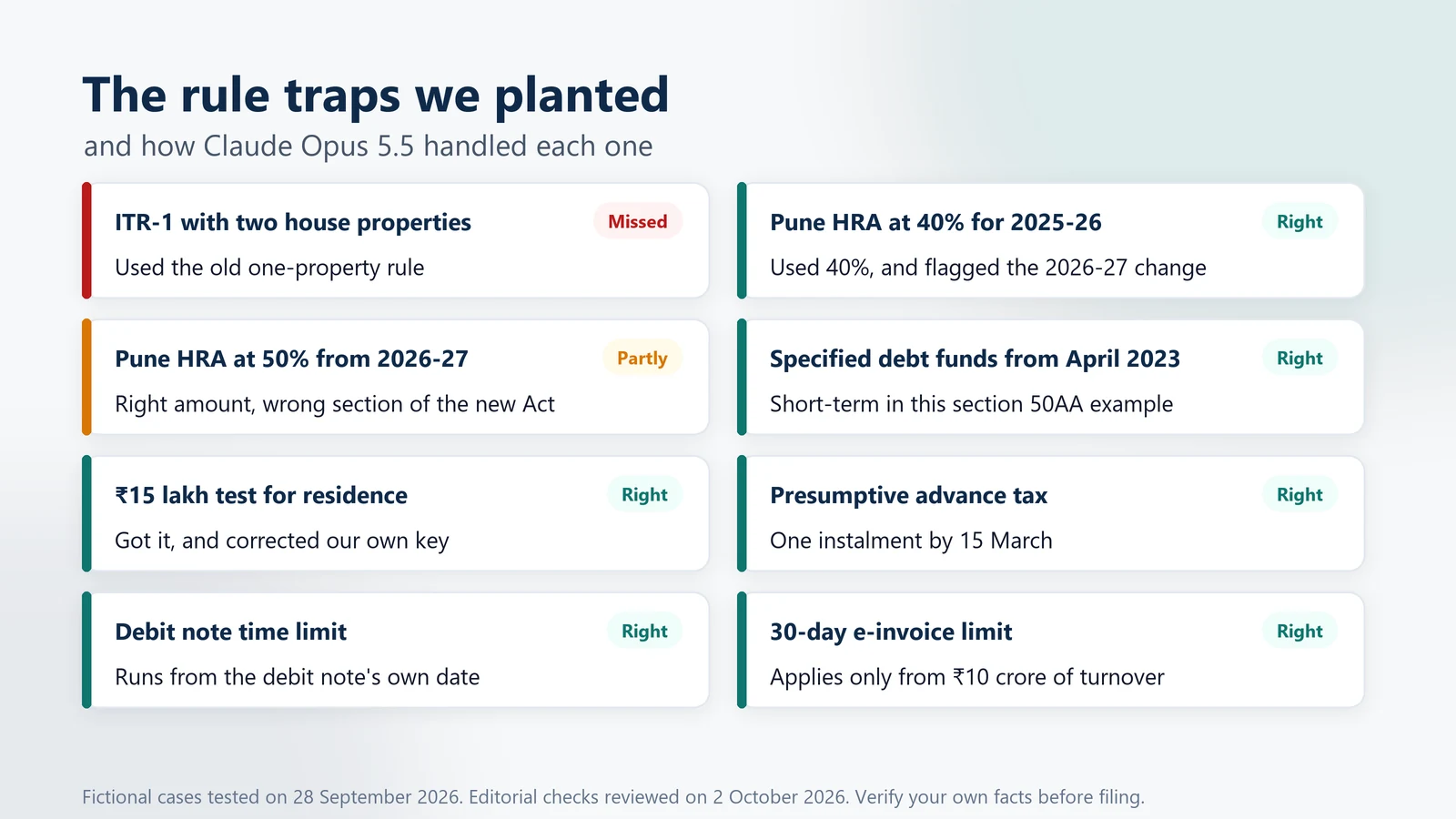
We built most prompts around a rule that changed recently or is easy to get wrong. This is how the AI handled each one.
| Rule we planted | Prompt | What the AI did | Result |
|---|---|---|---|
| ITR-1 now allows two house properties (AY 2026-27) | 1 | Missed it: put a client with two flats in ITR-2 under the old one-property rule | Missed |
| Section 112A gains up to ₹1.25 lakh are allowed in ITR-1 | 1 | Right: kept the shareholder in ITR-1 | Right |
| Pune is still at 40% for HRA in FY 2025-26 | 2 | Right: used 40%, and flagged the change from tax year 2026-27 | Right |
| Specified debt funds acquired on or after 1 April 2023 | 3 | Right for the specified fund in this case: section 50AA treats its gain as short-term | Right |
| Protected tax comparison for resident individuals/HUFs selling land or buildings acquired before 23 July 2024 | 4 | Right for this eligible property: worked both tax computations | Right |
| The ₹15 lakh Indian income test for residence | 5 | Right, and more careful than our key: it tested income as computed, not gross receipts | Right |
| TDS on rent only above ₹50,000 a month from April 2025 | 8 | Right: explained why the AIS shows no TDS on the rent | Right |
| Pune is on the eight-city 50% HRA list from tax year 2026-27 | 9 | Right amount, wrong section of the new Act (section 19, not section 11 with Schedule III) | Partly |
| Presumptive taxpayers pay advance tax in one instalment | 10 | Right: nothing due on 15 December, all of it by 15 March | Right |
| The higher presumptive limits need cash within 5% | 11 | Right for all three, with the new section numbers | Right |
| A debit note’s time limit runs from its own date | 13 | Right: claimable until 30 November 2027 | Right |
| The 30-day e-invoice reporting block applies from ₹10 crore AATO | 14 | Right on the provided turnover history; earlier years and the portal category still need checking | Right |
| Supplier cancellation is not the same as the rule 37A non-filing test | 13 | Too definite: the credit-availment year and supporting evidence are missing | Missed |
| Paying before a GST show-cause notice does not guarantee no penalty | 15 | Too broad: check section 73(11), the tax facts and the notice’s reply period | Missed |
| The 14% employer NPS deduction survives in the new regime | 16 | Right: disputed the proposal to disallow it | Right |
The useful part is the working, not the confident tone. In these examples, the arithmetic was often sound while eligibility, evidence and procedural conclusions still needed checking. Use the same discipline as our accounting examples: supply the facts, read the cited provision, reconcile the source records and have the final return or reply reviewed.
Keep your tax data safe when you use AI
Returns and notices carry PAN, Aadhaar, bank accounts and income details. Do not upload a client’s working papers merely because a tool can read them. Follow your firm’s approved process and the applicable confidentiality and data-protection requirements:
- Minimise and redact. Use fictional figures for learning. For authorised client work, remove names, PAN, Aadhaar, GSTINs, account numbers and identifying context that the task does not need. Replacing a name alone does not make a document anonymous.
- Never paste login details or OTPs into any AI tool, and never let a tool file a return or a reply on your behalf.
- Check the tool and your authority to share. Review retention, model-training and access settings, contractual terms and required permissions. A paid plan or a training opt-out alone is not a confidentiality guarantee. Retain approved prompts and answers only in access-controlled working papers.
- Treat every rate, section and date as a claim to check on the e-filing portal, the GST portal or the notified text before you file or pay.
Please note: we update this page from time to time, but tax laws, rules, forms and AI tools change and there can be a gap between a change and our update. Check the current position on the official portal before you rely on an answer. These AI prompts for tax and the tested answers help you work faster; they are not tax advice, and ReconScribe is not responsible for decisions made on them.
Want your tax work checked or set up with AI?
We help individuals, businesses and tax practices in India with returns, GST and notice replies, and set up AI workflows with the checks that keep them right. Tell us what you need and we will reply with a plan and a quote.
Frequently asked questions
What are the best AI prompts for tax?
The best AI prompts for tax name the year and the Act, describe the taxpayer (residence, age, city and regime), give every figure with its date, state any rule that changed recently, and ask for the working. The sixteen prompts on this page follow that pattern, and each one is tested.
How accurate is AI for Indian tax?
Our review of these 16 fictional cases rates 11 Right, 3 Mostly right and 2 Needs fixing. These are case-specific editorial ratings, not a general accuracy rate. The GST credit and notice answers need material qualifications; other gaps concern AIS evidence, ITR-1 eligibility and an HRA citation. Check law, figures and missing facts independently.
Does AI know the Income-tax Act, 2025?
Partly. It knew the new Act applies from tax year 2026-27 and got most section numbers right: 58 for the presumptive scheme, 62 and 63 for books and audit, and 408, 424 and 425 for advance tax. It cited the wrong section for the HRA exemption. If a section number matters, give it in the prompt or check it in the Act.
What is a good AI prompt for tax return filing?
Start with the regime comparison (prompt 2) and the AIS reconciliation (prompt 8). Reconcile AIS with Form 26AS, certificates and your records: sale proceeds are not the same as taxable gains, and a timing difference needs checking. Add the capital gains prompts if you sold shares, funds or property.
Do these work as ChatGPT prompts for tax professionals?
The prompts are plain text, so you can paste them into ChatGPT, Claude or Gemini. We tested the saved answers on Claude Opus 5.5 only, not the other models. Portability does not mean equal accuracy: check each model's answer against the same facts and official sources.
Can AI reply to a GST or income tax notice?
It can help draft a reply, but it cannot settle your liability from incomplete facts. Our GST example got the interest arithmetic right but went too far on penalty relief. Check the evidence, applicable provisions and the actual notice deadline, then have a qualified person review it before you submit.
Which AI prompts for tax professionals help with GST?
Prompts 12 to 15: place of supply, input tax credit checks before GSTR-3B, e-invoice and e-way bill rules, and a scrutiny notice reply. The credit and notice answers need fixes, while the other examples depend on the stated supply and turnover facts. Include payment, ITC-availment and supplier-return details, not just invoice dates.
Is it safe to share tax data with an AI tool?
Use only tools approved for that client work. Minimise and redact data, check the provider's retention, training and access settings, and confirm that you are authorised to share it. Removing names does not automatically make a document anonymous or lawful to upload. Never share logins or OTPs, and protect retained working papers.
Sources
The test answers are dated 28 September 2026. We reviewed the checks on 2 October 2026 using the following government publications and official portal guidance. Read the provision with its applicable amendments and the facts of your own case.
- Income-tax Act, 1961, as amended by the Finance Act, 2026, for the AY 2026-27 return examples, including capital gains, TDS and notice provisions.
- Income-tax Act, 2025, as amended by the Finance Act, 2026, including sections 6, 11, 58, 156, 202, 404, 408 and 425 and Schedule III (Income Tax Department).
- Income-tax Rules, 2026, including rule 279 on house rent allowance.
- CBDT Notification 45/2026 and the AY 2026-27 ITR-1 eligibility FAQ, including the two-house-property change.
- Income Tax Department: transition between the 1961 and 2025 Acts, explaining which Act governs AY 2026-27 returns.
- Cost Inflation Index and capital-gains guidance (Income Tax Department), including the protected tax comparison for qualifying land and buildings.
- Central Goods and Services Tax Act, 2017, section 16, on input tax credit and its time limit (CBIC).
- Notification 26/2022-Central Tax, inserting rule 37A on specified supplier-return non-filing. Check the financial year in which ITC was availed.
- IGST Act, 2017 (original notified text hosted by the GST Council), particularly sections 10 and 12 for the place-of-supply examples.
- Authorised IRP advisory: 30-day e-invoice reporting limit from 1 April 2025 and GSTN e-invoice overview, on the turnover thresholds and reporting process.
- CBIC Instruction 02/2023-GST, the scrutiny procedure involving ASMT-10, ASMT-11 and ASMT-12.
- CGST Act section 73 and Circular 76/50/2018-GST, on the conditions and exceptions affecting penalty relief.
- Digital Personal Data Protection Act, 2023 (Ministry of Electronics and Information Technology). Its provisions have notified commencement dates; removing identifiers is not by itself a compliance assessment.
Related guides and calculators: AI prompts for finance, ITR forms for AY 2026-27, old vs new regime calculator, capital gains tax calculator, HRA exemption calculator, advance tax estimator and 44ADA and 44AD calculator.