
Your finance team writes the process, the control owner approves it, and Claude only improves the wording. If that SOP later carries a Claude mark, does it become unreliable?
No. But the question exposes a real governance gap. A team that cannot explain which source documents were used, what Claude changed, who checked the facts, and who approved the final version already had a documentation problem. The new Claude AI watermark may simply make that problem easier to see.

Claude AI watermark: the short answer
Anthropic says supported Claude models will place an imperceptible, machine-readable watermark into generated text. Supported files can also receive signed C2PA provenance metadata. The change is designed to support transparency obligations under the EU AI Act, but marks from supported models will apply worldwide.
A detected mark means the content may have been processed by Claude. It does not prove that Claude created every idea, that the document is inaccurate, or that the person presenting it did no work. Equally, no detected mark does not prove that a document is human-written.
What Anthropic has confirmed
- Claude models launched on or after 2 August 2026 support marking at launch.
- Text from supported models carries an embedded watermark.
- Supported generated files can receive signed C2PA provenance metadata.
- Marking applies across Claude products and worldwide where supported.
- Anthropic’s watermark detection is in private preview for eligible organisations under EU law, with wider access planned, and its free Claude Content Checker reads file credentials.
What you should not assume
- Not every older Claude model is necessarily marked today.
- A mark does not identify the original human author.
- A mark does not establish whether the content is true or false.
- An unmarked passage is not proof that AI was never involved.
- A detector result is not a substitute for audit evidence or review.
What exactly is the Claude AI watermark changing?
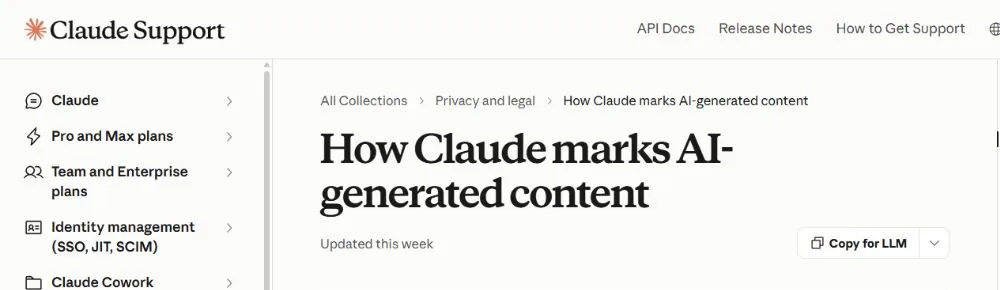
Anthropic has signed the EU AI Act’s Article 50(2) Code of Practice on Transparency of AI-Generated Content. Its official support article describes two complementary methods for marking content generated or processed by Claude.
An embedded watermark in generated text
When a supported model generates text, Anthropic says it weaves an imperceptible watermark into the text at the model level. It is intended to travel when the text is copied and pasted and may remain detectable after some editing. Anthropic has not yet published the full technical mechanism, so teams should not assume it is a simple zero-width character that a basic text cleaner can reliably remove.
The model-level approach matters because it can apply whether the user works through Claude, the API, Claude Code, Claude Cowork, Claude Tag or a supported cloud partner. Anthropic says the supported-model marking is not limited to users located in the European Union.
Signed provenance metadata for supported files
Anthropic also plans to attach signed provenance metadata to supported generated files, with its article listing SVG, PNG and JPG as examples. The metadata follows the C2PA standard and can record that a file was processed by Claude and help identify tampering.
C2PA itself is careful about what that means. Provenance records facts about an asset’s history. It does not make a value judgment that the asset is good, bad, accurate or misleading. A valid credential is therefore useful context, not a truth certificate.
Is every Claude response already watermarked?
No such blanket conclusion should be published yet.
Anthropic says models launched on or after 2 August 2026 support marking at launch. Its summary refers specifically to Claude models launched in the EU on or after that date. Anthropic also says work is underway to add marking support to models released before that date.
The accurate position as of 13 August 2026 is therefore:
- Supported new models are covered at launch.
- Marking for older models is still a transition project.
- Some platforms, features and file types may not support every marking method.
- Anthropic has not yet published the full third-party detection mechanism.
This distinction is important. Headlines saying that every existing Claude answer is already detectable go further than Anthropic’s official wording.
Why is Anthropic introducing the Claude AI watermark?
The immediate policy driver is Article 50 of the EU AI Act. The European Commission says the transparency obligations became applicable on 2 August 2026. Providers of generative AI systems are expected to make generated or manipulated audio, image, video and text detectable in a machine-readable way, as far as technically feasible.
The EU’s voluntary Code of Practice provides a recognised way for signatories to demonstrate compliance. It distinguishes between provider responsibilities for marking and detection and deployer responsibilities for labelling certain public-interest publications and deepfakes.
For an Indian finance team, the legal trigger may be European, but the operational impact is global because Anthropic says supported marks will apply wherever Claude is offered. That does not create a new Indian audit rule by itself. It does mean that Indian teams using Claude should expect provenance signals to appear in documents that move across clients, group companies, regulators and international offices.
The good: why the Claude AI watermark can help
| Benefit | Why it matters |
|---|---|
| Better provenance | A reviewer receives an additional signal that Claude may have processed the text or file. |
| More honest disclosure | Teams have less incentive to describe AI-assisted work as completely untouched human work. |
| Stronger document controls | Organisations can add AI involvement to existing preparation, review and approval records. |
| Tamper evidence for files | Signed C2PA metadata can help show whether a supported file and its provenance information remain intact. |
| Clearer AI policy enforcement | Companies can distinguish approved assistance from prohibited unsupervised use. |
This can be positive for professional work. AI use is already common in research, drafting, translation, coding and document preparation. A provenance signal gives organisations a chance to manage that use openly instead of pretending it does not happen.
The bad: where the Claude AI watermark can create confusion
The main risk is not the mark itself. It is an overconfident interpretation of the mark.
- Processing can be mistaken for authorship. A person may write the entire draft and ask Claude only to proofread it. The output can still carry a mark.
- Detection can be mistaken for inaccuracy. Claude involvement does not prove the facts or calculations are wrong.
- No detection can be mistaken for human authorship. Heavy editing, translation, short passages and unsupported older models can reduce detectability.
- Employees may hide legitimate AI use. Fear-based policies encourage people to use unapproved tools or conceal useful assistance.
- Reviewers may focus on origin rather than evidence. A beautifully written unmarked document can still be wrong, while a marked document can be fully sourced and carefully reviewed.
- Metadata can disappear. Re-saving, screenshots and format conversion can strip file metadata, so its absence proves very little.
Audit regulators are already addressing AI risk
The risk is not hypothetical, but neither is it a reason to ban useful technology. Audit regulators are focusing on source traceability, output reliability, confidentiality, professional judgement and clear human accountability.
AI output still needs evidence and review
PCAOB staff reported that GenAI use discussed by audit firms was still focused mainly on administrative and research work. Firms highlighted the risks of false or misleading output, biased output, compromised source data and confidential information being entered into tools.
The firms also said the engagement team member using GenAI remains responsible for the result and documentation, while reviewers should apply the same diligence used for work completed without GenAI.
The human auditor remains accountable
The UK Financial Reporting Council’s guidance explains how audit firms can seek appropriate confidence in GenAI and agentic AI outputs. It covers audit quality risks, possible mitigations and the professional judgement needed for different use cases.
The FRC states that accountability for deploying AI tools and for audit quality does not change. Technology may assist the engagement, but the firm and responsible auditor remain accountable.
What the Claude AI watermark means for audits
Auditors already work with documents created through many tools. A spreadsheet formula, an ERP report, an audit sampling program and an AI-generated summary all require different reliability checks. The Claude AI watermark adds one more provenance signal, but it does not change the basic evidence test.
ICAI’s SA 500 requires the auditor to consider the relevance and reliability of information used as audit evidence and to obtain sufficient appropriate audit evidence. ICAI’s SA 230 requires documentation sufficient to support the work performed and conclusions reached. Those principles lead to a practical rule:
An AI-generated summary can help organise evidence. It is not the underlying evidence.
| Audit use | Reasonable use of Claude | Control that remains necessary |
|---|---|---|
| Audit programme | Draft procedures from an approved methodology and engagement facts. | Engagement-specific tailoring, risk linkage and manager approval. |
| Walkthrough questions | Create a first list based on the process description. | Process-owner confirmation and follow-up on actual system evidence. |
| Contract or policy summary | Summarise long clauses and identify possible areas for review. | Retain the original document and verify every material conclusion against it. |
| Workpaper narrative | Improve structure, grammar and clarity. | Preparer ownership, factual review, evidence references and reviewer sign-off. |
| Data analysis code | Draft SQL, Python, formulas or test logic. | Controlled input, test cases, reconciliation and independent review of exceptions. |
| Audit observation | Help organise condition, criteria, cause, impact and recommendation. | Verified facts, management response and professional judgment. |
| Audit conclusion | Challenge reasoning or suggest missing considerations. | The auditor forms and documents the conclusion. Claude must not become the evidence or decision-maker. |
If a reviewer detects a Claude mark in a workpaper, the right questions are not “Who cheated?” or “Can we remove it?” The right questions are:
- What task was Claude asked to perform?
- Was the input permitted under the firm’s confidentiality and AI policies?
- Which original records support the statements and calculations?
- What checks were performed against those records?
- Who prepared, reviewed and approved the final workpaper?
Real AI failures: what professional teams should learn
These cases did not all involve Claude, and none proves that every use of AI is unsafe. They show why a watermark can only be one part of the control environment. Source checking, ownership, disclosure, payment controls and independent review still decide whether the work is reliable.
A review process missed AI-generated citation errors
An Australian Department of Finance FOI release records that Deloitte used MyAssist and ChatGPT for limited summarisation and citation-formatting tasks after an assurance review. Deloitte’s own account says its review corrected some errors but did not identify all of them. A further investigation confirmed that the GenAI tools had produced inaccurate citations and found additional inaccurate output.
The Associated Press later reported that Deloitte agreed to repay the final instalment of the Australian government’s AU$440,000 contract after the report was corrected.
Control lesson: A statement that output was reviewed is not enough. Every citation, legal proposition and key source must be opened and matched to the final text.
Fabricated cases led to sanctions
In Mata v. Avianca, lawyers submitted judicial opinions that did not exist, including false quotations and citations created by ChatGPT. The court imposed a US$5,000 penalty and required notices to the client and judges whose names had been falsely used.
The decision also made an important distinction: using technology for assistance was not inherently improper. The failure was abandoning the professional gatekeeping duty to verify the filing.
Control lesson: Never cite a case, standard, notification or circular that the preparer has not opened and checked in an authoritative database.
False AI claims triggered SEC penalties
The US Securities and Exchange Commission charged two investment advisers with making false and misleading statements about how they supposedly used AI. The firms agreed to pay US$400,000 in combined civil penalties.
This is the opposite of hiding AI use, but the governance principle is the same. Organisations need an accurate description of what a tool does, what data it uses and where human judgement remains involved.
Control lesson: Do not understate AI involvement, but do not exaggerate AI capabilities for clients, investors or marketing either.
A deepfake meeting preceded a HK$200 million loss
Hong Kong’s government reported that a fraudster impersonated a UK-head-office CFO and used a pre-recorded deepfake video conference to support confidential payment instructions. The employee authorised transfers to five bank accounts and the company suffered a loss of about HK$200 million.
The case involved synthetic video and voice rather than text, but it shows why apparent provenance cannot replace transaction controls.
Control lesson: High-value payments need independent callback verification, maker-checker approval and trusted contact details outside the message or meeting that initiated the request.
What the Claude AI watermark means for SOPs and controlled documents
AI is useful for SOP work because it can reorganise rough notes, standardise headings, simplify language, create checklists and identify gaps. None of those benefits removes the need for a process owner.
A controlled SOP should still identify:
- Document owner and approver
- Version number, effective date and review date
- Purpose, scope and responsible roles
- Systems, reports and source documents used
- Control points, evidence retained and escalation route
- Change history and testing before release
If Claude helped draft or edit the document, record that fact in the working file or change log according to the organisation’s policy. The final SOP should still describe the real process, not an ideal process invented by a model.
This is where the Claude AI watermark can be helpful. It can prompt the reviewer to ask for process-owner confirmation. It becomes harmful only when the organisation treats any AI involvement as automatic disqualification.
9 essential checks before accepting AI-assisted audit or SOP work
- Confirm the tool is approved. Use the organisation’s permitted Claude plan, account and data-handling route. Consumer access should not receive confidential client or employee data unless policy and contracts allow it.
- Classify the information before prompting. Separate public information, internal information, confidential records, personal data and privileged material. Mask or avoid sensitive inputs where required.
- Preserve the source material. Keep the contract, invoice, ledger report, policy, law, interview note or dataset that the AI output is based on.
- Record the purpose of AI use. Note whether Claude drafted, summarised, translated, formatted, coded, checked or challenged the work. “AI used” is too vague to be useful.
- Verify facts, calculations and citations. Reperform material calculations and open the cited source. A polished answer can still contain an invented section, threshold or conclusion.
- Link every conclusion to evidence. The AI output may organise the reasoning, but the workpaper must point to reliable underlying records.
- Assign a human owner and reviewer. Someone with appropriate competence must accept responsibility for the final document and its use.
- Retain meaningful version history. Keep the approved final version and enough change information to explain material edits. Do not preserve every abandoned sentence when normal document policy does not require it.
- Apply proportionate disclosure. Internal notes, client deliverables and public-interest publications may need different disclosure. Follow applicable law, contract terms, professional standards and organisational policy.
A ready-to-use AI drafting policy for finance teams
Sample internal policy wording
Employees may use approved generative AI tools to assist with research planning, drafting, summarisation, translation, formatting, coding and quality checks. AI output must not be treated as authoritative evidence or a final professional conclusion. The preparer must protect confidential information, retain the relevant source material, verify material facts and calculations, disclose AI involvement where policy or law requires it, and obtain the normal level of review and approval. The named preparer and approver remain responsible for the final document regardless of whether a machine-readable watermark is detected.
This wording can be adapted for an audit manual, finance SOP framework or document-control policy. Add the organisation’s approved tools, prohibited data classes, retention period and escalation contact.
Good and bad uses in everyday finance work
| Scenario | Good practice | Bad practice |
|---|---|---|
| Month-end close SOP | Claude organises process-owner notes into a consistent template; the owner tests and approves each step. | Claude invents the close process from a generic prompt and staff publish it without testing. |
| Audit sampling memo | The auditor uses AI to improve clarity after documenting population, risk, method and selected items. | The auditor accepts a sample size suggested by AI without methodology or evidence. |
| GST or tax research | AI identifies issues and official sources for a qualified reviewer to check. | A team files or advises based on an uncited AI answer. |
| Management report | AI drafts narrative from reconciled numbers and the finance owner validates every figure. | AI receives unapproved confidential data and produces unexplained conclusions. |
| Policy translation | A bilingual reviewer checks the translated controlled document before release. | The translation is treated as legally equivalent without specialist review. |
Should organisations try to remove the Claude AI watermark?
Removing a provenance signal should not be the default response. The better response is to document legitimate AI use and preserve accountability.
There may be ordinary operational reasons why a mark becomes undetectable. A paragraph can be rewritten, a short excerpt can be used, or file metadata can disappear during conversion. Anthropic explicitly warns that lack of detection does not prove that AI was not involved.
Trying to remove the Claude AI watermark so that AI-assisted work can be presented as untouched human work creates a larger governance problem than the mark itself. It also leaves the organisation with no reliable answer when a client, reviewer or regulator asks how the document was prepared.
What should reviewers do when they detect a Claude AI watermark?
Use the mark as a trigger for proportionate inquiry, not an automatic rejection.
- Confirm what the detector actually reports and which marking system it supports.
- Ask the preparer how Claude was used.
- Inspect the original evidence and material source documents.
- Reperform important calculations or technical conclusions.
- Check confidentiality, approval and disclosure requirements.
- Document the review result and any correction required.
A mark may reveal a policy breach, but it may also reveal a perfectly acceptable proofreading or formatting step. The facts decide the response.
What this means for Indian audit and finance teams
The Claude AI watermark is not an amendment to ICAI’s Standards on Auditing. It does not create a rule that marked documents must be rejected. Existing professional principles remain the better guide.
SA 230 focuses on documentation that supports the work performed and conclusions reached. SA 500 focuses on sufficient appropriate audit evidence and the relevance and reliability of information used. Those standards fit the watermark issue well:
- Document how the AI tool was used when that context matters.
- Do not treat AI-generated content as a replacement for original records.
- Evaluate reliability based on source, controls and corroboration.
- Ensure a competent person reviews and owns the conclusion.
NIST’s Generative AI Profile reaches a similar practical position. It recommends documenting content lineage, defining oversight, checking generated output against known ground truth, reviewing sources and citations, and maintaining clear governance responsibilities.
Frequently asked questions
Does a Claude watermark prove Claude wrote the whole document?
No. Anthropic says the mark may show that content was processed by Claude. The original ideas, text or data may still have come from a person or another source.
Can Claude mark text that I wrote myself?
If a supported model generates the returned version after proofreading, translating, summarising or restructuring your text, that output may carry a mark even though the source material was yours.
Does the watermark survive copying and pasting?
Anthropic says the embedded text watermark travels with copied text and may persist through some editing. Heavy editing, paraphrasing, translation, mixing and short excerpts can reduce detectability.
Does no watermark mean the text is human-written?
No. Older unsupported models, other AI systems, short text, heavy editing and detection limitations can all produce an unmarked result.
Can AI still be used for audits and SOPs?
Yes, where the organisation permits it and appropriate confidentiality, evidence, validation, ownership and review controls are applied. AI can assist the work but should not become the evidence or final decision-maker.
Is every existing Claude model already covered?
Anthropic says models launched on or after 2 August 2026 support marking at launch. It says models released before that date will have marking coverage by 2 December 2026.
Does the Claude AI watermark apply in India?
Anthropic says marks from supported models apply wherever Claude is offered, worldwide. The EU rules are the policy driver, but supported-model output used in India can still carry the mark.
Official sources and further reading
- Anthropic: How Claude marks AI-generated content
- European Commission: Code of Practice on Transparency of AI-generated Content
- EU AI Act Service Desk: Article 50 transparency obligations
- ICAI: Standards on Auditing, including SA 230 and SA 500
- ICAI: Implementation Guide to SA 230, Audit Documentation
- NIST: Generative Artificial Intelligence Profile
- C2PA: Guiding principles for provenance and authenticity
- PCAOB: GenAI in audits and financial reporting staff spotlight
- UK FRC: Generative and Agentic AI Guidance for audit
- Australian Department of Finance: Deloitte assurance-review AI disclosure
- Associated Press: Deloitte report correction and partial-refund report
- US District Court: Mata v. Avianca sanctions order
- US SEC: Enforcement action involving misleading AI claims
- Hong Kong Government: Deepfake payment-fraud account
Final takeaway
The Claude AI watermark should not scare teams away from useful AI assistance. It should push them toward better documentation.
A mark is a provenance clue. It is not proof of authorship, quality, fraud or error. For audits, SOPs and finance work, the dependable controls remain the same: approved tools, protected data, reliable source evidence, verified calculations, clear human ownership and documented review.
Organisations that already follow those controls have little to fear from transparent AI use. Organisations that rely on polished text without evidence had a problem long before watermarking arrived.
Choose the right model, understand where automation fits, and keep clear human responsibility for finance and compliance work.