
Two major AI models arrived on the same day, and they made the buying decision harder, not easier. Claude Opus 5.5 leads GPT-6 Sol on the two published benchmarks we can reasonably compare. GPT-6 Sol costs half as much per input and output token on ordinary API requests. Both facts matter. Neither settles the question on its own.
Anthropic and OpenAI released the models on 22 September 2026. There is no reliable official record for the often repeated idea that one model enjoyed exactly 30 minutes in the spotlight before the other appeared. The useful question is what happens after the launch noise: which model would we trust with a difficult piece of work, and which would we pay to run a thousand times?

Our short answer: ReconScribe picks Claude Opus 5.5 overall for complex coding and judgment-heavy work. For a clear, repeatable task where throughput is the priority, we would start with GPT-6 Sol. That is an editorial call based on published evidence and pricing, not a claim that we have run our own controlled model benchmark.
Claude Opus 5.5 vs GPT-6 Sol at a glance
| Question | Claude Opus 5.5 | GPT-6 Sol |
|---|---|---|
| Standard API input / output | $4 / $20 per 1M tokens | $2 / $10 per 1M tokens |
| Cached input read | $0.20 per 1M tokens | $0.20 per 1M tokens below the long-prompt threshold |
| Context / maximum output | 1M / 128K tokens | 1.05M / 128K tokens |
| Knowledge cutoff | June 2026, reliable knowledge cutoff | 20 April 2026 |
| AutomationBench | 40.0%, max effort | 33.2%, xhigh effort |
| FrontierCode v1.1 Main | 54.4%, max effort | 49.3%, max effort |
| Our starting choice | Hard coding and messy, review-heavy work | High-volume, well-scoped tasks and lower token spend |
Those are seven useful differences, not seven claims that one model wins everywhere. The benchmark rows are the best published scores available for these models on the named tests. They are not measurements of your next audit, spreadsheet or codebase.
Want more than two models? Our live AI leaderboard compares every major model on the same independent tests, with prices and a custom mix of scores.
What kind of model are you buying?
Claude Opus 5.5 is Anthropic’s newer Opus model. It is aimed at long-running agentic coding and knowledge work, and Anthropic positions it as comparable to the more expensive Claude Fable 5.1 on much everyday work. It replaces Opus 5 at a lower price, with faster output than its predecessor and a different default thinking setting.
GPT-6 Sol is OpenAI’s lower-cost GPT-6 workhorse. OpenAI still positions GPT-6 Astra as its most capable model. Sol is the model for people who want strong coding and agent performance without paying Astra prices on every request. GPT-6 Luna is a smaller and cheaper sibling, but it is not the subject of this comparison.

In plain terms, Opus is the senior specialist you bring in when a job could go wrong in several ways. Sol is the strong workhorse you want available for a larger stream of jobs. That is an analogy, not a guarantee. A well-defined task can favour either model once you measure the actual result.
Price: Sol wins the simple calculation
For ordinary API requests, the standard rates are easy to compare. Every million input tokens cost $2 with Sol and $4 with Opus 5.5. Every million output tokens cost $10 with Sol and $20 with Opus. At the same uncached token volume, Sol’s list-price bill is half as large.
Update, 29 September 2026: Anthropic’s Claude Sonnet 5.5 now lists the same $2 and $10 as Sol and comes within a few points of Opus 5.5 on most of Anthropic’s launch benchmarks, which makes it the like-for-like rival to Sol on price.
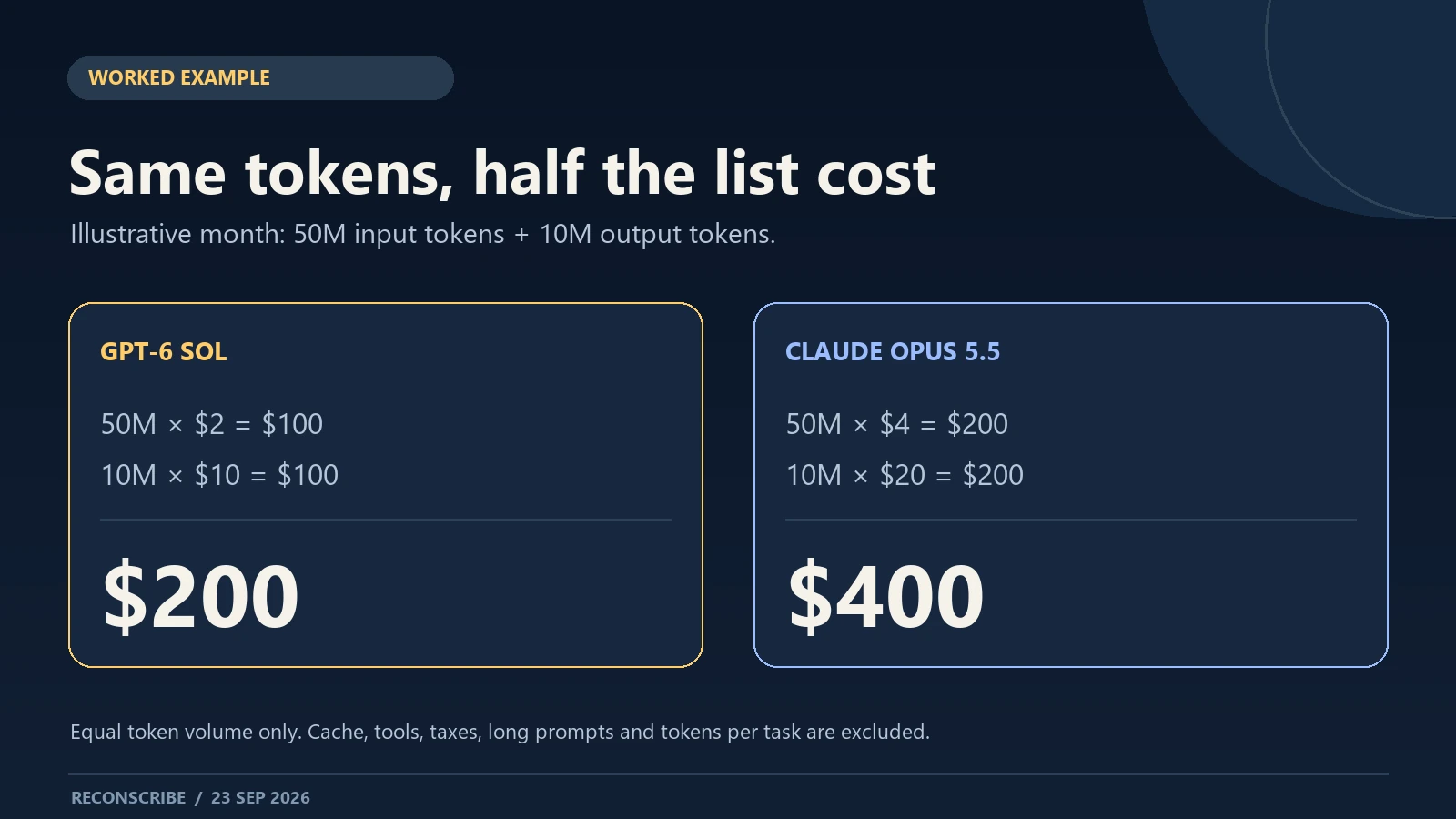
That distinction matters. If one model needs fewer retries, shorter prompts or less manual repair, its bill for an accepted result can be lower even when each token costs more. For a coding agent, we would track total cost per merged change. For finance work, we would track cost per approved report or reconciled exception. Token price is one line in that calculation.
Cache, batch and fast mode
| API rate per 1M tokens | Claude Opus 5.5 | GPT-6 Sol |
|---|---|---|
| Standard input / output | $4 / $20 | $2 / $10 |
| Cache read | $0.20 | $0.20, or $0.40 on requests above 272K input tokens |
| Cache write | $5 for 5 minutes; $8 for 1 hour | $2.50, or $5 above the 272K threshold |
| Batch input / output | $2 / $10 | $1 / $5 |
| Fast input / output | $8 / $40 | Twice the applicable standard rate |
Both providers discount eligible asynchronous batch work by 50%. Anthropic also offers an optional faster Opus 5.5 mode at a higher price. OpenAI lists a fast processing multiplier for Sol. Neither vendor’s speed claim is a controlled Sol-versus-Opus latency test, so do not infer that one will return your specific task faster from those figures alone.
The long-prompt price catch
The price gap narrows sharply on very large individual prompts. OpenAI’s Sol model page says requests with more than 272,000 input tokens are charged twice the standard input and cache rate and 1.5 times the output rate for the entire request. Anthropic says Opus 5.5 keeps its standard per-token rate across its full one-million-token context window.
Take one uncached request with 300,000 input tokens and 20,000 output tokens. Sol’s long-prompt rate makes that about $1.50, while Opus 5.5 comes to about $1.60. At that point, the token-price lead is just ten cents. Cache reads on a large Sol request also rise from $0.20 to $0.40 per million tokens, while Opus 5.5’s listed cache-read rate stays $0.20.
This is why we would not route a huge document review by the headline $2-versus-$4 input price alone. Split the work when the documents allow it, test whether the model retains the needed context, and compare the full bill with the quality of the final answer. A context window is a capacity limit, not a promise that every detail will be used correctly.
The benchmark results worth comparing
Launch-day charts tend to compare each new model with yesterday’s rival. OpenAI’s Sol announcement compares it with Claude Opus 5, not Opus 5.5. Anthropic’s Opus 5.5 table includes GPT-5.6 Sol, not GPT-6 Sol. Swapping those names would produce a dramatic but false comparison.
There is a narrower route. On AutomationBench and FrontierCode, the two vendors’ shared baseline model scores line up, so their published new-model results can be placed next to one another with care. On those two tests, Opus 5.5 is ahead:
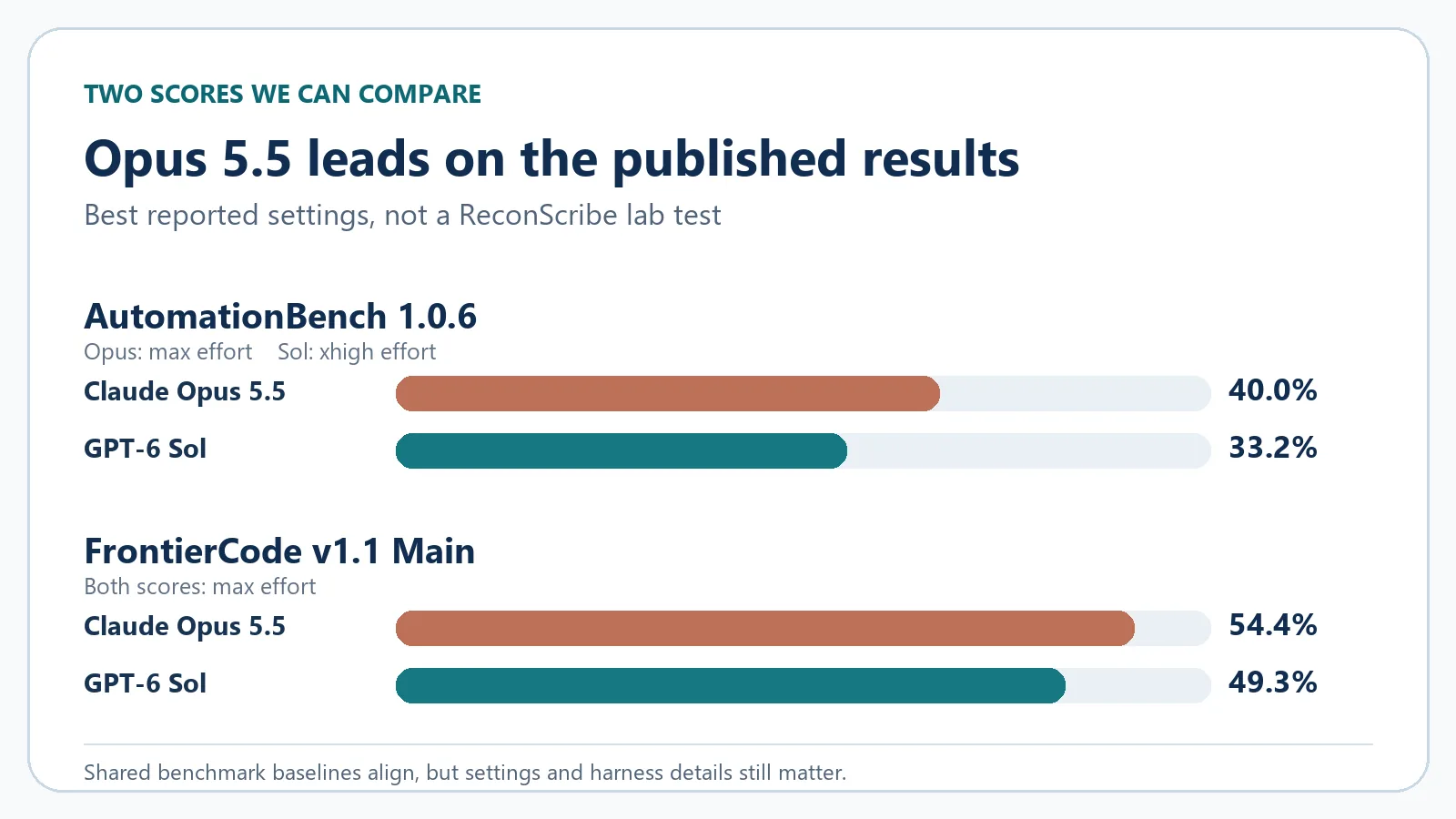
AutomationBench asks agents to finish business workflows across connected apps. Opus 5.5 reaches 40.0% at max effort; Sol reaches 33.2% at xhigh. The 6.8-point gap is meaningful in this published result, but the effort settings differ and it does not tell us how many of your payroll or support workflows either model will finish.
FrontierCode v1.1 Main checks whether code changes are suitable to merge, not merely whether a test happens to pass. Anthropic’s Opus 5.5 table reports 54.4% at max effort. The Sol point on OpenAI’s official chart is 49.3% at max. Here, Opus leads by 5.1 points. Anthropic’s chart also shows a medium-effort Opus run around 54.6% at roughly $0.80 per attempt; OpenAI’s Sol max point is $2.14. On this particular test, the higher-priced model can be cheaper per attempt. That is not a price promise for any other task.
What the other headline numbers do not prove
Anthropic reports 66.4% for Opus 5.5 on Terminal-Bench 4.0 and 1846 Elo on GDPval-AA v2.1, a measure of professional knowledge work. OpenAI reports 56.4% for Sol on Agents’ Last Exam and 68.8% on DeepSWE v1.1. These are useful signs of capability, but the launch materials do not give us a Sol and Opus 5.5 result on the same setup for those tests. There is no honest winner row to add.
We would also leave OSWorld 2.0 out of a direct score table. OpenAI reports Sol on an offline set; Anthropic reports Opus 5.5 under a different setup. Putting 60.5% beside 81.8% without that distinction would make a large gap look cleaner than the evidence allows. Likewise, OpenAI’s finding that Sol makes roughly half as many mistakes as its predecessor on selected error-inducing conversations is not a claim that it is twice as factual as Opus 5.5.
Coding: we would start with Opus 5.5
For a multi-file change with ambiguous requirements, a messy test suite and a real reviewer waiting at the end, we would try Opus 5.5 first. Its FrontierCode lead is relevant, and Anthropic’s other coding results show a model built for extended work. A stronger agent that reaches a mergeable patch in fewer attempts can save more than a cheaper agent that repeatedly needs repair.
That does not mean we would use Opus for every code task. Sol is the more economical default for generating test cases, drafting small functions, explaining logs, checking a known pattern or running many bounded sub-tasks. We would escalate to Opus when the task spans several modules, the failure mode is hard to spot or the first attempt has not earned trust. For high-stakes changes, neither gets to merge its own work without tests and review.
Developers switching from Opus 5 should also check the API migration details. Opus 5.5 has always-on adaptive thinking, does not accept certain forced tool-use settings, and changes how some thinking blocks and computer-use versions behave. Sol supports effort settings from none through max. Those controls may matter as much as a benchmark score if you have an existing agent that expects a particular response shape.
Finance, audit and spreadsheet work: our practical choice
In finance, we would personally reach for Opus 5.5 when the job calls for judgment across several imperfect sources. Think of a month-end variance note where ledger movements, contract dates and management explanations do not agree at first glance. Or an audit support pack where the model must identify the missing evidence rather than merely restate the files. Anthropic’s knowledge-work results make Opus a sensible first candidate for those tasks, although there is no published Sol-versus-Opus finance benchmark that settles it.
We would use Sol more readily for repetitive first-pass work: extracting fields from a batch of invoices, turning a standard reconciliation into a draft exception list, checking that a report follows a fixed template, or preparing a clean summary of policies already supplied to it. Its ordinary API rates leave more room for volume and iteration. If Sol’s output creates a lot of reviewer cleanup, the apparent saving disappears.
Here is the test we would run before paying to switch a finance workflow. Give both models the same 20 anonymized tasks, the same source documents and the same acceptance checklist. Score each answer for traceable figures, missing exceptions, unsupported conclusions, time to review and actual API cost. Keep a person responsible for sign-off. The useful metric is not which model sounded more confident; it is which left fewer errors for the reviewer to find.
Neither model should be the final authority for a statutory filing, an audit conclusion or a journal entry simply because its prose is polished. Recalculate material numbers outside the model, keep source links or document references, and record the human approval. Our finance AI prompts guide is a practical starting point for designing those checks.
Writing, context and access
Both launches promise better communication. Opus 5.5 is presented as a clearer, more natural writer, while Sol inherits some of Astra’s shorter, less jargon-heavy style. We have not seen an independent writing test of these two versions on the same brief. If writing quality is the deciding factor for you, run your own blind sample with the tone, facts and editing rules you actually use.
Sol’s 1.05-million-token context window is slightly larger than Opus 5.5’s one million. Both list up to 128,000 output tokens. That 50,000-token context gap is not a reason by itself to choose Sol, especially once its long-prompt price changes above 272,000 input tokens. Opus 5.5’s reliable knowledge cutoff is June 2026; Sol’s listed cutoff is 20 April 2026. Use current source retrieval for live laws, product prices or tax rates regardless of either date.
At launch, Opus 5.5 was available across Claude products and through the Claude API. Five-hour limits also rose for Pro, Max and Team plans. Sol launched through the OpenAI API as gpt-6-sol, and through ChatGPT Work and Codex for Plus, Pro, Business, Enterprise and Edu users. It was not yet in ordinary Chat at launch. Free and Go desktop users were offered GPT-6 Luna, not Sol. Plan limits and regional access can change, so check the current product screen before choosing a subscription.
Tools, images and safeguards
Both models can read text and images and produce text. In the right product or API setup, they can use tools to search, work with files, write code or operate a computer. That does not mean the base model itself renders a picture or video. A tool may call a separate image or video service, with its own availability and charges.
The launch posts also discuss safer agent behaviour. Anthropic describes action screening, a sandbox and stronger prompt-injection resistance than Opus 5 in its tests. OpenAI reports fewer misleading claims about coding work than GPT-5.6 in selected alignment tests. There is no common safety score in these announcements that proves one is safer than the other. For a business workflow, the important controls are still your permissions, allowed tools, log of actions, ability to reverse a change and human approval at the right point.
Subscription access and API billing should stay separate in your budget. The $2/$10 and $4/$20 figures are API token rates, not the monthly price of ChatGPT or Claude. A subscription has usage limits and product features that may change. If your team works mostly inside Codex or Claude Code, test the actual plan limits and workflow before converting token arithmetic into a subscription recommendation.
ReconScribe’s winner: Claude Opus 5.5
This is not a vote for spending more by habit. On a short, well-scoped API request, Sol’s standard list price is exactly half. If we were processing a large, predictable queue with strict validation, we would try Sol first and keep it if the accepted-output rate held up. On a small number of complex tasks where rework is expensive, we would pay for Opus and measure whether it actually reduces that rework.
If we could use only one of the two today for a mixed finance and coding team, we would pick Opus 5.5. If we could use both, we would not make people choose: Sol for the first pass and high-volume routine work, Opus for the cases that need a deeper second look. That routing is a starting policy, not an excuse to skip evaluation.
Frequently asked questions
Is Claude Opus 5.5 better than GPT-6 Sol?
On the two published benchmarks where shared baselines line up, Opus 5.5 scores higher. We therefore pick it for demanding coding and review-heavy work. Sol is cheaper per token on ordinary API requests and may be the better choice for large volumes of well-defined tasks.
Which model is cheaper?
Sol is half the standard API list price: $2 input and $10 output per million tokens versus Opus 5.5 at $4 and $20. That advantage narrows for a single Sol request above 272,000 input tokens because a long-prompt surcharge applies to the whole request.
Which should I use for coding?
We would start with Opus 5.5 for large, uncertain codebase changes because it leads the published FrontierCode comparison. For small, well-scoped tasks and cheap iteration, start with Sol. Review the code and run the tests either way.
Which should I use for finance or audit work?
Our preference is Opus 5.5 for ambiguous analysis and Sol for structured first-pass drafting or extraction. That is an editorial workflow recommendation, not a direct finance benchmark result. Use source documents, independent arithmetic and human sign-off for consequential work.
Does GPT-6 Sol beat Claude Opus 5.5 on every price measure?
No. The standard input and output rates are lower, but both list $0.20 per million cached input reads below Sol’s long-prompt threshold. Sol’s rate rises for requests above 272,000 input tokens, while Opus 5.5 retains its standard rate across the full context window.
Can I use GPT-6 Sol in ChatGPT?
At launch OpenAI offered Sol in ChatGPT Work and Codex for eligible paid plans and in the API, not in ordinary Chat. Check your current product and plan because rollout details can change.
Did Opus 5.5 launch exactly 30 minutes before GPT-6 Sol?
Both official launch pages date the releases to 22 September 2026. Neither gives a verified 30-minute interval. We would not present that social-media line as a fact.
Related reading
- Claude Opus 5.5: the full model guide
- Claude Sonnet 5.5, Anthropic’s model at the same price as Sol
- GPT-6 Sol: pricing, benchmarks and launch details
- GPT-6 Astra vs Claude Fable 5.1 if you need the pricier frontier models
- Our guide to choosing an AI model in India
Sources
- Anthropic: Claude Opus 5.5 launch and benchmark methodology
- Anthropic: Claude Opus 5.5 model specifications
- Anthropic: Claude API pricing, cache and batch rates
- OpenAI: GPT-6 Sol and Luna launch, pricing and evaluations
- OpenAI: GPT-6 Sol API model specifications and long-prompt rates
- OpenAI: API pricing