
Claude Opus 5.5 might have been the most exciting frontier model launch for all of 30 minutes. On the same day, OpenAI unveiled GPT-6 Sol. The timing made for a good rivalry story, but the useful question is less dramatic: which model can finish your work reliably at a cost you can live with?
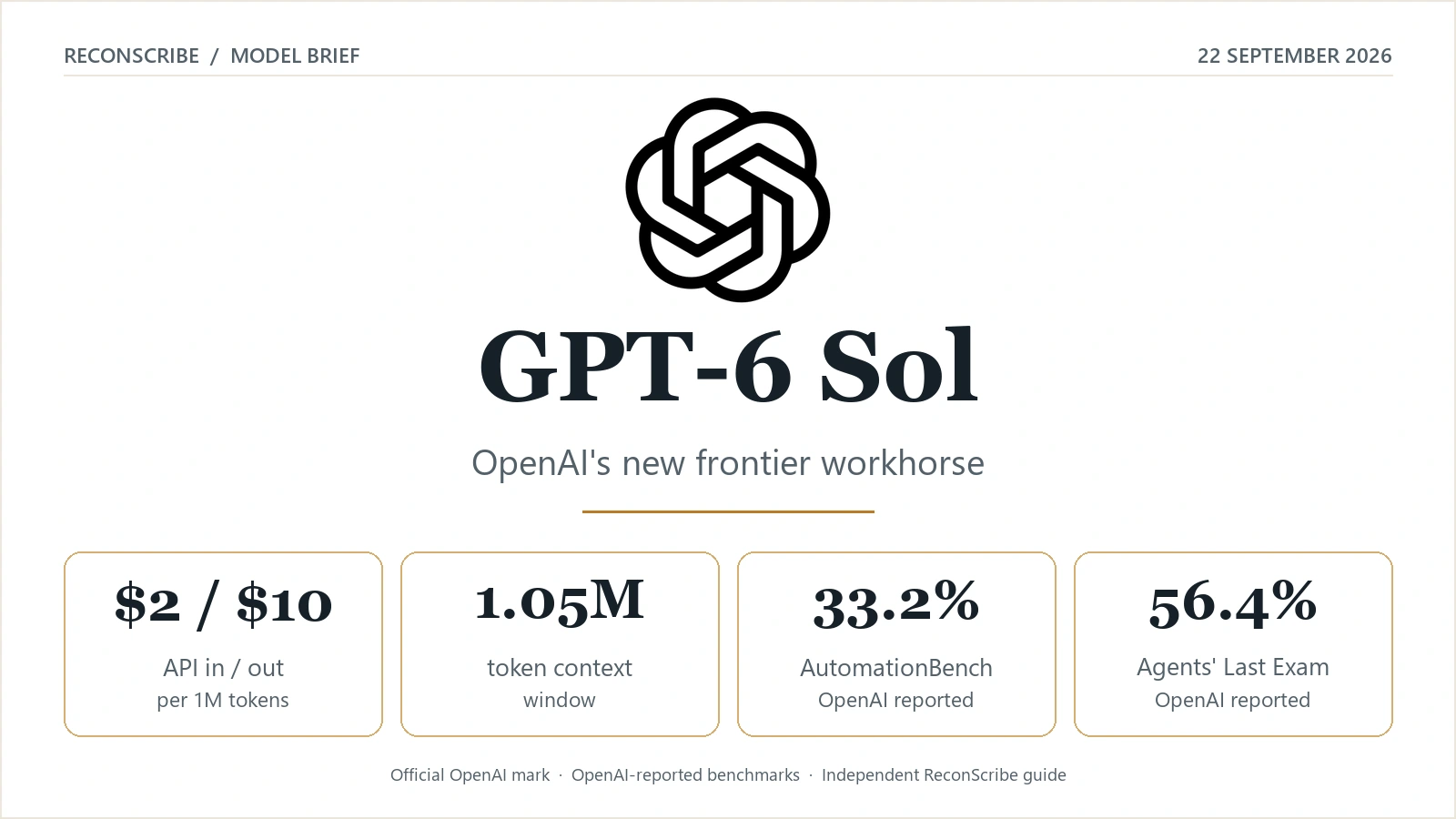
OpenAI released GPT-6 Sol on 22 September 2026 alongside the smaller GPT-6 Luna. Sol is the middle of the GPT-6 family: built for complex coding and agent workflows, with standard API rates of $2 per million input tokens and $10 per million output tokens. Those are half the launch article’s comparison rates for GPT-5.6 Sol. OpenAI still positions GPT-6 Astra as its strongest model overall. Read OpenAI’s announcement.
There is an important date change from our Claude Opus 5.5 guide: when that article was written, GPT-6 Sol had not been announced. It has now arrived. Here are the verified specifications, the launch results worth reading, the actual price arithmetic, and a careful comparison with Opus 5.5. We have not independently benchmarked either release for this article.
🧩 Explain GPT-6 Sol simply ↓ Jump to Sol vs Opus 5.5 ↓
GPT-6 Sol: the short answer
 OpenAI wordmark identifies the source. This is independent ReconScribe coverage.
| Fact | GPT-6 Sol |
|---|---|
| Announced | 22 September 2026 |
| Model ID | gpt-6-sol |
| Standard API price | $2 input / $10 output per 1 million text tokens |
| Cached input / cache writes | $0.20 / $2.50 per 1 million tokens, under the documented standard rates |
| Context and output | 1,050,000-token context window; 922,000 maximum input tokens; 128,000 maximum output tokens |
| Knowledge cutoff | 20 April 2026 |
| Input and output | Text and image input; text output |
| Reasoning effort | none, low, medium (default), high, xhigh, max |
| At launch | Sol was available in the API and began rolling out in ChatGPT Work and Codex for Plus, Pro, Business, Enterprise and Edu users. |
Sources: OpenAI launch post and GPT-6 Sol model documentation. Availability and prices can change after the review date.
What GPT-6 Sol actually is
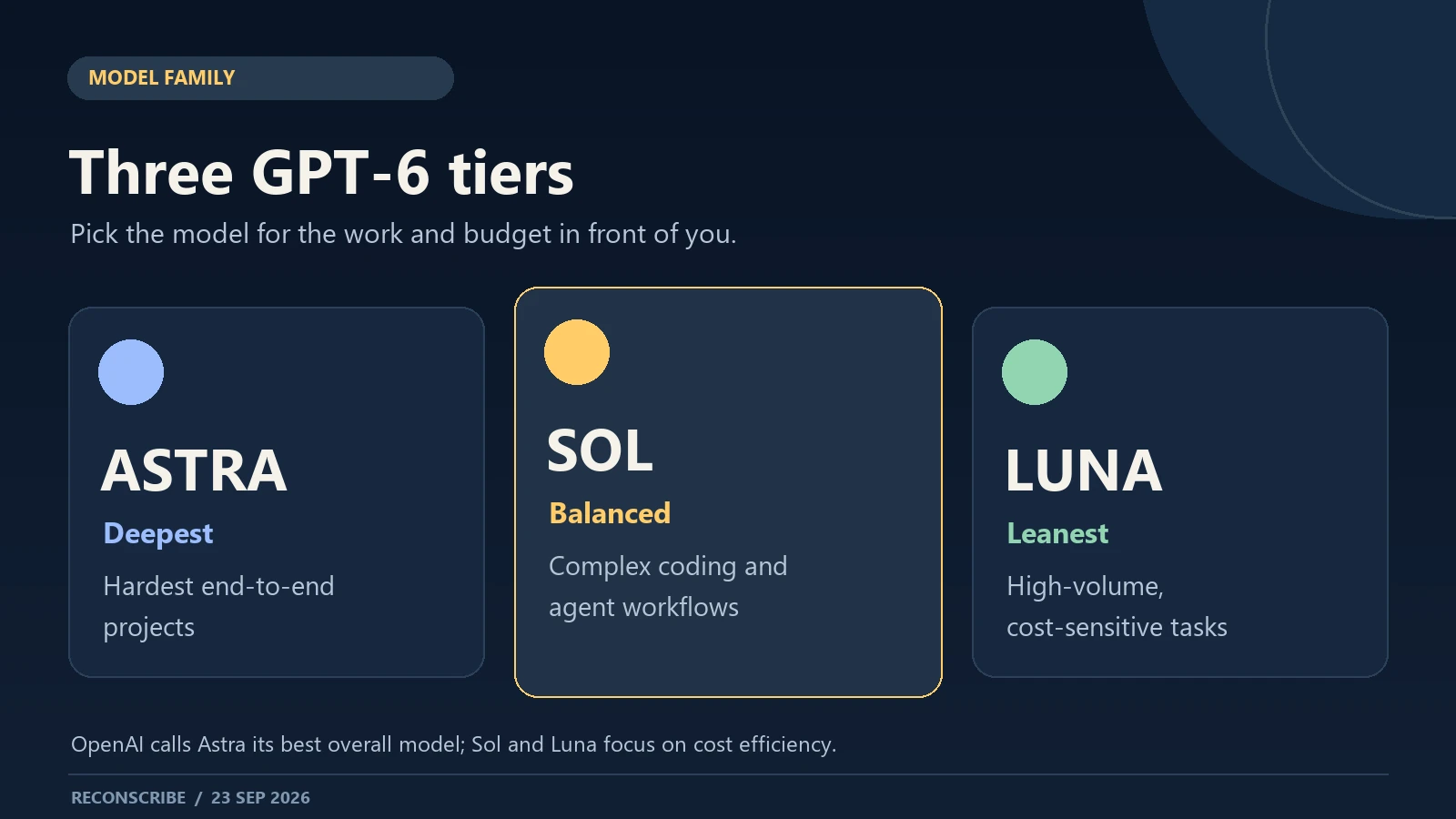
Sol is a general-purpose reasoning model for people who need an AI assistant to work through code, research, documents and connected tools. It shares training methods with GPT-6 Astra, while the models in the family target different cost and capability points. Astra remains OpenAI’s strongest option overall. Sol makes demanding work more affordable at scale, while Luna serves smaller or more price-sensitive jobs.
For where GPT-6 Sol sits today among every major model, by test and by price, see our live AI leaderboard.
The tier names are a useful starting point, not a promise that one model always wins. A hard task completed once by Astra might cost less than five unsuccessful Sol attempts. A short classification job might be wasteful on either model if Luna handles it accurately. The right test is your own task set, with pass rate, time, tokens and review effort measured together.
OpenAI’s model page confirms that Sol accepts images as input, but produces text. It is not itself a video, audio or image-generation endpoint. In the Responses API it can use supported tools, including web search, file search, code interpreter, computer use and function calling. Those tool workflows can add separate charges or operational steps.
GPT-6 Sol explained simply
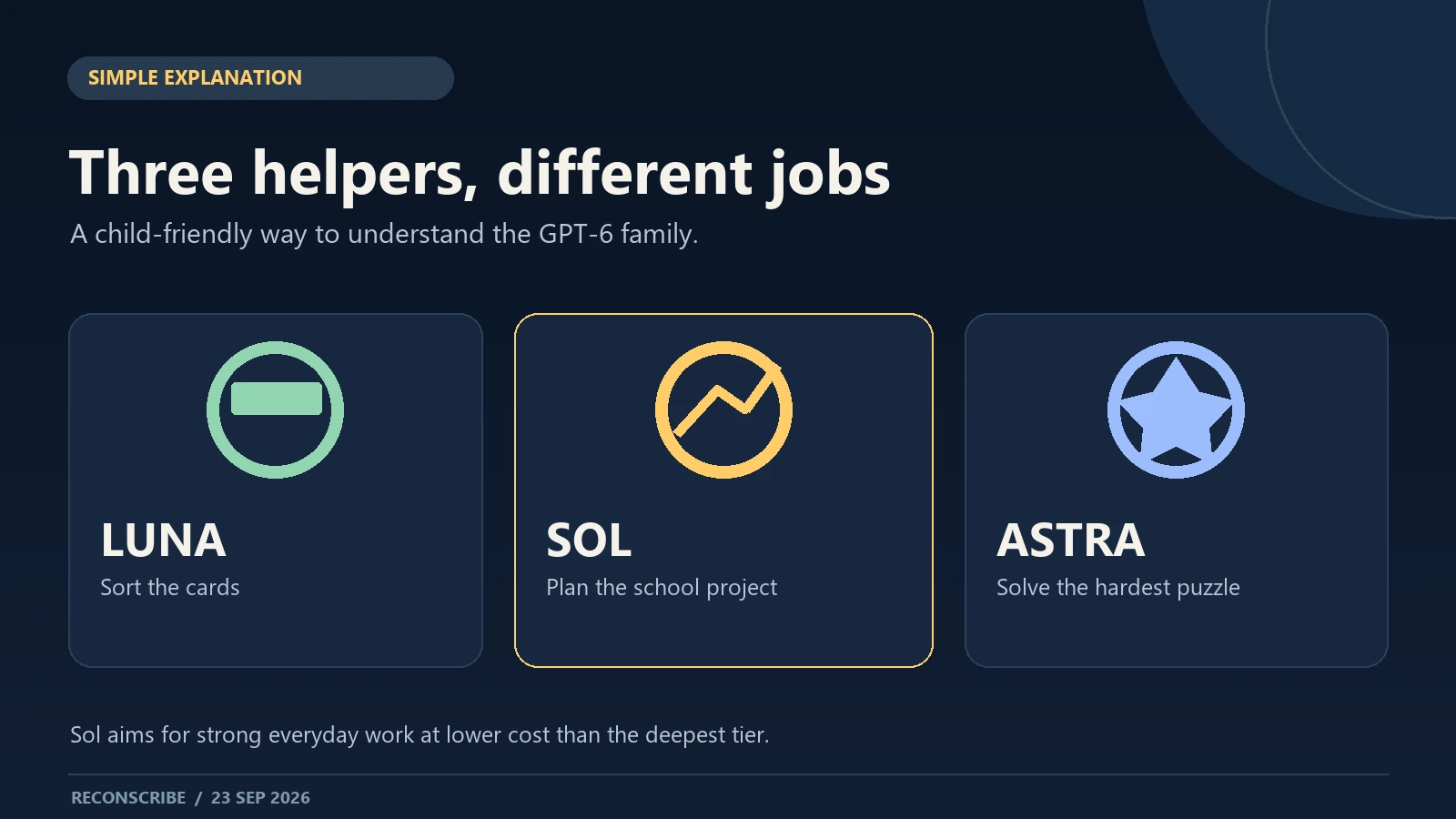
A class has a school project to finish. Someone must sort the picture cards, someone must plan the pages and put the project together, and one very hard puzzle at the end may need extra attention.
Luna is the quick helper for sorting the cards. Sol is the helper who can plan the project, work through several steps and get a solid draft done without using the most expensive helper every time. Astra is the helper you call when the puzzle is especially difficult and the best answer matters more than the extra cost. Even after Sol finishes the project, the teacher still checks it before handing it in.
What changed from GPT-5.6 Sol?
The price cut is easy to see: OpenAI’s launch table moves Sol from $4 to $2 per million input tokens and from $20 to $10 per million output tokens. That is a 50% reduction in those two list rates. OpenAI also reports stronger results across professional workflows, coding and computer use, plus fewer errors in an internal factuality evaluation. These are the company’s launch measurements, not our own field test.
Another change is how the model communicates. Sol and Luna carry Astra’s clearer collaboration style: less jargon, less low-value detail and clearer descriptions of what was actually checked. That matters for code review or an audit note, where a confident but vague completion message can waste more time than a slower, precise one. Style remains subjective; the strongest test is to give both versions the same work and compare the final artifact.

GPT-6 Sol benchmarks: what OpenAI reported
OpenAI’s announcement contains several useful tests, but each answers a different question. We have put the headline figures together here with the comparator named exactly as published. Claude Opus 5 in those results means Opus 5, not the newer Opus 5.5.
| Evaluation | What it tests | OpenAI-reported Sol result | Comparison in OpenAI’s post |
|---|---|---|---|
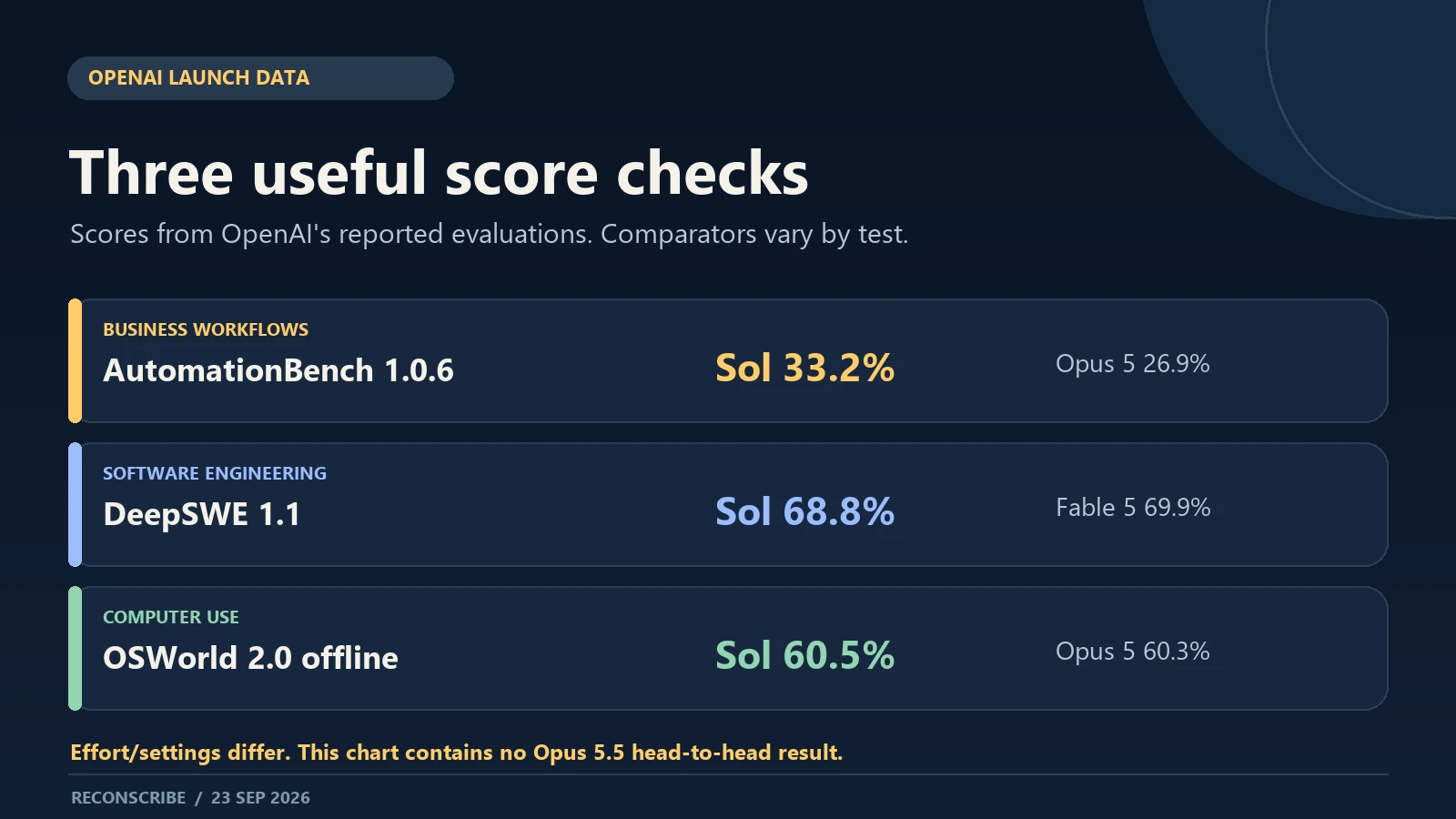
| AutomationBench 1.0.6 | End-to-end business workflows across connected apps | 33.2% at xhigh effort; $0.27 per task | Claude Opus 5 at max: 26.9% and 11.1 times Sol’s cost per task |
| Agents’ Last Exam V1 | Long-horizon professional tasks across many industries | 56.4% at max effort | Above the highest Claude Opus 5 score in this evaluation, at 60% lower cost per task |
| DeepSWE 1.1 | Long-horizon software engineering in real codebases | 68.8% at max effort | Claude Fable 5 at xhigh: 69.9%; Sol cost about 80% less per task |
| OSWorld 2.0 offline | Computer-use workflows | 60.5% at xhigh effort | Claude Opus 5 at medium: 60.3%; Sol cost about 80% less per task |
All rows are from OpenAI’s 22 September announcement. The models, effort levels, harnesses and pricing assumptions differ by row. OpenAI notes that research and API evaluations can differ from a production app experience because tools and system prompts differ.
Business workflows are the clearest price-performance claim
AutomationBench asks agents to complete work across apps and tools in areas such as sales, marketing, operations, finance and HR. OpenAI reports Sol at 33.2% and $0.27 per task at xhigh effort, ahead of Opus 5 at max effort on that run. The low pass rates are a reminder that these are hard, multi-step tasks. A one-third pass rate is an improvement worth studying, not a case for unsupervised financial posting.
Coding is strong, but the result depends on the test
In OpenAI’s launch tests, Sol improves substantially over GPT-5.6 Sol on FrontierCode, which judges whether a coding agent’s changes are ready to merge. It matches Claude Fable 5.1 at xhigh effort at much lower estimated cost, although the launch page does not give a simple standalone Sol score for that claim. On DeepSWE, Sol’s 68.8% sits close to Claude Fable 5’s 69.9%, with an estimated task cost about 80% lower. That is promising for repeated software work, but a team’s own tests, code review and deployment gates still decide whether a change is useful.
Computer use and factuality need careful reading
On OSWorld 2.0 offline, OpenAI reports 60.5% for Sol and 60.3% for Opus 5 under different effort settings. A 0.2-point gap is too small to treat as a meaningful quality victory. OpenAI’s stronger claim is the lower estimated cost per task in that setup. The company also says Sol makes about half as many mistakes as GPT-5.6 Sol in an internal set of conversations selected because users had flagged factual errors. OpenAI cautions that those conversations are not typical traffic. It is not a general hallucination rate.
What the launch tables do not answer
There is no published, controlled GPT-6 Sol versus Claude Opus 5.5 head-to-head in either company’s launch material. The two vendors also select and configure tests differently. The safest way to use these charts is to identify relevant workloads, then run both models on a small set of your own completed tasks with the same tools, source material, reviewer and success rules.
GPT-6 Sol pricing and the real cost of a task
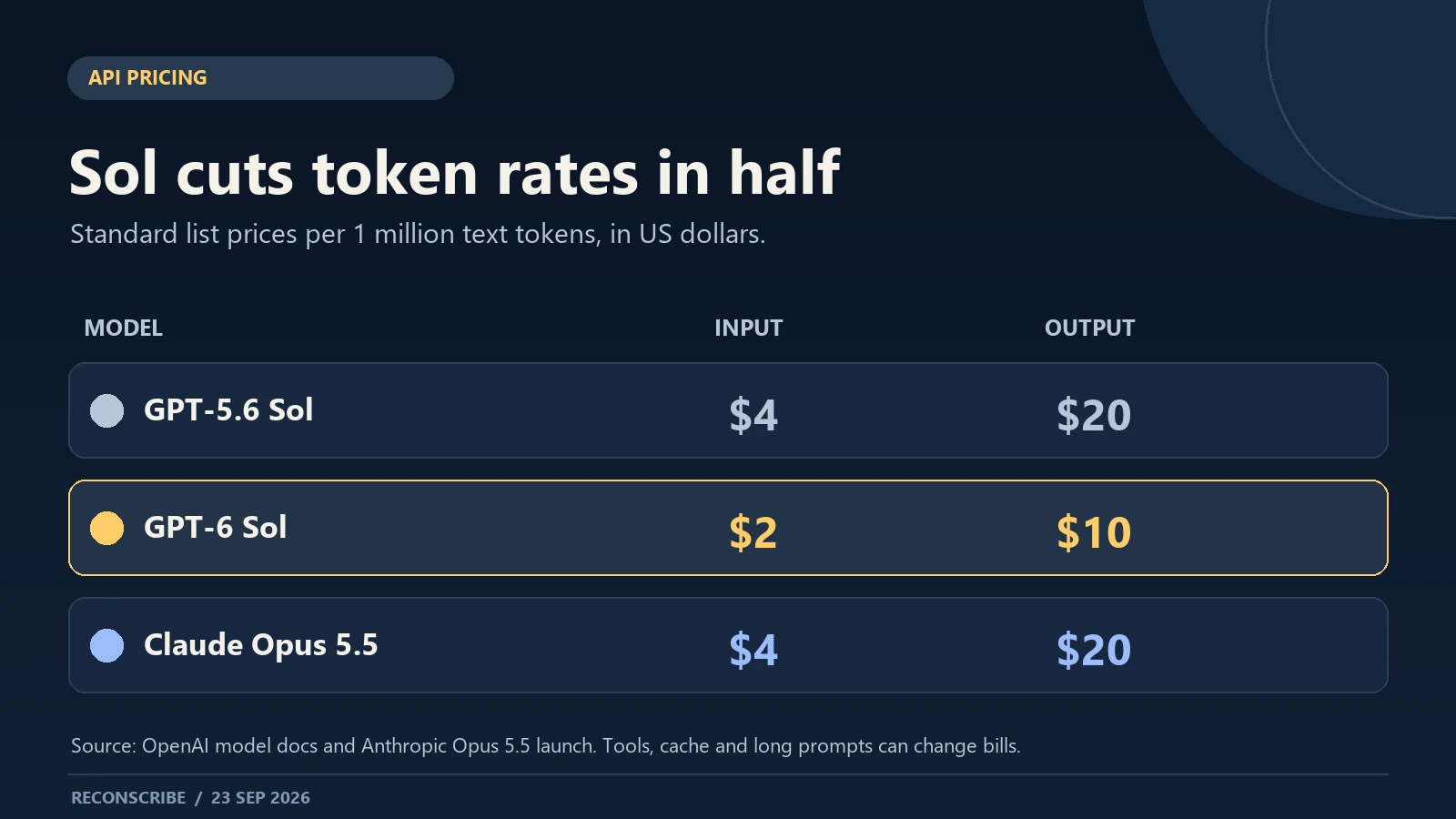
For standard API text usage, GPT-6 Sol costs $2 per million input tokens and $10 per million output tokens. OpenAI’s model documentation lists cached input reads at $0.20 and cache writes at $2.50 per million. It also says prompts above 272,000 input tokens are billed at double input and cache rates and 1.5 times output rates for the full request. Regional processing, Fast mode, tools and other service choices may add cost.
A fixed-volume example, without hiding the assumptions
Suppose a team processes 50 million input tokens and receives 10 million output tokens in a month. At the published standard list rates, with no cache, tools, premium long prompts or taxes, Sol’s bill would be $200: 50 × $2 plus 10 × $10. At Claude Opus 5.5’s $4 and $20 rates, the same number of input and output tokens would cost $400. That is the cleanest sense in which Sol is half the price.
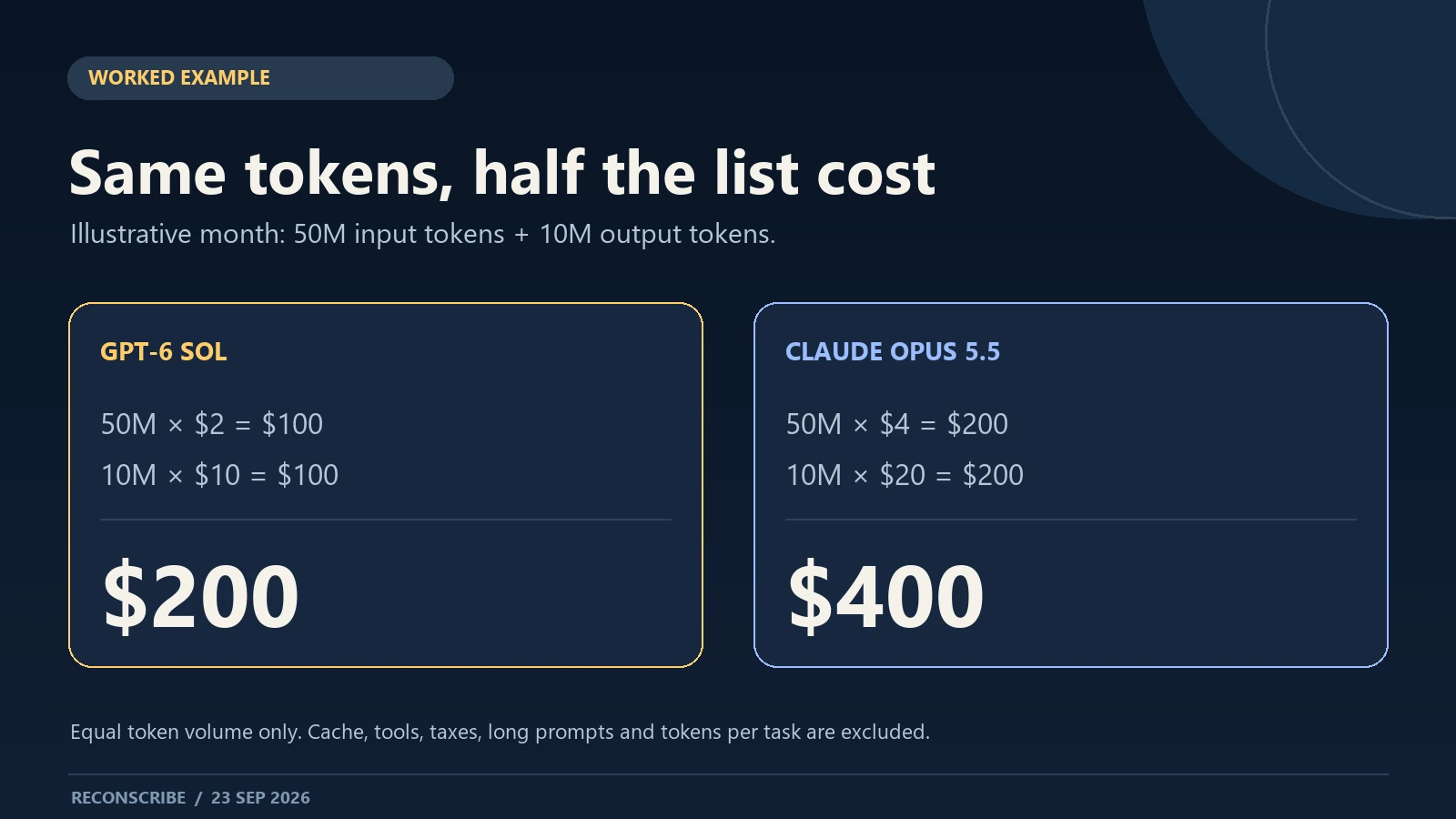
Actual work rarely uses the same tokens on two models. One might write more, need more attempts or use more tool calls. A cache-heavy app may also look different: OpenAI lists a 90% discount on Sol cached reads, while Anthropic lists the same $0.20 per million cache-read price for Opus 5.5, under its own caching rules. Compare complete successful tasks, including review and rework, before choosing a model for a production workflow.
GPT-6 Sol vs Claude Opus 5.5: what can we say today?
Anthropic launched Claude Opus 5.5 on the same date. It is a substantial Opus 5 upgrade that Anthropic says approaches Fable 5.1 on most work while costing 40% less than Opus 5 on typical workloads at default settings. Its standard API rates are $4 input and $20 output per million tokens. It also reports faster output, strong agentic coding and knowledge-work results, and a 1 million-token context window. Our full Opus 5.5 guide covers those claims in detail.
| Decision point | GPT-6 Sol | Claude Opus 5.5 |
|---|---|---|
| Standard input / output API rate | $2 / $10 per 1M tokens | $4 / $20 per 1M tokens |
| Cached input read rate | $0.20 per 1M tokens | $0.20 per 1M tokens under Anthropic’s caching terms |
| Published context window | 1,050,000 tokens; 922,000 max input | 1 million tokens |
| Launch emphasis | Complex coding and agents at a lower token price | High-end coding and knowledge work with lower task cost than Opus 5, by Anthropic’s tests |
| Controlled Sol vs Opus 5.5 result | Not provided in either launch announcement | |
The verdict is deliberately narrow. Sol wins on the published standard input and output token rates. Opus 5.5’s launch shows impressive results on Anthropic’s agentic coding and professional-work tests, including 66.4% on Terminal-Bench 4.0 and 1846 Elo on GDPval-AA v2.1. Neither vendor published a controlled direct Sol-versus-Opus result. Two published benchmarks have matching shared baselines, so our comparison uses those scores for a provisional editorial pick. That is not our own benchmark. For your workload, test both models on the same tasks, tools and settings.
Where GPT-6 Sol could help a finance team
Finance work is a useful stress test because a polished answer is not enough. The numbers, source trail, period and approval all matter. Sol’s price and tool support make it a candidate for the drafting and investigation steps of high-volume work, provided the workflow preserves source evidence and puts deterministic checks and a reviewer around the model.
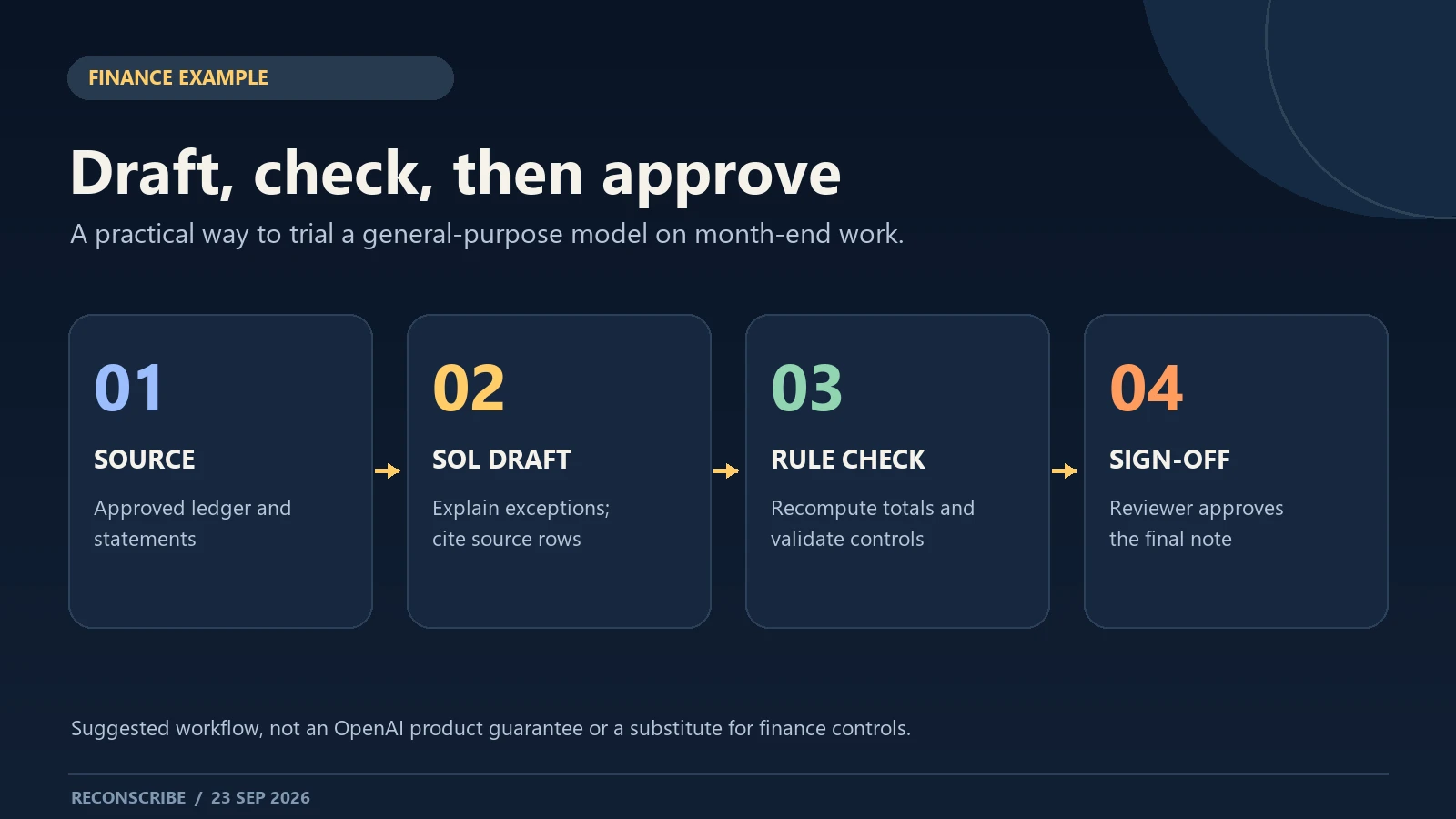
Month-end commentary and exception review
Give Sol a controlled export of the current and prior period, an approved chart of accounts and the reporting rules. Ask it to identify large variances, cite the exact rows, explain the likely drivers and mark any unsupported inference. Recompute the amounts outside the model. A reviewer then checks the source and signs off on the commentary. The model can reduce drafting time; it should not become the book of record.
Reconciliations and investigation notes
Sol can help turn a list of unmatched items into a prioritized investigation note: which items share a counterparty or date, which supporting document is missing, and what follow-up question should be asked. Deterministic matching should still handle exact identifiers, amounts and tolerances. A reviewer approves any adjustment or outgoing message. This makes the model useful for messy context while keeping account balances under ordinary controls.
Building internal finance tools
A development team could use Sol to build or review a report generator, spreadsheet import, audit trail or dashboard. OpenAI’s coding results make that plausible, but the test is whether the code passes your fixtures, handles edge cases and fits the repository’s standards. For tax or payroll logic, verify rules against current authoritative sources and write deterministic calculations; do not ask a model to invent a statutory rate from memory.
A practical starting prompt is: “Using only the attached approved ledger and the prior-month export, draft a variance note for entries above the stated threshold. Show the source row ID for every figure, label unsupported explanations as questions, and do not change any records or send any messages.” Then check the answer against the data. This is a suggested workflow, not a vendor-tested finance benchmark.
How to start using GPT-6 Sol
GPT-6 Sol is available through the API as gpt-6-sol. The model page recommends the Responses API for built-in tools and function calling. Set OPENAI_API_KEY in your environment, then run this minimal Python request:
Start with a small evaluation set before switching a live process. Include straightforward tasks, ambiguous records, wrong or missing source files, and work that should be escalated. Track success, reviewer time, token use and any tool fees. OpenAI lists medium as the default reasoning effort; a higher setting can help hard tasks but may change latency and total cost.
On 22 September, GPT-6 Sol and Luna began rolling out in ChatGPT Work and Codex for Plus, Pro, Business, Enterprise and Edu users. Free and Go desktop users could access Luna. Neither model was in ordinary Chat at launch. Access can change by plan and region, so check your current model picker before choosing a subscription.
What to keep in view
- Benchmarks are directions, not production guarantees. OpenAI ran the release evaluations in research or API settings that can differ from the app you use.
- Neither vendor published a controlled Sol-versus-Opus 5.5 test. Our comparison makes a provisional editorial pick from two vendor-published scores with matching shared baselines. It is not a ReconScribe head-to-head benchmark.
- Cheap tokens can still make an expensive workflow. Retries, large prompts, outputs, cache writes and tool calls can change the result.
- The context window is not a reason to dump every file into one prompt. OpenAI documents a premium above 272,000 input tokens. Retrieval and careful source selection are usually easier to audit.
- Finance and compliance outputs need an evidence trail. Keep deterministic calculations, source-row checks and a named reviewer.
Our take
GPT-6 Sol’s strongest immediate proposition is straightforward: a capable new model for complex work with a much lower published token price than GPT-5.6 Sol and Claude Opus 5.5. OpenAI’s release tests suggest useful gains in business workflows, coding, computer use and factuality, but the numbers mostly compare against older models. The most interesting unanswered question is how Sol and Opus 5.5 perform on the same real work, with the same tools and reviewer.
If you build or buy AI workflows, test Sol on a narrow set of tasks where you can verify the result. Measure total cost per correct, approved outcome. That will tell you more than either company’s launch-day victory lap.
Frequently asked questions
When was GPT-6 Sol released?
OpenAI announced GPT-6 Sol and GPT-6 Luna on 22 September 2026. Claude Opus 5.5 was also released that day. The exact “30 minutes” in the opening is a turn of phrase about the crowded launch day, not a verified interval between publication timestamps.
How much does GPT-6 Sol cost?
OpenAI’s standard API text list price is $2 per million input tokens and $10 per million output tokens. Cached reads are listed at $0.20 and cache writes at $2.50 per million. Long prompts above 272,000 input tokens and certain service choices cost more. Check the current model page before budgeting.
What is the GPT-6 Sol API model ID?
Use gpt-6-sol in supported OpenAI API requests.
What is the GPT-6 Sol context window?
OpenAI documents a 1,050,000-token context window, with 922,000 maximum input tokens and 128,000 maximum output tokens. Pricing changes for requests above 272,000 input tokens.
Is GPT-6 Sol better than Claude Opus 5.5?
The official launch material does not provide a controlled head-to-head. Sol has lower published standard input and output token rates. Anthropic reports strong Opus 5.5 results on its own coding and knowledge-work evaluations. Test both on the same completed tasks before choosing.
Is GPT-6 Sol better than GPT-6 Astra?
Astra remains OpenAI’s strongest model overall. Sol brings strong results to more work at a lower cost. Whether the cheaper model is the better choice depends on the task, retries and review effort.
Does GPT-6 Sol generate images or audio?
The model accepts text and image input and produces text. It is not itself an image, audio or video generation endpoint, although supported Responses API tool workflows can use separate tools.
Can a finance team use it without checking the output?
No. Use it to investigate, draft and explain, then verify figures against source records and deterministic calculations. Keep a reviewer for any adjustment, filing, payment or external message.
Sources and review date
Reviewed by ReconScribe on 23 September 2026. Product and price details come from the vendors’ own publications. Their evaluations are attributed to them; ReconScribe did not reproduce the benchmark runs.
- OpenAI: Introducing GPT-6 Sol and Luna
- OpenAI API: GPT-6 Sol model page
- OpenAI API pricing
- Anthropic: Claude Opus 5.5 launch
Related ReconScribe reading: Claude Opus 5.5 benchmarks and pricing and GPT-6 Astra vs Claude Fable 5.1.