
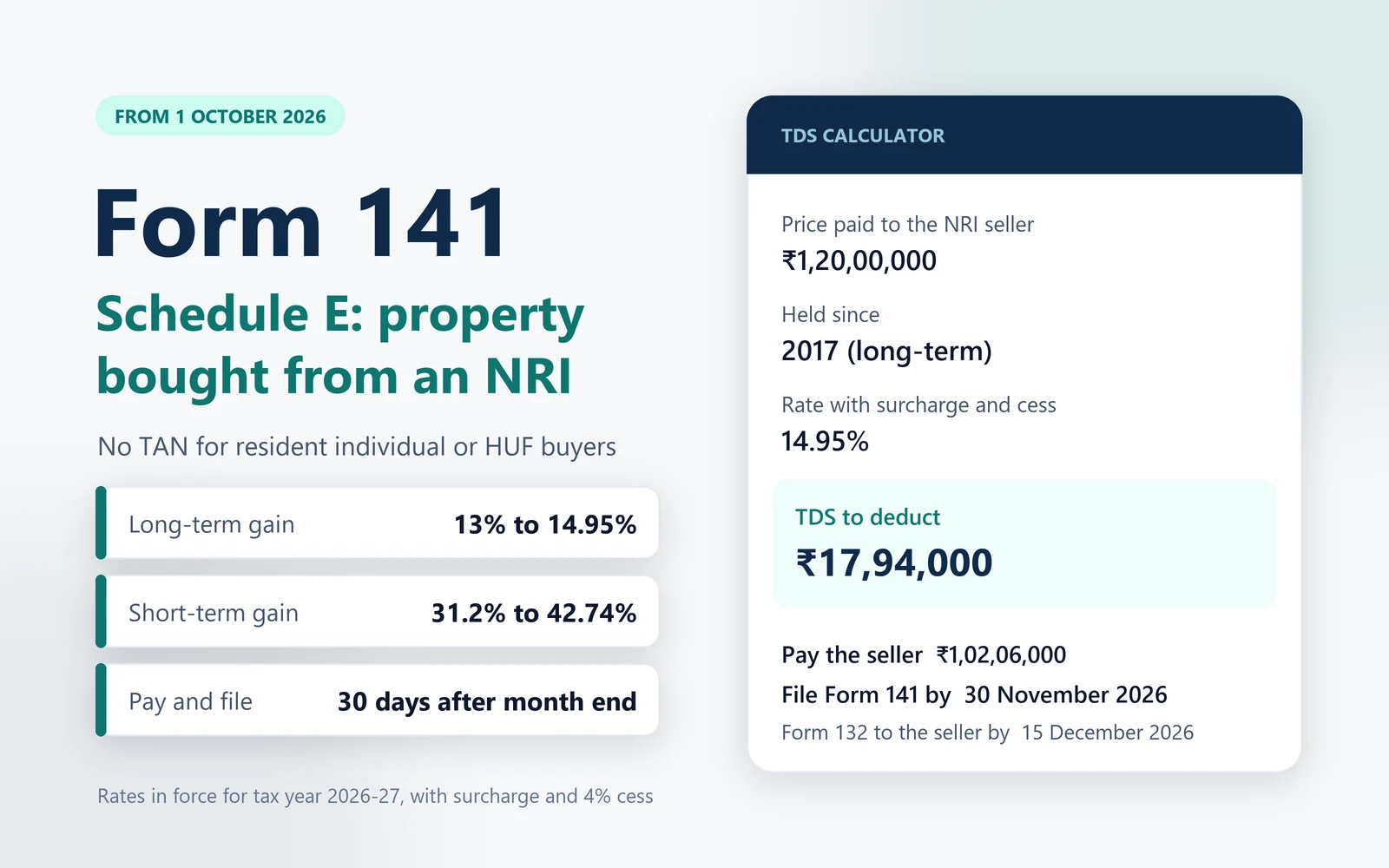
From 1 October 2026, a resident individual or HUF buying property from a non-resident no longer needs a TAN. The tax is deducted, paid and reported in Form 141, the same challan-cum-statement that replaced Form 26QB in April.
Form 141 is the one form under the Income-tax Act, 2025 for TDS that buyers and individuals deposit from their own PAN login: rent paid by individuals, property bought from a resident, payments by individuals to contractors and professionals, crypto and, from 1 October 2026, property bought from an NRI in the new Schedule E. This guide explains every schedule, the Schedule E rate with surcharge and cess, the Form 141 due date and Form 132, and gives you a calculator for TDS on property purchase from NRI and resident sellers, with the deadline.
What changed on 1 October 2026: CBDT Notification 121/2026 (G.S.R. 830(E), 22 September 2026) amends rules 215, 218 and 219 of the Income-tax Rules, 2026 and adds Schedule E to Form 141 for tax deducted under section 393(2) [Table: Sl. No. 17] when a resident individual or HUF buys immovable property from a non-resident. Section 87 of the Finance Act, 2026 rewrites section 397(1)(c) with effect from the same date, so these buyers need no TAN.
Every rate and date on this page is taken from the Act, the Rules, the notification and the Finance Act, 2026 as they stood on 27 September 2026.
What is Form 141?
Form 141 is a challan-cum-statement: you pay the TDS and report the transaction in one go, from your own PAN login, without a TAN. It replaced Forms 26QB, 26QC, 26QD and 26QE when the Income-tax Act, 2025 came into force on 1 April 2026. One Form 141 covers one type of transaction and one month of deduction, for one deductor, and it can carry several deductees of the same status.
| Schedule | What it covers | Section (old section) | TDS rate | Threshold |
|---|---|---|---|---|
| A | Rent paid by an individual or HUF other than a “specified person”, deducted in the last month of the tax year or of the tenancy | 393(1) [Table: Sl. No. 2(i)] (194-IB) | 2% | ₹50,000 for a month or part of a month |
| B | Property (other than agricultural land) bought from a resident | 393(1) [Table: Sl. No. 3(i)] (194-IA) | 1% of the consideration or the stamp duty value, whichever is higher | ₹50 lakh (consideration or stamp duty value) |
| C | Payments by an individual or HUF to contractors, professionals or commission agents, where no other TDS provision applies | 393(1) [Table: Sl. No. 6(ii)] (194M) | 2% | ₹50 lakh |
| D | Consideration for the transfer of a virtual digital asset | 393(1) [Table: Sl. No. 8(vi)] (194S) | 1% | As set out in section 393 |
| E (from 1 October 2026) | Property bought from a non-resident by a resident individual or HUF | 393(2) [Table: Sl. No. 17] (195) | Rates in force, plus surcharge and 4% cess | None |
Form 141 Schedule E: buying property from an NRI
Schedule E applies to tax deducted on or after 1 October 2026 by a resident individual or Hindu undivided family on the price of land (other than agricultural land) or a building bought from a non-resident. The deduction is made under section 393(2) [Table: Sl. No. 17] of the Income-tax Act, 2025, which replaced section 195, at the “rates in force” in the Finance Act, 2026.
Who files Schedule E, and who still needs a TAN
- Resident individual or HUF buyer: Form 141, Schedule E, from your own PAN login, with no TAN, for deductions made on or after 1 October 2026 (rules 218(3)(e) and 219(5)(e), section 397(1)(c)(iii)).
- A deduction made before 1 October 2026: the TAN exemption did not exist yet, so the buyer needed a TAN and reports the deduction in the quarterly statement in Form 144, the successor of Form 27Q.
- Companies, firms and other buyers: still need a TAN and still report in Form 144 each quarter. The July to September 2026 statement is due by 31 October 2026 (rule 219(4)).
- Joint buyers: each buyer files a separate Form 141 for their share of the payment. The form lists every buyer and every seller with their percentage.
What to collect from the seller before you pay
- PAN. Without a PAN the rate is at least 20%, or the rate in force if that is higher (section 397(2)(b)), unless the seller gives the details below.
- If there is no PAN: name, email, phone number, address in the country of residence, a tax residency certificate (TRC) and the tax identification number (TIN) there. With these, the higher rate does not apply (rule 217).
- Always: the phone number, email and overseas address go into Schedule E whether or not the seller has a PAN (Note 6 to Schedule E).
- How long the seller held the property. More than 24 months makes the gain long-term.
- Whether the seller has opted out of the new tax regime under section 202. It matters only for a short-term gain above ₹5 crore.
- Any lower TDS certificate under section 395, with its number and rate.
The TDS rate: rates in force, surcharge and cess
Part II of the First Schedule to the Finance Act, 2026 sets the rates in force for a non-resident individual: 12.5% on long-term capital gains and 30% on other income, which is where a short-term gain on property falls.
The same Part adds a surcharge that depends on the amount paid or likely to be paid to that seller: 10% above ₹50 lakh and 15% above ₹1 crore. For a short-term gain it rises to 25% above ₹2 crore, and to 37% above ₹5 crore only if the seller has opted out of the new regime; a long-term gain stays capped at 15%. Section 3(16) of the Finance Act, 2026 then adds the 4% Health and Education Cess, which applies because the payee is not resident.
| Amount paid to the seller | Long-term gain | Short-term gain, new regime | Short-term gain, opted out |
|---|---|---|---|
| Up to ₹50 lakh | 13% | 31.2% | 31.2% |
| Above ₹50 lakh up to ₹1 crore | 14.3% | 34.32% | 34.32% |
| Above ₹1 crore up to ₹2 crore | 14.95% | 35.88% | 35.88% |
| Above ₹2 crore up to ₹5 crore | 14.95% | 39% | 39% |
| Above ₹5 crore | 14.95% | 39% | 42.744% |
Deduct on the amount you pay. A buyer cannot know the seller’s cost or gain, so without a certificate buyers deduct on the whole payment. That is why an NRI selling at a small gain usually applies for a certificate first.
Lower TDS with a certificate under section 395
- The seller applies in Form 128 for a certificate of lower or no deduction under section 395(1) (rule 213). The Finance Act, 2026 also allows the application to be decided electronically by a prescribed authority under section 395(6).
- The buyer can apply in Form 129 under section 395(2) for the Assessing Officer to fix the proportion of the payment that is chargeable to tax (rule 214).
- Schedule E has separate fields for a certificate under section 395(1) and one under section 395(2). Deduct at the rate the certificate states, for the payment and period it covers.
Form 145 and Form 146 before you pay
Anyone paying a non-resident also furnishes Form 145, the successor of Form 15CA (section 397(3)(d), rule 220). Part A covers payments up to ₹5 lakh in the tax year. Above ₹5 lakh, you file Part B if a certificate under section 395 exists, and otherwise Part C, backed by an accountant’s certificate in Form 146, the successor of Form 15CB. Schedule E asks for the Form 145 acknowledgement number.
Worked example: ₹1.2 crore flat bought from an NRI
Anita, a resident in Pune, buys a flat for ₹1.2 crore from Ravi, who lives in Dubai and bought it in 2017. Ravi has a PAN and no certificate. The gain is long-term and the amount is above ₹1 crore, so the rate is 12.5% plus 15% surcharge plus 4% cess, or 14.95%.
| Step | Amount |
|---|---|
| TDS at 14.95% on ₹1,20,00,000 | ₹17,94,000 |
| Anita pays Ravi | ₹1,02,06,000 |
| Paid on 15 October 2026: deposit and file Form 141 (Schedule E) by | 30 November 2026 |
| Download Form 132 from TRACES and give it to Ravi by | 15 December 2026 |
Had Ravi held the flat for 18 months, the gain would be short-term and the rate 35.88%: TDS of ₹43,05,600 on the same price. A certificate that fixes the rate at, say, 2% would bring the TDS down to ₹2,40,000. The certificate decides; the figure here only shows the scale.
Form 141 due date, Form 132 and late payment
- Due date: pay the TDS and furnish Form 141 within 30 days from the end of the month in which you deduct (rules 218(3) and 219(5)). A deduction in October 2026 is due by 30 November 2026; November by 30 December; December by 30 January 2027; February 2027 by 30 March 2027.
- Form 132: the TDS certificate, the successor of Forms 16B to 16E. Download it from TRACES and give it to the seller within 15 days from the Form 141 due date (rule 215(1)).
- Interest: 1% for every month or part of a month from the date the tax was deductible to the date you deduct it, and 1.5% for every month or part of a month from deduction to payment (section 398(3)). Pay it before you file.
- Late fee: ₹200 for every day the statement is late, capped at the TDS amount, paid before you file (section 427).
Schedule B: buying property from a resident
When the seller is resident, deduct 1% of the consideration or the stamp duty value, whichever is higher, if either is ₹50 lakh or more (section 393(1) [Table: Sl. No. 3(i)]). The ₹50 lakh test uses the total paid by all buyers to all sellers, but each buyer deducts on their own payments. A flat bought for ₹75 lakh with a stamp duty value of ₹80 lakh carries TDS of ₹80,000. No TAN is needed, and Form 141 Schedule B follows the same due dates as Schedule E.
How to file Form 141 on the e-filing portal
- Log in to the e-filing portal with your PAN, not a TAN.
- Go to e-File, then e-Pay Tax, select Income Tax Act, 2025, then New Payment, and choose Form 141.
- Pick the nature of transaction and fill in the schedule: the property, every buyer and seller with their share, the amounts, the date and the TDS.
- Pay the TDS, and any interest and fee, online. You receive an SMS and an email; the form appears under Payment History.
- After processing, download Form 132 from TRACES (register there as a taxpayer) and give it to the seller.
Corrections are made on TRACES, not on the e-filing portal. The portal’s own FAQs, reviewed on 27 September 2026, still say Form 141 is only for resident deductees; that changes with Schedule E from 1 October 2026.
Mistakes that cost buyers money
- Using Schedule B for an NRI seller. 1% instead of 13% or more leaves a short deduction that you, the buyer, must make good with interest.
- Leaving out surcharge and cess. Above ₹1 crore on a long-term gain, 12.5% becomes 14.95%.
- No PAN and no TRC. The floor becomes 20%, so collect the rule 217 details before the payment date.
- Ignoring the stamp duty value in Schedule B when it is higher than the price.
- One form for two buyers. Each buyer files their own Form 141.
- Skipping Form 145 and Form 146 when paying a non-resident.
Please note: we update this page from time to time, but tax rules change and there can be a gap between a change and our update. Check the current position on the Income Tax Department’s portal before you deduct, pay or file. This guide and calculator help with estimates; they are not legal or tax advice, and ReconScribe is not responsible for decisions made on them.
Frequently asked questions
What is Form 141 in income tax?
Form 141 is the challan-cum-statement under the Income-tax Act, 2025 for paying and reporting TDS without a TAN. It replaced Forms 26QB, 26QC, 26QD and 26QE from 1 April 2026 and has five schedules: rent paid by individuals (A), property bought from a resident (B), payments by individuals to contractors and professionals (C), crypto (D) and, from 1 October 2026, property bought from a non-resident (E).
Is TAN required to buy property from an NRI?
Not for a resident individual or HUF, for a deduction made on or after 1 October 2026. Section 87 of the Finance Act, 2026 rewrote section 397(1)(c) from that date, and the TDS is paid through Form 141 Schedule E. Companies, firms and other buyers still need a TAN and report in Form 144.
What is the TDS rate on property purchased from an NRI?
The rates in force: 12.5% on a long-term gain and 30% on a short-term gain, plus a surcharge of 10% above ₹50 lakh and 15% above ₹1 crore (more for large short-term gains) and 4% cess. For a long-term gain that works out to 13%, 14.3% or 14.95%. A certificate under section 395 can lower it.
What is the due date for Form 141?
Within 30 days from the end of the month in which the tax is deducted, for both the payment and the statement. A deduction on any day in October 2026 is due by 30 November 2026. Form 132 must reach the seller within 15 days after that.
Can Form 141 be used when the seller is a non-resident?
Yes, from 1 October 2026, through Schedule E, when the buyer is a resident individual or HUF. Before that date, and for other buyers, a TAN and Form 144 are needed. The portal FAQ saying Form 141 is only for resident deductees was written before this change.
How do I correct Form 141?
Corrections are made on the TRACES portal, not on the e-filing portal. Register on TRACES as a taxpayer and file the correction there.
What is Form 132?
The TDS certificate for Form 141 transactions, replacing Forms 16B, 16C, 16D and 16E. Download it from TRACES and give it to the seller within 15 days from the Form 141 due date.
Do I need Form 145 (formerly 15CA) when buying from an NRI?
Yes. Rule 220 requires Form 145 from anyone paying a non-resident. For payments above ₹5 lakh in the tax year, file Part B if a section 395 certificate exists and otherwise Part C, with an accountant's certificate in Form 146 (formerly 15CB).
Sources
We checked every rate, date and form on this page against these official documents on 27 September 2026.
- CBDT Notification 121/2026, G.S.R. 830(E), 22 September 2026: Income-tax (Fifth Amendment) Rules, 2026 and Form 141 Schedule E.
- Income-tax Rules, 2026, rules 213 to 220 and Form 141.
- Section 393, section 397, section 398 and section 427 of the Income-tax Act, 2025.
- Finance Act, 2026 (No. 4 of 2026): section 3(7), (16) and (17), section 87 and Part II of the First Schedule.
- Form 141 FAQs, Income Tax Department e-filing portal.
- Tax on long-term capital gains, Income Tax Department (holding period of 24 months).
Related tools: Section 393 TDS lookup, how to pay TDS online, TDS due dates FY 2026-27, capital gains tax calculator and the Income-tax Act 2025 section mapping.