
Choosing between Zoho Books and TallyPrime is not really a contest between “modern” and “traditional” accounting. It is a choice between two different operating models.
Zoho Books is a cloud-native accounting platform built around browser and mobile access, approvals, automation and connections with other Zoho applications. TallyPrime is a Windows-first accounting and business-management application built around local company data, fast voucher entry, Indian compliance, inventory and an established desktop workflow.
Either can be the better choice. The answer depends on where your team works, how complex your stock and manufacturing processes are, how your accountant operates, and what you will spend after licences, users, hosting, migration and implementation are included.
Research status: Product features and public list prices were checked against official vendor pages on 13 August 2026. This is a documentation-based comparison, not a claim that ReconScribe ran a recorded hands-on test of both products. Prices and features can change. Confirm the selected plan, bank support, GST workflow and implementation scope before buying.
Zoho Books vs TallyPrime: the short answer
Choose Zoho Books first if your business is cloud-first, has remote users, wants browser and mobile access, needs approval workflows, or already uses products such as Zoho CRM, Zoho Expense, Zoho Payroll or Zoho Analytics.
Choose TallyPrime first if your finance team works mainly on Windows computers, internet reliability is a concern, your accountant already operates in Tally, or you need deeper built-in inventory, job work, bills of materials and manufacturing-accounting workflows.
Consider neither product as a standalone answer if you need complex production planning, group consolidation, advanced warehouse management or tightly integrated enterprise operations. That is the point at which an ERP assessment becomes more useful than stretching accounting software.
Do not choose only from a feature checklist. Run a trial with your own GSTIN, invoice formats, bank statement, item master, approval rules and month-end reports. The product that handles those five things cleanly is more valuable than the product with the longer marketing page.
Find your best-fit starting point
Answer six workflow questions. You will get a directional recommendation and the risks to test before buying. No sign-up is required, and your answers stay in this browser.
Explore Zoho Books | Check TallyPrime’s official pricing
Swipe or scroll sideways to compare all columns.
| Decision area | Zoho Books | TallyPrime | Practical edge |
|---|---|---|---|
| Core deployment | Cloud-based; normal work requires internet access | Full Windows desktop application with local data; core work can continue offline | Depends on your operating model |
| Remote collaboration | Native browser and mobile access with plan-based users and roles | LAN multi-user with Gold; remote access, browser reports or hosted Cloud Access have separate rules | Zoho Books for distributed teams |
| GST | GSTR-1 filing from Zoho Books; GSTR-3B data can be pushed, but final payment, offset and filing are completed on the GST portal | GSTR-1 can be filed from TallyPrime; GSTR-3B can be downloaded, reconciled and uploaded, but final filing is on the portal | Both are capable, with workflow differences |
| Inventory | Stock tracking in lower plans; warehouses, serial/batch tracking, composite items and bin locations in Elite | Multiple godowns, batches, valuation methods, job work, job costing and manufacturing journals in the core product | TallyPrime for manufacturing depth; Zoho Elite for cloud inventory |
| Automation | Workflow rules, alerts, field updates, webhooks, custom functions and a REST API, depending on plan | XML, JSON, ODBC and TDL-based integration; powerful but generally more technical | Zoho Books for out-of-the-box cloud automation |
| Banking | Imports, matching, rules and bank feeds where supported | Broad statement import; Connected Banking is currently limited to named partner banks | Check your exact bank and account type |
| Audit history | Activity logs and transaction version history | Edit Log available; Tally says only the separate TallyPrime Edit Log application has the permanently enabled log required for MCA audit-trail compliance | Validate the exact edition and configuration |
| Payroll | Integrates with Zoho Payroll; access and limits depend on plan | Integrated payroll is included in Silver and Gold | TallyPrime for built-in payroll; Zoho for connected-suite workflows |
| Pricing model | Per organisation per month; plan includes a fixed user count | Rental or perpetual licence; Silver is single-computer and Gold is multi-user on one LAN | Compare the full three-year cost, not one headline price |
| Best fit | Service firms, agencies, startups, remote finance teams, multi-location cloud operations | Trading, distribution, accountant-led finance, inventory-heavy and basic manufacturing businesses | Business-specific |
What exactly is being compared?
This article compares the India edition of Zoho Books with TallyPrime 7.1, the current TallyPrime release at the research date. It does not compare every product sold by Zoho or Tally.
Zoho Books is accounting software. Features such as advanced inventory, payroll, analytics and higher automation limits depend on the Zoho Books plan or a connected Zoho product. TallyPrime Silver and Gold have the same core accounting, GST, inventory, payroll and reporting functionality; their main difference is concurrent access. Silver is for one user on one computer at a time, while Gold supports multiple concurrent users on the same local-area network.
That distinction matters. It is inaccurate to compare a one-computer TallyPrime Silver price with an unlimited remote team, or to assume Zoho Books Standard includes every warehouse and manufacturing feature shown across the wider Zoho Finance suite.
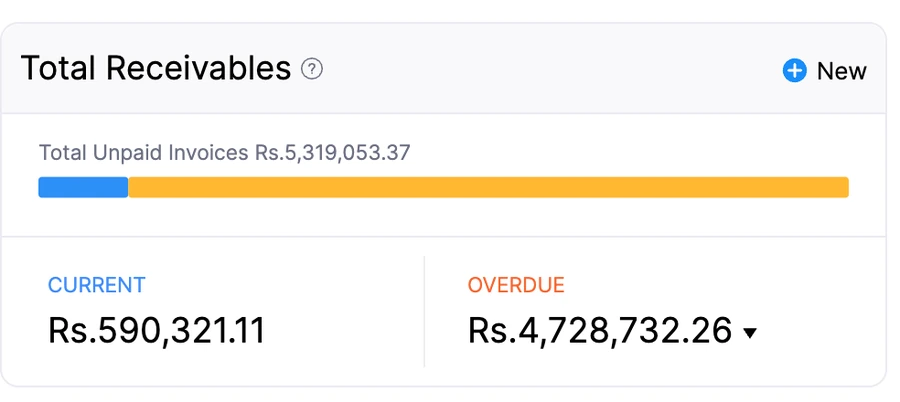
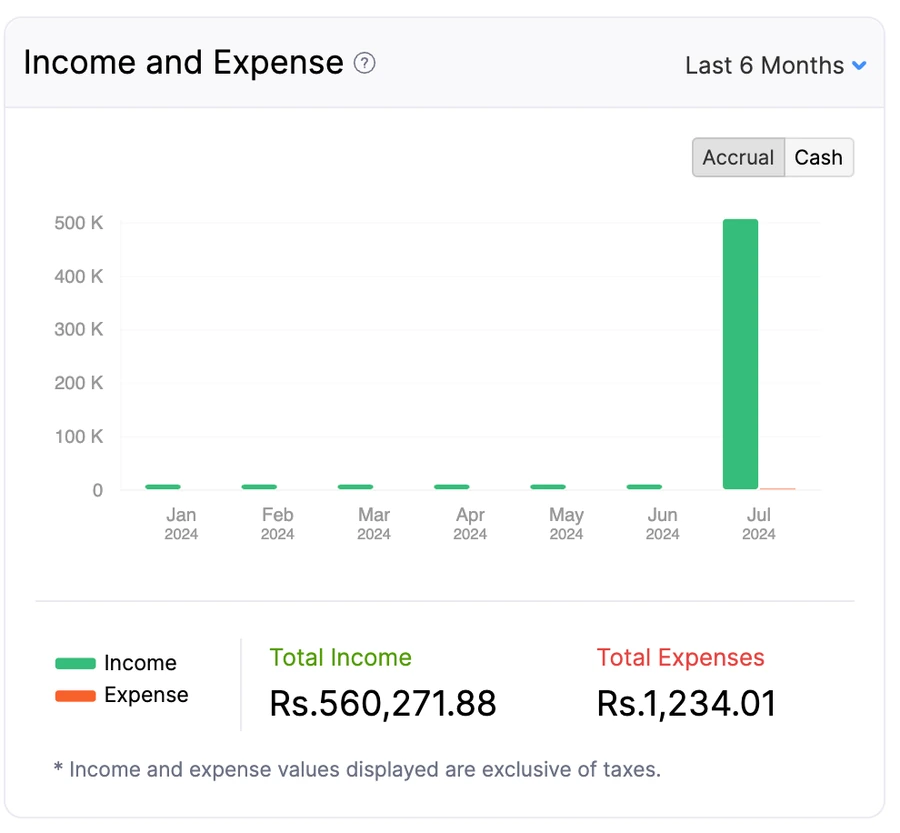
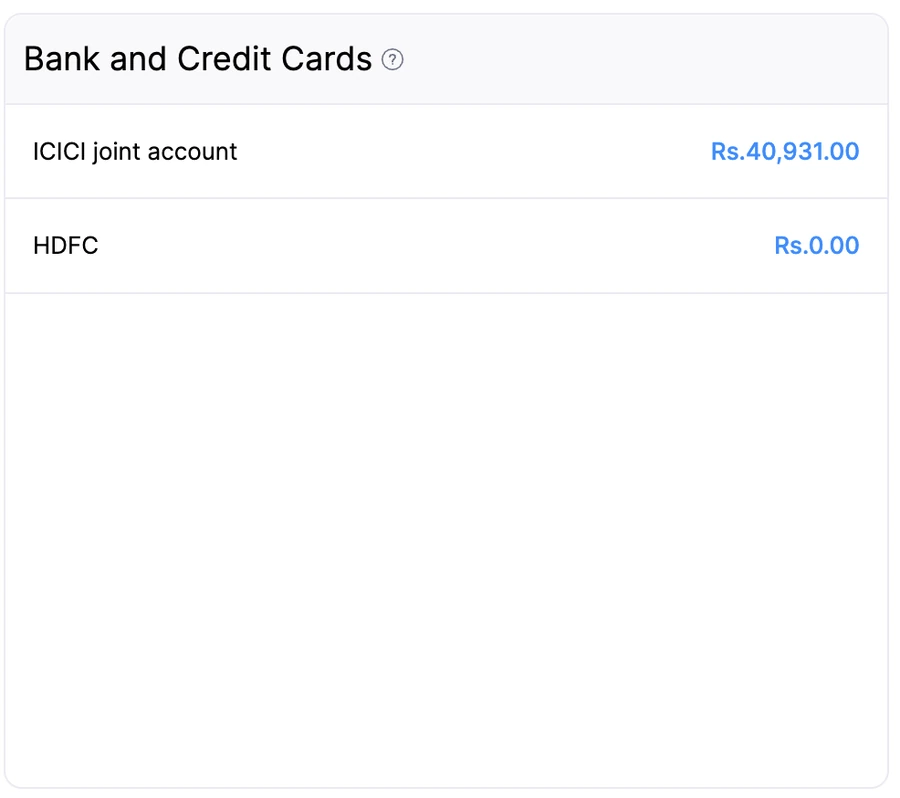
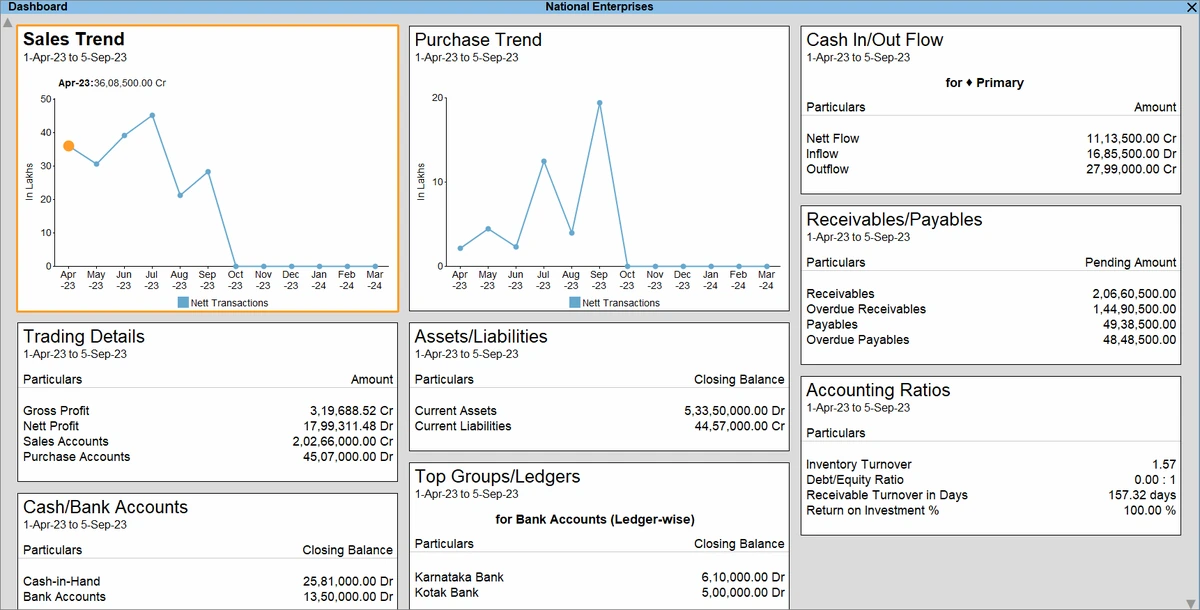
These official examples illustrate each product’s interface style. They are not a claim that the two screenshots show feature-equivalent configurations.
Five Zoho Books vs Tally claims that are now outdated
- “TallyPrime is offline-only.” It remains a local Windows application, but now has browser reports, remote access, connected banking and separately priced Cloud Access.
- “Zoho Books has no inventory.” Basic inventory is available across current plans. Warehouses, serial and batch tracking, composite items and bin locations require Elite or Ultimate.
- “Tally is a one-time cost forever.” The perpetual licence keeps working, but current upgrades, statutory updates and connected services depend on active TSS. Hosted Cloud Access is another recurring cost.
- “Tally can only export GST files.” Current releases have connected upload, reconciliation, IMS and direct GSTR-1 filing. GSTR-3B still requires final portal filing.
- “Every Tally installation is automatically MCA audit-trail compliant.” Tally says only the separate TallyPrime Edit Log application has a permanently enabled log and meets that requirement.
1. Cloud access, offline work and remote teams
Zoho Books: cloud-native access
Zoho describes Books as a cloud-based service that needs no local installation. Users can work through a browser and supported mobile or desktop applications, and changes sync through the cloud. This makes it straightforward to give an owner, accountant, sales administrator and approver access without maintaining a common office network.
The trade-off is internet dependence. Zoho Books may have device applications and cloud backup, but it should not be treated as a local accounting database designed for sustained offline voucher entry. A business with unstable connectivity should test its real daily workflow before migrating.
TallyPrime: local-first, with several remote options
The full TallyPrime desktop application runs on 64-bit Windows 7 or later. Its local-first design lets a finance team continue core data entry when the internet is unavailable. Tally’s current licensing guidance says the computer still needs to reconnect at least once every 30 days for licence validation.
Remote use is more nuanced than “Tally is offline” or “Tally is cloud”:
- TallyPrime Gold allows multiple concurrent users on the same LAN. “Unlimited users” does not mean unlimited internet users.
- Tally.NET Remote Access requires an installed TallyPrime client and active Tally Software Services (TSS). Tally documents one remote data session for Silver and up to ten for Gold.
- Reports in Browser lets authorised users view, drill down and download selected reports. It is not full mobile voucher entry.
- TallyPrime Cloud Access provides a hosted virtual environment and is separately priced per user. A TallyPrime software licence is still required.
Tally’s official Cloud Access page currently starts at ₹600 per user per month before GST. Add that amount before calling a hosted Tally deployment cheaper than a cloud subscription.
Verdict: Zoho Books has the cleaner model for a distributed team. TallyPrime has the stronger local-work continuity model. Hosted Tally can support remote work, but it adds cost and administration.
2. GST, e-Invoicing, e-Way Bills and reconciliation
Both products are serious India GST systems, but their return workflows are not identical.
GSTR-1
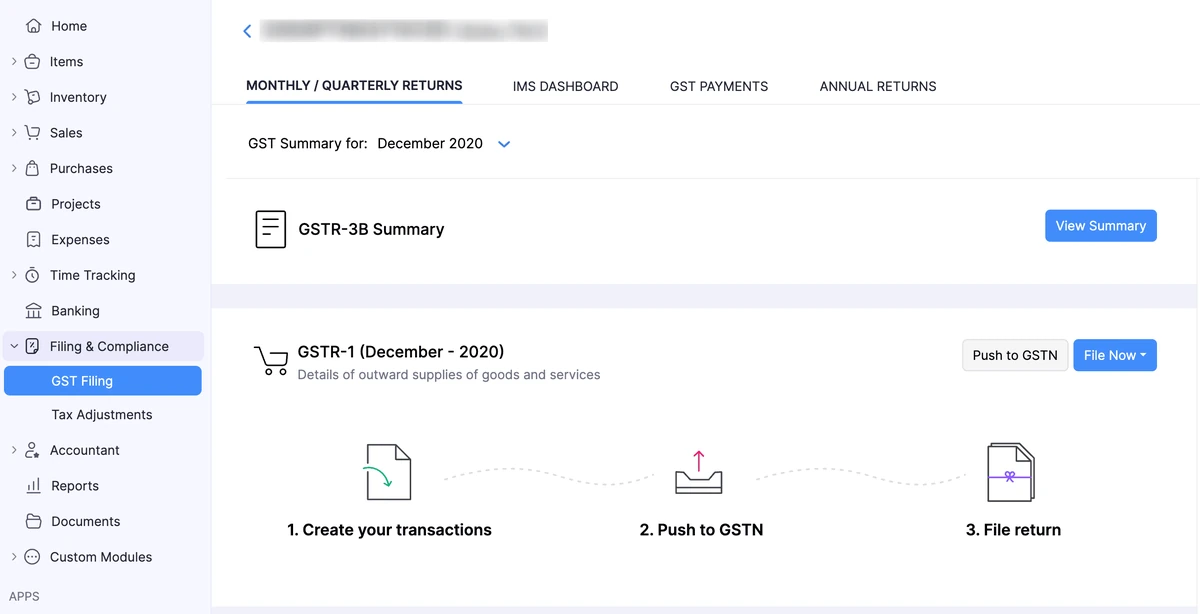
Zoho Books can push transactions to GSTN and file GSTR-1 from Zoho Books after GST portal API access is enabled. It also supports reconciling e-Invoices before pushing transactions so an IRP-populated record is not carelessly duplicated or overwritten.
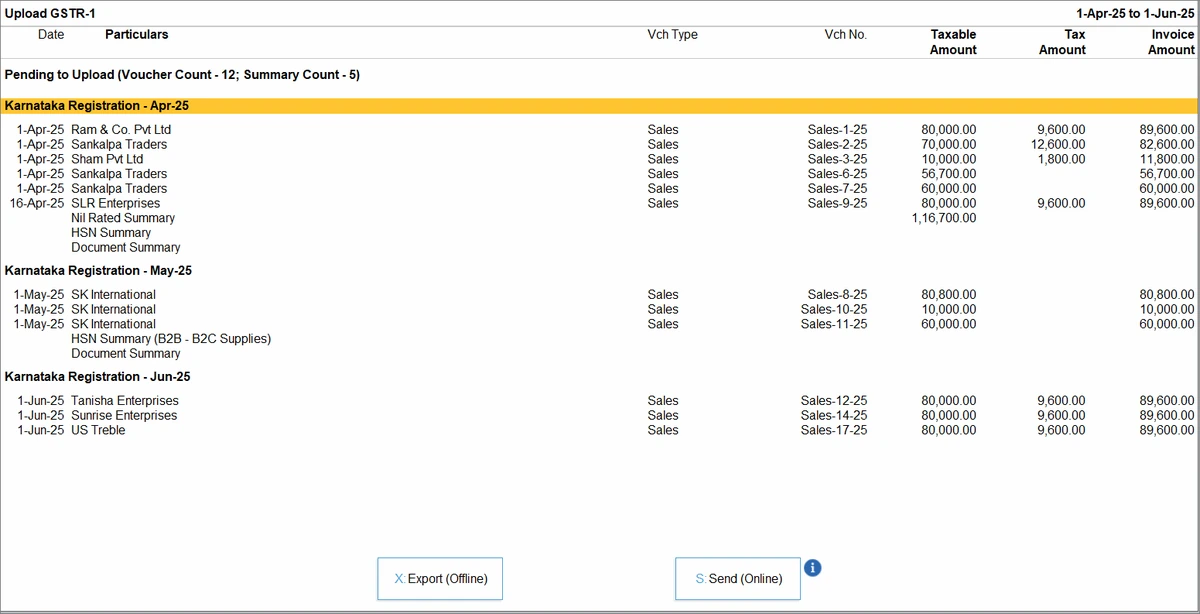
TallyPrime can prepare, reconcile, upload and complete GSTR-1 filing from TallyPrime using the configured EVC or DSC workflow. GST portal API access and login are prerequisites.
GSTR-3B
This is where articles often overstate what the software does.
Zoho Books can prepare the summary and push data to GSTN. Its current GSTR-3B help workflow then directs the taxpayer to the GST portal to pay and offset liability and complete filing. The return is subsequently marked as filed in Zoho Books.
TallyPrime can download portal values, compare books with portal data and upload GSTR-3B summaries. Tally’s own GSTR-3B filing FAQ explicitly says the upload does not finish the return: the taxpayer must prepare it online, pay any liability and file on the GST portal.
Purchase reconciliation and IMS
Zoho Books includes GSTR-2B reconciliation and an Invoice Management System workflow in its current India offering. TallyPrime supports direct download or import of GSTR-2A and GSTR-2B, reconciliation categories, and IMS accept, reject and pending actions.
Reconciling outside both products? Our free GSTR-2B reconciliation Excel template matches the purchase register against 2B in a workbook.
e-Invoice and e-Way Bill
Both products support connected e-Invoice and e-Way Bill workflows, subject to registration, configuration and active services. TallyPrime can generate IRNs, print QR codes, cancel e-Invoices and generate e-Invoices and e-Way Bills together. Zoho Books supports e-Invoicing from Standard upward and e-Way Bill generation across current plans.
TDS and TCS
Both products also support Indian TDS and TCS bookkeeping. Zoho Books can apply Income TDS across sales and purchase transactions, track liabilities and record challans. TallyPrime supports TDS/TCS setup, transaction recording, statutory reports and e-return output under its current India compliance documentation. In either system, confirm the exact form, validation utility, portal and professional-review steps rather than assuming that recording a deduction completes the statutory filing.
Verdict: Neither product wins GST merely because a button says “file” or “upload”. Test one real return cycle, including exceptions, amendments, OTP/DSC, tax payment and books-to-portal reconciliation. Also confirm that the plan and support subscription you are pricing includes the connected functions you expect.
3. Accounting, invoicing and day-to-day work
Both systems cover double-entry accounting, receivables, payables, sales, purchases, credit and debit notes, journals, bank reconciliation, financial statements and Indian tax configuration. The difference is how people do the work.
Zoho Books is form- and workflow-oriented. It is well suited to teams that create quotes, convert them to sales orders and invoices, collect online payments, route purchases for approval, attach documents, send reminders and let customers or vendors use a portal. Project time, retainers and project profitability in the Professional plan make it particularly relevant to agencies, consultants and other service businesses.
Purchase approvals, document capture and payment controls should be tested as one end-to-end process, not as isolated features. ReconScribe’s accounts payable automation guide explains the wider workflow questions to ask.
TallyPrime is voucher- and report-oriented. Experienced operators can enter and inspect high volumes of accounting and inventory transactions quickly with keyboard-driven workflows. It is also comfortable for businesses whose accountant maintains the books locally and exchanges backups or synchronised data with branches.
User preference is not a trivial issue. Ask the people who will post 500 entries a month to complete the same sample tasks in both systems. Training and correction time can easily outweigh a modest difference in licence price.
4. Banking and reconciliation
Zoho Books can import bank statements, match and categorise transactions, create transaction rules and provide automatic feeds for supported banks. Direct connectivity varies by bank, account type and current integration. Check the Zoho Books banking help and the current integration list rather than assuming every Indian bank has a live feed.
TallyPrime supports Excel, CSV and MT940 statement imports, exact and potential matching, voucher creation from imported entries and manual reconciliation. Tally’s current documentation says it supports 145+ bank statement formats. That is broader than its live connectivity: current Connected Banking material names Axis Bank, SBI, Kotak Mahindra Bank and ICICI Bank, with services differing by bank.
Verdict: Zoho Books generally offers the more natural cloud-feed and rule experience. TallyPrime has strong statement-import and reconciliation tooling. For either product, obtain written confirmation for your exact bank and account type before buying.
5. Inventory, trading and manufacturing
This category needs a plan-level comparison.
Zoho Books Free and Standard include basic stock tracking, purchase orders and sales orders. Higher plans add broader controls. The current Zoho Books India pricing page places advanced inventory control, warehouses, composite items, serial numbers, batches, shipping, sales-channel connections and bin locations in Elite.
TallyPrime includes a deeper desktop inventory and basic manufacturing-accounting set in Silver and Gold. Official documentation covers stock groups and categories, godowns, batch and expiry tracking, multiple valuation methods, reorder levels, job costing, job work, Bill of Materials, Manufacturing Journals, raw-material consumption, finished goods, co-products, by-products, scrap and additional-cost allocation. See Tally’s inventory overview and manufacturing workflow.
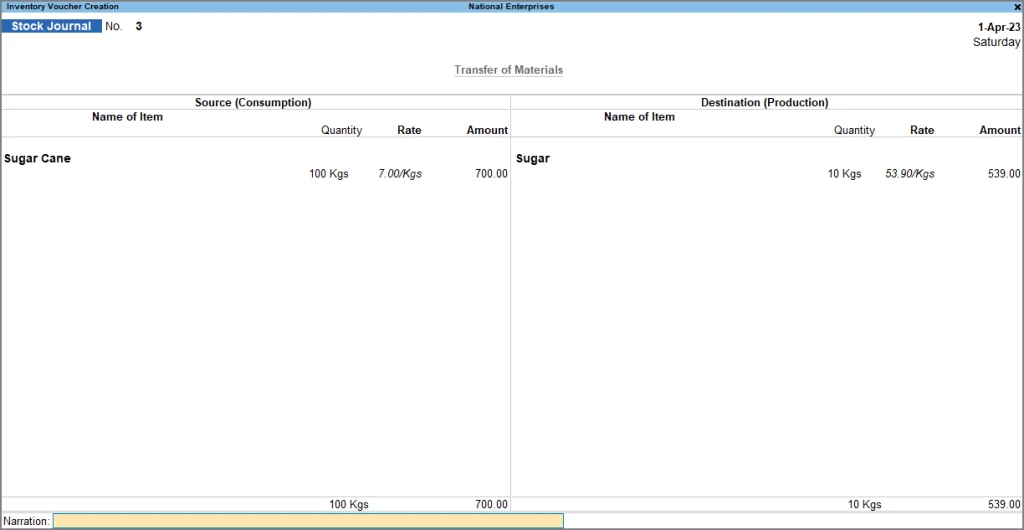
That does not make TallyPrime a full manufacturing resource planning or plant-management system. Its verified scope does not establish advanced capacity planning, production scheduling or a manufacturing execution system. A complex manufacturer may need an ERP.
Use this practical rule:
- Choose TallyPrime first for a local trading or manufacturing-accounting workflow with BOMs, job work, multiple godowns and an experienced Tally team.
- Evaluate Zoho Books Elite for cloud-based warehouses, serial/batch tracking, composite items and ecommerce connections.
- Evaluate an ERP if production planning, quality, routing, capacity, procurement and finance need one controlled system.
6. Users, permissions, approvals and audit history
Zoho Books prices users by plan: Standard includes three, Professional five, Premium ten, Elite fifteen and Ultimate twenty-five. Additional users are listed at ₹180 per month or ₹150 per month when billed annually. Professional introduces sales and purchase approvals and custom user roles; higher plans expand customisation and automation.
Zoho’s Activity Logs and Audit Trail record who performed an action, what changed, when it changed and where it occurred. Transaction versions can be compared. Companies with a statutory audit-trail obligation should still validate configuration, access controls, retention and export procedures with their auditor.
TallyPrime provides user security and an Edit Log, but there is a critical product-edition distinction. In standard TallyPrime, Edit Log can be enabled or disabled. In TallyPrime Edit Log, it is permanently active. Tally states that only the separate Edit Log application meets the MCA audit-trail requirement because the log cannot be switched off.
Do not accept a proposal that simply says “Tally has Edit Log”. Ask which application will be installed on every relevant machine, whether users can disable logging, and how the organisation will retain and review the records.
Backup and data control
Zoho Books keeps the live organisation in the cloud and lets an administrator request a whole-organisation backup in CSV format. Zoho says generation can take about 30 minutes and another organisation backup cannot be initiated for 15 days. Regular report and data exports should therefore be part of the control plan, not something done only after a cancellation decision.
TallyPrime company data is locally controlled by default. Current releases support manual or scheduled backups to a local drive or TallyDrive; cloud backup and scheduling capabilities depend on the applicable release and active TSS. Review Tally’s backup and restore procedure and test an actual restore.
Whichever product you choose, keep independent period-end exports, restrict backup access, document retention and perform restore drills. “Cloud backup” and “a folder copied occasionally” are not substitutes for a tested recovery procedure.
7. Automation, integrations and the surrounding ecosystem
Zoho Books has the clearer SaaS integration model. Depending on plan, it supports workflow rules, e-mail alerts, field updates, webhooks, scheduled actions, custom functions and APIs. It also connects with products such as Zoho CRM, Expense, Payroll, Inventory, Analytics, Projects and Commerce. The official workflow documentation explains event- and date-based triggers and actions.
TallyPrime is highly extensible, but its model is more technical. It supports XML over HTTP, ODBC, Tally Definition Language (TDL), and native JSON exchange from Release 7.0. Tally can act as a server or client in an integration. The current JSON integration guide covers native and custom JSON structures, online HTTP exchange and offline files.
Verdict: Choose Zoho Books if business users expect no-code workflows and cloud-app connections. Choose TallyPrime if a capable Tally developer or implementation partner will build and maintain the required integration. “API available” does not mean the same implementation effort in both products.
8. Payroll
TallyPrime includes payroll in Silver and Gold. Its current documentation covers employee masters, salary structures, attendance and production-based pay, pay heads, variable pay, advances, PF, ESI, NPS, Professional Tax, income tax, payslips and statutory reports. This is integrated payroll, not a complete human-resource management suite.
Zoho Books integrates with Zoho Payroll so salary expenses and statutory liabilities can flow into the accounting ledgers. The Books pricing page lists payroll management from Premium, while Zoho’s help material also describes access to a free Zoho Payroll version from Standard; limits and features therefore need to be checked for the exact Books and Payroll plans. Read the Zoho Books payroll integration help and ReconScribe’s Zoho Payroll setup guide for India before pricing the combined stack.
Verdict: TallyPrime is simpler if integrated payroll accounting is all you require. The Zoho route is stronger when payroll needs to connect with cloud HR, expense, employee self-service and analytics workflows, but its total subscription cost must include those requirements.
9. Pricing in India: current list prices
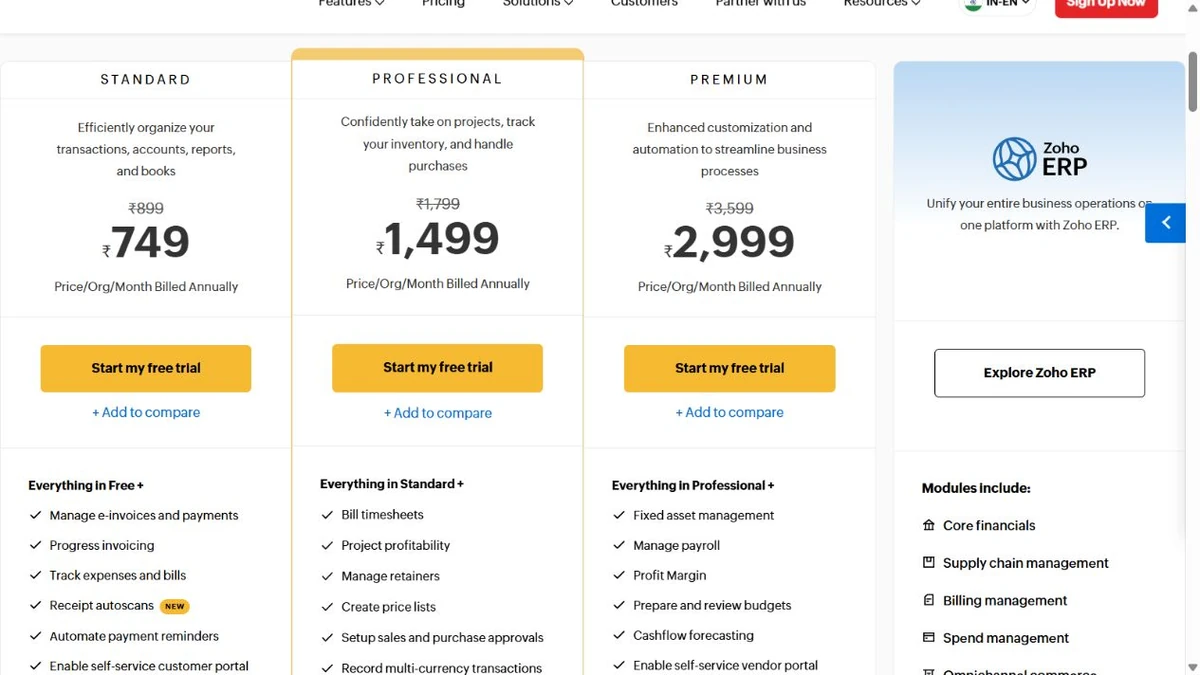
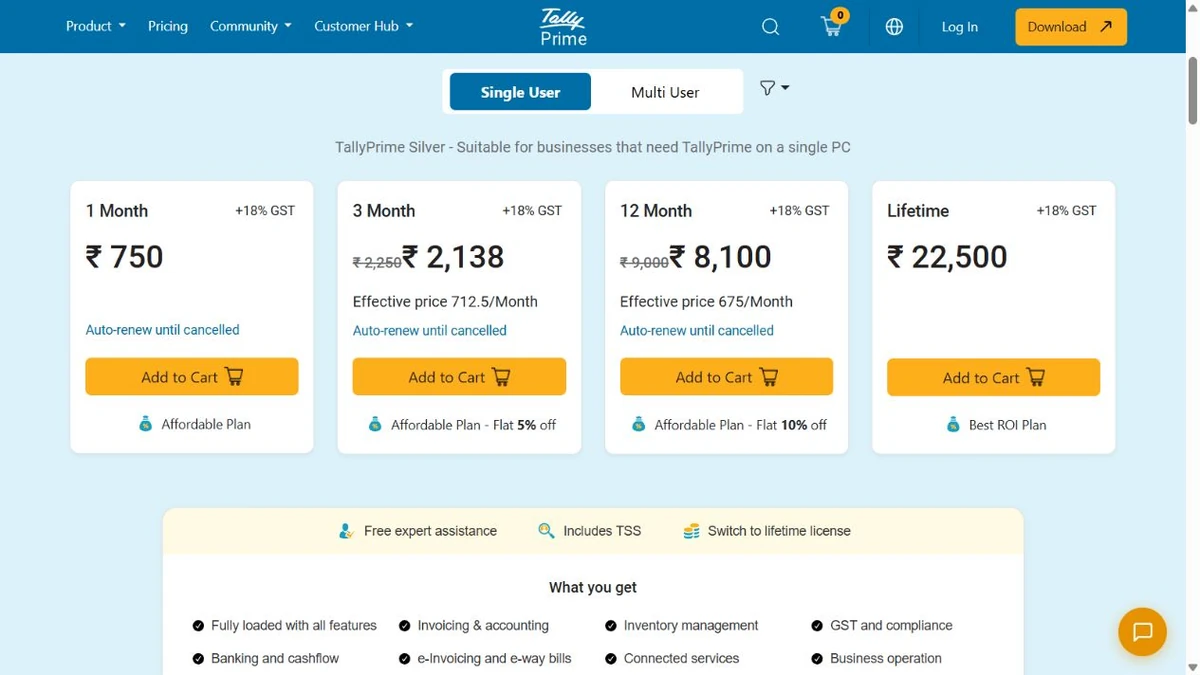
The tables below use public list prices checked on 13 August 2026. They exclude GST or other local taxes and exclude implementation, data migration, training, hardware, customisation and third-party services.
Zoho Books pricing
Swipe or scroll sideways to compare all columns.
| Plan | Monthly billing | Effective monthly price when billed annually | Included users | Important fit |
|---|---|---|---|---|
| Free | ₹0 | ₹0 | 1 user + 1 accountant | Eligible businesses with annual revenue up to ₹25 lakh; 1,000 invoices and 1,000 bills/expenses annually |
| Standard | ₹899 | ₹749 | 3 | Core accounting, GST, inventory, orders, banking and reconciliation |
| Professional | ₹1,799 | ₹1,499 | 5 | Projects, multi-currency, approvals, price lists, custom roles and workflows |
| Premium | ₹3,599 | ₹2,999 | 10 | Fixed assets, budgets, forecasting, payroll management and deeper customisation |
| Elite | ₹5,999 | ₹4,999 | 15 | Advanced inventory, warehouses, serial/batch tracking, bins and sales channels |
| Ultimate | ₹9,599 | ₹7,999 | 25 | Elite plus advanced analytics and larger reporting capacity |
Source: Zoho Books India pricing. Zoho’s published annual invoice and bill/expense limits increase by plan, from 1,000 on Free to 100,000 on Elite and Ultimate. Businesses approaching a limit should include the next plan in their cost model.
TallyPrime pricing
Swipe or scroll sideways to compare all columns.
| Licence | 1 month rental | 3 months rental | 12 months rental | Perpetual licence | Access model |
|---|---|---|---|---|---|
| Silver | ₹750 | ₹2,138 | ₹8,100 | ₹22,500 | One user on one computer at a time |
| Gold | ₹2,250 | ₹6,413 | ₹24,300 | ₹67,500 | Multiple concurrent users on the same LAN |
Source: TallyPrime official buy page and Tally’s July 2026 total-cost guide. Rentals include TSS during the active period. A new perpetual licence includes one year of TSS.
Current annual TSS renewal is ₹4,500 for Silver and ₹13,500 for Gold before GST. TSS provides major upgrades, statutory updates and connected services such as GST, banking, remote access, browser reports, synchronisation and TallyDrive. A perpetual licence continues to operate if TSS lapses, but later releases, statutory updates and connected services are unavailable until renewal.
A transparent three-year cost illustration
This is arithmetic, not a quote. It assumes current prices remain unchanged for three years and annual billing or renewal is paid on time.
Compare published licence costs
Change the assumptions below. Totals use Indian list prices checked on 13 August 2026, exclude GST, implementation, migration and unspecified add-ons, and do not imply feature equivalence.
Before tax. Zoho is priced per organisation. Tally licensing guidance ties a licence to one legal entity. User allowances, deployment rights and features differ, so the lower displayed total is not automatically the better choice.
Swipe or scroll sideways to compare all columns.
| Option | Three-year calculation | Three-year list cost before tax |
|---|---|---|
| Zoho Books Standard, up to 3 users | ₹749 × 36 months | ₹26,964 |
| Zoho Books Professional, up to 5 users | ₹1,499 × 36 months | ₹53,964 |
| TallyPrime Silver rental | ₹8,100 × 3 years | ₹24,300 |
| TallyPrime Silver perpetual with current TSS in years 2 and 3 | ₹22,500 + ₹4,500 + ₹4,500 | ₹31,500 |
| TallyPrime Gold rental | ₹24,300 × 3 years | ₹72,900 |
| TallyPrime Gold perpetual with current TSS in years 2 and 3 | ₹67,500 + ₹13,500 + ₹13,500 | ₹94,500 |
The rows are not feature-equivalent. Silver is a one-computer licence, while Zoho Standard includes three users. Gold is LAN multi-user, while Zoho Professional includes five cloud users. Tally Cloud Access, Zoho add-ons, extra organisations, implementation and migration are excluded. Use the table to expose cost components, not to declare a winner.
Multi-company buyers need another licensing check. Zoho Books pricing is per organisation. TallyPrime can technically create multiple company datasets, but Tally’s current licensing guidance ties a licence to one legal business entity. Do not assume that “create multiple companies” means one licence lawfully covers unrelated entities.
If you choose not to renew TSS on a perpetual Tally licence, the three-year licence outlay remains ₹22,500 for Silver or ₹67,500 for Gold before tax, but you give up current statutory updates and connected services. That is rarely a sensible comparison for an actively GST-registered business.
Before buying Zoho Books
Use the official pricing page to confirm the plan that covers your users, invoice volume, inventory, approvals and locations. If Zoho Books fits, use the link below to explore the available Zoho options.
Verify the displayed product, India edition, price and plan before purchase.
10. Which product fits your business?
Find the closest real-world scenario
Select the situation nearest to yours. The recommendation includes the check that can change it.
Select a scenario to see the practical starting point.
Service firm or agency
Starting point: Zoho Books is the stronger starting point.
Why: Cloud access, projects, approvals and connected workflows suit distributed service delivery.
Watch before buying: Check the exact plan for projects, users, multi-currency and approval limits.
Remote team
Starting point: Zoho Books is usually the cleaner operating model.
Why: Browser access, mobile use and cloud roles are native rather than a hosted desktop add-on.
Watch before buying: Compare against TallyPrime Gold plus any Cloud Access users, not a bare Silver licence.
Local accountant-led business
Starting point: TallyPrime is a strong starting point.
Why: A familiar Windows voucher workflow can reduce training and correction time for an established local finance team.
Watch before buying: Price TSS, backups and any remote-access requirement rather than comparing only the licence headline.
Trading business
Starting point: Pilot both systems with your real stock workflow.
Why: TallyPrime is strong for familiar godown and voucher operations; Zoho Elite is attractive for cloud warehouses and channels.
Watch before buying: Test valuation, batches, serials, purchase returns and month-end reports.
Ecommerce or D2C
Starting point: Zoho Books is the stronger cloud starting point.
Why: Cloud sales-channel connections and connected inventory workflows can reduce handoffs between orders and accounts.
Watch before buying: Confirm every sales channel, return flow, warehouse and transaction-volume limit before buying.
Manufacturing
Starting point: TallyPrime is the stronger accounting-software starting point.
Why: BOMs, Manufacturing Journals, job work and costing align with basic production accounting.
Watch before buying: If you need routings, capacity or shop-floor control, assess an ERP instead.
Already on Zoho
Starting point: Zoho Books usually has the integration advantage.
Why: CRM, Expense, Payroll, People and Analytics can reduce duplicate data and approval handoffs.
Watch before buying: Calculate the full suite price and confirm which connections and limits are included.
Unreliable internet
Starting point: TallyPrime is the safer local-first starting point.
Why: Core desktop data entry can continue during an outage.
Watch before buying: Still test backups, licence validation, remote support and branch data exchange.
Audit-trail requirement
Starting point: There is no generic winner from the feature label alone.
Why: The installed edition, ability to disable logs, user roles, retention and review process determine whether the control works.
Watch before buying: For Tally, verify the separate TallyPrime Edit Log application. For Zoho, have the auditor test the exact activity history and operating controls.
11. Migration: TallyPrime to Zoho Books or Zoho Books to TallyPrime
Migration risk is usually higher than licence-price risk. A cheap subscription does not compensate for wrong opening balances, duplicate parties, missing bill references or unreconciled GST data.

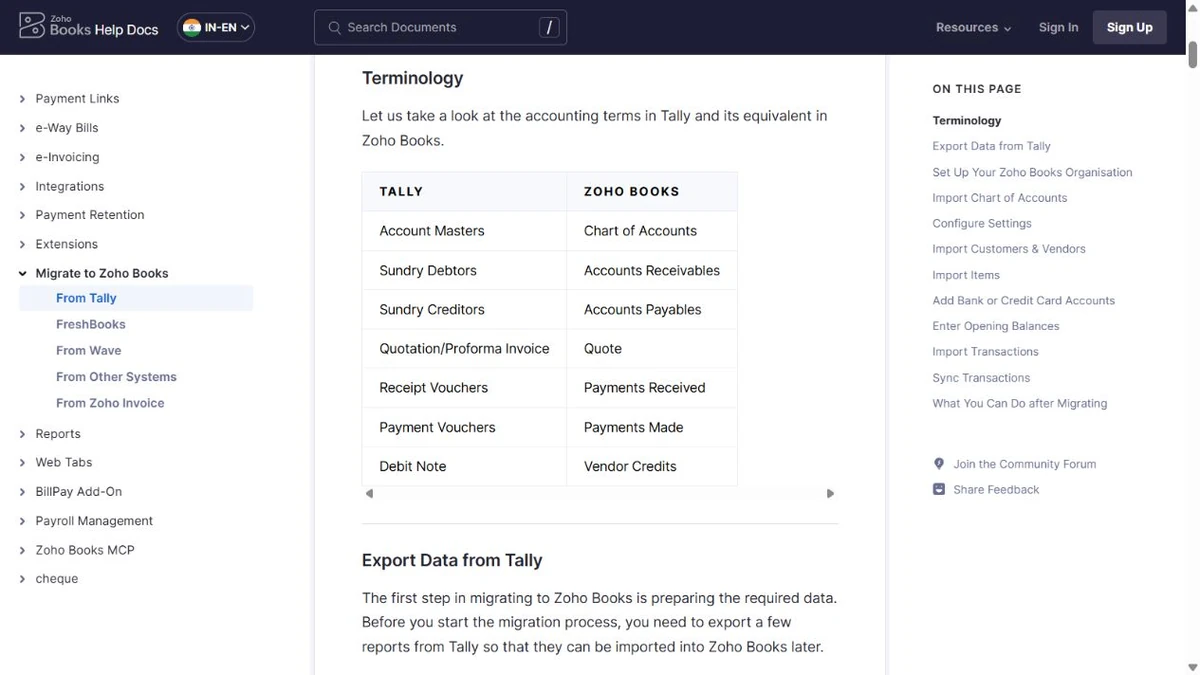
Zoho publishes a specific Tally-to-Zoho Books migration guide. It covers exporting Tally stock summary, master data, voucher data and trial balance, then importing the chart of accounts, contacts, items, opening balances and transactions into Zoho Books.
For either migration direction, use this cutover checklist:
Migration checklist
Use this whether you are moving from TallyPrime to Zoho Books or the other way around.
0 of 10 completed
Do not delete the old system after migration. Retain exports, backups, audit history and the original reports needed to support prior periods.
12. What about QuickBooks, QuickBooks Enterprise and SAP?
For an India GST business, QuickBooks is no longer a normal local contender. Intuit states that new India sign-ups ended in July 2022, subscribers retained access through 30 April 2023, and access to QuickBooks products in India ended on 1 July 2023. The affected list includes QuickBooks Online, QuickBooks Online Accountant, the mobile app and QuickBooks Time.
QuickBooks Enterprise is a separate Windows desktop product presented on Intuit’s US Enterprise pages. Those pages do not establish it as a supported India GST edition, so it should not be inserted into an India shortlist as though it were one. It may still matter for an overseas entity, but that is a different comparison involving local tax, support, hosting and accountant requirements.
“SAP vs Tally” is also too broad. The closer small-business ERP comparison is often SAP Business One, which SAP positions for accounting, purchasing, inventory, sales, CRM, reporting and analytics. It is quote- and partner-led, and implementation is materially more involved than buying Zoho Books or TallyPrime. Evaluate SAP Business One when the business needs connected ERP controls, not simply because it wants a more famous accounting brand.
For a wider country-by-country shortlist, read ReconScribe’s best accounting software by location.
Need professional help choosing or migrating?
A software demo can show features. It cannot tell you whether your ledgers are clean, how your GST workflow should be mapped, which inventory controls you actually need, or what will fail during migration.
ReconScribe can help you compare the right plans, map requirements, plan a TallyPrime-to-Zoho Books or Zoho-to-Tally cutover, clean masters and opening balances, configure GST and approvals, and supervise the first reporting cycle. Fill in the form below. Your requirements go directly to the ReconScribe team.

Want a professional second opinion?
Send us your current setup and the result you need. We will review the likely fit, migration risks and next steps before discussing scope. Your requirements go directly to the ReconScribe team.
Final verdict
Zoho Books is the better default for a cloud-first service or growing business that values remote access, approvals, automation and the Zoho ecosystem.
TallyPrime is the better default for a Windows-first, accountant-led, inventory-heavy or basic manufacturing business that values local operation and deep Indian desktop workflows.
Neither conclusion is universal. Compare the correct Zoho plan with the correct Tally licence and deployment. Then test your own GST return, bank statement, invoice, stock workflow and month-end reports before signing off.
A migration acceptance test you can use in both products
Create fictional vendor DEMO-V01 and a purchase invoice for ₹10,000 plus assumed GST of ₹1,800. Add a supplier credit note for ₹2,000 plus ₹360 tax and apply a ₹5,000 payment. Expected open payable is ₹4,440: ₹11,800 − ₹2,360 − ₹5,000.
In each trial, inspect the vendor statement, credit-note linkage, bank entry, tax report and period lock. Add the invoice twice to observe duplicate handling. Compare the evidence and staff correction time. These expected values are our original fixture; they are not a claim that ReconScribe ran it inside both products.
Frequently asked questions
Is Zoho Books better than TallyPrime?
Zoho Books is generally a better fit for cloud access, remote teams, approvals, automation and Zoho integrations. TallyPrime is generally a better fit for local Windows operation, experienced Tally users, deeper built-in inventory and basic manufacturing accounting. Your workflow decides the winner.
Is Zoho Books cheaper than TallyPrime?
It depends on users and deployment. At current annual billing, Zoho Books Standard costs ₹26,964 before tax over three years for up to three users. TallyPrime Silver rental costs ₹24,300 over three years but is for one user on one computer. TallyPrime Gold is the LAN multi-user licence and costs more. Hosting, add-ons and implementation can change the result.
Is TallyPrime cloud-based?
The full product is a Windows desktop application with local data. Tally also offers Remote Access, browser reports and separately priced TallyPrime Cloud Access. Those services have different capabilities and should not be treated as one generic “cloud Tally” feature.
Can Zoho Books work without internet?
Zoho Books is cloud-based and normal accounting work depends on internet access. It has device applications and cloud sync, but businesses that need sustained offline voucher entry should test carefully or favour a local-first system.
Which is better for GST filing?
Both support substantial GST workflows. Zoho Books and TallyPrime can file GSTR-1 through their connected workflows. Both can prepare and push GSTR-3B data, but final GSTR-3B payment, offset and filing are completed on the GST portal. Test exceptions and reconciliation, not just the happy path.
Can I migrate from TallyPrime to Zoho Books?
Yes. Zoho publishes a Tally migration guide covering master data, items, opening balances and transactions. A controlled migration still requires data cleanup, mapping, reconciliation, a pilot and sign-off.
Which product is better for inventory and manufacturing?
TallyPrime has stronger built-in desktop inventory and basic manufacturing accounting, including BOMs, Manufacturing Journals, job work and costing. Zoho Books Elite provides advanced cloud inventory such as warehouses, serial and batch tracking, composite items, bin locations and sales channels. Complex plants should assess an ERP.
Does TallyPrime automatically meet the MCA audit-trail requirement?
Not every installation does. Tally says standard TallyPrime lets users turn Edit Log on or off, while the separate TallyPrime Edit Log application keeps it permanently enabled and is the edition that meets the requirement. Confirm the installed application and operating controls with the auditor.
Is QuickBooks still available in India?
No. Intuit says access to QuickBooks products in India ended on 1 July 2023. An overseas entity can separately evaluate a supported QuickBooks product, but it is not a current local India GST edition.
Editorial and professional-use note
This article is educational and is not accounting, tax, legal or implementation advice. Product availability, prices, plan limits, connected bank support and statutory workflows change. Confirm current details with the vendor and obtain professional sign-off before migration or filing.