
Claude Haiku 5.5 costs up to 90% less than Haiku 4.5 and leaves it far behind. It scores 72.4% on OSWorld 2.1, the test of operating a real computer, against Haiku 4.5’s 15.7%. On GDPval-AA, which is built on real professional work, it reaches 1620 Elo against 735. And it costs $0.10 per million input tokens and $0.50 per million output tokens, against $1 and $5. Cheap and fast no longer means weak.
Anthropic released Claude Haiku 5.5 on 7 October 2026, the third model in the Claude 5.5 family after Opus 5.5 and Sonnet 5.5. It is Anthropic’s fastest model to date, the first Haiku with adjustable effort, and the first Haiku with a 1M token context window. It is built for high-volume work: classification, extraction, routing, summaries, compaction of long conversations, and subagent jobs under a bigger model. On average it costs around 75% less to run than Haiku 4.5.
It is not a Sonnet replacement. For complex agentic coding, Sonnet 5.5 and Opus 5.5 remain the better choice, and Terminal-Bench 4.0 shows why: 39.2% against Sonnet 5.5’s 70.6%. But for the narrow, repetitive jobs that run thousands of times a day, Claude Haiku 5.5 is now the obvious default. Below you will find every benchmark Anthropic published, the cost per task at every effort level, what the new tokenizer and the 100,000 token price line do to your bill, and how it compares with GPT-6 Luna, which lists exactly the same price.
Claude Haiku 5.5: the short answer
Claude Haiku 5.5 against Haiku 4.5, GPT-6 Luna and, for reference, Sonnet 5.5:
Scores from Anthropic’s launch page, at max effort. Teal marks the best of the three small models in each row; Sonnet 5.5 is shown for reference, as on Anthropic’s own table. Prices are per million input and output tokens, for prompts up to 100,000 tokens.
| Fact | Claude Haiku 5.5 |
|---|---|
| Released | 7 October 2026 |
| Family | Third model in the Claude 5.5 family, after Opus 5.5 (22 September) and Sonnet 5.5 (28 September) |
| Model ID | claude-haiku-5-5 (Amazon Bedrock: anthropic.claude-haiku-5-5) |
| Where you can use it | Claude API, Amazon Bedrock, Claude Platform on AWS, Google Cloud and Microsoft Foundry, plus the Claude apps |
| Input / output price | $0.10 / $0.50 per 1M tokens for prompts up to 100,000 tokens; $0.50 / $2.50 above that (Haiku 4.5: $1 / $5) |
| Cache reads | $0.01 per 1M tokens ($0.05 for prompts over 100,000 tokens) |
| Cache writes | $0.125 per 1M tokens for 5 minutes, $0.20 for 1 hour (five times that over 100,000 tokens) |
| Batch processing | Half price: $0.05 / $0.25 per 1M tokens |
| Tokenizer | The newer Claude tokenizer: the same text counts as about 30% more tokens than on Haiku 4.5 |
| Context window | 1M tokens (Haiku 4.5: 200K) |
| Max output | 128K tokens (Haiku 4.5: 64K), up to 300K on the Batches API with a beta header |
| Input and output | Text and images in, text out |
| Knowledge cutoff | June 2026 |
| Thinking | Adaptive, on by default |
| Effort levels | low, medium, high, xhigh, max. Medium is the default on the API and in Claude Code |
| Speed | Anthropic’s fastest model to date at standard speed |
| Available until | At least 7 October 2027 |
What is new in Claude Haiku 5.5
Anthropic calls Claude Haiku 5.5 the cheapest, fastest and most capable small model it has released. Against Haiku 4.5, seven things changed:
- A big jump in capability. OSWorld computer use rises from 15.7% to 72.4%, Terminal-Bench 4.0 from 0.0% to 39.2%, and Humanity’s Last Exam without tools from 10.2% to 45.9%. In a few areas it rivals or beats Sonnet 5.5.
- Adjustable effort, a first for Haiku. Like the bigger models, it takes low, medium, high, xhigh and max effort, so you choose between cost and intelligence on every request. Medium is the default.
- A much bigger window. 1M tokens of context and 128K tokens of output, up from 200K and 64K.
- A far lower price, with a new rule. Prompts up to 100,000 tokens cost 90% less per token than on Haiku 4.5. Longer prompts cost 50% less, because unlike Opus 5.5 and Sonnet 5.5, Haiku 5.5 is priced by prompt length.
- A new tokenizer. The same text now counts as about 30% more tokens, which eats part of the price cut. We work through the real numbers in the pricing section.
- Speed. It is Anthropic’s fastest model to date at standard speed. Only the Opus models in fast mode, a premium option, run quicker.
- Computer and browser use. It drives a computer through Anthropic’s new computer use toolset and can use the new browser use tool, which Haiku 4.5 could not. Anthropic’s Python and TypeScript SDKs now support both, in beta.
Anthropic positions it as a partner to its bigger models rather than a rival. The suggested jobs are summaries, compaction, database queries, classification, live customer support, browser tasks, and work as a fast subagent while Opus 5.5 or Sonnet 5.5 leads a coding job. Rogo gave a neat example from early testing: while a bigger model builds a slide deck, a Claude Haiku 5.5 subagent goes into a company’s annual report and pulls out the one revenue line the deck needs.
Claude Haiku 5.5 benchmarks: the official launch table
Here are the launch benchmarks exactly as Anthropic published them, with a plain note on what each test measures. Sonnet 5.5 sits in the last column for reference, as it does on Anthropic’s page:
| Benchmark | What it tests | Haiku 5.5 | Haiku 4.5 | GPT-6 Luna | Sonnet 5.5 |
|---|---|---|---|---|---|
| GDPval-AA v2.1 | Real professional work across 44 occupations (Elo) | 1620 | 735 | 1437 | 1840 |
| AA-Briefcase v1.1 | Long, multi-week knowledge work projects (Elo) | 1578 | 614 | 1336 | 1824 |
| OSWorld 2.1 (offline subset) | Operating a real computer through long tasks, partial credit | 72.4% | 15.7% | 48.9% | 83.9% |
| Humanity’s Last Exam, no tools | Expert questions across dozens of subjects | 45.9% | 10.2% | not reported | 56.9% |
| Humanity’s Last Exam, with tools | The same, with search and code | 57.4% | 18.7% | not reported | 64.5% |
| Terminal-Bench 4.0 | Agentic coding in a command line | 39.2% | 0.0% | 16.4% | 70.6% |
| FrontierCode 1.1 (Main) | Whether an agent’s code changes would be merged | 46.4% | not reported | 42.4% | 52.1% (xhigh) |
| Chartography, no tools | Reading values off complex charts | 46.4% | 6.4% | 29.1% | 61.6% |
Haiku 5.5 vs Haiku 4.5: a different class of model
Claude Haiku 5.5 wins every row against both small rivals, and the margins over Haiku 4.5 are not small: on Terminal-Bench 4.0, Haiku 4.5 did not pass a single trial, and on GDPval-AA the new model more than doubles the old one’s Elo.
Where Claude Haiku 5.5 beats GPT-6 Luna
GPT-6 Luna is OpenAI’s small model, released on 22 September 2026 alongside GPT-6 Sol, and it lists exactly the same price. On Anthropic’s table, Haiku 5.5 leads it everywhere both are scored: 72.4% against 48.9% on OSWorld, 39.2% against 16.4% on Terminal-Bench 4.0, 46.4% against 29.1% on Chartography, and 1620 against 1437 Elo on GDPval-AA. The FrontierCode gap is the narrowest, 46.4% against 42.4%. We compare the two in full further down.
Where Sonnet 5.5 still leads
Sonnet 5.5 is ahead on every row, which is what you would expect from a model that costs 20 times as much per token. The size of each gap tells you where Haiku 5.5 fits. The gaps are modest on knowledge work and computer use: 72.4% against 83.9% on OSWorld, and 220 Elo on GDPval-AA. They are large on agentic coding: 39.2% against 70.6% on Terminal-Bench 4.0. That is why Anthropic recommends Haiku 5.5 for narrow, well-scoped tasks and keeps Sonnet 5.5 and Opus 5.5 for complex coding agents.
The fine print behind the table
- Claude Haiku 5.5 results use adaptive thinking at max effort, averaged over five trials, unless a row says otherwise. Haiku 4.5 has no effort setting, so it ran with fixed thinking budgets.
- FrontierCode: Haiku 5.5 scored 46.4% at max and 45.8% at xhigh. Sonnet 5.5’s 52.1% is its best score, at xhigh; at max it scored 46.2%, just below Haiku 5.5.
- OSWorld uses the benchmark’s offline subset: 82 of its 108 tasks, with no internet access. Anthropic ran GPT-6 Luna on the same 82 tasks through OpenAI’s API.
- Terminal-Bench 4.0: Haiku 5.5 ran with its safeguards on and no fallback model, so the 1.8% of trials the safeguards stopped all counted as failures. GPT-6 Luna’s 16.4% comes from the public leaderboard.
- Artificial Analysis ran GDPval-AA and AA-Briefcase independently, and Luna’s Chartography score is as published by Surge AI, the benchmark’s maker.
Every other Claude Haiku 5.5 benchmark in the system card
The launch page shows eight results. Anthropic’s 144-page Claude Haiku 5.5 system card has many more. Here is every capability result it reports with a number, grouped by the kind of work. First, the extra rows from the system card’s own summary table, at max effort:
| Benchmark | Haiku 5.5 | Haiku 4.5 | Sonnet 5.5 |
|---|---|---|---|
| SWE-Bench Pro | 64.8% | not reported | 81.3% |
| SWE-bench Multilingual | 83.7% | 67.4% | 90.3% |
| SWE-bench Multimodal | 30.7% | 19.8% | 54.3% |
| HealthBench Professional | 64.8% | 32.2% | 69.2% |
Coding and agents
| Benchmark | What it tests | Claude Haiku 5.5 | For comparison |
|---|---|---|---|
| FrontierCode Extended | The full 150-task FrontierCode set | 58.4% at max | Sonnet 5.5 59.1% at max, 64.4% at xhigh |
| Terminal-Bench-Science 0.1 | 70 research tasks from the life, physical, earth, maths and engineering sciences | 20.6% | Sonnet 5.5 59.9%, Opus 5.5 58.7%, Haiku 4.5 0.1% |
| FrontierSWE v2 | 34 very long engineering and research tasks, with up to 20 hours each | 43.8% | Claude Fable 5 47.0% |
| ProgramBench | Rebuilding a program from its binary and documentation, with up to 1M tokens of context | 82.0% | Sonnet 5.5 79.7%, Opus 5.5 91.2% |
| OSWorld 2.1, strict | Computer use where every checkpoint must pass | 37.1% | Sonnet 5.5 48.8%, Opus 5.5 53.2% |
ProgramBench is the surprise: Claude Haiku 5.5 beats Sonnet 5.5 on it, 82.0% against 79.7%. It is a long-context coding test where episodes run up to the full 1M token window, which is a good sign for jobs that read a lot and write a little.
Office and knowledge work
| Benchmark | What it tests | Claude Haiku 5.5 | For comparison |
|---|---|---|---|
| GDPval-AA v2.1 | Real work across 44 occupations and nine industries (Elo) | 1620 at max, 1277 at medium | GPT-6 Luna 1437, Gemini 3.8 Flash 1435, Sonnet 5.5 1840 |
| AA-Briefcase v1.1 | Long-horizon knowledge work (Elo) | 1578 at max, 1372 at medium | GPT-6 Luna 1336, Gemini 3.8 Flash 1203, Sonnet 5.5 1824 |
| OfficeQA | Finding the right tables in long U.S. Treasury Bulletin documents and calculating from them | 73.5% | Haiku 4.5 63.0%, Sonnet 5.5 76.9% |
| OfficeQA Pro | The harder 133-question subset | 60.3% | Haiku 4.5 47.1%, Sonnet 5.5 65.6% |
The medium-effort figures matter more than they look. Medium is the default, and at medium Claude Haiku 5.5 used about a tenth of the output tokens it needed at max on GDPval-AA, and under a quarter on AA-Briefcase. Even at medium it scores far above Haiku 4.5’s 735 and 614.
Reasoning and vision
| Benchmark | What it tests | Claude Haiku 5.5 | For comparison |
|---|---|---|---|
| Humanity’s Last Exam | Expert questions across dozens of subjects | 45.9% without tools, 57.4% with tools | Haiku 4.5 10.2% and 18.7%, Sonnet 5.5 56.9% and 64.5% |
| Chartography | Reading values off specialised charts, such as candlestick and Sankey charts | 46.4% without tools, 86.2% with tools | Haiku 4.5 6.4% and 8.8%, Sonnet 5.5 61.6% and 90.2% |
| BenchCAD Vision2Code | Writing CAD code from multi-view drawings (1.0 is a perfect match) | 0.670 without tools, 0.870 with tools | Haiku 4.5 0.155 and 0.210, Sonnet 5.5 0.747 and 0.963 |
Tools change the picture for charts. With a cropping tool and code, Haiku 5.5 reads 86.2% of Chartography’s charts correctly, close to Sonnet 5.5’s 90.2%. If your work involves reading charts or scanned reports, give it tools.
Health and languages
| Benchmark | What it tests | Claude Haiku 5.5 | For comparison |
|---|---|---|---|
| HealthBench Professional | Answers to questions from health professionals, adjusted for length | 64.8% | Haiku 4.5 32.2%, Sonnet 5.5 69.2% |
| PhysicianBench | 100 physician tasks in an electronic health record | 43.0% | GPT-6 Luna 33.6%, Sonnet 5.5 63.2%, Opus 5.5 68.4% |
| GMMLU | General knowledge in 42 languages | 87.8% | Sonnet 5.5 92.1%, Opus 5.5 94.3%, Fable 5.1 94.0% |
| MILU | Ten Indian languages plus English | 87.6% | Sonnet 5.5 91.6%, Opus 5.5 93.1%, Fable 5.1 93.0% |
Anthropic also charted DRACO and WANDR, Perplexity’s deep and wide research tests, but published those as charts without headline numbers. One more pattern is worth knowing: Haiku 5.5 gains more from extra effort than the bigger models do. Its HealthBench Professional score rises from 57.9% at low to 64.8% at max, while Sonnet 5.5, Opus 5.5 and Fable 5.1 each move by less than two points across all five levels.
Claude Haiku 5.5 cost per task at every effort level
The single table hides the most useful part of this launch. Anthropic also published charts that plot each model’s score against the cost of running one task, at every effort level. Higher effort means the model thinks and works for longer, so each task costs more and usually scores higher. The closer a point sits to the top left, the more you get per dollar.
Medium is the default effort on the Claude API and in Claude Code, so that is the point most people will actually get. We turned all four charts into tables below. Haiku 4.5 has no effort setting, so it appears as a single point on each chart.
First, the spread on one test. Here is what each effort level costs and scores on GDPval-AA, the knowledge work test:
Claude Haiku 5.5 cost per task and Elo on GDPval-AA at each effort level, from Anthropic’s chart. Medium is the default on the API and in Claude Code.
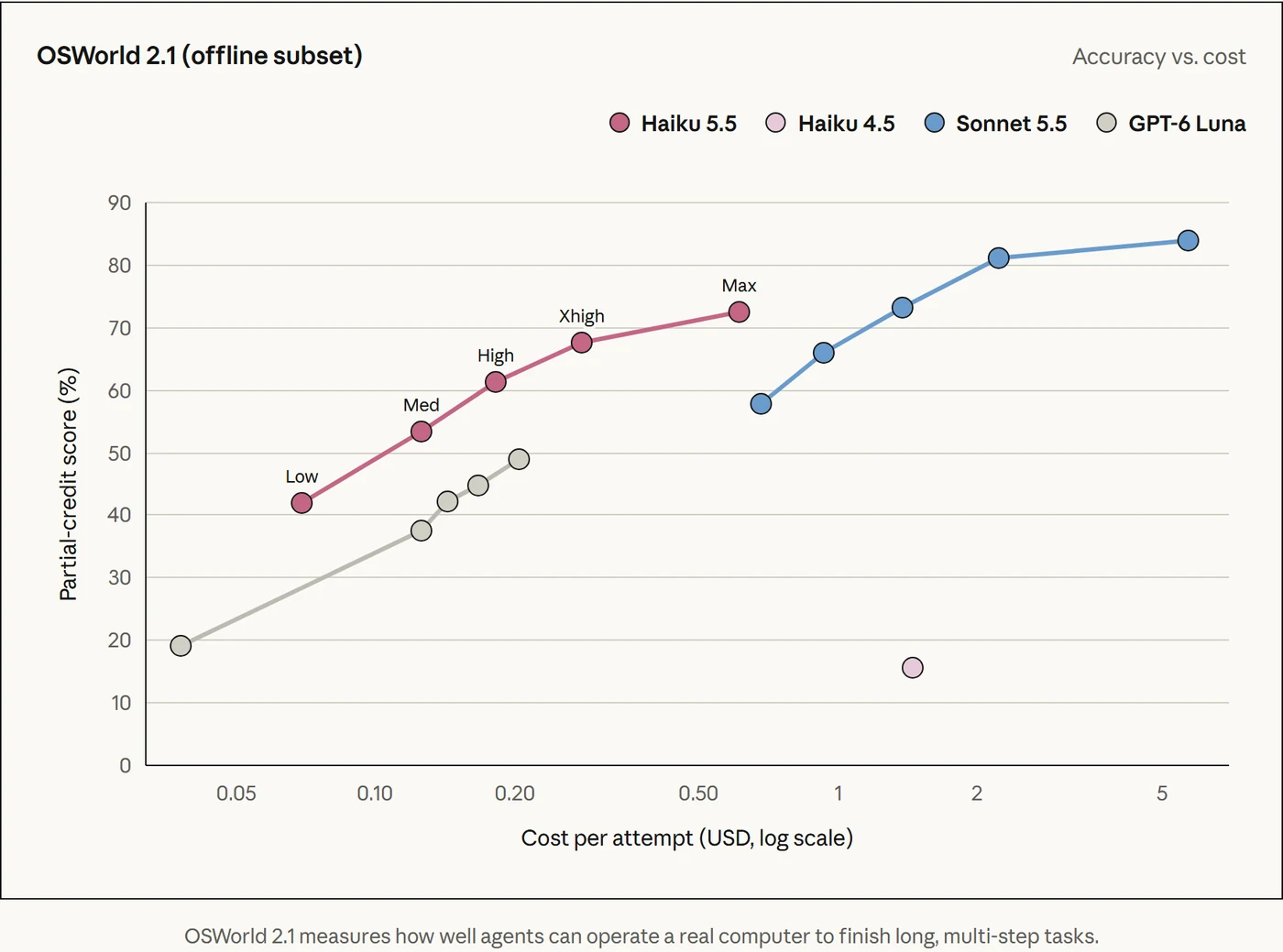
OSWorld 2.1: operating a real computer
| Effort | Claude Haiku 5.5 | Claude Sonnet 5.5 | GPT-6 Luna |
|---|---|---|---|
| Low | 42.0% at $0.07 | 57.9% at $0.68 | 19.2% at $0.04 |
| Medium (default) | 53.3% at $0.13 | 66.0% at $0.93 | 37.5% at $0.13 |
| High | 61.3% at $0.18 | 73.2% at $1.38 | 42.3% at $0.14 |
| Xhigh | 67.6% at $0.28 | 81.1% at $2.22 | 44.8% at $0.17 |
| Max | 72.4% at $0.61 | 83.9% at $5.73 | 48.9% at $0.20 |
This is Claude Haiku 5.5’s best chart. At Medium, the default, it scores 53.3% for $0.13 an attempt, already above GPT-6 Luna’s best of 48.9%, which costs $0.20. At Max it reaches 72.4% for $0.61, almost level with Sonnet 5.5 at High (73.2%) for less than half the cost. Haiku 4.5 scored 15.7% for $1.45, so even the new model’s Low setting beats it by 26 points, at about a twentieth of the cost.
Sonnet 5.5 still owns the top of the chart. If you need more than about 72%, Sonnet 5.5 at High or above is the only option here, at $1.38 to $5.73 an attempt.
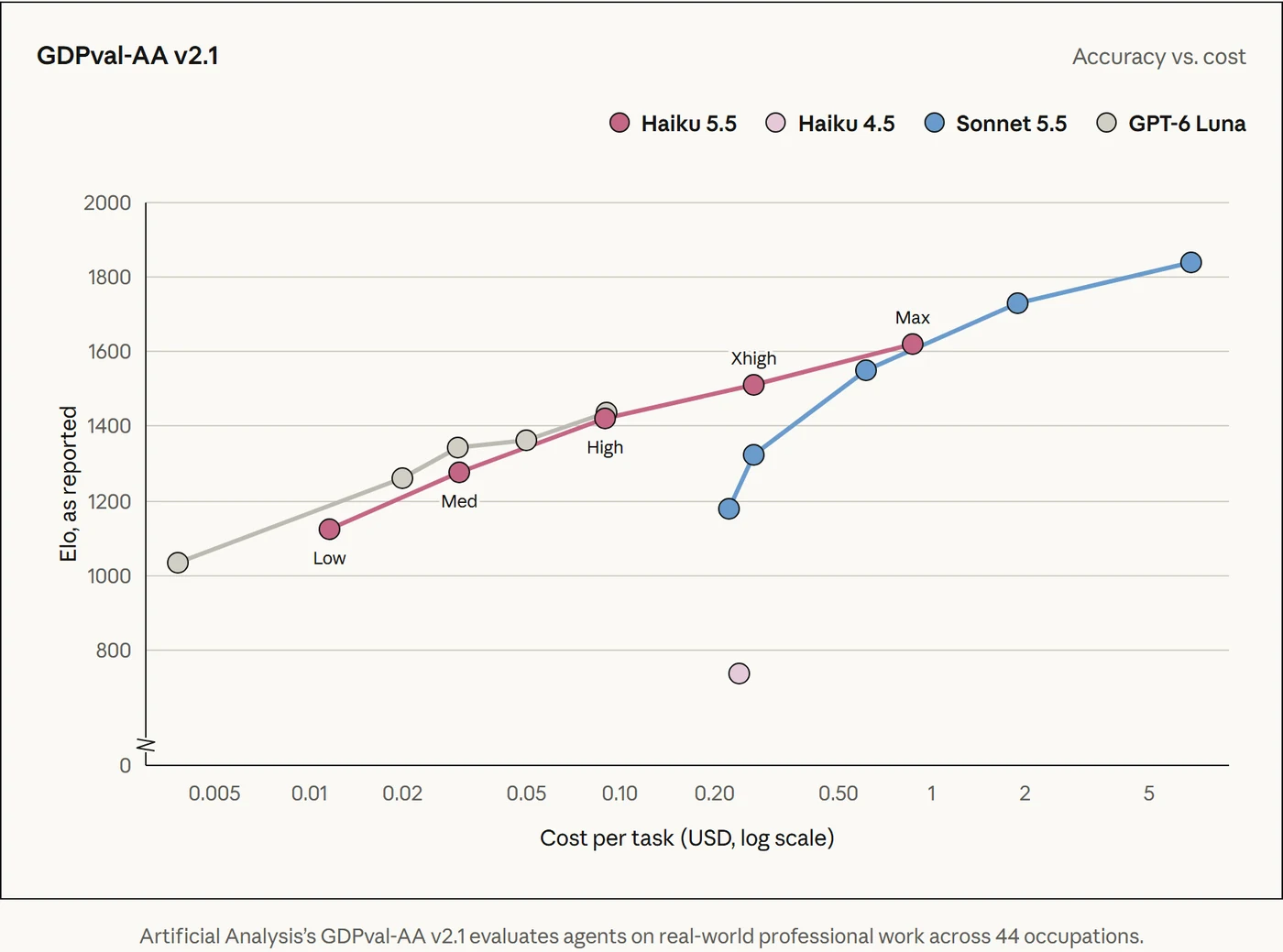
GDPval-AA: real professional work
| Effort | Claude Haiku 5.5 | Claude Sonnet 5.5 | GPT-6 Luna |
|---|---|---|---|
| Low | 1125 at $0.01 | 1179 at $0.22 | 1036 at $0.004 |
| Medium (default) | 1277 at $0.03 | 1324 at $0.27 | 1262 at $0.02 |
| High | 1420 at $0.09 | 1551 at $0.62 | 1344 at $0.03 |
| Xhigh | 1513 at $0.27 | 1731 at $1.88 | 1364 at $0.05 |
| Max | 1620 at $0.87 | 1840 at $6.78 | 1437 at $0.09 |
GDPval-AA is Artificial Analysis’s test of real professional work products, such as documents, slides and spreadsheets, across 44 occupations. It is the closest of the four charts to what a finance team does. At the same spend of $0.27 a task, Claude Haiku 5.5 at Xhigh scores 1513 Elo against 1324 for Sonnet 5.5 at Medium. At Medium, for $0.03, it scores 1277, far above Haiku 4.5’s 735, which cost $0.24 a task, eight times as much.
GPT-6 Luna is the honest exception. Between about two and nine cents a task, Luna scores higher than Haiku 5.5 for the same money on this test. Haiku 5.5’s lead comes from its top settings: 1513 at Xhigh and 1620 at Max are scores Luna does not reach at any setting. Past Haiku 5.5’s Max point, only Sonnet 5.5 goes higher: 1731 at Xhigh for $1.88, and 1840 at Max for $6.78.
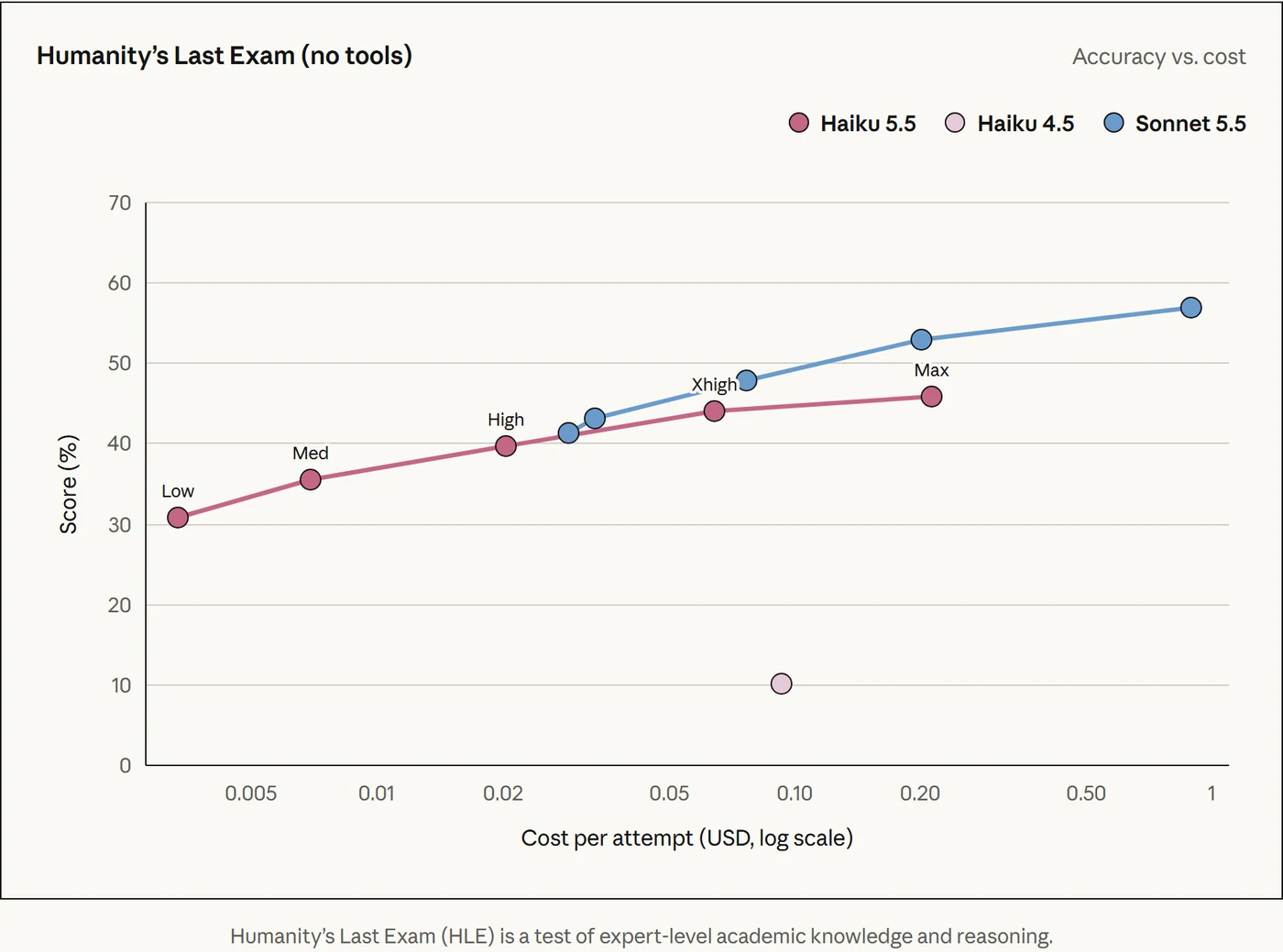
Humanity’s Last Exam: expert reasoning
| Effort | Claude Haiku 5.5 | Claude Sonnet 5.5 |
|---|---|---|
| Low | 30.9% at $0.003 | 41.4% at $0.03 |
| Medium (default) | 35.5% at $0.007 | 43.2% at $0.03 |
| High | 39.7% at $0.02 | 47.9% at $0.08 |
| Xhigh | 44.1% at $0.06 | 53.0% at $0.20 |
| Max | 45.9% at $0.21 | 56.9% at $0.89 |
On hard reasoning without tools, the economics flip. Claude Haiku 5.5 is the only option below about two cents a question, scoring 30.9% for $0.003 at Low and 39.7% for $0.02 at High. But Sonnet 5.5 at High scores 47.9% for $0.08, beating Haiku 5.5’s best (45.9% for $0.21) for under 40% of the cost. For expert-level questions, spend the money on Sonnet 5.5.
Terminal-Bench 4.0: agentic coding, and Sonnet’s price cut
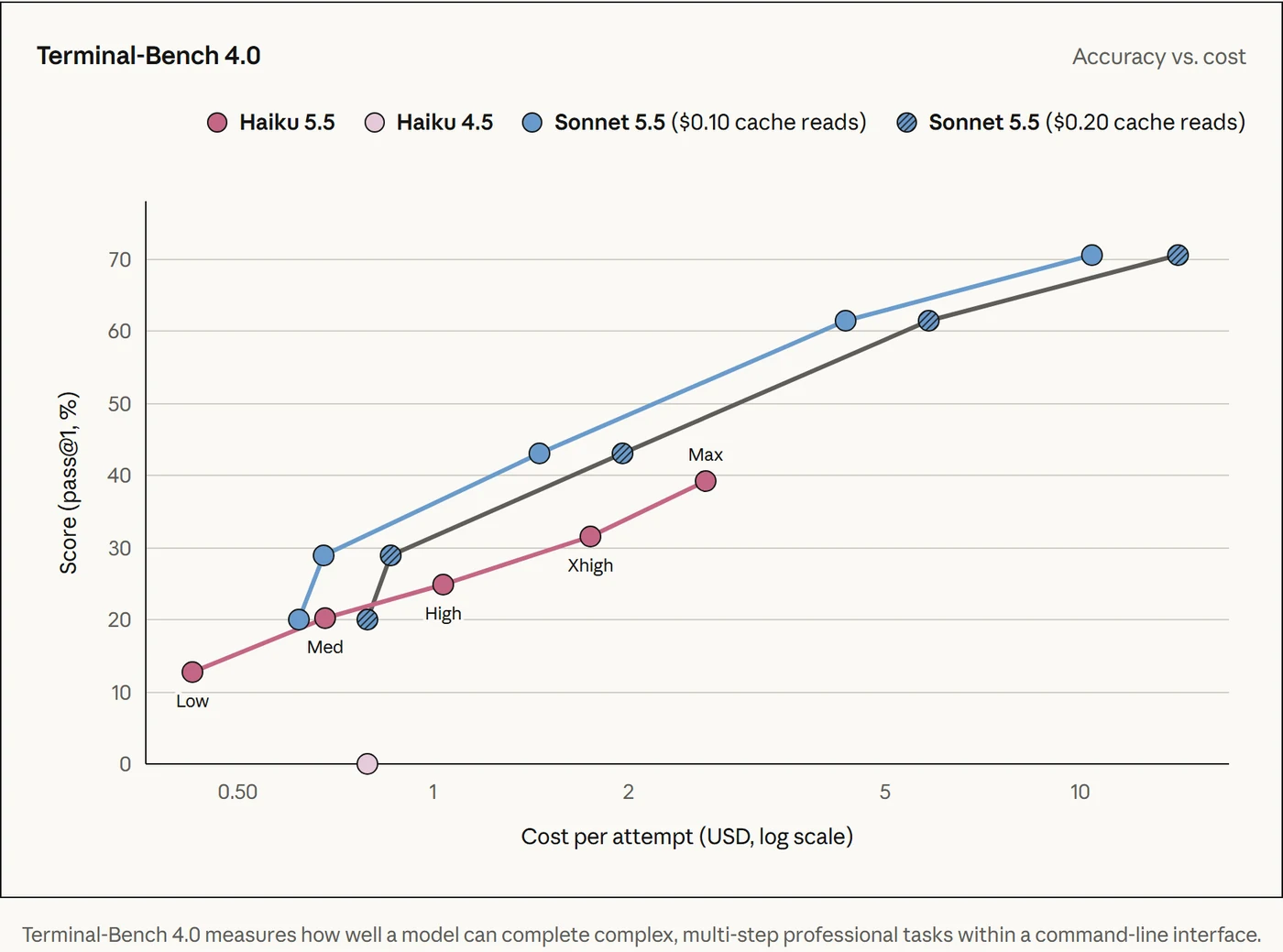
| Effort | Claude Haiku 5.5 | Sonnet 5.5, new $0.10 cache reads | Sonnet 5.5, old $0.20 cache reads |
|---|---|---|---|
| Low | 12.7% at $0.42 | 20.0% at $0.62 | 20.0% at $0.79 |
| Medium (default) | 20.3% at $0.68 | 28.8% at $0.68 | 28.8% at $0.86 |
| High | 24.8% at $1.04 | 43.0% at $1.46 | 43.0% at $1.97 |
| Xhigh | 31.5% at $1.75 | 61.5% at $4.34 | 61.5% at $5.83 |
| Max | 39.2% at $2.64 | 70.6% at $10.44 | 70.6% at $14.15 |
This chart shows both the limit of Haiku 5.5 and the second piece of news. On agentic coding in a terminal, Sonnet 5.5 wins at every budget from about 60 cents an attempt up. At the same $0.68 an attempt it scores 28.8% against Haiku 5.5’s 20.3%, and at High it scores 43.0% for $1.46, above Haiku 5.5’s best of 39.2%, which costs $2.64. Haiku 4.5 scored 0.0% for $0.79.
The two Sonnet lines show the new cache price. With cache reads at $0.10 instead of $0.20, the same Sonnet 5.5 runs cost 21% to 26% less on this test, from $14.15 to $10.44 an attempt at Max. Anthropic puts the saving at around 20% on most agentic work.
What the four charts say together
- Haiku 5.5 is the value pick for computer use and office work. On OSWorld and GDPval-AA it matches or beats far pricier settings of Sonnet 5.5, and even its cheapest setting beats Haiku 4.5’s best.
- For hard reasoning and agentic coding, pay for Sonnet 5.5. On Humanity’s Last Exam, Sonnet 5.5 at High beats Haiku 5.5’s best score for under 40% of the cost, and on Terminal-Bench it leads at every budget from about 60 cents an attempt up.
- Effort matters more on Haiku 5.5. Its GDPval-AA score climbs from 1125 at Low to 1620 at Max, and the cost climbs faster, from $0.01 to $0.87 a task. Pick the level per job instead of leaving everything at the default.
- Medium is a sound default. It is where Haiku 5.5 already beats GPT-6 Luna’s best OSWorld score, for a few cents a task.
- Judge cost per finished task, not price per token. Token prices hide thinking, retries and tokenizer differences. These charts include them.
Claude Haiku 5.5 pricing and what a month costs
The headline price is $0.10 per million input tokens and $0.50 per million output tokens, a tenth of Haiku 4.5’s $1 and $5. Two things complicate it: the price changes with prompt length, and the new tokenizer counts more tokens. Here is the full picture first:
| Price per 1M tokens | Input | Output | Cache reads | 5-minute cache writes | Batch (in / out) |
|---|---|---|---|---|---|
| Claude Haiku 5.5, prompts up to 100K | $0.10 | $0.50 | $0.01 | $0.125 | $0.05 / $0.25 |
| Claude Haiku 5.5, prompts over 100K | $0.50 | $2.50 | $0.05 | $0.625 | $0.25 / $1.25 |
| Claude Haiku 4.5 | $1 | $5 | $0.10 | $1.25 | $0.50 / $2.50 |
| Claude Sonnet 5.5 | $2 | $10 | $0.10 (was $0.20) | $2.50 | $1 / $5 |
| Claude Opus 5.5 | $4 | $20 | $0.20 | $5 | $2 / $10 |
| GPT-6 Luna, prompts up to 272K | $0.10 | $0.50 | $0.01 | $0.125 | $0.05 / $0.25 |
The 100,000 token line
Claude Haiku 5.5 is priced by prompt length. When a prompt is longer than 100,000 tokens, every token in that request moves to the higher price, output and cache included, and that higher price is five times the short-prompt rate. Opus 5.5 and Sonnet 5.5, by contrast, charge one rate across their whole 1M token window. Prompts up to 100,000 tokens made up around 90% of requests to Haiku 4.5, so most work stays on the cheap side of the line.
Watch the line when you migrate. Because the same text counts as about 30% more tokens on Haiku 5.5, a prompt that measured 80,000 tokens on Haiku 4.5 comes to about 104,000 on Haiku 5.5 and crosses into the higher price. Recount your long prompts with the new model before you estimate costs.
The new tokenizer: what one request really costs
The 90% cut is per token. Your bill depends on how many tokens the same work takes, and Haiku 5.5’s tokenizer counts about 30% more for the same text. Here is one request worked through, with token counts as Haiku 4.5 measures them and before any thinking tokens:
| Request | Claude Haiku 4.5 | Claude Haiku 5.5 | Saving |
|---|---|---|---|
| A 10,000-token prompt and a 1,000-token reply | $0.0150 | $0.00195 (about 13,000 in, 1,300 out) | About 87% |
| An 85,000-token prompt and a 1,000-token reply | $0.0900 | $0.0585 (about 110,500 in, so the higher price applies) | About 35% |
| The same job split into two prompts under 100,000 | $0.0950 | $0.01235 (two prompts of about 55,250) | About 87% |
The long prompt is the trap: crossing 100,000 tokens cuts the saving from about 87% to about 35%. Splitting the job, where the work allows it, brings the Haiku 5.5 cost back down from about $0.06 to $0.01.
Thinking is the other variable. Haiku 5.5 thinks by default, which adds output tokens that Haiku 4.5 often did not spend. Lower effort cuts that, and at low effort it can skip thinking on simple requests. Anthropic’s own estimate, after the tokenizer and the mix of short and long requests, is that Claude Haiku 5.5 costs around 75% less to run than Haiku 4.5 on average.
What 1,000 real tasks cost
Token sums only go so far. Anthropic’s GDPval-AA chart shows the measured cost of finishing one real piece of professional work, thinking included. Here is what 1,000 such tasks would cost at the main settings:
| Model and effort | GDPval-AA Elo | Cost of 1,000 tasks |
|---|---|---|
| Claude Haiku 5.5, Low | 1125 | $10 |
| Claude Haiku 5.5, Medium (default) | 1277 | $30 |
| Claude Haiku 5.5, High | 1420 | $90 |
| GPT-6 Luna, Max | 1437 | $90 |
| Claude Haiku 4.5 | 735 | $240 |
| Claude Haiku 5.5, Xhigh | 1513 | $270 |
| Claude Sonnet 5.5, Medium | 1324 | $270 |
| Claude Sonnet 5.5, High | 1551 | $620 |
Claude Haiku 5.5 at Medium does in $30 what Haiku 4.5 did worse for $240. At $270, its Xhigh setting beats Sonnet 5.5 at Medium by almost 190 Elo for the same money. GDPval-AA tasks are big pieces of work, such as whole documents, decks and spreadsheets, so simple jobs like tagging a transaction cost far less than this.
Caching and batch
- Cache reads cost a tenth of fresh input. If every request carries the same 20,000 tokens of instructions, such as a chart of accounts and your coding rules, reading them from the cache costs $0.0002 a request instead of $0.002. Writing them to the cache costs $0.125 per million tokens for five minutes, or $0.20 for an hour.
- Batch is half price. $0.05 input and $0.25 output per million tokens for prompts up to 100,000 tokens, for work that can wait for its results, such as an overnight run. Batches also allow up to 300K output tokens with a beta header.
- Changing effort can break the cache. A different top-level effort between requests invalidates the prompt cache for the conversation. To vary effort turn by turn, use the per-message effort setting (beta), which keeps the cache.
Sonnet 5.5 got cheaper too
Anthropic halved the price of Sonnet 5.5’s cache reads on the same day, from $0.20 to $0.10 per million tokens, starting 7 October. Cache reads are a large share of the tokens an agent uses, so Sonnet 5.5 now costs around 20% less on most agentic work. Its input and output prices stay at $2 and $10. Our Claude Sonnet 5.5 review has the full picture.
New monthly API credits for Max and Team plans
The third announcement is for people who already pay for Claude. From this week, Max and Team subscribers get monthly credits for the Claude API, to build their own tools, apps and agents. The credits work with any model, and at Haiku 5.5’s short-prompt price, $100 of credit covers about a billion input tokens or 200 million output tokens.
| Plan | Monthly API credit |
|---|---|
| Max 5x | $100 |
| Max 20x | $200 |
| Team, Standard seat | $20 per seat |
| Team, Premium seat | $100 per seat |
| Team plan in total | Pooled across seats, capped at $500 |
| Free, Pro and Enterprise | Not eligible |
- What they cover: the Claude API, Claude Managed Agents, the Claude Agent SDK and the playground. Not Claude Code, not extra usage in the Claude apps, and not the cloud platforms such as Amazon Bedrock or Google Cloud.
- How to claim: on claude.ai, open Settings, then Billing on a Max plan (Organization settings, then Billing, on Team), and link a Claude Console organization. New subscribers can claim after 7 days on an eligible plan.
- The catch: credits expire at the end of each billing cycle with no rollover, each plan links to one Console organization, and you cannot change that link yourself.
- A bonus: a linked organization moves up to at least the Start usage tier, or the Build tier if its monthly credit is over $200.
The full rules are on Anthropic’s API credits for Max and Team plans page. Startups can also get $1,000 of API credits through the Claude for Startups program.
Claude Haiku 5.5 vs GPT-6 Luna: same price, different results
GPT-6 Luna is OpenAI’s most efficient model, pitched at focused, high-volume tasks. That is the same job description as Claude Haiku 5.5, and the list price is identical: $0.10 in, $0.50 out and $0.01 for cached input per million tokens. Here is how they compare:
| Claude Haiku 5.5 | GPT-6 Luna | |
|---|---|---|
| Price per 1M tokens (in / out) | $0.10 / $0.50 | $0.10 / $0.50 |
| Cache reads / cache writes | $0.01 / $0.125 | $0.01 / $0.125 |
| Long prompts | 5x on every token once a prompt passes 100K tokens | 2x input and 1.5x output once input passes 272K tokens |
| Batch | Half price | Half price |
| Context window | 1M tokens | 1.05M tokens |
| Max output | 128K tokens | 128K tokens |
| Knowledge cutoff | June 2026 | May 2026 |
| Effort settings | low to max, default medium | none, then low to max, default medium |
| OSWorld 2.1 | 72.4% | 48.9% |
| GDPval-AA (Elo) | 1620 | 1437 |
| AA-Briefcase (Elo) | 1578 | 1336 |
| Terminal-Bench 4.0 | 39.2% | 16.4% |
| FrontierCode 1.1 (Main) | 46.4% | 42.4% |
| Chartography, no tools | 46.4% | 29.1% |
| PhysicianBench | 43.0% | 33.6% |
On every test where both are scored, Claude Haiku 5.5 is ahead at its best setting, often by a wide margin. Luna has two real advantages. It is much cheaper on long prompts between 100,000 and 272,000 tokens, where Haiku 5.5 charges five times its short rate and Luna stays at its standard rate. And it offers a no-reasoning mode for the simplest, fastest calls.
The two companies also count tokens differently, so identical list prices do not mean identical bills. Anthropic’s cost-per-task charts are the fairer test: on OSWorld, Haiku 5.5 at Medium beats Luna’s best for less money, while on GDPval-AA Luna gives more per dollar at the low end and Haiku 5.5’s top settings reach scores Luna cannot. OpenAI’s Luna model page has its full specification, and our GPT-6 Sol guide covers OpenAI’s family.
Which Claude model should you use now?
| If you need | Our pick | Why |
|---|---|---|
| Classification, extraction and routing at high volume | Claude Haiku 5.5 at Low or Medium | Its core job, at a few cents or less per task |
| Summaries and compaction of long conversations | Claude Haiku 5.5 | One of Anthropic’s named uses, with a 1M token window |
| A fast subagent under a bigger model | Claude Haiku 5.5 | Pairs with Opus 5.5 or Sonnet 5.5 as the lead |
| Live customer support and chat | Claude Haiku 5.5 | Anthropic’s fastest model |
| Computer or browser tasks on a budget | Claude Haiku 5.5 at Xhigh or Max | 67.6% to 72.4% on OSWorld for $0.28 to $0.61 an attempt |
| Documents, decks and spreadsheets | Claude Sonnet 5.5 | Higher GDPval-AA and AA-Briefcase ceilings |
| Agentic coding and long terminal work | Claude Sonnet 5.5 or Opus 5.5 | 70.6% on Terminal-Bench 4.0 for Sonnet 5.5, against 39.2% |
| Expert reasoning | Claude Sonnet 5.5 | A higher Humanity’s Last Exam score for the same money above a few cents |
| The hardest long-running work | Claude Opus 5.5 | Built for long-running agentic coding and knowledge work |
| Same price, other vendor | GPT-6 Luna | Cheaper on prompts between 100K and 272K tokens, but behind on every shared test |
A simple pattern works for most teams: let Claude Haiku 5.5 take the first pass on everything, and send only the hard cases to Sonnet 5.5. For the bigger models, see our Claude Sonnet 5.5 and Claude Opus 5.5 reviews, and our live AI leaderboard, which ranks models on independent tests only. We will add Haiku 5.5 there once independent scores are in.
The Claude family at a glance
| Model | Price per 1M (in / out) | Speed | Default effort | Built for |
|---|---|---|---|---|
| Claude Fable 5.1 | $10 / $50 | Slower | High | Demanding reasoning and long-horizon agentic work |
| Claude Opus 5.5 | $4 / $20 | Moderate | Medium | Long-running agentic coding and knowledge work |
| Claude Sonnet 5.5 | $2 / $10 | Fast | High | The best mix of speed and intelligence |
| Claude Haiku 5.5 | From $0.10 / $0.50 | Fastest | Medium | High-volume, latency-sensitive tasks such as classification, extraction and routing |
Haiku 4.5 is still active. Anthropic’s model deprecations page commits to keeping it available until at least 15 October 2026 and has not announced a retirement date, so there is no hard deadline to move yet. Haiku 5.5 itself is committed until at least 7 October 2027.
Claude Haiku 5.5 for finance and accounting teams
Benchmarks are useful, but the real question is what changes at your desk. Finance teams run a lot of narrow, repetitive work, which is exactly what Claude Haiku 5.5 is built for. Here is how we would use it.
Sorting, coding and extraction at volume
Classifying bank transactions, coding expense lines to the right account, pulling fields out of invoices and receipts, and routing emails to the right queue are all short, high-volume jobs. HubSpot’s result shows the fit: on its CRM tasks, Haiku 5.5 scored 92.8%, the best result on that test suite yet, and on a task that asks a model to find stale but ambiguous records, it was the fastest, with the highest hit rate and the fewest false positives. Run this kind of work at Low or Medium effort, ask for structured output, and use the batch rate when results can wait overnight. Our AI prompts for accounting are a good place to start.
Summaries, reviews and reports at scale
Box tested Haiku 5.5 on large volumes of business content and found it scored 11 points higher than Haiku 4.5 at about half the latency. It named cost reports, financial summaries and weekly recurring reviews as work it would move over. AlphaSense, whose document question answering runs about 8 million calls a week, measured a clear gain over Haiku 4.5 on 400 test queries. And on OfficeQA, which means finding the right table in long U.S. Treasury documents and calculating from it, Claude Haiku 5.5 scores 73.5%, close to Sonnet 5.5’s 76.9%.
Agents that work through portals and screens
A lot of finance work still happens in web portals: downloading statements, checking supplier portals, filling in standard forms. Claude Haiku 5.5’s 72.4% on OSWorld, at well under a dollar an attempt, makes cheap screen automation realistic, and it can now use Anthropic’s browser use tool. Start with read-only tasks, and keep a person on anything that moves money or files a return.
A cheap first pass, a stronger model for the exceptions
The pattern that saves the most is routing. Let Haiku 5.5 handle the easy cases and flag the ones it is unsure about, then send only those to Sonnet 5.5. Rogo’s example is the same idea in reverse: a bigger model builds the deck while a Haiku 5.5 subagent fetches the one figure it needs from a long filing.
Where to be careful
- Give it the documents, not just the question. On a closed-book factual test, Haiku 5.5 got more answers right than Haiku 4.5 but gave about as many wrong ones, and it scored below every other current Claude model. Do not rely on what it remembers; give it the source text.
- Its knowledge stops at June 2026. It will not know tax, payment or reporting rules that changed after that. Give it the current rule, or check the official source yourself.
- Let a calculator do the arithmetic. Use the model to explain, draft and check, and let your accounting system or a proper tool produce the numbers.
- Expect some refusals. Haiku 5.5 runs safety classifiers with no fallback model, and in Anthropic’s audit it refused more often than any other model tested. Sending the same request again usually gets another refusal, so give declined requests a clear path to a person.
- Protect client data. Use a business account with the right data terms, and never paste client data into a personal account.
- A person signs off. Anything that reaches the books, a filing or a client needs human review, however good the draft looks.
For more ideas, see our Claude for finance and accounting guide and our AI prompts for Excel.
What early testers found
Anthropic’s page carries results from six early access customers. They are customer claims, but specific enough to be useful:
| Company | What they reported |
|---|---|
| Asana | In its AI Teammates tests, such as triaging bugs and finding overdue work, tasks took over 30% less time than with its current model, and each agent turn ran up to 2.5 times faster |
| HubSpot | Scored 92.8% on its CRM tasks, the best result on that test suite yet, and was the fastest on a stale-records audit, with the highest hit rate and the lowest false positive rate |
| AlphaSense | Its Ask in Document feature runs about 8 million calls a week; on 400 test queries, Haiku 5.5 was a clear, statistically significant gain over Haiku 4.5, 0.84 against 0.76 |
| Box | Scored 11 points higher than Haiku 4.5 at about half the latency, and fits analytical work at scale such as cost reports, financial summaries and weekly recurring reviews |
| Rogo | Accurate enough to trust as a subagent for quick lookups and summaries, such as pulling a segment revenue line from a 10-K while a bigger model builds the deck, and cheap enough to run a lot |
| Cognition | As the sidekick model in Devin Fusion, it holds a top-tier FrontierCode score of 66.2 while cutting cost and latency; Devin CLI users can pair it with Opus 5.5 as the lead |
The common thread is speed first, then accuracy good enough to trust on narrow tasks. Asana summed up the feel in four words: “a noticeably snappier experience.”
What changes for developers moving from Haiku 4.5
Switching starts with the model ID, but Claude Haiku 5.5 changes more than the Sonnet 5.5 upgrade did. Anthropic lists five breaking changes, a new tokenizer and new defaults. Read them before you flip the model string.
| What changed | Claude Haiku 4.5 | Claude Haiku 5.5 |
|---|---|---|
| Model ID | claude-haiku-4-5-20251001 or claude-haiku-4-5 |
claude-haiku-5-5 (fixed, no date suffix, no alias) |
| Context and output | 200K context, 64K output | 1M context, 128K output (300K on Batches with a beta header) |
| Thinking | Extended thinking with a token budget | Adaptive thinking, on by default; a token budget returns a 400 error |
| Effort | Not available | low, medium (default), high, xhigh, max |
| Sampling parameters | temperature, top_p and top_k accepted |
Omit them; non-default values return a 400 error |
| Assistant prefill | Accepted with thinking off | Returns a 400 error |
| Computer use (Claude API, Google Cloud) | computer_20250124 |
computer_toolset_20260801 only |
| Browser use tool | Not supported | browser_toolset_20260801 |
| Tokenizer | Older | Newer: the same text is about 30% more tokens |
| Thinking text | Summarized | Omitted by default; ask for summarized |
| Safety refusals | None from classifiers | stop_reason: "refusal" with a category, and no fallback |
| Priority Tier | Supported | Not supported |
| Price per 1M tokens | $1 / $5 | $0.10 / $0.50 up to 100K tokens, $0.50 / $2.50 over |
The five breaking changes
- Manual thinking budgets return an error. A request with
thinking: {"type": "enabled", "budget_tokens": N}now fails. Leave thinking unset or send{"type": "adaptive"}, and use effort to control how much the model thinks. Where Haiku 4.5 ran without thinking or with a small budget, choose a lower effort. - Sampling parameters return an error. Omit
temperature,top_pandtop_k. If you must send them, temperature has to be 1 and top_p 0.99; any top_k, or temperature and top_p together, returns a 400 error. Use the prompt to steer the output instead. - Assistant prefill returns an error, even with thinking off. End every request with a user turn. Use structured outputs, or a tool with enum fields, for fixed formats and classification labels, and ask for a direct answer in the system prompt instead of prefilling one.
- Computer use needs the new toolset on the Claude API and Google Cloud. Replace
computer_20250124and its beta header with{"type": "computer_toolset_20260801"}, and update your agent loop for toolset blocks. - Changing earlier turns invalidates thinking blocks. If you send thinking blocks back, keep the conversation append-only: editing the system prompt, tools or earlier messages returns a 400 error. On accounts created before 31 August 2026, the error only comes when a specific prefix-mismatch setting is on.
Other changes you will notice
- Responses can start with thinking blocks. Code that reads the first content block as the answer must select blocks by type.
- Leave room for thinking. Thinking counts toward
max_tokens, so a limit sized for Haiku 4.5 can stop a reply before any text appears. - Thinking text is hidden by default. Blocks come back with only a signature; set
displaytosummarizedto see a summary. - Thinking blocks stay with their account. They only work in the account that produced them or a linked one, which matters if you replay stored conversations through another account.
- Forced tool use skips thinking. With
tool_choiceset toanyor a named tool, the response starts with the tool call and has no thinking block. - Thinking off works only at lower effort.
{"type": "disabled"}works at low, medium and high, and returns an error at xhigh and max. - Recount your tokens. Usage and token counts rise for the same text, so recheck
max_tokenslimits and cost estimates with the new model. - Priority Tier is not available, so plan capacity separately if you had a Priority Tier commitment on Haiku 4.5.
Prompting tips from Anthropic’s guide
Existing Haiku 4.5 prompts should work well without changes. Anthropic’s Claude Haiku 5.5 prompting guide adds a few model-specific fixes worth knowing:
- Give it today’s date with a search tool. It grounds answers in recent results. With a long system prompt or low effort, add a short line telling it to search for facts that may have changed.
- JSON plus tools needs thinking. With thinking off and a JSON output format, it can skip a tool call it needs. Keep adaptive thinking on for those requests, or tell it to call tools first and write the JSON last.
- Long agent prompts at low effort can stop early. Tell it to keep working until the job is done, or raise effort. Moving from low to medium roughly halved early stopping in Anthropic’s tests, but more than doubled output tokens.
- Ask coding agents to run a real check before they report a change as done.
- Put mid-task user messages in a user turn, never inside a tool result, which the model treats as untrusted text.
- Pin chatbots to their rules. Add a line saying the system prompt holds for the whole conversation, even when a user argues or keeps asking, and use high effort where instruction following matters most.
- Watch for empty replies at xhigh. In multi-turn chats it sometimes writes the whole answer in its thinking and ends the turn with no visible text.
The model change itself is one line, and Claude Code can do the rest: run /claude-api migrate and it applies the ID swap and the breaking changes across a project, then lists what to check by hand.
model = "claude-haiku-4-5"     # before
model = "claude-haiku-5-5"     # after
Full details are in Anthropic’s What’s new in Claude Haiku 5.5 page and the Haiku 5.5 migration guide. If you use Claude Managed Agents, changing the model name is all you need to do.
Claude Haiku 5.5 safety and safeguards
Claude Haiku 5.5 is not at the frontier of Anthropic’s models, and its safety testing reflects that. The main points from the system card and the launch page:
- Scaling policy. It is less capable than Claude Opus 5 on most evaluations and crosses no new Responsible Scaling Policy thresholds. Anthropic treats it as meeting the first-level thresholds for chemical and biological risk and for autonomy, and applies the matching protections.
- Alignment. It improves on Haiku 4.5 across almost all of Anthropic’s alignment tests, with far fewer cases of misaligned behaviour and less willingness to cooperate with misuse. Opus 5.5 is still stronger overall.
- Honesty. Under pressure from a user or a system prompt, it was at least as honest as every other model Anthropic tested. But it used a leaked answer without telling the user more often than Haiku 4.5 did.
- Over-refusal. In Anthropic’s automated audit it refused more than any other model tested, so expect some harmless requests to be declined.
- Prompt injection. It is Anthropic’s most robust Haiku yet against instructions hidden in content, largely matching the frontier models against adaptive attacks in coding and computer use. It also refused harmful computer use tasks more often than Sonnet 5.5 and Opus 5.5.
- Cybersecurity. Its cyber safeguards are stricter than Haiku 4.5’s but narrower than those on Anthropic’s bigger recent models. They allow a wider range of defensive work than Sonnet 5.5’s, but still block penetration testing and attacker techniques. Organisations doing wider security work can apply to the Cyber Verification Program.
- Biology. It uses the same safeguards as Sonnet 5, Sonnet 5.5 and Opus 5: research questions are fine, and requests judged likely to cause harm are blocked.
- No fallback. When a safeguard blocks a request, the request ends with a refusal; nothing reroutes to another model.
For finance work, the prompt injection gains matter most. An assistant that reads supplier emails and PDF invoices is safer when hidden instructions inside those files are less likely to work. Keep payment approvals with a person anyway.
How to start using Claude Haiku 5.5
- In the Claude apps: choose Haiku 5.5 from the model menu where your plan offers it.
- In Claude Code: use Haiku 5.5 as a fast subagent next to Opus 5.5 or Sonnet 5.5, or as the main model for quick, well-scoped jobs. Medium is the default effort. Our Claude Code tutorial helps if you are new to it.
- Through the API: change your model string to
claude-haiku-5-5, fix the five breaking changes above, recount your prompts, and leave room inmax_tokensfor thinking. See Claude API pricing for the full price list. - Through a cloud provider: it is on Amazon Bedrock as
anthropic.claude-haiku-5-5, and on Claude Platform on AWS, Google Cloud and Microsoft Foundry asclaude-haiku-5-5. - Claim your credits: on a Max or Team plan, link a Console organization in your billing settings to receive the new monthly API credits.
- Test on real work: run 20 of your own past tasks through Haiku 5.5 at Low, Medium and High, and compare the output and the cost per task with what you use today.
Key takeaways
- Claude Haiku 5.5 launched on 7 October 2026 at $0.10 input and $0.50 output per million tokens for prompts up to 100,000 tokens, 90% less per token than Haiku 4.5.
- It scores 72.4% on OSWorld 2.1, 1620 Elo on GDPval-AA and 39.2% on Terminal-Bench 4.0, against 15.7%, 735 and 0.0% for Haiku 4.5.
- It beats GPT-6 Luna, which lists the same price, on every benchmark where both are scored.
- The new tokenizer counts about 30% more tokens, and prompts over 100,000 tokens cost five times as much, so recount before you budget. On average it costs around 75% less to run than Haiku 4.5.
- At Medium effort it beats Luna’s best computer use score and Haiku 4.5’s best knowledge work score for a few cents a task.
- Sonnet 5.5 remains the pick for agentic coding and expert reasoning, and its cache reads now cost half as much.
- Developers face five breaking changes, including adaptive thinking by default and no sampling parameters or prefill.
- Max and Team subscribers get new monthly API credits worth $100 to $500.
Please note: we update this page from time to time, but AI models, prices and benchmark results change quickly, and there can be a gap between a change and our update. Check Anthropic’s official pages before you act. This guide helps you compare and estimate; it is not legal, tax or investment advice, and ReconScribe is not responsible for decisions made on it.
Claude Haiku 5.5: frequently asked questions
What is Claude Haiku 5.5?
Claude Haiku 5.5 is Anthropic's newest small model, released on 7 October 2026 as the third model in the Claude 5.5 family. It is Anthropic's fastest and lowest-cost current model, built for high-volume work such as classification, extraction, routing, summaries and subagent tasks.
How much does Claude Haiku 5.5 cost?
On the API it costs $0.10 per million input tokens and $0.50 per million output tokens for prompts up to 100,000 tokens. Longer prompts cost $0.50 and $2.50. Cache reads are $0.01 per million tokens, 5-minute cache writes $0.125, and batch processing is half price.
Is Claude Haiku 5.5 really 90% cheaper than Haiku 4.5?
Per token, yes, for prompts up to 100,000 tokens; longer prompts are 50% cheaper. But the same text counts as about 30% more tokens on Haiku 5.5, and it thinks by default. Anthropic's own estimate is that it costs around 75% less to run than Haiku 4.5 on average.
What is the Claude Haiku 5.5 model ID?
The model ID is claude-haiku-5-5 on the Claude API, Claude Platform on AWS, Google Cloud and Microsoft Foundry, and anthropic.claude-haiku-5-5 on Amazon Bedrock. It is a fixed ID with no date suffix and no separate alias.
What is the Claude Haiku 5.5 context window?
Claude Haiku 5.5 has a 1M token context window and up to 128K output tokens, or 300K on the Batches API with a beta header. Haiku 4.5 had 200K and 64K. Its knowledge cutoff is June 2026.
Is Claude Haiku 5.5 better than Haiku 4.5?
By a wide margin. OSWorld computer use rises from 15.7% to 72.4%, GDPval-AA from 735 to 1620 Elo, Terminal-Bench 4.0 from 0.0% to 39.2%, and Humanity's Last Exam without tools from 10.2% to 45.9%.
Is Claude Haiku 5.5 better than GPT-6 Luna?
On every benchmark where Anthropic reports both, yes: 72.4% against 48.9% on OSWorld, 1620 against 1437 Elo on GDPval-AA, and 39.2% against 16.4% on Terminal-Bench 4.0. Both list $0.10 and $0.50 per million tokens, but Luna is cheaper on prompts between 100,000 and 272,000 tokens.
Should I use Claude Haiku 5.5 or Sonnet 5.5?
Use Haiku 5.5 for narrow, high-volume work, quick lookups, summaries, chat and subagent jobs. Use Sonnet 5.5 for agentic coding, expert reasoning and complex documents: it scores 70.6% on Terminal-Bench 4.0 against 39.2%, and costs 20 times as much per token.
Does Claude Haiku 5.5 have effort levels?
Yes. It is the first Haiku model with them: low, medium, high, xhigh and max. Medium is the default on the API and in Claude Code. Higher effort scores better but costs more; on GDPval-AA a task costs about $0.03 at medium and $0.87 at max.
What breaks when I switch from Haiku 4.5?
Five things now return errors: manual thinking budgets, non-default temperature, top_p or top_k, assistant prefill, the old computer use tool on the Claude API and Google Cloud, and editing earlier turns when you send thinking blocks back. Responses can also start with thinking blocks, and token counts rise by about 30%.
Is Claude Haiku 5.5 good for accounting and finance work?
Yes, for high-volume tasks such as classifying transactions, extracting invoice fields, routing emails and summarising reports. Give it the source documents, let a calculator do the arithmetic, and have a person review anything that reaches the books, a filing or a client.
What are the new Claude API credits for Max and Team plans?
From the week of 7 October 2026, Max 5x subscribers get $100 a month in Claude API credits, Max 20x subscribers $200, and Team plans up to $500 pooled across seats. They cover the Claude API, Managed Agents and the Agent SDK, but not Claude Code, and they expire at the end of each billing cycle.
When will Claude Haiku 4.5 be retired?
Anthropic has not set a date. Its lifecycle page commits to keeping Haiku 4.5 available until at least 15 October 2026, and Haiku 5.5 until at least 7 October 2027.
Related reading
- Claude Sonnet 5.5: benchmarks, pricing and how it compares
- Claude Opus 5.5: benchmarks, pricing and how it compares
- AI leaderboard 2026: every major model ranked
- GPT-6 Sol guide, with GPT-6 Luna
- Claude for Startups: free Team plan and API credits
- Cloudflare for Startups: up to $350K in credits, with the real application
- Claude Code tutorial for finance teams
- AI prompts for finance
Sources
- Anthropic: Introducing Claude Haiku 5.5
- Claude Haiku 5.5 system card
- Claude Haiku 5.5 overview (Claude Platform docs)
- What's new in Claude Haiku 5.5
- Claude Haiku 5.5 migration guide
- Prompting Claude Haiku 5.5
- Claude API pricing
- API credits for Max and Team plans
- Claude model deprecations
- GPT-6 Luna model page (OpenAI API docs)
- OpenAI API pricing