
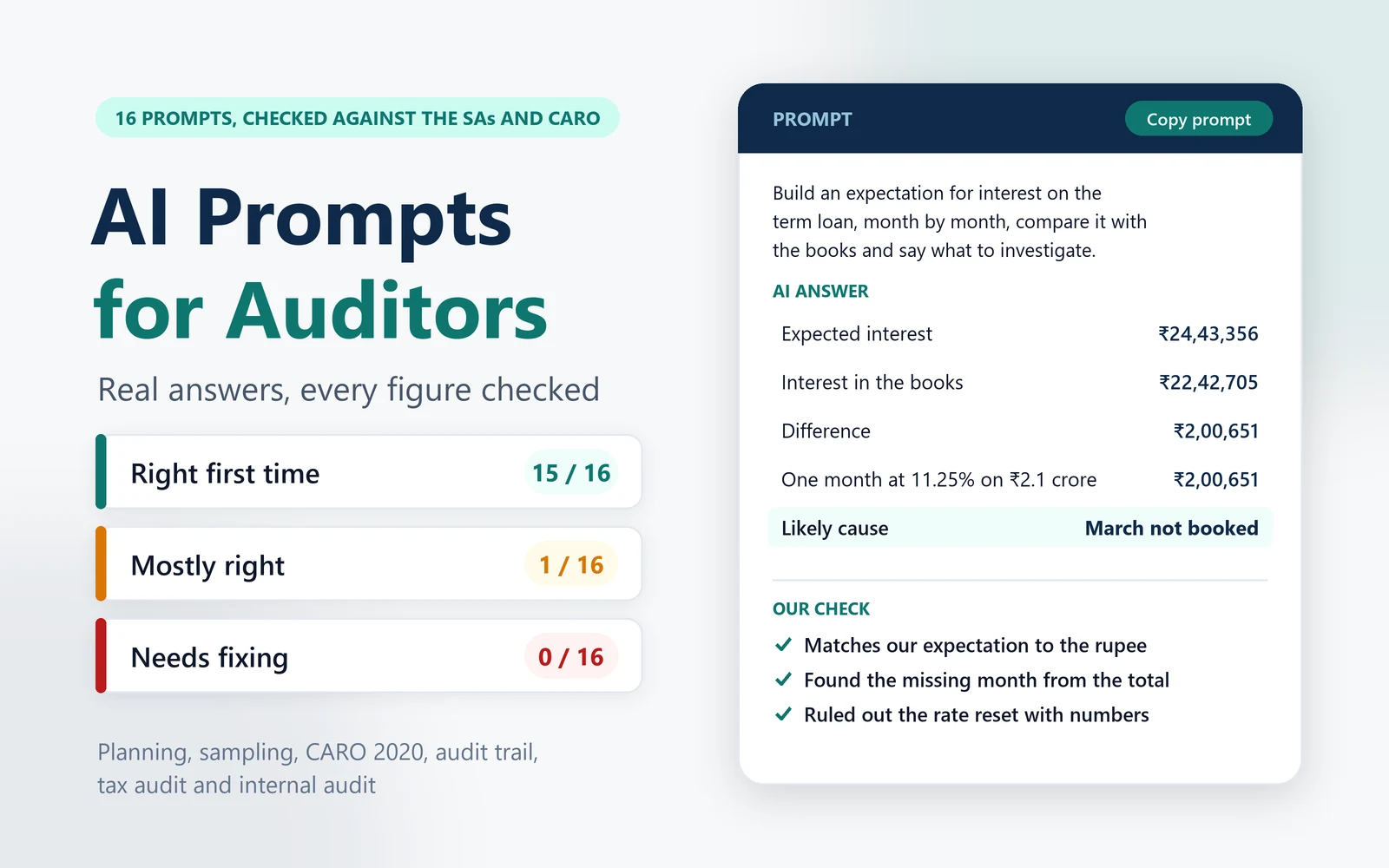
Most lists of AI prompts for auditors stop at the prompt. We ran sixteen of them on a sample audit file, checked every answer against the Standards on Auditing, CARO 2020 and our own workings, and kept a record of what the AI caught and what it missed.
These AI prompts for auditors cover the work of a statutory audit and an internal audit: risk assessment, materiality, projecting sample errors, analytical procedures, inventory roll-backs, unrecorded liabilities, going concern, the audit opinion, key audit matters, CARO 2020, the audit trail under Rule 11(g), the tax audit, a risk and control matrix, and red flags in vendor masters and expense claims. Each card has the prompt with its facts, the answer Claude Opus 5.5 gave, and our check.
How we tested
- Model: Claude Opus 5.5, in a fresh session for every prompt, with no files, memory or web search. It saw only the prompt you can copy below.
- Data: the same fictional company as our AI prompts for accounting, Acme Traders Private Limited in Pune, here a subsidiary of an unlisted public company. We planted the traps real files have: a related-party customer and a sales bonus, a one-time write-off, a count four days after the year end, an unlisted company asked for key audit matters, a petty cash fraud, a payroll system with no audit trail, and an employee’s bank account in the vendor master.
- Check: we worked every figure ourselves and checked every rule against the ICAI Standards on Auditing, the Companies (Auditor’s Report) Order, 2020 and its ICAI guidance note, the ICAI implementation guide on Rule 11(g), the Income-tax Act, 1961 and the CGST Act.
- Date: 28 September 2026. Rules change, so confirm the current position before you rely on any answer.
AI prompts for auditors: the scorecard
Of the 16 AI prompts for auditors we ran, 15 came back right first time and 1 was mostly right; none needed fixing. Every figure we could rework matched ours, and every planted trap was caught. The one slip was a side point in the going concern answer, on an Indian accounting carve-out. The answers also went further than we asked: one found a flaw in our own scenario, and another flagged a stock statement that could be a fraud on the bank.
| # | Prompt | Result | What to watch |
|---|---|---|---|
| 1 | Risk assessment for the audit plan | Right | Nothing; right first time |
| 2 | Materiality, performance materiality and the trivial threshold | Right | Nothing; confirm the ₹45 lakh really is one-time |
| 3 | Project sample misstatements and decide what next | Right | Nothing; it found a flaw in our scenario |
| 4 | Substantive analytical procedure on interest | Right | Nothing; right first time |
| 5 | Roll back an inventory count to the year end | Right | Nothing; confirm the sales figure excludes GST |
| 6 | Search for unrecorded liabilities | Right | Nothing; extend the search to the report date |
| 7 | Going concern assessment and reporting | Mostly right | Loan classification: the Ind AS carve-out still applies for 2025-26 |
| 8 | Choose the audit opinion and draft the basis paragraph | Right | Nothing; check the tax effect figures |
| 9 | Key audit matters for an unlisted company | Right | Nothing; KAMs are voluntary here |
| 10 | Draft CARO 2020 clauses from the facts | Right | Nothing; get the reason for the stock-statement gap |
| 11 | Report on the audit trail under Rule 11(g) | Right | Nothing; confirm hosting and daily backup in India |
| 12 | Tax audit: TDS defaults and interest for 2025-26 | Right | Nothing; add the other payments before filing |
| 13 | Risk and control matrix for procure to pay | Right | Nothing; confirm what the ERP can block |
| 14 | Find red flags in the vendor master | Right | Nothing; verify before approaching anyone |
| 15 | Find red flags in expense claims | Right | Nothing; get explanations before concluding |
| 16 | Write an internal audit observation from rough notes | Right | Nothing; add the ERP go-live date |
How to write AI prompts for auditors
Every prompt on this page has the same five parts. Keep them and you can write your own AI prompt for audit work on any engagement.
- The entity and the year. Legal form, whether it is listed, whether it is a subsidiary of a public company, the year end and the Act that applies. CARO, key audit matters, internal financial controls and section 197 all turn on these facts.
- Your firm’s method. Materiality percentages, performance materiality range, sampling approach, thresholds for investigating differences. Without them the AI falls back on textbook ranges.
- The facts on file. Paste the figures, the lists and the dates as they are in your working papers, including who found an issue and when.
- The output you will use. A risk table, a projection, adjusting entries, a draft clause with its table, an observation in the audit committee’s format.
- Ask for the reasoning. The paragraph relied on, the working behind each figure, and what evidence is still needed. That is what lets you review an answer in minutes.
For AI in the rest of the finance function, see our AI prompts for accounting and AI prompts for finance.
AI prompts for audit planning, materiality and sampling
Planning is where AI prompts for auditors save the most thinking time: risk assessment, materiality, projecting sample errors and building an expectation for analytics. Give the AI the facts and your firm’s method, and ask it to show the working.
1. Risk assessment for the audit plan
Use it for: the risk assessment for the audit plan, with the significant risks and the planned responses.
I am the engagement partner on the statutory audit of Acme Traders Private Limited, a distributor of office supplies in Pune and a wholly owned subsidiary of Acme Holdings Limited, an unlisted public company, for the year ended 31 March 2026. What we know from planning:

- Revenue is ₹48.6 crore, up 38% on last year. Most of the growth comes from a new customer, Delta Supplies Private Limited, whose managing director is the brother of Acme's managing director.
- The sales team earns an annual bonus if revenue crosses ₹45 crore.
- The bank's working capital loan has a covenant: a current ratio of at least 1.33. It was 1.36 at 31 March 2026.
- In April 2026 Acme issued a credit note of ₹38 lakh to Delta Supplies against March 2026 sales, for "pricing differences".
- Inventory of ₹7.9 crore sits in three warehouses. The year-end count was held on 4 April 2026.
- Acme moved to a new ERP in October 2025 and switched the old system off in November.
- The CFO resigned in January 2026; the accounts manager has done both jobs since.
- GST input tax credit claimed in the year was ₹3.1 crore.

Prepare the risk assessment for the audit plan:
1. List the risks of material misstatement at the financial statement level and at the assertion level.
2. Mark the significant risks, and deal with the two fraud risks that SA 240 presumes. Say whether you would rebut the revenue presumption, and why.
3. For each significant risk, give the planned audit response.

Present it as a table: Risk | Level (financial statement or assertion, with the assertion) | Significant? | Why | Planned response. Cite the SA paragraph when you rely on one, and if you are not sure of a paragraph number, say so.
- The thresholds leave almost no room. Revenue needs to be overstated by only ₹3.6 crore (7.4% of reported revenue) for the ₹45 crore bonus not to have been earned. […] On the covenant, the headroom is 0.03 times current liabilities, or about 2.2% of current assets.
Revenue recognition (SA 240 para 26): I would not rebut the presumption. […] Acme is the opposite on every count: a sales bonus that depends on crossing ₹45 crore, a covenant with almost no headroom, growth concentrated in a customer run by the MD’s brother, a price reversal right after the year end, and weaker controls after the CFO left and the ERP changed.
Management override of controls (SA 240 paras 31 and 32). Always a significant risk and not open to rebuttal.
- ✓ It kept the revenue presumption and placed the risk where it belongs: occurrence and cut-off of the March sales to Delta, with the April credit note as a revenue reduction that may belong in 2025-26.
- ✓ Every paragraph it cited matches the ICAI texts, including SA 240 paras 26, 27, 31, 32 and 47, SA 315 paras 25 to 29 and SA 501 paras 4 to 7. Where it was unsure, it said so, as the prompt asked.
- ✓ It rated the GST credit as higher than normal but not significant, as we would, and went beyond the plan: the section 188 approvals the Delta sales may need, and the legacy data and audit trail the ERP switch-off puts at risk.
Prompt tip: Give the numbers that create pressure, such as a bonus target or a covenant, and ask for a table with the level and the assertion. The AI then ties each risk to a specific response instead of a generic list.
2. Materiality, performance materiality and the trivial threshold
Use it for: setting overall materiality, performance materiality and the trivial threshold, with the reasons on file.
I am planning the statutory audit of Acme Traders Private Limited, a distributor of office supplies in Pune and a wholly owned subsidiary of Acme Holdings Limited, an unlisted public company, for the year ended 31 March 2026. Key figures:

- Revenue: ₹48.6 crore.
- Profit before tax: ₹38 lakh, after a one-time bad debt write-off of ₹45 lakh. The last two years were ₹1.10 crore and ₹95 lakh.
- Total assets: ₹21.4 crore. Equity: ₹9.2 crore.
- Main users: the bank that funds our working capital, and the shareholders. The company is owner-managed.

Our firm's method: overall materiality from 5% of normalised profit before tax, 0.5% to 1% of revenue, or 1% to 2% of total assets, whichever benchmark best fits the users; performance materiality at 60% to 75% of overall materiality depending on risk (this is our first year on the audit, and the company changed its ERP during the year); a clearly trivial threshold of 5% of overall materiality.

1. Choose the benchmark and explain why it fits these users.
2. Calculate overall materiality, performance materiality and the clearly trivial threshold.
3. Say whether you would set a lower materiality for particular items, and which.
Show your working.
| Item | Amount | Working |
|---|---|---|
| Benchmark | Normalised profit before tax (PBT) of ₹83 lakh | Reported PBT ₹38 lakh + one-time bad debt write-off ₹45 lakh |
| Overall materiality | ₹4,00,000 | 5% × ₹83,00,000 = ₹4,15,000, rounded down |
| Performance materiality | ₹2,40,000 | 60% × ₹4,00,000 (bottom of the range: first-year audit, ERP change) |
An error of ₹21 lakh to ₹49 lakh would wipe out between a quarter and more than half of a normal year’s profit. […] so these two benchmarks set materiality far too high.
- ✓ Right benchmark and right numbers: normalised profit of ₹83 lakh, 5% of it rounded to ₹4 lakh, performance materiality at the low end for a first-year audit with an ERP change, and a ₹20,000 trivial threshold.
- ✓ It rejected revenue and total assets for the right reason: either would set materiality at over a quarter of a normal year’s profit.
- ✓ It set a lower specific materiality for directors’ remuneration and related party items, and spotted that a subsidiary of a public company is a deemed public company, which brings section 197 reporting into play.
Prompt tip: Give the AI your firm’s percentages and the users of the accounts. It then argues the benchmark instead of reciting textbook ranges.
3. Project sample misstatements and decide what next
Use it for: projecting misstatements found in a sample and deciding whether the sample supports a conclusion.
We tested purchases of Acme Traders Private Limited, a distributor of office supplies in Pune and a wholly owned subsidiary of Acme Holdings Limited, an unlisted public company, for the year ended 31 March 2026.

- Population: 1,860 purchase invoices, total ₹31.4 crore.
- We tested all 24 invoices above ₹10 lakh (total ₹4.2 crore) in full and found no errors.
- From the remaining ₹27.2 crore we selected a random sample of 60 invoices with a total value of ₹1.46 crore.
- Tolerable misstatement is ₹2.5 lakh.

Misstatements found in the sample:
1. Invoice PI-3321, ₹2,36,000, was booked twice, so purchases are overstated by ₹2,36,000.
2. Invoice PI-4410, ₹84,000: freight of ₹12,000 that the vendor did not charge was booked, so purchases are overstated by ₹12,000.
3. Invoice PI-5127, ₹1,18,000, was booked in April 2026 although the goods were received on 29 March 2026, so purchases for the year are understated by ₹1,18,000.

Management says misstatement 1 is an anomaly because "the new ERP now blocks duplicate invoice numbers".

1. Project each misstatement to the population using the ratio method, and give the total.
2. Can misstatement 1 be treated as an anomaly? What would we need to accept that?
3. Compare the result with tolerable misstatement and tell me what we should do next.
Project to the ₹27.2 crore stratum you sampled, not to ₹31.4 crore. The 24 invoices above ₹10 lakh were tested in full with no errors, so their misstatement is known (nil) and there is nothing to project there.
| # | Invoice | Error | Direction | Projected (₹) |
|---|---|---|---|---|
| 1 | PI-3321 | Booked twice | Overstatement | 43,96,712 |
| 2 | PI-4410 | Freight booked that the vendor did not charge | Overstatement | 2,23,562 |
| 3 | PI-5127 | Booked in April 2026, goods received 29 March 2026 | Understatement | 21,98,356 |
[…] How PI-5127 got into the sample. A purchase booked in April 2026 should not be in a list of FY 2025-26 purchases.
- ✓ Every projection matches ours to the rupee, on the right base: the sampled ₹27.2 crore, not the ₹31.4 crore that includes the invoices tested in full.
- ✓ It refused to treat the duplicate as an anomaly on management’s word: a control that blocks duplicates now says nothing about invoices booked before it existed.
- ✓ It caught a flaw in our own scenario: an invoice booked in April 2026 could not be in a list of 2025-26 purchases, so the sampling frame needs checking.
Prompt tip: Give the strata separately (items tested in full, and the sampled population). Projecting to the wrong base is the classic error, and the AI needs the split to avoid it.
4. Substantive analytical procedure on interest
Use it for: a proof in total of interest, or any expense that follows balance, rate and days.
For the audit of Acme Traders Private Limited, a distributor of office supplies in Pune and a wholly owned subsidiary of Acme Holdings Limited, an unlisted public company, for the year ended 31 March 2026, I want a substantive analytical procedure on interest on the term loan.

- Balance on 1 April 2025: ₹2,40,00,000. Principal of ₹10,00,000 is repaid on the last day of every quarter (30 June, 30 September, 31 December and 31 March).
- The rate was 10.5% a year until 30 September 2025, and 11.25% from 1 October 2025 after the bank's reset.
- Interest is charged monthly on the balance outstanding during the month, on actual days over 365, and debited on the last day of each month.
- Interest recorded in the books for the year: ₹22,42,705.
- Our threshold for investigating a difference: ₹50,000.

1. Build the expectation month by month and in total.
2. Compare it with the books, and say whether the difference needs investigation under SA 520.
3. If it does, list the likely causes in the order you would check them.
Summary. Expected interest is ₹24,43,356. The books show ₹22,42,705, which is ₹2,00,651 lower. That is about four times your ₹50,000 threshold, so SA 520 requires you to investigate. The shortfall equals, to the rupee, one 31-day month of interest at 11.25% on ₹2,10,00,000, and the books match the expected running total to the end of February 2026 exactly.
[…] Not applying the reset (10.50% all year) lowers interest by ₹80,425.
- ✓ The expectation matches ours month by month (₹24,43,356), and so does the difference of ₹2,00,651.
- ✓ It pinpointed the cause: the difference is exactly one month’s interest, and the books agree with the expectation to the end of February. March interest is missing.
- ✓ It ruled out the other suspects with numbers: ignoring the rate reset would explain only ₹80,425, and a 366-day year ₹6,676.
Prompt tip: Ask for a month-by-month expectation with a running total. That is what let the AI see exactly where the books stopped.
Prompts for audit evidence: inventory and unrecorded liabilities
Roll-backs and the search for unrecorded liabilities are arithmetic plus judgement. Paste the movements and the year-end lists as they are, and ask for the adjusting entries as well as the conclusion.
5. Roll back an inventory count to the year end
Use it for: rolling a stock count taken after the year end back to the balance sheet date.
Acme Traders Private Limited, a distributor of office supplies in Pune and a wholly owned subsidiary of Acme Holdings Limited, an unlisted public company counted its inventory on 4 April 2026, not on 31 March 2026. We attended the count. Help me roll it back to the year end.

- Inventory counted on 4 April 2026, at cost: ₹7,94,20,000.
- Goods received from suppliers from 1 to 4 April 2026 (GRNs dated in April): ₹28,40,000 at cost.
- Sales dispatched from 1 to 4 April 2026: ₹41,25,000 at selling price. The gross margin is 20% on sales.
- Goods in transit: a supplier dispatched goods costing ₹6,20,000 on 30 March 2026 under FOB shipping point terms. They arrived on 5 April 2026, so they were not in the count.
- Bill and hold: goods costing ₹3,40,000 were sold and invoiced to Crest Stationers on 31 March 2026 and are held in our warehouse at the customer's request. They were counted on 4 April 2026.
- A customer returned goods sold in March. They arrived on 2 April 2026 and were counted; their cost is ₹85,000.
- Inventory in the books at 31 March 2026: ₹8,12,40,000.

1. Roll the count back to 31 March 2026, item by item.
2. Compare it with the books and tell me what the difference means.
3. List the audit procedures for each reconciling item, and say whether a count four days after the year end is acceptable under SA 501.
| # | Item | ₹ |
|---|---|---|
| Physical count on 4 April 2026, at cost | 7,94,20,000 | |
| a | Less: goods received from suppliers, 1 to 4 April | (28,40,000) |
| b | Add: cost of goods dispatched, 1 to 4 April (₹41,25,000 × 80%) | 33,00,000 |
| c | Add: goods in transit, shipped 30 March on FOB shipping point terms | 6,20,000 |
| d | Less: bill-and-hold goods sold to Crest Stationers on 31 March | (3,40,000) |
| e | Less: customer return received on 2 April | (85,000) |
| Inventory at 31 March 2026 per roll-back | 8,00,75,000 |
[…] Dividing by 1.20 (₹34,37,500) would treat 20% as a mark-up on cost, which is a different thing.
- ✓ The roll-back matches ours (₹8,00,75,000), and so does the ₹11,65,000 gap to the books.
- ✓ It avoided the planted trap: a 20% margin on sales means cost is 80% of the price, not the price divided by 1.2.
- ✓ It showed how the gap moves depending on how the books treated the goods in transit and the bill-and-hold sale, and added the GST point: input credit on goods found missing must be reversed.
Prompt tip: Say whether the margin is on sales or on cost. It is the single line most likely to throw the roll-back off.
6. Search for unrecorded liabilities
Use it for: the search for unrecorded liabilities from post year-end payments and invoices.
For the audit of Acme Traders Private Limited, a distributor of office supplies in Pune and a wholly owned subsidiary of Acme Holdings Limited, an unlisted public company, for the year ended 31 March 2026, performance materiality is ₹2.5 lakh. Here are the payments made and invoices received from 1 April to 31 May 2026, with what we found in the 31 March 2026 creditors, GRNI (goods received not invoiced) and accruals lists.

| # | Date | Item | Amount (₹) | In the 31 March lists? |
|---|---|---|---|---|
| 1 | 08-04-2026 | Electricity bill dated 06-04-2026 for March 2026 usage (no GST on electricity) | 1,46,300 | No |
| 2 | 10-04-2026 | Paid Redline Couriers, invoice RC/2026/233 dated 31-03-2026 | 2,64,000 | Yes, in creditors |
| 3 | 15-04-2026 | Swift Logistics bill dated 12-04-2026 for shipments of 20 to 31 March 2026 (no GST charged) | 88,500 | No |
| 4 | 18-04-2026 | Kavya and Associates, Chartered Accountants, invoice dated 16-04-2026 for March 2026 GST refund work, ₹50,000 plus GST ₹9,000 | 59,000 | No |
| 5 | 20-04-2026 | Rent for April 2026, paid in advance to Zen Properties | 90,000 | No |
| 6 | 25-04-2026 | Blue Pine Computers invoice BP-5012 dated 02-04-2026 for goods received on 28-03-2026 (GRN 3319), ₹4,00,000 plus GST ₹72,000 | 4,72,000 | No, GRN 3319 is not in the GRNI list |
| 7 | 05-05-2026 | Statutory audit fee for 2025-26, ₹3,00,000 plus GST ₹54,000 | 3,54,000 | Yes, provision of ₹3,00,000 |
| 8 | 12-05-2026 | Greenfield Security, invoice dated 03-04-2026 for March 2026 services, ₹50,000 plus GST ₹9,000 | 59,000 | Yes, accrual of ₹50,000 |
| 9 | 20-05-2026 | Interest claimed by Orbit Stationery, a micro enterprise, under the MSMED Act for payments delayed up to 31 March 2026 | 18,400 | No |

1. Which items are liabilities at 31 March 2026 that were not recorded? Treat GST correctly.
2. Give the total and the adjusting entries, and compare the total with performance materiality.
3. Explain why the other items are not unrecorded liabilities.
Short answer: items 1, 3, 4, 6 and 9 are liabilities at 31 March 2026 that were not recorded. With GST treated correctly they total ₹7,03,200, about 2.8 times performance materiality of ₹2,50,000. Items 2, 5, 7 and 8 need no adjustment.
[…] The suppliers will invoice ₹7,84,200 in all. The extra ₹81,000 (₹9,000 for Kavya and ₹72,000 for Blue Pine) is GST that is booked with the April invoices against an equal ITC, so it affects neither profit nor net liabilities.
- ✓ It picked the same five items we did and gave the same total, ₹7,03,200, with the GST that is input credit kept out of the expense.
- ✓ It explained each item it left out: one already in creditors, April rent, and two accruals already booked at the value before GST.
- ✓ It added useful checks: MSMED interest is not deductible for tax, a goods transport agency may bring reverse charge, and the search should run to the date of the report.
Prompt tip: Paste the post year-end items next to what is already in the year-end lists. The AI then separates missing liabilities from ones already recorded.
Prompts for the audit report, CARO 2020, audit trail and tax audit
These are the reporting prompts, where wording matters. State the entity’s status (listed or not, a subsidiary of a public company or not), because it decides which reporting applies, and check every clause reference before it goes into a signed report.
7. Going concern assessment and reporting
Use it for: the going concern conclusion, the report wording and the CARO 2020 clauses that follow from it.
Audit of Acme Traders Private Limited, a distributor of office supplies in Pune and a wholly owned subsidiary of Acme Holdings Limited, an unlisted public company, for the year ended 31 March 2026. Facts:

- Loss before tax of ₹1.24 crore, the first loss in ten years, after a ₹45 lakh bad debt.
- The current ratio was 0.92 at 31 March 2026. The working capital loan covenant requires 1.33, so it is breached, and the bank can then recall the ₹2.4 crore term loan on demand.
- On 25 May 2026 the bank waived, in writing, the covenant breach for the year ended 31 March 2026 only. The repayment schedule is unchanged, and the covenant is tested again on 30 September 2026.
- The managing director has written that he will bring in ₹1 crore of equity "if needed". He has not said when, and we have not seen evidence of his means.
- The cash flow forecast for the next 12 months shows a peak shortfall of ₹60 lakh in November 2026, before any money from the promoter.
- Our report is due on 5 September 2026.

1. Which of these facts point to a going concern problem, and how serious is each?
2. Evaluate management's plans, and say what evidence we still need.
3. Conclude: is there a material uncertainty? Draft the paragraph for our report for the most likely outcome, and say what changes if the company does not disclose it adequately.
4. Mention any CARO 2020 reporting that follows.
Bottom line: there is a material uncertainty related to going concern, but the going concern basis is still appropriate. If the financial statements disclose the matter properly, the opinion stays unmodified and the report carries a separate “Material Uncertainty Related to Going Concern” section. If they do not, the opinion becomes qualified, or adverse if there is no disclosure at all.
| Fact | What it tells us | How serious |
|---|---|---|
| Bank waiver of 25 May 2026 | Mitigating: it removes the recall right for the March 2026 breach. But it covers that one test only, the repayment schedule (and so the cash outflow) is unchanged, and the covenant is retested on 30 September 2026, 25 days after we sign. Nothing suggests the ratio can climb from 0.92 to 1.33 by then. | Partial mitigant. It moves the problem to 30 September; it does not remove it. |
[…] Term loan classification. The ₹2.4 crore must be current at 31 March 2026 because the company had no unconditional right to defer settlement at that date, and a waiver received after the year end does not change that (Ind AS 1.74 says so expressly […]).
- ✓ The conclusion matches ours: significant doubt, a material uncertainty, and a going concern basis that is still appropriate. The waiver covers only the March test, and the MD’s letter is an intention, not evidence.
- ✓ The reporting follows SA 570 paragraph by paragraph, which we checked against the ICAI text: an unmodified opinion with a Material Uncertainty section if the note is adequate, qualified or adverse if it is not, and CARO 3(xix) and 3(xvii) drafted.
- ✗ One side point is wrong for India this year. It said a waiver received after the year end cannot keep the loan out of current liabilities, citing Ind AS 1.74. That is the IFRS rule. For 2025-26, Ind AS 1 as amended in August 2025 (G.S.R. 549(E)) keeps an Indian carve-out: a waiver received after the year end but before the accounts are approved lets the loan stay non-current. The carve-out ends from 2026-27.
Prompt tip: Say whether the company follows AS or Ind AS, and for which year. Classification and disclosure rules differ between them, and India’s carve-outs change from year to year.
8. Choose the audit opinion and draft the basis paragraph
Use it for: deciding the type of opinion and drafting the basis paragraph with amounts.
Audit of Acme Traders Private Limited, a distributor of office supplies in Pune and a wholly owned subsidiary of Acme Holdings Limited, an unlisted public company, for the year ended 31 March 2026. Overall materiality is ₹4 lakh. Unadjusted matters at the end of fieldwork:

1. Inventory includes printer cartridges costing ₹9.5 lakh that expired in December 2025 and cannot be sold. Management refuses to write them down.
2. A trade receivable of ₹6 lakh from Nova Packaging Private Limited is disputed. The customer did not reply to our confirmation, management has no correspondence, and nothing was received after the year end. We could not obtain other evidence.
3. Other small errors total ₹1.2 lakh (overstating profit).

Reported profit before tax is ₹38 lakh and total assets are ₹21.4 crore.

1. Decide the type of opinion under SA 705 (Revised), explaining material and pervasive for each matter.
2. Draft the Opinion paragraph and the basis section, with amounts.
3. Tell me what else changes in the report and in our communication with those charged with governance.
Answer: a qualified (“except for”) opinion. The expired cartridges are a material misstatement. The Nova receivable is a material inability to obtain evidence. Neither is pervasive, alone or together, so an adverse opinion or a disclaimer would be wrong.
[…] except for the effects of the matter described in paragraph (a), and the possible effects of the matter described in paragraph (b), of the Basis for Qualified Opinion section of our report […]
- ✓ Right opinion for the right reasons: one material misstatement and one material scope limitation, neither pervasive, so qualified rather than adverse or a disclaimer.
- ✓ The basis paragraph quantifies the cartridges (₹9.5 lakh off inventory and profit), describes the receivable without naming the customer, and leaves out the ₹1.2 lakh below materiality.
- ✓ It carried the qualification through the rest of the report: section 143(3) answers, the Board’s duty to explain the qualification, and communication with those charged with governance.
Prompt tip: Give overall materiality and the key totals (profit, total assets). Material and pervasive are judged against them, and the AI needs them to show its reasoning.
9. Key audit matters for an unlisted company
Use it for: drafting key audit matters, and checking first whether the report needs them.
We are finalising the statutory audit report of Acme Traders Private Limited, a distributor of office supplies in Pune and a wholly owned subsidiary of Acme Holdings Limited, an unlisted public company, for the year ended 31 March 2026. The opinion is unmodified.

Draft three Key Audit Matters for our report: revenue recognition (including a ₹38 lakh credit note issued in April 2026 against March sales), inventory at three warehouses counted four days after the year end, and the move to a new ERP in October 2025.
KAMs are optional for this company. SA 701 applies to listed entities, and to other entities only where the auditor decides, or is required by law, to communicate KAMs (SA 701, para 5). Acme Traders is a private company and its parent is unlisted, so nothing requires a KAM section. You can include one voluntarily, but SA 701 then applies in full […]
The ₹38 lakh credit note has to be reflected in the 2025-26 accounts. […] A KAM cannot take the place of a modified opinion (SA 701, para 12).
- ✓ It caught the planted trap before drafting: SA 701 requires key audit matters for listed entities, and Acme and its parent are unlisted, so the section is voluntary.
- ✓ It then drafted all three in proper SA 701 form, with why each is a key matter and how the audit addressed it.
- ✓ It raised a point we had not asked: a credit note against March sales is normally an adjusting event, and a key audit matter cannot stand in for a modified opinion.
Prompt tip: State whether the company is listed. Reporting requirements turn on it, and the AI can only flag the trap if the status is in the prompt.
10. Draft CARO 2020 clauses from the facts
Use it for: drafting CARO 2020 clauses, with the tables, from the facts on file.
Draft our CARO 2020 reporting for Acme Traders Private Limited, a distributor of office supplies in Pune and a wholly owned subsidiary of Acme Holdings Limited, an unlisted public company, for the year ended 31 March 2026, on these clauses, from these facts:

- Paragraph 3(ii)(a): management counted all inventory on 4 April 2026. Discrepancies were 0.8% for stationery and 1.4% for printer consumables, and were adjusted in the books.
- Paragraph 3(ii)(b): Acme has a working capital limit of ₹5.5 crore from Mahima Bank (fictional), secured by inventory and receivables. The quarterly stock statement for December 2025 showed inventory of ₹8.4 crore; the books showed ₹6.9 crore. The other quarters agreed with the books.
- Paragraph 3(vii)(a): provident fund of ₹1,86,000 for August 2025 was still unpaid on 31 March 2026. All other statutory dues were paid, a few of them late.
- Paragraph 3(vii)(b): a GST demand of ₹12.4 lakh for 2022-23 is under appeal before the Commissioner (Appeals). ₹1.24 lakh was paid as the pre-deposit.
- Paragraph 3(xi): in November 2025 the company found that a cashier had taken ₹4.6 lakh from petty cash over six months. He was dismissed and ₹1.1 lakh was recovered.

Write the text for each clause as it would appear in the annexure to our report, with tables where needed. Also tell me whether we must file Form ADT-4 for the fraud.
Applicability. CARO 2020 applies to Acme even though it is a private company. The exemption in paragraph 1(2)(v) of the Order is not available to a private company that is a subsidiary of a public company […]
| Nature of the fraud | Amount involved (₹ lakh) | Amount recovered (₹ lakh) | Amount not recovered (₹ lakh) |
|---|---|---|---|
| Misappropriation of cash from petty cash by the Company’s cashier over a period of six months, detected by the management in November 2025 | 4.60 | 1.10 | 3.50 |
[…] ADT-4 is the auditor’s report to the Central Government, and it applies only to a fraud that involves, or is expected to involve, ₹1 crore or more individually (rule 13(1) of the Companies (Audit and Auditors) Rules, 2014).
- ✓ Every clause is right: no class of inventory with a 10% discrepancy, the December stock statement difference of ₹1.5 crore in a table, the August provident fund dues outstanding more than six months, and the GST appeal with the pre-deposit.
- ✓ The ADT-4 answer is right on both grounds: the fraud is below ₹1 crore, and management found it, not the auditor.
- ✓ It flagged something we had not asked: if the ₹1.5 crore overstatement to the bank was deliberate, it is a fraud on the company’s creditors and changes the reporting.
Prompt tip: Say who detected a fraud and when. Section 143(12) reporting turns on it as much as on the amount.
11. Report on the audit trail under Rule 11(g)
Use it for: reporting under Rule 11(g) on the audit trail, and the management letter that goes with it.
Draft our reporting under Rule 11(g) of the Companies (Audit and Auditors) Rules, 2014 for Acme Traders Private Limited, a distributor of office supplies in Pune and a wholly owned subsidiary of Acme Holdings Limited, an unlisted public company, for the year ended 31 March 2026, and the points for the management letter. Facts:

- From 1 April to 30 September 2025 the books were kept in the old accounting software, "TallyBooks" (fictional); from 1 October 2025 in a new ERP, "LedgerOne" (fictional).
- In TallyBooks the edit log was on for the whole period it was used.
- In LedgerOne the edit log is on at the application level, but it was off from 12 to 23 October 2025 during data migration. There is no audit trail at the database level, and the vendor's administrator can change the database directly.
- Payroll runs in a separate payroll application that has no audit trail feature. Salary journals are imported into LedgerOne every month.
- LedgerOne keeps edit logs for three years and then deletes them automatically.
- The audit trail for 2024-25 (TallyBooks) has been kept.
(a) in LedgerOne, the audit trail (edit log) feature at the application level was disabled from 12 October 2025 to 23 October 2025 during the migration of data from TallyBooks […]
(b) in LedgerOne, no audit trail was maintained at the database level […]
(c) the Company’s payroll records, which form part of its books of account, are maintained in a separate payroll application […] This application does not have a feature of recording audit trail (edit log) […]
[…] LedgerOne is configured to delete its audit trail automatically after three years. This is shorter than the period of eight financial years for which books of account are required to be preserved under section 128(5) of the Act.
- ✓ It reported all three exceptions we planted, in wording that follows the ICAI implementation guide (Revised 2024): the migration gap, no database-level trail, and payroll software with no audit trail.
- ✓ It carved the migration gap out of the “not tampered with” statement and said plainly that it cannot comment on direct database changes.
- ✓ It caught the three-year auto-delete as a breach of the eight-year retention period, and gave a practical management letter with owners and priorities.
Prompt tip: List every system that holds accounting records, including payroll. The Rule 11(g) exceptions often sit in the software people forget.
12. Tax audit: TDS defaults and interest for 2025-26
Use it for: TDS defaults, section 201(1A) interest and the Form 3CD clause 34 rows for a tax audit.
I am the tax auditor of Acme Traders Private Limited, a distributor of office supplies in Pune and a wholly owned subsidiary of Acme Holdings Limited, an unlisted public company for financial year 2025-26 (assessment year 2026-27, Income-tax Act, 1961). Review these payments for TDS, work out interest under section 201(1A) as TRACES does (each month or part of a month counts as a full month), and prepare the information for clause 34 of Form 3CD.

| # | Payee and nature | Amount (₹) | Credited or paid | TDS deducted | Date deducted | Date deposited |
|---|---|---|---|---|---|---|
| 1 | Zen Properties (a firm), office rent for April 2025 | 90,000 | 30-04-2025 | 9,000 | 30-04-2025 | 12-06-2025 |
| 2 | Kavya and Associates, professional fees | 1,20,000 | 15-07-2025 | 12,000 | 20-09-2025 | 05-10-2025 |
| 3 | Greenfield Security Services Private Limited, security contract | 4,50,000 | 28-02-2026 | 9,000 | 28-02-2026 | 30-04-2026 |
| 4 | A sales agent, commission | 60,000 | 31-03-2026 | 1,200 | 31-03-2026 | 30-04-2026 |
| 5 | An individual landlord, godown rent of ₹45,000 a month for the whole year | 5,40,000 | monthly | nil | | |
| 6 | An advocate (individual), one legal opinion in the year | 40,000 | 10-11-2025 | nil | | |

1. For each item, say whether TDS was required, at what rate, and whether it was deducted and deposited on time.
2. Work out the interest under section 201(1A) for each default, showing the months counted.
3. Say whether any amount is disallowed under section 40(a)(ia).
4. Give the rows for clause 34(a) and 34(c) of Form 3CD.
| # | Default | From | To | Months counted | Rate | Tax (₹) | Interest (₹) |
|---|---|---|---|---|---|---|---|
| 1 | Late deposit, 201(1A)(ii) | 30-04-2025 (deducted) | 12-06-2025 (deposited) | April, May, June 2025 = 3 | 1.5% | 9,000 | 405 |
| 2 | Late deduction, 201(1A)(i) | 15-07-2025 (credited) | 20-09-2025 (deducted) | July, August, September 2025 = 3 | 1% | 12,000 | 360 |
| 3 | Late deposit, 201(1A)(ii) | 28-02-2026 (deducted) | 30-04-2026 (deposited) | February, March, April 2026 = 3 | 1.5% | 9,000 | 405 |
[…] No. ₹45,000 a month does not exceed ₹50,000 a month. The old ₹2,40,000 annual limit no longer applies […]
- ✓ All six items are right, including the two recent threshold changes: rent is tested at ₹50,000 a month from 2025-26, and professional fees at ₹50,000 a year.
- ✓ The interest (₹1,170) matches ours, with the February deduction due on 7 March, not 30 April.
- ✓ No section 40(a)(ia) disallowance, correctly, and it filled in the clause 34(a) and 34(c) rows, including the below-threshold payments in column 4.
Prompt tip: Name the year and the Act. For 2025-26 audits the 1961 Act still applies, with the Finance Act 2025 thresholds, even though the 2025 Act is in force.
AI prompts for internal auditors
These AI prompts for internal auditors cover the work that fills an internal audit plan: a risk and control matrix, red flags in the vendor master and expense claims, and turning rough notes into an observation the audit committee can act on.
13. Risk and control matrix for procure to pay
Use it for: a risk and control matrix for procure to pay, with tests and sample sizes.
I lead internal audit at Acme Traders Private Limited, a distributor of office supplies in Pune and a wholly owned subsidiary of Acme Holdings Limited, an unlisted public company. Build a risk and control matrix for our procure-to-pay process. How it works today:

- Store keepers raise purchase requisitions; the purchase officer raises purchase orders in LedgerOne (our ERP).
- Goods are received at three warehouses and the store keeper who raised the requisition also records the GRN.
- The AP clerk books vendor invoices with a three-way match in the ERP, with a 2% price tolerance. The same AP clerk also creates and edits vendor master records, including bank details.
- Payments are released every Friday by the CFO through the bank's portal from a payment file the AP clerk uploads.
- About 30% of spend is with micro and small enterprises. We deduct TDS and claim GST input tax credit.

Give a table with: process step, risk, control (existing or needed), preventive or detective, manual or automated, frequency, test of design, test of operating effectiveness, and sample size. Mark the control gaps in the current process.
- The AP clerk controls who gets paid (VM-1, PY-1, IT-1). The clerk can switch a real supplier’s bank account and book that supplier’s genuine invoice. The three-way match passes because the PO and GRN are genuine. The clerk then uploads the file and switches the account back. The CFO’s release will not catch it, because the batch looks normal. This is the largest fraud exposure in the process.
- The person who raises the requisition also records the receipt (GR-1). […]
- The 2% tolerance (AP-2). It has no amount cap, and no one reviews the variances accepted inside it.
- ✓ It found every control gap we built into the process: the AP clerk who maintains vendors and uploads payments, the store keeper who raises and receives, the uncapped tolerance, and a single authoriser.
- ✓ The matrix covers what an internal auditor expects, from vendor master to MSME payments, TDS and GST credit, with tests of design, tests of operating effectiveness and sample sizes by frequency.
- ✓ It added current points: TDS references move to the Income-tax Act, 2025 from April 2026, and the MSME category limits rose from 1 April 2025.
Prompt tip: Describe who does each step, not just the steps. Segregation of duties gaps only show up when the AI can see the same person twice.
14. Find red flags in the vendor master
Use it for: a vendor master review for fraud indicators, before anyone is approached.
I am an internal auditor at Acme Traders Private Limited, a distributor of office supplies in Pune and a wholly owned subsidiary of Acme Holdings Limited, an unlisted public company. Review this extract of our vendor master and payments for 2025-26 and flag anything that needs follow-up. These are flags for review, not accusations.

Employee bank accounts on the payroll (last six digits): E012 Priya S. 448210; E045 Ravi K. 771903; E061 Anil M. 205588. Employee E012 lives at 14 Lotus Park, Kothrud, Pune.

| Code | Vendor | PAN | GSTIN | Bank account (last 6) | Address | Created by, on | Last bank change | Paid 2025-26 (₹) |
|---|---|---|---|---|---|---|---|---|
| V101 | Blue Pine Computers Private Limited | AAKCB4471M | 27AAKCB4471M1Z7 | 552901 | Hinjewadi, Pune | PUR01, 12-06-2021 | none | 38,40,000 |
| V109 | Nova Packaging | AAHFN6620R | 27AAHFN6620R1ZN | 330417 | 8 MIDC Bhosari, Pune | PUR01, 03-01-2022 | none | 6,20,000 |
| V112 | Crest Office Furniture | AADFC7781Q | 29AADFC7781Q1ZK | 118262 | Baner, Pune | AP01, 19-07-2025 | none | 9,85,000 |
| V115 | Sunrise Traders | ABKFS3012H | 27ABKFS3012H1ZA | 640055 | Chakan, Pune | PUR01, 04-02-2019 | AP01, 05-03-2026 | 4,40,000 |
| V118 | Sai Enterprises | CQRPS5521L | none | 771903 | Wakad, Pune | AP01, 10-10-2025 | none | 7,20,000 |
| V119 | Lotus Services | BZTPS8841E | none | 902211 | 14 Lotus Park, Kothrud, Pune | AP01, 22-11-2025 | none | 3,10,000 |
| V121 | Prime Office Solutions Private Limited | ABCPP4321K | 27ABCPP4321K1ZN | 415598 | Aundh, Pune | PUR01, 09-09-2024 | none | 12,60,000 |
| V124 | Quick Supplies | AFQPQ1190D | none | 887120 | Pimpri, Pune | AP01, 12-02-2026 | AP01, 14-02-2026 | 4,80,000 (all on 15-02-2026) |
| V126 | Nova Pack Solutions | AAHFN6620R | 27AAHFN6620R1ZN | 330417 | 8 MIDC Bhosari, Pune | AP01, 08-01-2026 | none | 2,95,000 |
| V130 | Metro Couriers | none | none | 559031 | Hadapsar, Pune | PUR01, 15-05-2025 | none | 2,60,000 |
| Priority | Vendor | What stands out | Paid 2025-26 (₹) |
|---|---|---|---|
| High | V118 Sai Enterprises | Bank account ends 771903, the same as E045 Ravi K.’s payroll account | 7,20,000 |
| High | V124 Quick Supplies | Created 12-02-2026, bank changed two days later (both by AP01), fully paid the next day, a Sunday | 4,80,000 |
| High | V121 Prime Office Solutions Pvt Ltd | Company name, but the PAN and GSTIN belong to an individual | 12,60,000 |
[…] The pattern points at the access, not necessarily at a person. A shared or borrowed login would look exactly the same.
- ✓ It found every red flag we planted: the employee’s bank account, the employee’s home address, the vendor created and paid in four days, the duplicate vendor, the dormant vendor’s bank change, the wrong-state GSTIN and the company with an individual’s PAN.
- ✓ It spotted the pattern behind them: one user created most of the new vendors and made both bank changes.
- ✓ It kept the right tone for fraud work: leads, not proof, and no approach to the people named until evidence is secured.
Prompt tip: Paste the employee bank accounts and addresses alongside the vendor master. Employee-vendor matches are the highest-value test, and the AI cannot run them without both lists.
15. Find red flags in expense claims
Use it for: testing expense claims against policy, with the follow-up for each flag.
I am an internal auditor at Acme Traders Private Limited, a distributor of office supplies in Pune and a wholly owned subsidiary of Acme Holdings Limited, an unlisted public company. Review these expense claims for July and August 2026 against our policy and flag what needs follow-up. These are flags for review, not accusations.

Policy: a claim above ₹10,000 needs the CFO's approval; below that, the manager's. Fuel is reimbursed for working days only (Monday to Saturday). Hotels are paid only outside the employee's home city. Every claim needs a bill. Nobody may approve their own claim.

Leave register: E11 was on leave from 12 to 16 August 2026. Home city of all employees: Pune.

| # | Employee | Date | Category | Amount (₹) | Bill no | Approved by | Remarks |
|---|---|---|---|---|---|---|---|
| 1 | E07 | 11-07-2026 | Client entertainment | 9,800 | RS-4410 | M02 | Dinner, Hotel Saffron |
| 2 | E07 | 11-07-2026 | Client entertainment | 9,600 | RS-4411 | M02 | Dinner, Hotel Saffron |
| 3 | E03 | 18-07-2026 | Fuel | 3,200 | FUEL-5521 | M01 | Site visits |
| 4 | E03 | 22-08-2026 | Fuel | 3,200 | FUEL-5521 | M01 | Site visits |
| 5 | E07 | 26-07-2026 | Fuel | 2,400 | FUEL-6102 | M02 | Customer visit |
| 6 | E11 | 14-08-2026 | Local travel | 1,850 | UB-7781 | M03 | Cab to customer |
| 7 | M03 | 20-08-2026 | Travel | 14,500 | TK-9920 | M03 | Flight to Bengaluru |
| 8 | E02 | 05-08-2026 | Hotel | 6,300 | HT-2231 | M01 | Stay, Pune, client meeting |
| 9 | E15 | 28-08-2026 | Miscellaneous | 5,000 | none | M02 | Sundry expenses |
| 10 | E09 | 29-08-2026 | Travel | 12,400 | TK-9981 | CFO | Train and hotel, Mumbai, trade fair |
| Priority | Row | What the data shows | Policy point |
|---|---|---|---|
| High | 7 | M03 approved their own ₹14,500 flight to Bengaluru (20 Aug). | Nobody may approve their own claim. Claims above ₹10,000 need the CFO. |
| High | 3 and 4 | E03 claimed ₹3,200 of fuel on 18 Jul and again on 22 Aug, both times with bill FUEL-5521. | Every claim needs a bill, and one bill can support only one claim. |
| High | 1 and 2 | E07 claimed ₹9,800 and ₹9,600 for dinners on the same day at the same venue, on consecutive bills […] | Claims above ₹10,000 need the CFO. |
- ✓ It flagged all nine planted issues and cleared the one compliant claim, including the Sunday fuel claim, which needed the day of the week worked out.
- ✓ Its totals are right: ₹55,850 of the ₹68,250 flagged, of which ₹18,750 may be recoverable.
- ✓ It pointed to the weak approval step behind the claims and listed the system checks that would stop them.
Prompt tip: Paste the policy and the leave register with the claims. The AI can only test rules it has been given.
16. Write an internal audit observation from rough notes
Use it for: turning rough fieldwork notes into an observation for the audit committee.
I am an internal auditor at Acme Traders Private Limited, a distributor of office supplies in Pune and a wholly owned subsidiary of Acme Holdings Limited, an unlisted public company. Turn my rough notes into a proper audit observation for the report to the audit committee: a title, a risk rating, the criteria, the condition, the cause, the effect, a recommendation, and a management action plan with an owner and a target date (leave these as placeholders for management). Keep it factual and do not name individuals.

My notes: cycle counts not done Jun to Sep at Chakan and Bhosari warehouses, SOP INV-04 says monthly cycle counts of all A-class items. Counted 40 SKUs at Chakan on 22 Sep ourselves, shortfall ₹3.2 lakh at cost, mostly toner and printer cartridges. Stores manager says staff were busy with the ERP go-live. Nobody reviews whether the cycle count schedule is followed. Last full count was 4 April. Risk of theft, wrong stock in the books, maybe GST issue?
Observation [X]: Cycle counts not performed at the Chakan and Bhosari warehouses since June 2026; audit test count found a ₹3.2 lakh stock shortfall
Risk rating: High
[…] GST. Input tax credit taken on goods confirmed as lost, stolen or written off must be reversed under Section 17(5)(h), which adds to the loss (about ₹0.58 lakh on the ₹3.2 lakh shortfall if the items carry GST at 18%).
- ✓ It used the structure internal audit reports expect: criteria, condition, cause, effect, recommendation and an action plan with owners and dates left for management.
- ✓ It kept to the facts: no names, and the shortfall is described as unexplained until investigated, not as theft.
- ✓ It answered our “maybe GST issue?” correctly: input credit on goods lost or stolen must be reversed, and unexplained differences can be treated as supplies.
Prompt tip: Ask for the effect “stated carefully” and for placeholders for management. It stops the AI from inventing owners, dates or conclusions.
The traps we planted, and what the AI did
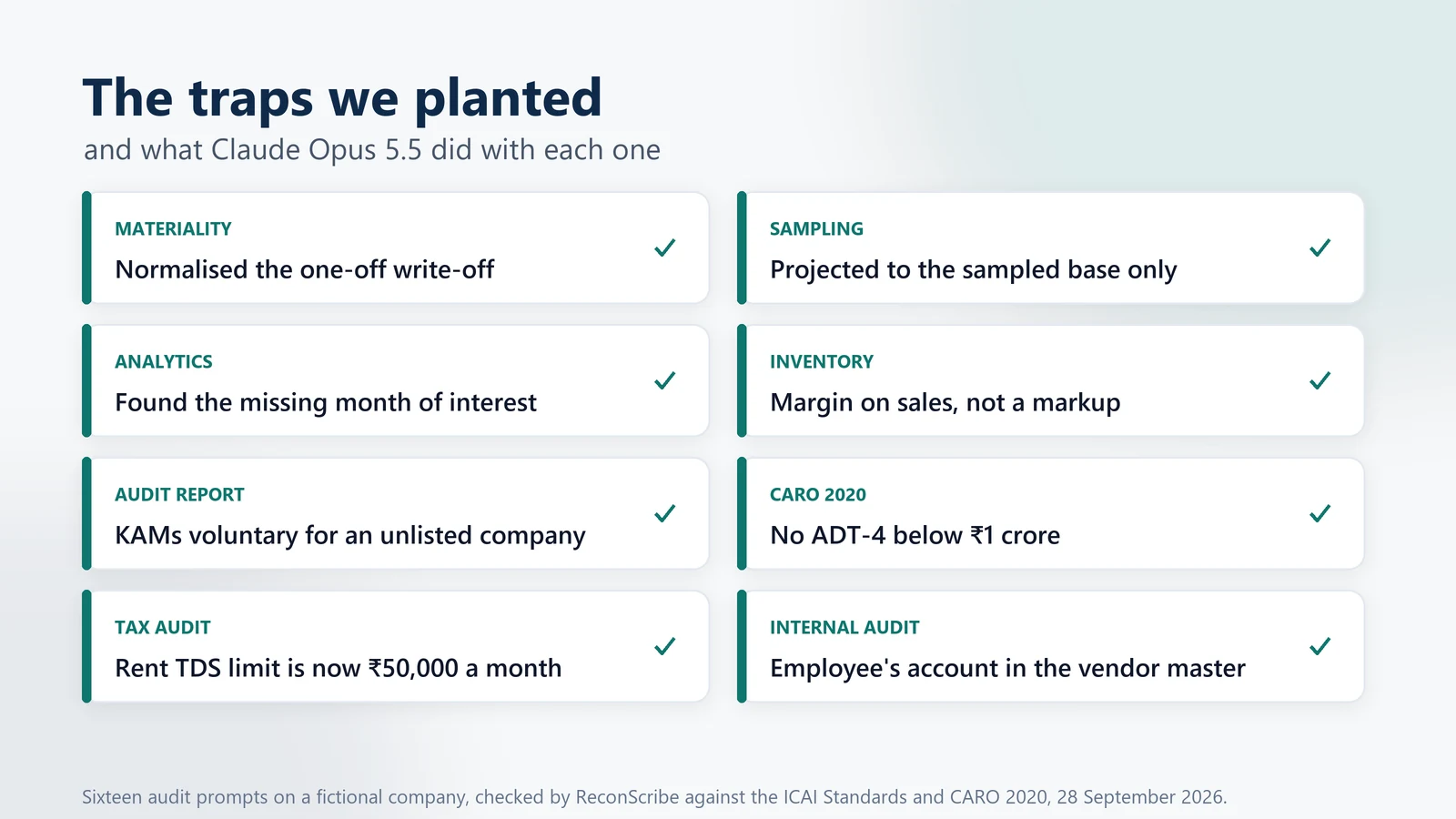
Each prompt carried at least one trap, the kind that catches a tired senior on a deadline. This is what the AI did with the ones that matter most.
| Trap | Prompt | What the AI did |
|---|---|---|
| A one-time ₹45 lakh write-off depresses profit | Materiality | Normalised profit to ₹83 lakh and rejected revenue as a benchmark, which would have set materiality at over a quarter of normal profit. |
| Sample errors projected to the wrong base | Sampling | Projected to the ₹27.2 crore it sampled, not the ₹31.4 crore that included items tested in full. |
| One month missing from an interest total | Analytics | Found that the ₹2,00,651 gap is exactly March’s interest. |
| A 20% margin read as a markup | Inventory roll-back | Took cost at 80% of sales, not sales divided by 1.2. |
| Key audit matters asked for an unlisted company | Audit report | Said SA 701 applies to listed entities, then drafted them as voluntary. |
| A ₹4.6 lakh fraud and Form ADT-4 | CARO 2020 | No ADT-4: below ₹1 crore, and found by management, not the auditor. |
| Rent of ₹45,000 a month and the old annual limit | Tax audit | No TDS: the limit is ₹50,000 a month from 2025-26, not ₹2,40,000 a year. |
| An employee’s bank account in the vendor master | Internal audit | Flagged it first, and saw one user behind most of the new vendors. |
What to watch when you use AI for audit work
The AI got every figure and every planted trap right in our test, and slipped once, on an Indian accounting carve-out. That says as much about the prompts as the model, so here is what made the difference, and what to keep an eye on.
- It can only apply rules to facts it has. It worked out that a subsidiary of a public company cannot use the CARO exemption, and that key audit matters are voluntary for an unlisted company, because the prompts said so. Leave the status out and you will get the textbook answer.
- It reads your facts critically. In the sampling test it noticed that an invoice booked in April 2026 could not sit in a list of 2025-26 purchases. Read those notes: they are often the most useful part of the answer.
- It defaults to the global rule. Its citations of Standards, CARO clauses and thresholds were right, but in the going concern answer it applied the IFRS rule on loan waivers, where India’s Ind AS 1 still has a carve-out for 2025-26. Check anything that depends on an Indian carve-out or a recent notification before it goes into a signed report.
- A tool may stop mid-answer. Runs on three of our prompts ended with an error from the AI provider; each asked the AI to work to a named Standard, and rewording them to ask for the reasoning got full answers. The going concern prompt also stalled or ran out of room several times before it answered. If that happens, ask for the conclusion first and the report wording in a second prompt.
Keep client data safe when you use AI
Audit files hold confidential client information, and your duties under the ICAI Code of Ethics and the Digital Personal Data Protection Act, 2023 apply to anything you paste into a tool:
- Strip identifiers first. Replace client, vendor and employee names, PAN, GSTINs and bank accounts with codes. Every one of these AI prompts for auditors works just as well with codes.
- Use a business plan with training switched off, and follow your firm’s policy on which tools are approved for client work.
- Keep the AI out of the conclusion. Let it draft, compute and list; the engagement team gathers the evidence and signs. File the prompt and the answer with the working papers.
- Check every rate, clause and date against the official text before you rely on it.
Please note: we update this page from time to time, but Standards, CARO, tax rules and AI tools change and there can be a gap between a change and our update. Check the current position before you rely on an answer. These AI prompts for auditors and the tested answers help you work faster; they are not professional advice, and ReconScribe is not responsible for decisions made on them.
Frequently asked questions
What are the best AI prompts for auditors?
The ones that give the AI the facts on file, your firm's method and the exact output: a table, a draft clause, a projection. Written that way, fifteen of our sixteen audit prompts came back right first time in Claude Opus 5.5 and the last was mostly right, from materiality and sample projections to CARO 2020 and Rule 11(g) wording.
Do these work as ChatGPT prompts for auditors?
Yes. They are plain text, so they work in ChatGPT, Gemini, Copilot or Claude. We tested them in Claude Opus 5.5. Results in other tools can differ, especially on Indian reporting rules, so keep the step where you check every clause and threshold before it goes into a signed report.
Are these AI prompts for internal auditors too?
Yes. Four of them are internal audit work: a risk and control matrix for procure to pay, red flags in the vendor master, red flags in expense claims, and an audit observation written from rough notes. The statutory audit prompts are also useful to internal auditors who review year-end controls.
Can AI draft CARO 2020 clauses and audit report wording?
It can draft them well if you give it the facts, including who detected a fraud, the amounts and the forum for each dispute. Treat the draft as a first version: check each clause against the Order and the ICAI guidance note, and never sign wording you have not verified against the file.
Is it safe to paste client data into an AI tool?
Only with care. Replace client names, PAN, GSTINs and bank details with codes, use a business plan that does not train on your chats, and keep the prompt and the answer with your working papers. Your confidentiality duties under the ICAI Code of Ethics still apply.
Does AI know the Standards on Auditing and CARO 2020?
It knew them well in our test: it cited the right SA paragraphs, the CARO clauses and the ₹1 crore threshold for reporting fraud to the Central Government. Its one slip was an Indian accounting carve-out, where it applied the IFRS rule instead. It works from memory, so give it any recent change, and check citations before they go into a report.
Why did an AI tool stop in the middle of an audit answer?
It happened to us. Runs on three prompts ended with an error from the AI provider instead of an answer; each asked the AI to work to a named Standard, and rewording them to ask for the reasoning fixed it. Our going concern prompt also stalled or ran out of room several times before it answered. If a tool stops mid-answer, rephrase or split the task rather than repeat it.
Will AI replace auditors?
No. In our test the AI did the arithmetic, drafting and pattern-spotting well, but every useful answer ended with steps only an auditor can take: inspect the document, confirm with the third party, judge whether an explanation holds up and sign the report.
Sources
We checked the answers to these AI prompts for auditors against these official texts on 28 September 2026.
- ICAI Standards on Auditing: SA 240, SA 320, SA 501, SA 520, SA 530, SA 570 (Revised), SA 701 and SA 705 (Revised) (Institute of Chartered Accountants of India).
- Guidance Note on the Companies (Auditor's Report) Order, 2020, including the text of the Order (ICAI).
- Implementation Guide on Reporting on Audit Trail under Rule 11(g) of the Companies (Audit and Auditors) Rules, 2014 (Revised 2024 Edition) (ICAI).
- Interest for delay in payment of TDS or TCS, on section 201(1A) of the Income-tax Act, 1961 (Income Tax Department).
- Central Goods and Services Tax Act, 2017, section 17, including section 17(5)(h) on goods lost or stolen (CBIC).
- Digital Personal Data Protection Act, 2023 (Ministry of Electronics and Information Technology).
Related guides and tools: AI prompts for accounting, AI prompts for Excel, AI prompts for finance, TDS interest calculator, MSME delayed payment interest calculator and audit checks for AI-generated documents.