
One million output tokens. That is the number that makes Gemini 4 Argon worth paying attention to. Not because anyone needs a million-token email, but because difficult work can run out of room halfway through. A complicated financial review, a large software migration or a long research task needs more than a neat first answer.
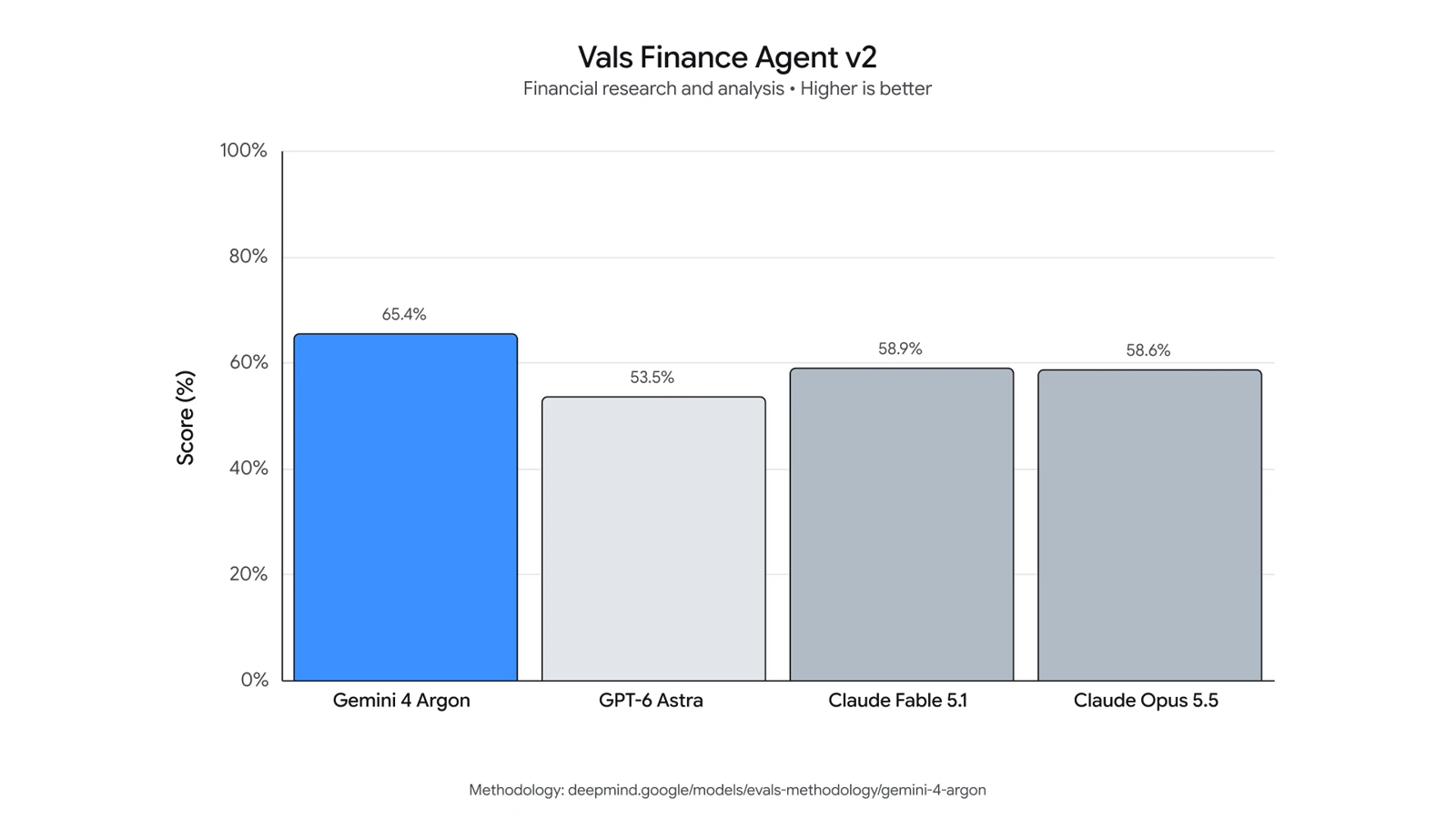
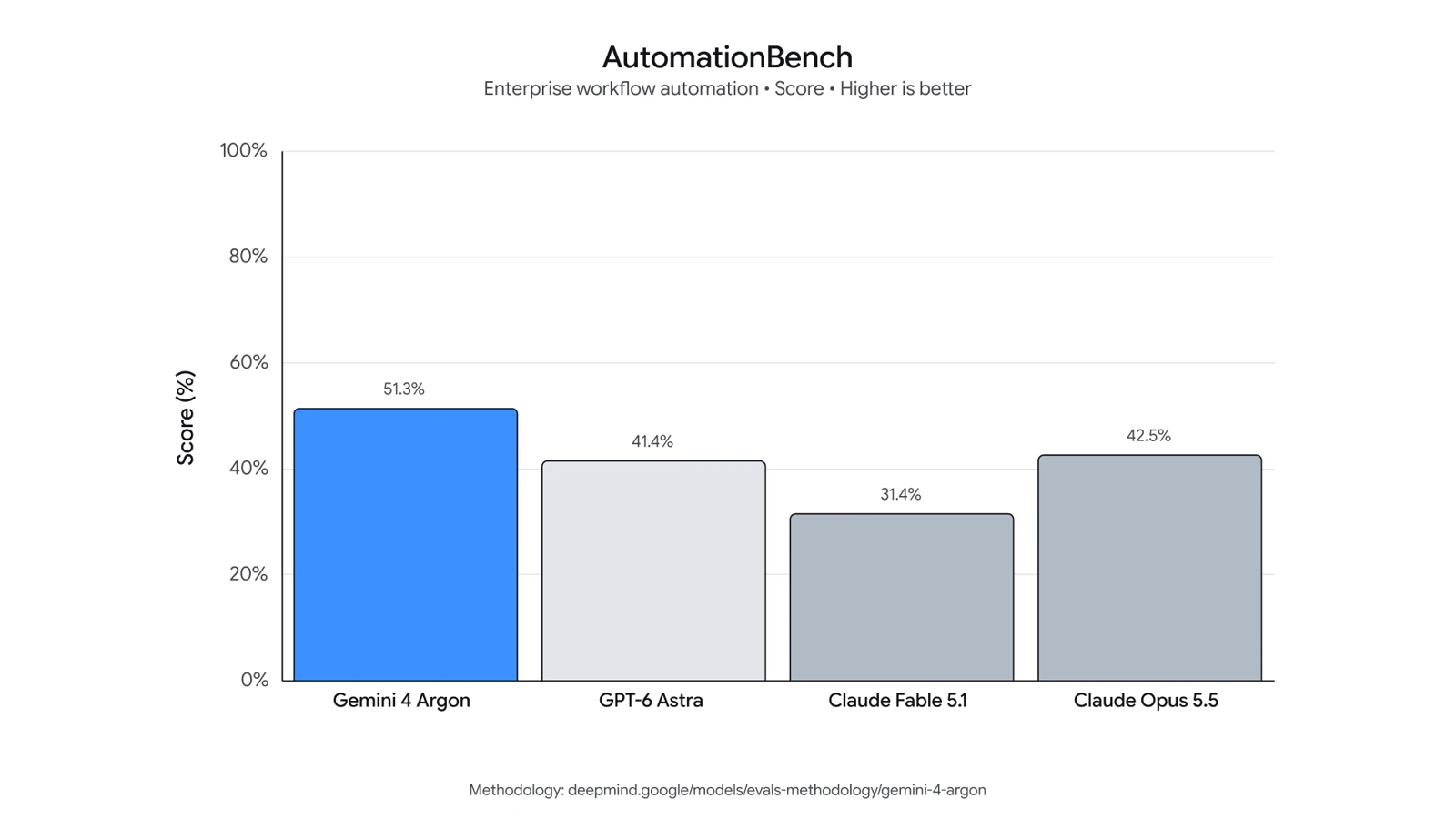
Google has given its new model much more room to keep reasoning and work through a difficult problem. There are serious finance results behind the announcement too: 65.4% on Vals Finance Agent v2 and 51.3% on AutomationBench. The introductory API price is $2 for input and $10 for output per million tokens.
The catch is access, not a missing announcement. Gemini 4 is already going to selected trusted cyber defenders, while the broader release is still ahead. Here is what is confirmed, what that huge output limit changes, where the model leads, and where Claude or ChatGPT still have a better result.
Gemini 4 Argon: the short answer
| Detail | Confirmed announcement |
|---|---|
| Model name | Gemini 4 Argon; not a confirmed Gemini 4 Pro or Flash release |
| Announcement | 30 September 2026 on the Google blog; 1 October in India at the time the X posts appeared |
| Output allowance | 1M tokens, up from the previous 64K |
| Introductory input / output | $2 / $10 per 1M tokens |
| Introductory cached input | $0.10 per 1M tokens, derived from the announced 95% discount |
| Later input / output | $4 / $20 per 1M tokens; introductory end date not specified |
| First rollout | Selected trusted cyber defenders through the Fairwind Program |
| First named broader access | Paid API customers and Google AI Ultra subscribers |
| Exact public release date | Not announced in the material checked on 1 October 2026 |
| Public API identifier and limits | Not verified yet; do not assume an identifier or a combined context specification |
The announcement is about Gemini 4 Argon. We would not quietly rename it Gemini 4 Pro, promise a Flash version, or treat Gemma 4 as the same product. The name matters when you look for access, specifications and pricing.
Gemini 4’s 1M output limit: why it is a big deal
Most people judge a model by the answer in the chat window. For harder work, the more important question can be how much room it has before that answer. Google’s official follow-up post connects the 1M limit with deeper reasoning and long, multi-step problems in one trajectory.
A token is a piece of text, not a word. Code, numbers, languages and formatting use tokens differently. One million output tokens therefore does not mean one million words. It also does not mean the Gemini chat window will let every account produce a response that large.
It raises the ceiling, not the minimum
Think of a difficult task that needs the model to inspect evidence, test an explanation, notice a conflict and revise its answer. A small generation budget can force it to stop before the useful work is complete. A larger ceiling gives it more room to continue that process.
That can be particularly valuable when a task has a long chain of dependencies. A coding change might need several files updated consistently. A finance review might need the movement explained, the schedule reconciled and the missing evidence listed. Finishing the first part is not the same as completing the assignment.
Google’s previous 64K allowance becomes 1M here, a roughly sixteenfold expansion. Against the ordinary 128K advertised output limits of GPT-6.1 Sol and Sonnet 5.5, it is about eight times the headroom. These are approximate capacity comparisons, not claims that Argon is eight or sixteen times better at the task.
Less forced continuation can make a difference
When a model stops at its limit, you can ask it to continue. But now the application has to preserve the working state, decide what to resend, avoid repeating sections and recover the unfinished result. Developers can engineer that process well. They can also spend a lot of time fixing it.
A longer single trajectory can reduce some of that stitching on tasks that genuinely need it. It does not eliminate state management, checkpoints or context limits. If a job runs for a long time, you still want recoverable progress rather than one enormous response that cannot be safely resumed.
Three useful examples
- Financial research: reviewing an earnings pack, checking statements against management commentary, building a source-backed exception list and preparing a structured operating review.
- Software work: migrating a library, updating related tests, checking performance and documenting what changed, rather than returning one isolated patch.
- Policy and SOP work: comparing several versions of a policy, mapping responsibilities, identifying conflicts and preparing an implementation pack with a review trail.
These are proposed uses, not results from our private access to Argon. The value comes from completing the chain of work, not from producing a longer document for its own sake.
1M output is not the same as a 1M context window
Input and context describe the material the model can work with. Output describes its generation allowance. Google is announcing a 1M output limit. That should not be rewritten as a verified public API specification for one million input tokens plus one million output tokens.
The GraphWalks results below test long contexts up to 1M tokens, but a benchmark setup is not a complete developer specification. We still need the released API rules for input, combined limits, thinking settings, truncation, streaming and timeouts.
Why it is not automatically better for everything
You do not need a supercomputer to work out 2 + 2. A routine email or a short explanation does not need a million-token budget either. If a smaller, faster model already gets the answer right, paying for a long frontier-model run may make the job slower and more expensive without improving the outcome.
More room also does not prove that the model will use it well. It can spend longer on the wrong interpretation. A long result can be harder to review, and extra reasoning is not a substitute for a sound method. Use a large budget when your test set shows that it produces more successful work.
Gemini 4 benchmarks: every result in the launch table
The official table contains 19 result rows across knowledge work, coding, science, long context, computer use, vision and cybersecurity. Argon has the highest reported score in 13 rows and shares the lead in one more. It does not lead the other five.
That count is useful as a quick reading aid, but it is not an overall intelligence score. A finance task, a graph traversal test and an engineering task have different difficulty, cost and commercial value. The official five-page evaluation document explains the methods behind the numbers.
Knowledge work, finance and legal research
| Benchmark | What it tests | Gemini 4 Argon | GPT-6 Astra | Claude Fable 5.1 | Claude Opus 5.5 |
|---|---|---|---|---|---|
| Vals Index | Economic-weighted professional work across finance, tax, law and coding | 68.9% | 63.1% | 65.8% | 67.0% |
| AutomationBench | Completing business workflows across connected applications | 51.3% | 41.4% | 31.4% | 42.5% |
| Vals Finance Agent v2 | Financial research requiring several steps | 65.4% | 53.5% | 58.9% | 58.6% |
| Harvey’s Legal Agent Benchmark | Legal research and drafting | 19.6% | 5.4% | 6.7% | 3.8% |
This is the part we would pay the most attention to at ReconScribe. Argon’s 65.4% on Vals Finance Agent v2 is 6.8 percentage points ahead of Opus 5.5 and 11.9 points ahead of Astra. On AutomationBench, its 51.3% is 8.8 points ahead of Opus and 9.9 points ahead of Astra.
Those are encouraging differences for financial research and connected workflows. They are not evidence that Argon can sign off an audit, choose a legal position or get every number right. A financial research task and a controlled month-end close are not the same thing.
The Vals Index is broader than finance alone: it combines finance, coding, law and tax tasks, weighted by their contribution to U.S. GDP. A high index score is a useful professional-work signal, but does not automatically transfer to every Indian accounting or statutory question.
The legal result is also striking, but the metric is tied to that particular benchmark. Do not turn a 19.6% score into a general claim about the percentage of legal questions it can answer. Use the evaluation’s criteria and your own review process.
Coding and machine learning engineering
| Benchmark | What it tests | Gemini 4 Argon | GPT-6 Astra | Claude Fable 5.1 | Claude Opus 5.5 |
|---|---|---|---|---|---|
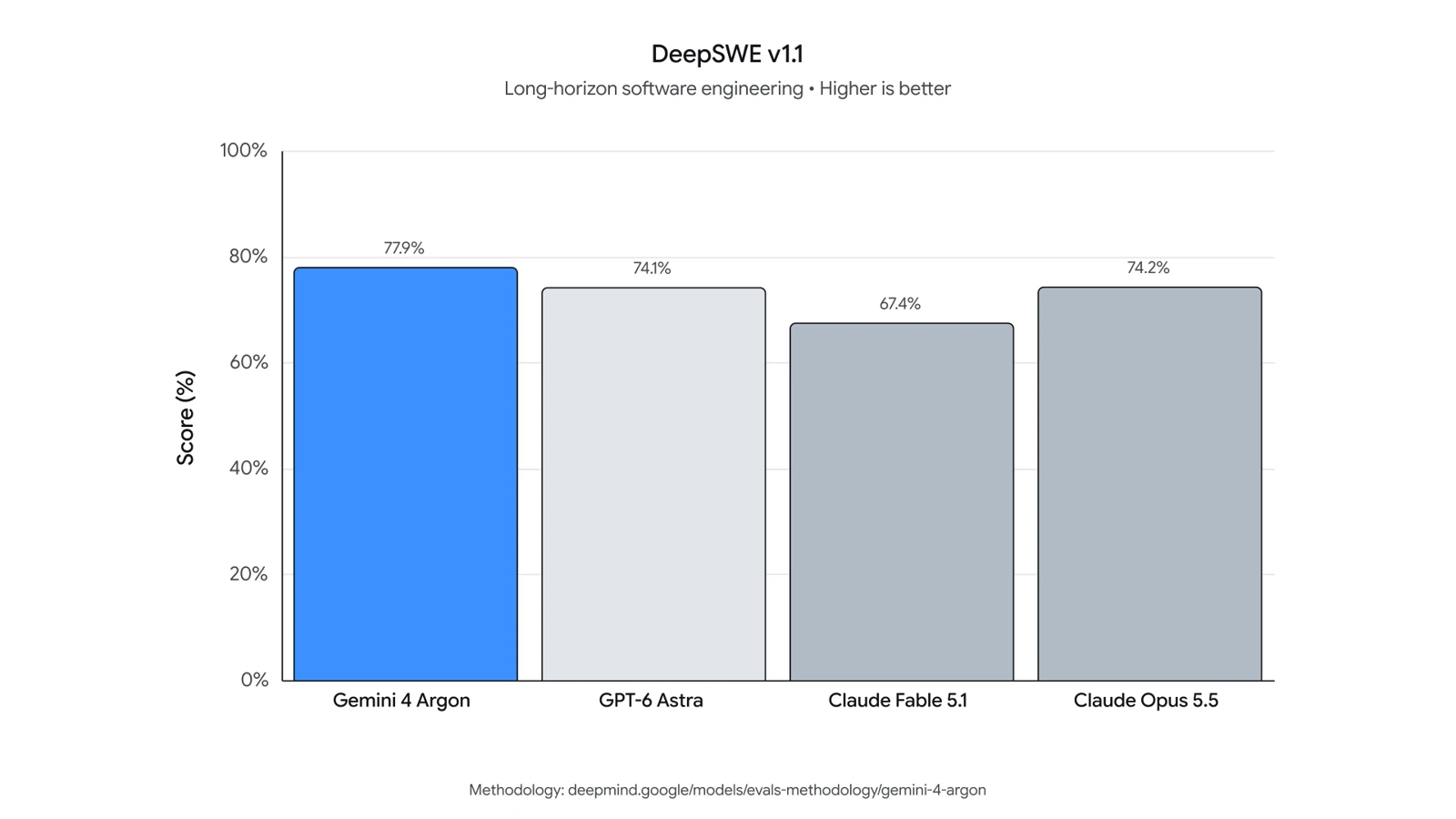
| DeepSWE v1.1 | Long software engineering tasks | 77.9% | 74.1% | 67.4% | 74.2% |
| FrontierSWE v2 | Very long engineering and research tasks | 55.0% | 65.5% | 56.3% | 62.3% |
| Vibe Code Bench | Building working software from a brief | 91.9% | 89.6% | 90.3% | 90.3% |
| Terminal-Bench 4.0 | Completing tasks in a command-line environment | 57.4% | 58.2% | 57.9% | 66.4% |
| PostTrainBench | Machine learning engineering, v1.1 setup | 45.3% | 44.3% | 40.2% | 49.3% |
DeepSWE is Argon’s clearest coding win: 77.9%, compared with 74.2% for Opus 5.5 and 74.1% for Astra. It also leads Vibe Code Bench at 91.9%.
The harder comparison is FrontierSWE v2, where Astra scores 65.5% and Opus 62.3%, ahead of Argon’s 55.0%. On Terminal-Bench 4.0, Opus leads at 66.4% while Argon scores 57.4%. Opus also leads PostTrainBench in this table.
So our coding conclusion is not “Google wins every coding test.” Argon looks especially interesting for the long software tasks represented by DeepSWE, while Astra and Opus retain important wins elsewhere. Test the kind of repository work you actually need.
Science and maths
| Benchmark | What it tests | Gemini 4 Argon | GPT-6 Astra | Claude Fable 5.1 | Claude Opus 5.5 |
|---|---|---|---|---|---|
| Terminal-Bench Science 0.1 | Scientific research tasks using a terminal | 57.6% | 68.1% | 52.6% | 63.3% |
| LABBench 2 | Biology research tasks with tools | 88.8% | 85.4% | 68.6% | 73.1% |
| RiemannBench | Mathematical reasoning | 76.0% | 72.0% | 65.6% | 69.6% |
Argon leads LABBench 2 and RiemannBench here. Astra has the strongest Terminal-Bench Science 0.1 result at 68.1%, ahead of Opus at 63.3% and Argon at 57.6%. A maths win does not make it the best model for every scientific tool workflow.
Long context and computer use
| Benchmark | What it tests | Gemini 4 Argon | GPT-6 Astra | Claude Fable 5.1 | Claude Opus 5.5 |
|---|---|---|---|---|---|
| GraphWalks, up to 128K | Graph traversal; breadth-first search F1 score | 99.7% | 98.7% | 91.4% | 90.6% |
| GraphWalks, 256K to 1M | Graph traversal in longer contexts; BFS F1 score | 84.2% | 71.8% | 65.0% | 66.8% |
| Agent’s Last Exam | Computer-use tasks; binary pass rate | 39.5% | 34.2% | Not reported | 38.2% |
| OSWorld 2.0 | Offline subset, partial score, 08.08 patch | 69.2% | 72.6% | Not reported | Not reported |
GraphWalks asks the model to reason about a graph. The 84.2% F1 score in the 256K to 1M range is promising for work where relevant information is spread across a lot of material. F1 is not a financial-document accuracy rate, and these are not million-token output tests.
On computer use, Argon leads Agent’s Last Exam in this table but trails Astra on OSWorld 2.0. The OSWorld number is the offline subset with partial credit, not a complete all-checkpoints pass rate. The missing Anthropic results are missing because their reported subsets differ, not because the models scored zero.
Charts, long videos and vulnerability fixes
| Benchmark | What it tests | Gemini 4 Argon | GPT-6 Astra | Claude Fable 5.1 | Claude Opus 5.5 |
|---|---|---|---|---|---|
| Chartography | Reading complex charts without tools | 71.6% | 71.0% | 46.2% | 66.3% |
| LVBench | Understanding long videos without tools | 91.7% | 87.5% | 79.7% | 83.7% |
| CWE-bench v1 | Fixing security vulnerabilities; pass@1 | 68.0% | 68.0% | 58.0% | 67.0% |
Chartography is directly relevant to a finance team reading graphs in investor decks or operating reviews. Argon scores 71.6% without tools, slightly ahead of Astra at 71.0%. The gap is only 0.6 percentage points, so we would not present that as a dramatic lead.
LVBench measures long-video understanding. Argon’s 91.7% is the strongest result here, but the models were given different amounts of video material because of API limits. Google used 1 FPS for Gemini, 800 frames for Astra, 300 for Fable and 600 for Opus. That matters when interpreting the result.
CWE-bench v1 is about remediating vulnerabilities. Argon and Astra share the 68.0% headline score. The methodology says results are ranked by pass@1, with pass@4 used to break ties. Matching the reported headline number does not establish an identical full ranking.
The fine print behind these comparisons
- Thinking settings: Google generally uses the highest thinking setting for Argon and maximum or best available published reasoning settings for the rivals.
- Different sources: some results are self-computed, some are from benchmark providers, and some come from rival system cards. This is not one independent lab running every model identically.
- Smaller tests: Google averages multiple trials where needed to reduce variance. General pass@1 framing has stated exceptions.
- Science verification: Argon’s Terminal-Bench Science run uses a sixfold verifier timeout to address verification timeouts.
- Computer use: Agent’s Last Exam uses a five-hour window and safety filters. OSWorld is the offline subset, maxed over three runs, with a 500-step limit and the 08.08 patch.
- No cost curve: Google has not published a matching effort-by-effort cost-per-task series in this launch material. We cannot calculate a comparable cost-efficiency winner from headline token prices alone.
What Google is already doing with Gemini 4
The internal examples give a better sense of ambition than a chatbot demo. Google describes teams using Argon for quantum algorithm optimisation, memory optimisation and large code migrations. These are reported examples from Google, not results we reproduced.
- Quantum work: one example improved a published spacetime-resource baseline by 40%. That is a particular algorithmic optimisation, not a claim that every quantum task is 40% better.
- Data-centre memory: an agent workflow identified and applied optimisations that freed more than 300 TiB after rollout. Google estimates further savings; those estimates are not completed savings.
- C/C++ to Rust: projects range from core libraries to more than 800,000 lines in Fuchsia’s Zircon kernel. Critical rewrites still undergo automated and manual auditing, emulation tests and review.
- Video decoding: in libgav1, agents replaced 32,000 lines of SIMD code through repeated profiling experiments. The resulting decoder was 2.7 times faster than the prior Rust port with identical output, not 2.7 times faster than the optimised C++ version.
Our takeaway is straightforward: the interesting work is not just generating code. It is inspecting results, running experiments and keeping a large change consistent. The 1M ceiling fits that kind of ambition, while the tests and human review still decide whether a change ships.
Gemini 4 pricing: the introductory rate and the later bill
The introductory rate looks attractive next to other frontier models. The small footnote matters just as much: after the introductory period, the headline input and output rates double. Google’s announcement does not state an end date for that period.
| Rate per 1M tokens | Introductory | After the introductory period |
|---|---|---|
| Input | $2 | $4 |
| Output | $10 | $20 |
| Cached input | $0.10 | Later cache rate not separately specified |
The launch cache discount is 95% off ordinary input. At a $2 input rate, that gives $0.10 per million cached input tokens. This is cache input pricing, not a 95% discount on output or the whole task. Cache storage, eligibility and later cache pricing need the released billing documentation.
| Model | Input / output per 1M | Standard advertised output | How we would use it |
|---|---|---|---|
| Gemini 4 Argon | $2 / $10 introductory; $4 / $20 later | 1M | Evaluate long financial research and complex workflows when access arrives |
| GPT-6.1 Sol | $2 / $10 | 128,000 | A current lower-cost option to trial for coding and finance work |
| Claude Sonnet 5.5 | $2 / $10 | 128K | A current practical option for everyday coding and knowledge work |
| Claude Opus 5.5 | $4 / $20 | 128K | Keep in the comparison for difficult work needing sustained judgment |
| GPT-6 Astra | $10 / $50 | 128,000 | Compare on difficult science and long engineering tasks |
Argon’s introductory input/output rates match Sol 6.1 and Sonnet 5.5. Its later rates match Opus 5.5. Astra’s standard headline rates are higher. That is a price comparison, not proof that any one of them completes your task more cheaply.
Other models have their own cache rules, long-prompt charges, processing modes and special limits. Compare a complete workload bill before treating the smallest headline number as the cheapest option.
What one million output tokens could cost
At $10 per million output tokens, a million billable output tokens cost $10 for output alone. At the later $20 rate, the same output quantity costs $20. Input and any applicable tools or additional charges sit on top.
| Illustrative request | Introductory bill | Later bill |
|---|---|---|
| 20,000 input + 5,000 output tokens | $0.09 | $0.18 |
| 100,000 input + 100,000 output tokens | $1.20 | $2.40 |
| 200,000 input + 1M output tokens | $10.40 | $20.80 |
These are deliberately simple arithmetic examples, not predictions of how much reasoning Argon will use. Google’s existing Gemini API pricing commonly includes thinking tokens in output billing, but Argon’s exact usage fields and billing treatment still need its public developer documentation. Budget for the billable generation, not only the words you can see.
The output limit is a ceiling. You do not pay for a full million-token allowance merely because it is available. Nor should you budget every task as a million-token run. If a 5,000-token result is enough, aim for that.
Gemini 4 for finance, accounting and audit teams
We personally think finance teams should pay more attention to this release than to an ordinary chatbot upgrade. The combination of a strong finance-agent result, better workflow scores and more generation headroom speaks to work that involves a chain of evidence.
That does not mean a finance department should hand over its close. It means there are sensible, bounded processes worth testing when access arrives.
A quarterly operating review
Give the model the earnings release, supporting schedules, presentation and review template. Ask it to separate reported figures from commentary, trace each important movement to a source, identify gaps and draft the narrative only after that evidence pass.
For example, if the pack reports a margin improvement while the segment schedule points the other way, the useful output is the conflict and the relevant pages, not a smooth explanation invented to make them agree.
TASK: Review a quarterly operating-results pack.

1. Build a source index: file, page, table and reporting period.
2. Separate reported figures from estimates and commentary.
3. Reconcile the main movements to the provided schedules.
4. Flag missing evidence, inconsistent units and unsupported claims.
5. Draft the review in the supplied format.
6. Keep an exception log and a list of reviewer questions.

Use the provided files for company figures. Cite each material claim.
Do not invent missing schedules, approvals or statutory rules.
Have a deterministic calculation step verify every reported total.
Do not post journals, send emails or change files without approval.
Return a concise management summary and an evidence appendix.
An audit-preparation pack
Use it to organise evidence, map requests to supporting files and prepare questions for a reviewer. A missing approval should stay missing. A plausible explanation does not replace the approval itself, and a confident narrative is not audit evidence.
Keep journal arithmetic and reconciliation checks in a deterministic step. The model can explain a difference, but a formula or code check should verify that the amounts agree. The review trail should show source, date, assumptions and exceptions.
A policy or SOP migration
A new process often affects several documents: the main SOP, approval matrix, checklists, exception handling and training notes. The output headroom could help prepare one consistent implementation pack rather than several disconnected answers.
Have a reviewer confirm authority, deadlines and legal references. For statutory content, the official rule remains the source. A model’s knowledge-work score does not give it current statutory knowledge for every jurisdiction.
Our first finance pilot would be small
We would start with a closed, historical review pack and a known answer, not live bank instructions or confidential files uploaded without permission. Measure whether the model finds the real exceptions, cites the right evidence and saves reviewer time. That is more useful than seeing how many pages it can generate.
For everyday prompting, our accounting prompt guide and auditor prompt examples provide a starting point. For the current models you can already evaluate, see our GPT-6.1 Sol guide and Claude Sonnet 5.5 comparison.
Gemini 4 for coding: where we would trial it
We would put Argon on the shortlist for repository tasks that need several related changes, investigation, tests and a careful finish. DeepSWE is a strong reason to try it. Google’s internal examples also point toward migrations and profile-guided optimisation.
We would not assume the biggest output budget is the right default. A narrow bug fix should stay narrow. Ask for the intended scope, relevant tests, acceptance criteria and a readable final change summary. Extra headroom should make the work more complete, not give the agent permission to rewrite unrelated files.
Run the same repository tasks on Argon, Sol 6.1, Sonnet and the harder-work models. Keep the harness, tools, test commands, time allowance and approval rules consistent. Record successful fixes, regressions, review time and total spend.
On a very long scientific or engineering task, Astra’s stronger FrontierSWE and Terminal-Bench Science scores deserve attention. On terminal work, Opus leads Argon in the launch table. The model that wins your actual acceptance test is the one to keep.
Gemini 4 cybersecurity and prompt-injection safeguards
Cybersecurity is not just another row in this rollout. The first access goes to trusted defenders, and Google describes a dedicated deployment of Argon without cyber guardrails for approved defenders and internal teams. That is not a promise of unrestricted public access.
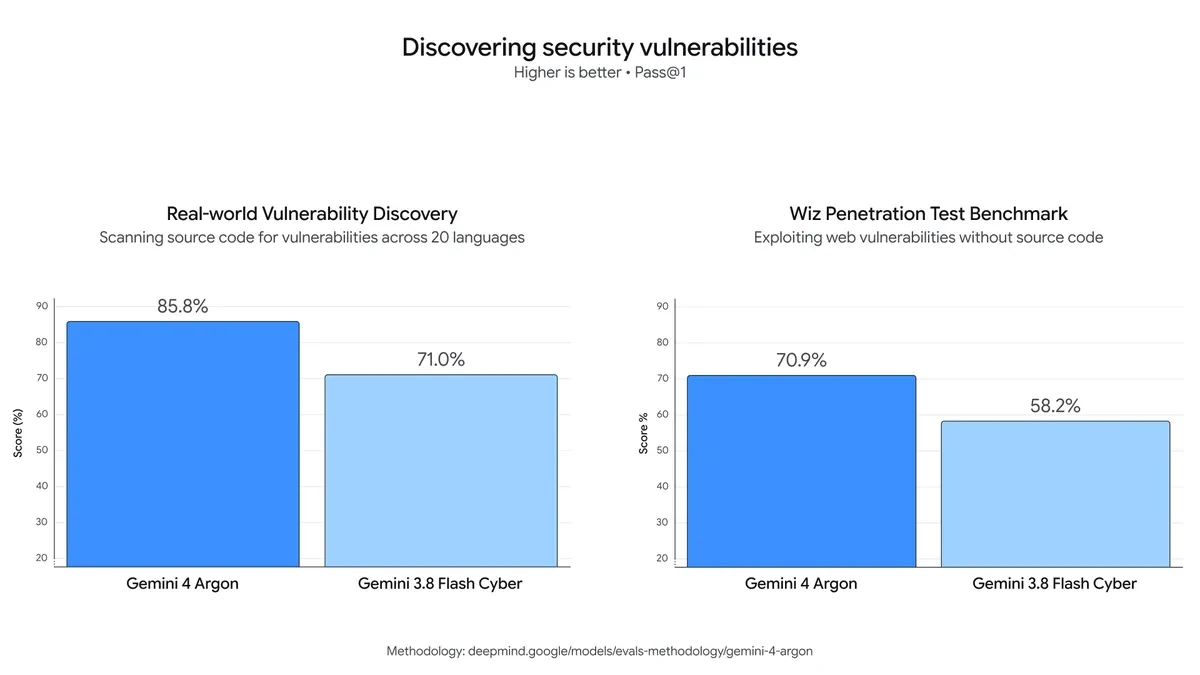
Google’s internal vulnerability chart reports two additional evaluations beyond CWE-bench. One uses source-code access across 20 programming languages. Wiz’s test uses live web systems without the codebase. They measure different kinds of defensive work.
| Evaluation | Gemini 4 Argon | Gemini 3.8 Flash Cyber |
|---|---|---|
| Real-world vulnerability discovery, pass@1 | 85.8% | 71.0% |
| Wiz penetration testing benchmark, pass@1 | 70.9% | 58.2% |
Prompt injection matters to finance teams too
A PDF, webpage or email can contain instructions that try to redirect an agent away from your task. For a finance workflow, that could mean an instruction inside a supplier file asking the model to ignore checks, change an account or send information somewhere else.
Google reports a 0.7% attack-success rate for Argon on the Gray Swan indirect prompt-injection chart at up to 15 attack attempts, lower than the other listed models. The chart is worth showing, but “low” is not “impossible.” It is also not your organisation’s production breach probability.
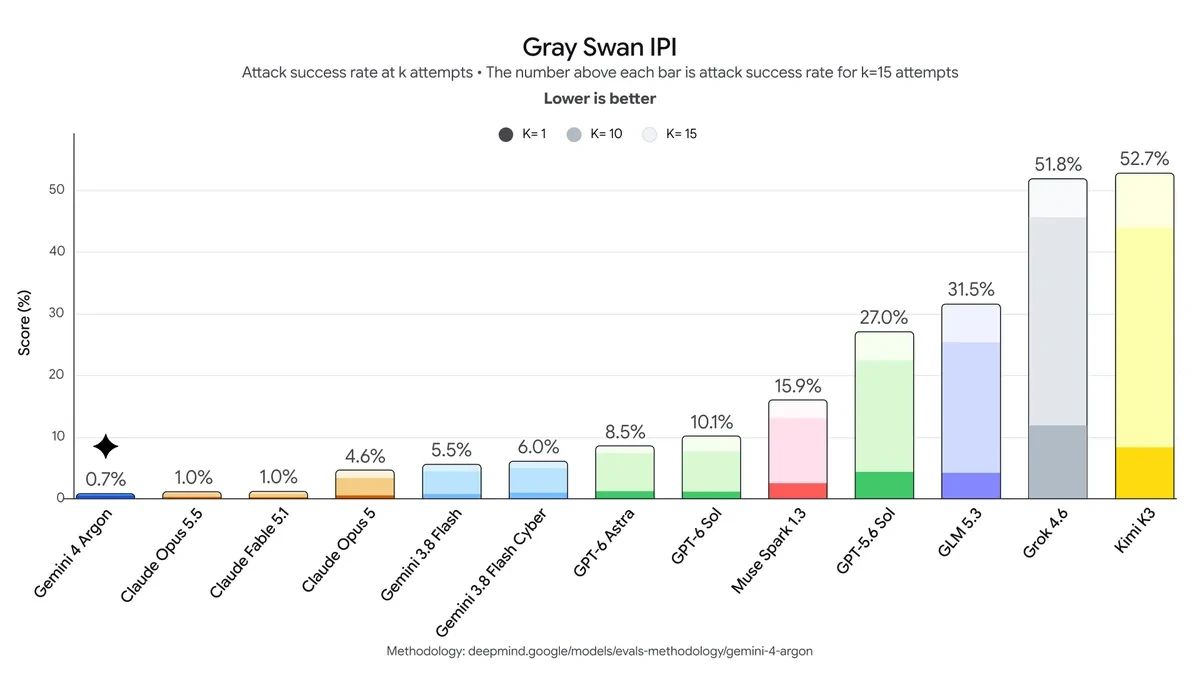
| Model | Attack success rate at up to 15 attempts |
|---|---|
| Gemini 4 Argon | 0.7% |
| Claude Opus 5.5 | 1.0% |
| Claude Fable 5.1 | 1.0% |
| Claude Opus 5 | 4.6% |
| Gemini 3.8 Flash | 5.5% |
| Gemini 3.8 Flash Cyber | 6.0% |
| GPT-6 Astra | 8.5% |
| GPT-6 Sol | 10.1% |
| Muse Spark 1.5 | 15.9% |
| GPT-6.5 Sol | 27.0% |
| GLM-5.3 | 31.5% |
| Grok 4.6 | 51.8% |
| Kimi K3 | 52.7% |
This chart lists GPT-6 Sol, not GPT-6.1 Sol, and older versions of some other models. Do not silently relabel them as their current successors. The launch scores are evidence for those evaluated versions.
Four layers of release safeguards
- Misuse prevention: refusal of harmful requests, robustness testing and monitoring aimed at spotting misuse.
- Injection resistance: adversarial training and red teaming to make hostile instructions in external material harder to follow.
- Misalignment monitoring: checks on reasoning and actions, with the ability to stop execution when necessary.
- Hardened environments: isolated, controlled systems before high-risk training and evaluations.
For our own workflow design, we would still separate untrusted document content from approved instructions, keep credentials out of the prompt, restrict tools and require approval for consequential actions. Better model safeguards strengthen those controls; they do not replace them.
Data retention depends on the access route
Fairwind’s FAQ confirms zero data retention support when Argon is accessed directly as a managed model on Gemini Enterprise. That is a specific deployment route, not a blanket privacy promise for every future Gemini app, API or Workspace account.
Before using client, employee or financial records, check the agreement, retention settings and controls for the product you will actually use. A subscription name or a strong injection benchmark does not establish permission to upload those records.
Gemini 4 release date, access and the official Google replies
There are two stages to keep straight: the model announcement and access for your own account. Google’s blog is dated 30 September 2026. The linked X posts appeared just after midnight in India on 1 October. Those are the same launch event, not two separate releases.
The initial stage is selected trusted cyber defenders through the Fairwind Program. Google’s expanded official rollout reply confirms this phased approach. Broader release is planned, with paid API customers and Google AI Ultra subscribers named first in the blog.
There is no exact public launch date in the material we checked. “Rolling out soon” is not the same as “available to everyone today.” Buying a subscription is not evidence that the model has reached your account.
How to follow or request access
- For ordinary users: check Google’s announcement and your actual model picker or plan details when broader rollout is announced. Google AI Ultra is the named first consumer group, not a confirmed universal entitlement.
- For API developers: watch the official Gemini API model documentation for an Argon model identifier, settings, limits and billing rules before building a production integration.
- For eligible defensive organisations: read Fairwind’s criteria and use its linked official application form. Access is vetted; applying is not approval.
- For business or Workspace users: check your administrator’s product and data-policy settings. A Gemini model announcement does not automatically enable it in Gmail, Docs, NotebookLM or every enterprise surface.
Fairwind prioritises governments and partners important to societal resilience. It requires controlled access, strong authentication and organisation-level vetting. Partners cannot resell or redistribute access. It is not a general waitlist shortcut for individual users.
Free users, Google AI Pro and the Jio offer
The launch does not confirm Argon access for free users or Google AI Pro. It also does not confirm that a Jio promotional subscription includes Gemini 4 Argon. The first named consumer group is Google AI Ultra. Treat offer eligibility and model eligibility as two separate questions.
A promotional plan can still be valuable for the benefits it actually includes. Just do not buy, renew or switch a plan on the assumption that a future model is included when Google has not confirmed that.
What we are waiting for in the developer details
The public API model ID, exact input and combined token limits, supported thinking settings, maximum run time, streaming behaviour, tool charges and introductory-price expiry are the key missing operational details. We have not filled those gaps with guesses.
We have also not found an official cost-per-task curve, a published consumer latency comparison or a per-account Argon message allowance in this launch pack. That prevents a fair claim that it is the fastest, cheapest or least rate-limited model for everyone.
How we would compare Gemini 4 with the models you use now
Before moving a live process, choose a short evaluation set that includes ordinary tasks, difficult exceptions and situations where the correct action is to stop and ask. Keep the source files and acceptance criteria the same for each model.
- Accuracy: are the material claims and amounts correct, and can the reviewer trace them to evidence?
- Completeness: did it finish the whole assignment, or only the easy part?
- Scope: did it stay within the requested documents, changes and permissions?
- Recovery: can the application resume safely after a timeout or interrupted run?
- Cost: what did the successful result cost, including retries, tools and reviewer time?
- Speed: when was the useful, reviewed work finished, not just the first token?
Give the model enough output budget to complete the task, then test whether a larger budget improves the result. If doubling the budget does not improve acceptance, there is no commercial reason to keep doubling it.
Our AI model leaderboard is useful for exploring the wider field. Its data has its own refresh date; an announced model should not be treated as an independently ranked public model before that evidence exists.
ReconScribe’s verdict on Gemini 4 Argon
For financial research and multi-step knowledge work: we personally think Argon looks especially promising. It leads every knowledge-work row in Google’s table. The finance-agent gap is material, and more room to finish a complex assignment could make that capability easier to use.
For coding: it earns a trial on long repository work, but it is not the winner of every coding test. Astra and Opus still lead important rows. Sol 6.1 and Sonnet 5.5 also deserve a fair comparison for the everyday work people actually buy.
For routine tasks: the big output limit is not a reason to spend more. Keep the fast, inexpensive model that already passes your checks. Move up when the task needs it.
Our winner today: Argon wins the finance-and-workflow shortlist on the published launch evidence. We are not naming it the best model at everything, and we have not tested it hands-on. Until wider access arrives, the best operational choice is still a model you can use and have already validated.
Google has made a serious return to the frontier conversation. The next question is not whether it can generate a very long answer. It is whether it can finish difficult work more accurately, with a bill and a review trail your team can accept.
Gemini 4 FAQs
What is Gemini 4 Argon?
When will Gemini 4 be released?
What does a 1M output token limit mean?
Is 1M output the same as a 1M context window?
Is Gemini 4 about 16 times smarter?
How much does Gemini 4 cost?
How much would one million output tokens cost?
Will free Gemini users get Gemini 4?
Will Gemini 4 be included in Google AI Pro or the Jio offer?
Is Gemini 4 better for finance work?
Does Gemini 4 beat Claude and ChatGPT in coding?
What is the Gemini 4 API model ID?
Is Gemini 4 the same as Gemma 4?
Has ReconScribe tested Gemini 4 hands-on?
Can one million output tokens replace separate agents and checkpoints?
Sources and further reading
- Google's Gemini 4 Argon announcement, 30 September 2026: 1M output, rollout, introductory rates, later-rate footnote, internal examples and official images.
- Google DeepMind's Gemini model page: all 19 launch result rows and safety overview.
- Gemini 4 Argon model evaluation PDF: methods, effort settings, harnesses, dataset subsets, video inputs and complete result table.
- Google's official X announcement, benchmark follow-up and rollout follow-up: official thread, checked with expanded replies.
- Google DeepMind's announcement and 1M-output follow-up: trusted testers and long reasoning trajectories.
- Fairwind Program: eligibility, applications, governance and controlled defensive access.
- Gemini API models, API pricing and token guidance: current developer references; not a substitute for an unreleased Argon specification.
- GPT-6.1 Sol documentation and GPT-6 Astra documentation: current headline rates and advertised output limits.
- Claude model overview and Claude API pricing: Sonnet and Opus rates and ordinary response limits.