
Your salary may stay the same, but the PF deduction on your payslip could change. The new EPF limit is ₹25,000 a month, up from the earlier ₹15,000 wage ceiling. For someone who was outside mandatory coverage, that can mean a first PF deduction. For someone already contributing, the answer depends on how their PF is calculated today.
For payroll teams, the timing is awkward: the change takes effect on 17 September 2026, halfway through the salary month. Before changing ₹15,000 to ₹25,000 in the software, there are three things to get right: which employees are affected, what counts as wages, and how September is handled.
Here is what the EPF wage ceiling increase means for your salary and your next payroll, starting with the Ministry’s official announcement. For September, the question is not just whether your PF goes from ₹1,800 to ₹3,000. It is which part of the month uses the new ceiling.

EPF wage ceiling ₹25,000: the change in one minute
- Earlier ceiling: ₹15,000 per month.
- New ceiling: ₹25,000 per month for Chapter III of the Code on Social Security, 2020.
- Notification: S.O. 5109(E), dated 17 September 2026, Gazette reference CG-DL-E-17092026-276299.
- Start date: the date of publication in the Official Gazette, 17 September 2026.
- Replaces: S.O. 2702(E), dated 29 May 2026, with a saving for things done or omitted before supersession.
- Important distinction: a wage ceiling is not a new minimum salary, a pay rise or a rule that every employee must have ₹3,000 deducted.
Work out your own figures: our EPF calculator splits employee PF, EPS, EPF, EDLI and admin charges on the ₹25,000 ceiling, with both September 2026 methods side by side and a projection of your balance at retirement.
What exactly does the notification say?
S.O. 5109(E) uses the power under section 2(89) of the Code on Social Security, 2020 to set the monthly wage ceiling for Chapter III. Its operative text is short: it changes the ceiling, identifies the earlier notification being superseded and makes the new amount effective on publication.
That scope matters. Do not treat this document as an amendment to every number in payroll. It does not itself set a new percentage contribution rate, replace the ESI threshold, change professional tax slabs or specify every EPF/EPS/EDLI operational detail.
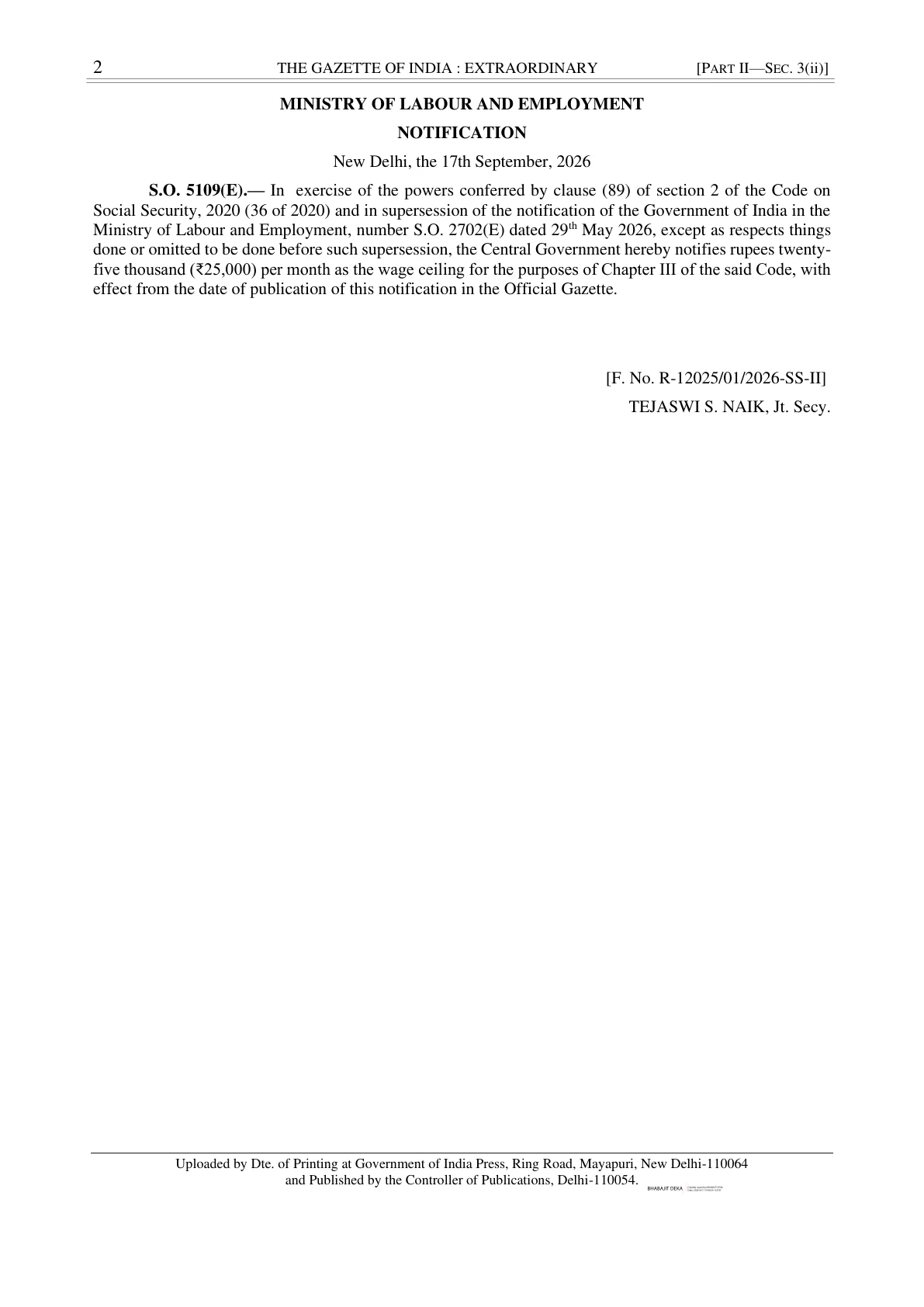
Read the two-page government Gazette PDF, S.O. 5109(E) (reference CG-DL-E-17092026-276299). The EPFO press briefing reported by PIB also confirms that the revised monthly contribution ceiling is ₹25,000 or actual applicable wages, whichever is lower, subject to the scheme rules.
Check which pages you are reading. In a nine-page PDF shared with us as “PF Notification 2026”, only pages 1 and 2 are the Gazette. Pages 3 to 9 match a private payroll advisory. Its September split and cost tables are useful examples, but they are not part of S.O. 5109(E). Compare any forwarded file with the official two-page PDF before calling its calculation an EPFO instruction.
Earlier versus now: what changed?
| Point | Earlier position | New position |
|---|---|---|
| Monthly ceiling | ₹15,000 | ₹25,000 |
| Code-level notification | S.O. 2702(E), 29 May 2026 | S.O. 5109(E), 17 September 2026 |
| Main coverage effect | Fresh entrants above ₹15,000 were not automatically covered solely by the wage test | The mandatory-coverage wage band extends up to ₹25,000, subject to establishment and scheme conditions |
| Timing | Earlier ceiling before the new notification took effect | Effective 17 September, not automatically 1 September or 1 October |
| Contribution percentage | Applicable establishment and scheme rate | This notification does not change that rate |
The earlier official May 2026 notification expressly specified ₹15,000 for Chapter III. Historically, the ₹15,000 ceiling dated from the September 2014 revision. The Cabinet announcement of 16 September 2026 describes the new decision as an expansion of mandatory coverage, with benefits subject to the applicable schemes.
September 2026 calculation: why payroll teams are getting different answers
The Gazette starts the ₹25,000 ceiling on 17 September 2026. It does not print an ECR formula for a month with two ceilings. A private advisory attached to the scanned PDF uses a day split. greytHR’s payroll note says the full-month versus pro-rated treatment has been debated while awaiting an EPFO clarification. Some payrolls may also still be set to the old cap until October. These are not three equally authoritative choices: the notification starts on 17 September, while software and filing instructions still need to be checked.
Take one existing EPF member who worked all 30 days of September, has statutory PF wages of at least ₹25,000 a month, was previously capped at ₹15,000 and contributes at the usual 12% rate. Under the split-month working, the capped base is ₹15,000 × 16/30 = ₹8,000 for 1 to 16 September, plus ₹25,000 × 14/30 = ₹11,666.67 for 17 to 30 September. Total September PF wages are ₹19,666.67 and the illustrative employee contribution is ₹2,360, subject to ECR rounding.
Our EPF calculator runs the day split and the full month for any PF wage, including employees newly covered from 17 September.
| Treatment being discussed | September PF wage | Employee PF | What to check |
|---|---|---|---|
| Split at 17 September | ₹19,666.67 | ₹2,360 | Tracks the effective date; confirm ECR and EPS handling. |
| New ceiling for all September | ₹25,000 | ₹3,000 | Illustrates a full-month result for an eligible active employee. The Gazette does not prescribe this method. |
| Old ceiling for all September | ₹15,000 | ₹1,800 | Misses the notified 17 to 30 September period if used simply because software has not changed. |
Pro-rated September versus Zoho’s threshold approach
For the same existing member in the table, a day split produces ₹2,360 employee PF. A full September at the new ₹25,000 cap produces ₹3,000. That is a ₹640 difference for the employee and, assuming a matching 12% employer contribution, another ₹640 for the employer. These figures compare only the ceiling treatment; the employee’s statutory wages, membership, attendance and contribution rate must otherwise be the same.
A separate Zoho Payroll support email shared with us describes an EPFO threshold Migration Tool that Zoho said would arrive by 25 September 2026 with a dashboard notice. Once an organisation updates its configuration, Zoho says the revised threshold will be considered in its September payroll. Its stated rule keeps ₹15,000 for employees who exited before 17 September, while employees active on or after 17 September are considered under ₹25,000. The email describes 17 September as the date for deciding which employees get the new threshold; it does not describe a 16-day/14-day ceiling split for employees active after that date. This is Zoho’s planned software treatment, not an EPFO instruction or proof that the feature is already enabled in every account.
The email does not give an employee-level September calculation or ECR example. For an existing member, check whether Zoho actually produces the full-month ₹3,000 result in the stated case, then compare the PF wage, EPS wage and ECR export with the ₹2,360 day-split working. Ask Zoho and your statutory adviser how that output should be filed. Do not confuse this threshold tool with Zoho’s New Wage Code Migration tool, which changes which salary components count as wages. Zoho’s separate pro-rate PF for days worked setting deals with days worked, not the mid-month ceiling change. Its public help page still shows the old ₹15,000 ceiling, so check the current behaviour in your account.
A newly covered person is different. Consider an employee who worked all September, earned ₹20,000 in monthly statutory wages and was outside EPF solely because of the old ceiling. Membership may start on 17 September. A post-17-only contribution working uses ₹20,000 × 14/30 = ₹9,333.33 and gives about ₹1,120 employee PF at 12%. A full-month contribution working on the ₹20,000 actually earned gives ₹2,400. The Zoho threshold email says such an active employee is within the revised limit for September, but does not supply a member-level contribution example proving which amount its software will produce. This is a different question from an employee who actually joined employment on 17 September and earned only part-month wages.
Our reading is that the split working follows the effective date more closely than ignoring September. But the Gazette does not itself prescribe that arithmetic or resolve every ECR validation and EPS history question. Argus Partners’ legal analysis explains the full-month view for both existing and newly covered members while acknowledging the split-month argument. That is a professional interpretation, not an EPFO direction. The EPFO Goa advisory reported by PIB tells employers to update payroll from 17 September and file on time; it does not set out this table. A privately hosted FAQ page gives a split-month example and describes it as EPFO guidance, but we could not verify its original on an EPFO government domain. Ask your EPFO office or payroll provider for the filing basis and retain the written reply before closing the September ECR.
Keep the prior payroll configuration, component-level wage calculation, membership and EPS history, the revised September working and a copy of the final ECR. A portal limitation is not a change in the Gazette date. If a filing validation rejects the supported amount, save the error and resolve it through EPFO rather than silently starting the new ceiling in October.
How to check a forwarded PF calculation
- Open the government PDF. Confirm S.O. 5109(E), ₹25,000, Chapter III and the 17 September publication date. Do not assume a table on later pages of a forwarded file is part of the Gazette.
- Recalculate statutory wages from salary components. Check whether the person was already an EPF member, was capped at ₹15,000, contributed on higher wages or was previously excluded. Record EPS eligibility separately.
- For a split-month working, show the old and new periods as separate lines, then reconcile the total employee PF and employer EPF/EPS split to the September payslip and ECR fields. Check the provider’s rounding and any joining or exit days.
- Ask for a dated EPFO or payroll-provider instruction if the result or ECR validation differs. Keep the answer with the working rather than replacing a calculation with a screenshot of the software setting.
Who should check their EPF position now?
Employees above ₹15,000 and up to ₹25,000
This is the central group to review. Someone previously outside mandatory membership because their joining wages exceeded the old ceiling may now fall within the widened threshold. Check the establishment’s coverage, the employee’s wage calculation, employment dates and existing membership history before assigning a payroll treatment.
Employees already contributing to PF
Do not confuse an existing member with a fresh entrant. Check whether contributions were capped, paid on a higher wage base or affected by an existing option. A ceiling change does not establish the same incremental deduction for all three situations. Do not remove an existing member from coverage simply because their salary exceeds the new threshold.
Employees above ₹25,000
The headline is not a general PF exemption above ₹25,000. Membership history and applicable provisions still matter. Conversely, a high gross salary does not by itself prove which statutory wage figure should be tested.
Employers, contractors and payroll teams
Review employees whose old exclusion was based on wages above ₹15,000, including relevant contractor records. Keep responsibility and applicability checks separate from the wage comparison. This notification does not mean every business, regardless of coverage conditions, suddenly has the same EPF obligations.
Does ₹25,000 mean basic salary, gross salary or CTC?
Do not compare the limit mechanically with CTC or take-home pay. The notification uses a statutory wage ceiling under the Social Security Code. Payroll needs the applicable wage definition and scheme provisions, not merely the label on an offer letter.
For example, ₹30,000 gross pay and ₹20,000 labelled basic pay do not give enough information by themselves to decide coverage. The composition and treatment of allowances matter. Review the Code on Social Security on India Code and document the wage base used. Our labour-code wage-definition guide provides related background; it should not replace the current notification or official instructions.
New wage definition explained: what is included and excluded?
Think of statutory wages as a calculation, not a column already printed on your payslip. Start with remuneration payable for employment, identify the exclusions that genuinely apply, then check whether part of those exclusions must be added back. The result can differ from basic salary, gross cash salary, take-home pay and CTC.
What is included in wages?
Section 2(88) expressly includes basic pay, dearness allowance (DA) and retaining allowance, if any. Retaining allowance is a payment to retain an employee’s services during a period when work is not available. The opening definition covers remuneration more broadly; it is not simply a three-item checklist that excludes everything else.
For example, basic pay of ₹16,000 plus DA of ₹2,000 gives ₹18,000 before considering other remuneration and the exclusion test. A regular payment called special allowance does not become excluded merely because payroll gives it that name. Identify the actual provision supporting its treatment. Similarly, an amount excluded for this statutory purpose is not automatically exempt from income tax.
Full exclusion list under section 2(88)
The table paraphrases the excluded-payment clauses in the official Social Security Code, PDF pages 18 and 19. These are initial exclusions, not permission to ignore the 50% add-back. The lettering below belongs to the excluded list, not the separate basic-pay, DA and retaining-allowance inclusions.
| Clause | Excluded payment or value | 50% add-back pool? |
|---|---|---|
| (a) | Statutory bonus that is not contractual employment remuneration. | Yes |
| (b) | Value of housing, light, water, medical attendance and the amenities or services described in this clause. Check any required government exclusion order. | Yes |
| (c) | Employer pension or provident-fund contributions and interest accrued on them. | Yes |
| (d) | Conveyance allowance or travel-concession value. | Yes |
| (e) | Amounts paid to meet special expenses arising from the nature of the job. | Yes |
| (f) | House rent allowance (HRA). | Yes |
| (g) | Remuneration under an award, settlement, court order or tribunal order. | Yes |
| (h) | Overtime allowance. | Yes |
| (i) | Employee commission. | Yes |
| (j) | Gratuity payable on termination. | No, outside clauses (a) to (i) |
| (k) | Retrenchment compensation, other retirement benefits or termination ex gratia covered by this statutory clause. | No, outside clauses (a) to (i) |
Read “Yes” correctly: the qualifying amount belongs in the combined excluded-payment pool for the test. It is not automatically added back in full, and each allowance does not receive its own separate 50% limit. Whether a payment qualifies for an exclusion must be established first.
The 50% rule: how the add-back actually works
Once the components have been classified, calculate:
- Test limit: 50% of the correctly determined remuneration for this purpose.
- Add-back: the amount by which the combined qualifying exclusions in clauses (a) to (i) exceed that limit. If there is no excess, the add-back is zero.
- Statutory wages: wages included before the test, plus that excess, with any other applicable statutory adjustments.
Wages are not automatically 50% of CTC. The Ministry’s March 2026 FAQ 1 includes employer PF/pension contributions and statutory bonus in the relevant remuneration exercise, but excludes gratuity, ESI and other retirement benefits. Employee PF is a deduction from earnings, not another employer payment to add a second time. Overtime enters the add-back exercise too. A CTC sheet can therefore contain amounts that need different treatment.
Worked example 1: exclusions exceed half of remuneration
For a simple wage-definition illustration, assume an establishment outside EPF coverage, no employer PF/pension or statutory bonus to bring into this calculation, and no in-kind or termination payments. The employee receives ₹12,000 basic pay and ₹18,000 genuine HRA. Cash remuneration is ₹30,000. This example isolates the wage test; it is not an EPF filing example.
| Step | Working | Amount |
|---|---|---|
| Included wages before the test | Basic pay | ₹12,000 |
| Qualifying exclusions | HRA under clause (f) | ₹18,000 |
| 50% test limit | ₹30,000 × 50% | ₹15,000 |
| Excess exclusion added back | ₹18,000 − ₹15,000 | ₹3,000 |
| Resulting statutory wages | ₹12,000 + ₹3,000 | ₹15,000 |
The entire ₹18,000 HRA is not added back. Only the ₹3,000 excess is. The employee still receives ₹30,000 gross cash remuneration; the calculation does not convert their salary into ₹15,000 or itself change their contract. Under the same assumptions, ₹12,000 basic plus ₹12,000 HRA gives ₹24,000 remuneration and a ₹12,000 threshold. The exclusions equal, but do not exceed, that threshold, so the add-back is zero.
Worked example 2: wages are already above the 50% floor
Keep the first example’s assumptions, but change the breakup to ₹20,000 basic and ₹10,000 HRA. Remuneration remains ₹30,000 and half is still ₹15,000. The excluded ₹10,000 is below the limit, so nothing is added back. Statutory wages stay ₹20,000, not ₹15,000. The rule prevents excessive exclusions; it does not reduce a larger included wage amount.
Worked example 3: employer PF makes remuneration different from gross
Now take an EPF-covered employee with ₹25,000 basic, ₹5,000 HRA and an assumed, independently confirmed employer PF/pension contribution of ₹3,000. Assume no other relevant components. Gross cash salary is ₹30,000, but remuneration for this illustration is ₹33,000 after including the employer contribution in the test.
The excluded pool is ₹5,000 HRA plus ₹3,000 employer contribution, or ₹8,000. Half of ₹33,000 is ₹16,500. There is no excess, so statutory wages remain ₹25,000. Neither half of gross, ₹15,000, nor half of the test remuneration, ₹16,500, is the answer. Do not add the employee’s own PF deduction again. If the employer contribution depends on the wage calculation, check that both figures are consistent before finalising payroll.
Two qualifications that a cropped definition can miss
Payment-of-wages and equal-pay purposes: the second proviso specifically brings items in clauses (d), (f), (g) and (h) into the computation for those purposes. Do not reuse a social-security wage mapping unchanged for every legal test.
Remuneration in kind: the explanation deals with benefits provided instead of all or part of wages, subject to its 15% provision. The Ministry’s FAQ 18 gives food coupons, ration items and mobile recharge as examples under employment terms. Do not assume every non-cash benefit is excluded, or treat the provision as a general 15% exemption.
The Ministry separately addresses annual performance-based incentives in FAQ 4. Do not confuse that clarification with statutory bonus, contractual monthly pay or employee commission. Match the actual payment to the rule rather than renaming salary as an incentive.
Read the complete definition, not a cropped extract. The full Code on Social Security, 2020 (official India Code PDF) contains section 2(88) across PDF pages 18 and 19, followed by the wage-ceiling definition in section 2(89). The full Code on Wages, 2019 (official India Code PDF) contains section 2(y) across PDF pages 7 and 8. Read the exclusions, add-back provisos and explanation together. These are complete Acts, not new September notifications.
What about ESI: gross salary or the new wage definition?
Do not use the gross-pay column as an automatic ESI test. ESIC’s 11 December 2025 circular confirms that the Social Security Code’s section 2(88) wage definition applies from 21 November 2025. It specifically asks employers to review employees who could come into ESI coverage under that definition.
Earlier, ESI used its own wage definition under section 2(22) of the ESI Act. Payroll often described this as gross wages, but that shorthand was never a substitute for the statutory inclusions and exclusions. Now the relevant starting point is the Social Security Code definition, including its add-back provisions, for ESI wage assessment rather than a blanket gross-salary mapping.
The Ministry’s March 2026 FAQ, question 12, confirms the new definition and the ordinary ₹21,000 monthly ESI coverage ceiling. The September EPF notification does not raise that ESI ceiling to ₹25,000. Special-category rules and contribution-period continuity still need checking separately.
For example, someone with gross pay above ₹21,000 should not be rejected from ESI solely because of that gross figure. If their correctly calculated statutory wages are ₹20,000, they pass the ordinary wage-threshold test, subject to the other coverage conditions. Conversely, do not exclude allowances without checking whether an add-back brings them into wages.
Connecting this to worked example 1: if that establishment is covered by ESI, the ₹30,000 gross salary alone is not the deciding figure. Under the stated assumptions, the wage calculation produced ₹15,000, below the ordinary ₹21,000 coverage ceiling. Confirm establishment coverage, the employee’s position and contribution-period rules before deciding the actual treatment. This is why ESI cannot be explained simply as “gross above ₹21,000 means not covered.”
Coverage and contribution are separate checks. Establish the employee’s coverage position, then calculate the contribution on the applicable statutory wage base. This is not permission to replace every gross-pay figure with basic pay, or automatically cut every ESI contribution in half.
And gratuity?
The PF ceiling is not a ₹25,000 cap on gratuity wages. Gratuity sits under separate provisions. The Ministry’s March FAQs explain that the revised wage definition applies from the Code’s implementation on 21 November 2025. A gratuity calculation needs its own eligibility, service and wage checks. Do not copy the EPF ceiling into the gratuity formula.
Keep the two dates separate: 21 November 2025 for the wage-definition change discussed here; 17 September 2026 for the new EPF ceiling. They affect the same payroll, but they are not the same legal change.
How much could the employee contribution change?
The following arithmetic assumes a 12% employee contribution rate, an applicable full-month contribution base and no other adjustments. EPFO’s present rates of contribution set out the usual 12% framework, but their ₹15,000 references predate this change. Confirm the rate applicable to your establishment.
| Assumed contribution base | 12% employee share | Difference from ₹1,800 |
|---|---|---|
| ₹15,000 | ₹1,800 | ₹0 |
| ₹20,000 | ₹2,400 | ₹600 |
| ₹25,000 | ₹3,000 | ₹1,200 |
Example 1: previously capped contributor. If the applicable contribution base moves from ₹15,000 to ₹25,000 at 12%, the employee share moves from ₹1,800 to ₹3,000. With gross cash earnings unchanged, that is ₹1,200 less take-home before considering tax or any other payroll changes. This is conditional arithmetic, not a statement that every member must receive that exact deduction this month.
Example 2: newly covered employee. If someone previously had no employee PF deduction and now contributes at 12% on an applicable ₹20,000 base for a full month, the employee deduction is ₹2,400. Their comparison is against zero, not ₹1,800. That distinction is easily missed in headline salary examples.
Example 3: already contributing on higher wages. A person already contributing on ₹25,000 does not acquire another ₹1,200 deduction merely because the published ceiling changed. Compare their actual old and new contribution bases.
What does it mean for employer cost, EPS and EDLI?
Under a matching 12% employer-contribution assumption, a ₹10,000 increase in the applicable base means ₹1,200 more employer contribution per full month. For 50 employees in that exact situation, the planning increase is ₹60,000 a month, before applicable insurance, administration charges and other adjustments. It is not a universal cost forecast.
The employer share is not the employee share. Keep employee deductions, employer contributions and associated charges separate. A fixed-CTC arrangement requires a lawful, contract-specific review; the notification is not permission to simply recover the employer’s additional liability from an employee.
EPF is retirement savings, EPS is the pension component and EDLI is linked insurance protection. Do not describe the entire employer contribution as money entering the employee’s EPF balance. At a ₹25,000 full-month pensionable wage, 8.33% is about ₹2,083 employer EPS for an eligible EPS member; EPFO’s Berhampore briefing reported by PIB confirms the new maximum. That amount is part of the employer contribution, not an extra employee deduction. EPS membership and age rules still matter, especially for a person who was previously EPF-only.
Payroll checklist: what to do before closing September
- Save the source. Keep S.O. 5109(E), the superseded notification and the Ministry announcement in your compliance file.
- Identify the affected population. Filter the relevant wage band, then check prior membership and establishment applicability individually.
- Validate the wage base. Reconcile the proposed statutory wage amount to salary components rather than assuming gross or CTC.
- Review EPF, EPS and EDLI separately. Do not use a single unverified percentage split for everyone.
- Confirm September implementation. Check current EPFO communications, scheme notifications and payroll-vendor release notes. Vendor guidance should identify the official basis.
- Run a parallel payroll. Compare old and proposed employee deductions, employer cost and net pay. Explain exceptions rather than hiding them in manual adjustments.
- Communicate before paying salaries. Tell affected employees what changes, from when and which amounts are deductions versus employer-funded contributions.
- Retain approval and reconciliation. Reconcile the approved payroll, ECR and payment records, and document unresolved cases for professional review.
Why the wage definition matters at audit time
A payroll setting can become a balance-sheet issue. If statutory wages have been mapped incorrectly, the review may extend beyond this month’s deductions to employee-benefit liabilities, gratuity valuations and the support for financial-statement disclosures. Changing the payslip format alone does not answer those questions.
This is already part of published professional guidance. ICAI’s Auditing and Assurance Standards Board released Guidance on New Labour Codes on 9 February 2026. EY, one of the Big Four, discusses wage definitions, gratuity and financial-reporting implications in its April 2026 Assurance EYe, pages 13 and 14. That supports treating this as an audit-readiness matter, not just an HR update.
For your audit file, prepare a salary-component mapping, the reason for each inclusion or exclusion, the effective-date assessment, an old-versus-new reconciliation and the treatment of any differences. Where relevant, give the revised wage working to the actuary and reconcile the resulting employee-benefit liability to the books.
An auditor’s question is not automatically an audit qualification. The result depends on the facts, financial impact, evidence and applicable reporting requirements. Published guidance also does not establish that every Big Four firm has raised the same finding in every client audit.
Payroll software still using the old wage basis? Check the migration settings
Do not assume a software update has changed the calculation in your account. A product can offer a migration tool while your organisation still uses its previous configuration. If your software shows both an old and a new wage option, check which one is active, which employees it affects and the period from which it applies. Two available settings do not mean the law lets you choose whichever produces the lower deduction.
Zoho Payroll example: the separate New Wage Code Migration tool
We also asked Zoho Payroll about statutory deductions under the new wage definition. Its support team said a New Wage Code Migration tool can be enabled from the backend after the organisation gives consent. Zoho lists a New Wage Code Migration Process webinar on its official India payroll site. This component-mapping tool is not the EPFO threshold Migration Tool described above. Check the availability and activation steps for both in your account.
- Request activation. If the tool is not visible, ask Zoho support whether it needs backend enablement for your organisation and what your administrator must approve.
- Review the earnings map. The tool asks you to inspect existing salary components, identify which form part of statutory wages and configure the treatment of each available Wage Code component. Zoho’s response says its Basic and Fixed Allowance components are mandatory inclusions in the tool; other components depend on their configured treatment. That is a software rule, not a substitute for section 2(88).
- Check the output. Test employees with HRA, special or fixed allowances, exclusions and the 50% add-back. Compare PF, ESI, gratuity and bonus outcomes with your approved workings before completing the migration.
- Check the EPF ceiling separately. Ask whether the ₹25,000 limit and the 17 September split are included in your account’s payroll and ECR configuration. A wage-definition migration alone does not prove that September’s EPF or EPS figures are right.
Before you approve the September pay run, compare the output two ways. First, reconcile the mapped statutory wages to the salary components. Second, hold that wage figure constant and compare September’s PF and EPS amounts with the day-split and full-month ceiling workings above. Ask support how the threshold tool treats employees who left before 17 September, employees active afterward and newly covered employees. Keep the written replies, the payroll calculation and the ECR export together.
Watch the Zoho wage-code demonstration from 41:34, the recording linked in the support email. Keep a before-and-after payroll comparison and Zoho’s written answer for your account. The support email uses the word “proposed” for wage-code requirements; it is product correspondence, not a statement of the legal commencement date.
What to ask support if you cannot see the option
- Availability: is the wage-code migration feature enabled for this organisation, or does support need to activate it?
- Permissions and consent: which administrator must approve it, and what changes when consent is given?
- Effective period: which payroll month changes, and how should earlier differences be assessed?
- Component mapping: which earnings are mandatory inclusions, which can be configured, and how does the system apply the 50% add-back?
- Separate EPF update: does this also address the September ₹25,000 ceiling, or is that a separate statutory configuration?
- Testing and correction: can you compare results before committing, export the working and correct an incorrect mapping? Do not assume a migration can be reversed.
Keep the support confirmation, approved component mapping and a sample old-versus-new payroll reconciliation. Feature activation alone is not evidence that every employee’s wages, contributions and benefit calculations are correct. The support reply’s reference to “proposed” requirements is vendor wording, not a substitute for checking the applicable legal commencement dates.
Frequently asked questions: salary, adoption and audits
Has the ₹25,000 EPF ceiling actually been announced?
Yes. The Ministry’s official announcement confirms the increase and 17 September 2026 effective date. The supplied S.O. 5109(E) Gazette copy sets ₹25,000 for Chapter III from publication.
Will everyone’s take-home salary fall by ₹1,200?
No. ₹1,200 is the difference between 12% of ₹25,000 and 12% of ₹15,000. It applies only to that assumed base change. Previously uncovered employees, higher-wage contributors and other situations have different comparisons.
Is this a salary increase to ₹25,000?
No. A social-security wage ceiling is not a minimum-wage notification or an instruction to raise everyone’s salary.
Does the notification also raise the ESI ceiling?
No such change is made in S.O. 5109(E). Its wording is expressly limited to Chapter III. Do not change ESI settings on the basis of this document.
Should payroll wait until October?
The notified start is 17 September, not October. Assess the impact now, while verifying the correct September calculation and filing treatment through applicable official instructions.
How is PF calculated for September 2026 after the new ₹25,000 limit?
For an existing member previously capped at ₹15,000, a split-month working uses the old cap for 1 to 16 September and the new cap for 17 to 30 September. On monthly statutory wages of at least ₹25,000 for a full 30-day month, the illustrative base is ₹19,666.67 and employee PF at 12% is ₹2,360. A full month at the new cap would instead be ₹3,000. Zoho support has described a September threshold migration based on whether an employee was active on or after 17 September, rather than a stated day split. Neither approach is specified as the September ECR formula in the Gazette. Read the worked September examples and verify filing treatment before closing payroll.
Is Zoho’s EPFO threshold Migration Tool the same as its New Wage Code Migration tool?
No. Zoho’s support emails describe two different changes. The EPFO threshold tool updates the ₹15,000 or ₹25,000 limit used for applicable employees in September. The wage-code tool maps salary components into statutory wages. Check both the wage base and the ceiling in the September pay run, especially if the result differs from a manual pro-rated calculation.
Is the nine-page PF notification one government document?
No. The file shared with us contains the two-page Gazette notification followed by seven pages of private guidance. The government’s official S.O. 5109(E) PDF is two pages. Do not cite an adviser table as the Gazette’s calculation rule.
Will eligible EPS contributions rise to ₹2,083?
For a full month at the ₹25,000 pensionable wage ceiling, the maximum employer EPS allocation is about ₹2,083 at 8.33%, as EPFO’s Berhampore briefing explains. This is not a deduction from the employee’s 12% PF share. Check whether the particular member is eligible for EPS and how September is treated.
We already adopted the new wage definition. Is there anything left to do?
Yes. Treat the wage definition and the EPF ceiling as two separate checks. First, confirm that your component mapping and add-back calculation are supported. Then assess the September ceiling change, employee membership and contribution treatment. Adopting the wage definition earlier does not mean the new ₹25,000 ceiling has already been implemented correctly.
Other employers still use the old basis. Can we wait too?
Another employer’s practice is not an extension of an effective date. The official ESIC circular identifies 21 November 2025 for the new wage definition. Check the provisions relevant to your establishment and benefit, record your assessment and resolve any gap. Do not rely only on a peer company’s payslip or the fact that nobody has queried your payroll yet.
Does an unchanged basic-salary percentage prove non-compliance?
No. A salary labelled 40% basic does not, by itself, prove whether statutory wages were calculated correctly. The statutory calculation may include other remuneration and an add-back. Equally, relabelling basic as 50% does not automatically fix every benefit calculation. Ask for the component-by-component working, not just the salary breakup.
Our software still calculates ESI on gross. What should we check?
Ask the provider for its current wage-component mapping and legal basis. Reconcile the system result to the applicable statutory definition for a sample of employees, especially those near the coverage limit. If the figures happen to match, a field called gross is not itself an error. If they differ, assess the coverage and contribution consequences before making controlled changes. Do not simply switch every employee to basic pay.
If we adopt the correct basis now, does that clear earlier differences?
No. A prospective configuration change does not, by itself, resolve a past-period difference. Reconstruct the affected months from the applicable effective date, quantify the amounts and obtain advice on corrections, filings, accounting and any associated exposure. Avoid a blanket arrears deduction from employees before checking what recovery is legally permitted.
What should we do if our Big Four or other auditor raises this?
Ask which provision, period, employee population and financial amount the observation concerns. Share the wage mapping, calculations and supporting notifications, then agree how factual differences will be resolved. Involve your payroll adviser and actuary where relevant. Separate an EPF-ceiling question from a wage-definition or gratuity-valuation question; they may require different corrections. Keep the agreed conclusion and supporting evidence in the audit file.
I cannot find the migration option in Zoho Payroll. Does that mean it is unavailable?
Not necessarily. In the support case described above, Zoho said the feature required backend enablement after customer consent. Contact support for your organisation rather than assuming the option must already be visible. Ask about permissions, the effective payroll period and the impact before approving activation.
My payroll software offers old and new wage options. Can I keep the old one?
The presence of a setting does not establish its legal validity for your current payroll. Check the relevant provision, effective date, organisation coverage and employee treatment. Ask the provider why both options exist and which periods they support. Historical processing or staged product migration should not be mistaken for a general extension of compliance dates.
Sources and verification notes
The legal change and the worked September payroll examples are different sources. The Gazette fixes the new ceiling and effective date. The two-page government document does not print a split-month formula; verify your final September ECR working against any later EPFO instructions.
- Official Gazette PDF: S.O. 5109(E), 17 September 2026. Reference CG-DL-E-17092026-276299, two pages.
- PIB report of EPFO Imphal briefing, 23 September 2026, covering the revised contribution ceiling, newly eligible employees and EPS subject to scheme rules.
- PIB report of EPFO Berhampore briefing, 23 September 2026, confirming the ₹2,083 full-month EPS maximum where applicable.
- PIB report of EPFO Goa advisory, 23 September 2026, on updating payroll from 17 September and filing ECR.
- Ministry of Labour: S.O. 2702(E), 29 May 2026, earlier ₹15,000 ceiling.
- PIB Cabinet release, 16 September 2026.
- PIB Labour Ministry release confirming the effective date.
- India Code: complete Code on Social Security, 2020 (113-page PDF). Section 2(88), PDF pages 18 and 19, defines wages; section 2(89), PDF page 19, defines the wage ceiling.
- India Code: complete Code on Wages, 2019 (32-page PDF). Section 2(y), PDF pages 7 and 8, is the complete provision corresponding to the supplied extract.
- EPFO present rates of contribution, background only; its old ceiling references must not override the September notification.
For wage-definition context: ESIC headquarters circular, 11 December 2025, and Labour Ministry additional FAQs, 16 March 2026, especially questions 1, 7, 11 and 12.
The supplied wage-definition extract is labelled section 2(y), the Code on Wages provision. We have linked the complete official Acts rather than asking readers to rely on that extract. For EPF and ESI, distinguish it from section 2(88) of the Social Security Code. Neither definition is a new September 2026 notification.
Professional guidance, separate from government sources: ICAI’s announcement of its audit guidance and publication page (download requires sign-in), plus EY’s April 2026 reporting publication. These support the audit discussion; they do not replace legislation or prove the prevalence of findings in private audits.
Adviser examples, not law: the seven pages after the Gazette in the supplied scan match an SGCMS payroll advisory. We used its split-month approach as a worked illustration, not as an EPFO circular. greytHR's payroll note describes the industry debate about full-month and pro-rated treatment. Argus Partners sets out a reasoned full-month view while acknowledging the split. A later SGCMS-hosted FAQ attributes more detailed examples to EPFO, but we could not confirm the original FAQ on a government domain during this review.
Software example: Zoho’s official webinar listing, its statutory-component help page, the recording linked above and two account-specific support emails supplied to ReconScribe. One email concerns wage-component mapping; the other describes a separate September 2026 EPFO threshold migration and an expected 25 September release. Neither is an EPFO filing instruction, and the expected release is not confirmation of rollout.
ReconScribe’s September figures assume a 30-day wage month, stated wages and a 12% employee rate. Check membership, scheme eligibility, rounding and the final EPFO filing process before using them in a live payroll.