
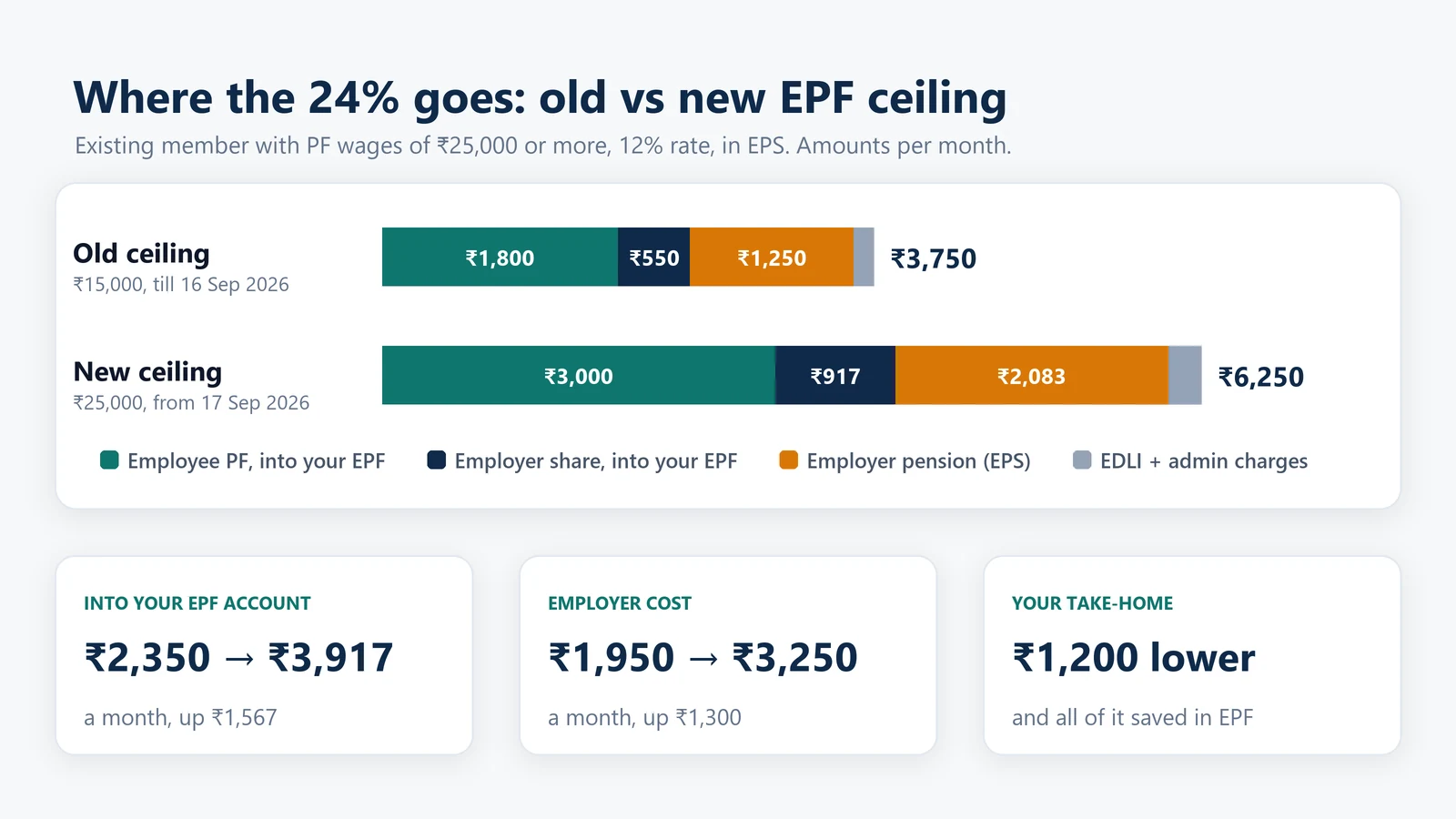
The EPF wage ceiling is now ₹25,000, and every capped payslip in India changes with it. A PF deduction of ₹1,800 becomes ₹3,000 a month. The employer’s pension share rises from ₹1,250 to ₹2,083. And for September 2026 alone, the same salary can show ₹2,360 or ₹3,000, depending on the method your payroll uses.
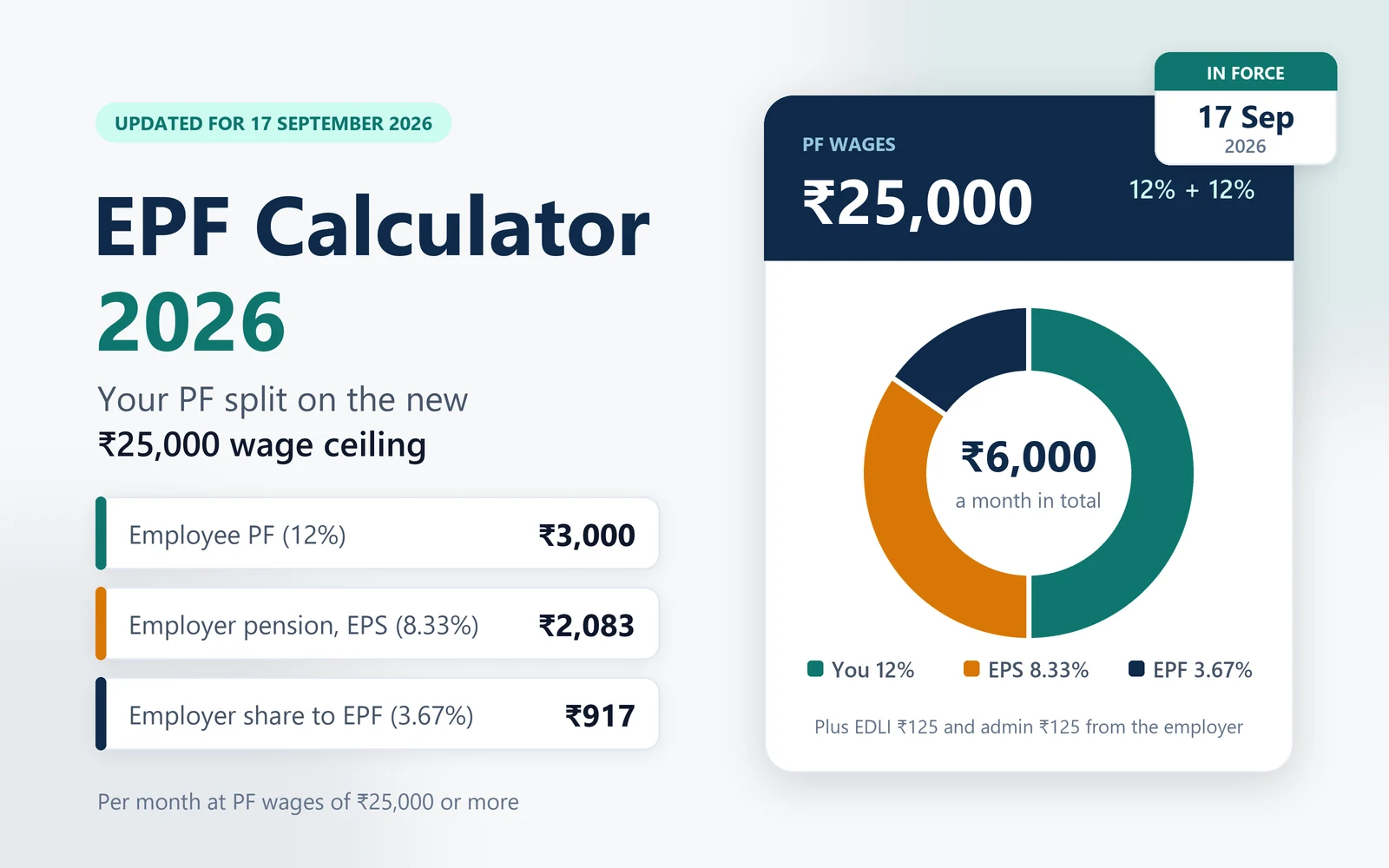
This EPF calculator works out every rupee of that split for your own salary: your PF deduction, the employer's EPS and EPF shares, EDLI and admin charges, both September methods side by side, and the balance your EPF can reach by the time you retire.
What changed on 17 September 2026: the Ministry of Labour and Employment notified ₹25,000 a month as the wage ceiling for the EPF chapter of the Code on Social Security, 2020, through Gazette notification S.O. 5109(E). It replaces the ₹15,000 ceiling that had applied since September 2014. The contribution rates did not change: 12% from the employee and 12% from the employer.
EPFO has not yet published an ECR method for a month with two ceilings, so the EPF calculator shows both methods payroll teams are using for September.
How to use the EPF calculator
You need one number from your payslip. Everything else in the EPF calculator starts with a sensible default, and payroll teams can use it as an EPF contribution calculator for each employee.
- Enter your monthly PF wages in the EPF calculator. PF wages are the part of your salary that PF is calculated on: basic pay plus dearness allowance (DA) and any retaining allowance. Payslips usually label this figure "PF wages" or "EPF wages". Under the new labour codes, allowances above half of your total pay are added back into wages, so PF wages can be higher than basic pay. Our new wage definition guide shows how that add-back works, and our salary structure calculator works out PF wages for a whole CTC.
- Pick the payroll month. Any month from October 2026 uses the ₹25,000 ceiling. September 2026 opens the two methods explained further down.
- Say whether the employee was in PF before 17 September 2026. Existing members are compared with the old ₹15,000 ceiling. Someone earning between ₹15,001 and ₹25,000 who was outside PF is newly covered, and is compared with having no PF at all.
- Choose the pension (EPS) setting. Most employees under 58 are EPS members. Pick "EPF only" if your passbook shows no pension contribution, or if you are 58 or older.
- Choose the wage basis for each side. "Wages up to the ceiling" is the legal minimum and the most common setup. "Full PF wages" applies when PF is paid on your entire PF wages.
- Add the optional extras. Switch the rate to 10% only if your employer falls in a notified 10% category, and enter a percentage for voluntary PF if you save extra.
- Read the result and the projection. The first card of the EPF calculator shows the monthly split. The second card projects your EPF balance at retirement with the same settings.
How EPF is calculated: where the 12% + 12% goes
Four terms explain everything the EPF calculator shows:
- EPF (Employees' Provident Fund) is your retirement savings account with EPFO. It earns interest every year and can be withdrawn under EPFO's rules.
- EPS (Employees' Pension Scheme) is a separate pension fund. It is paid for entirely out of the employer's share and gives you a monthly pension later, not a lump sum.
- EDLI (Employees' Deposit Linked Insurance) is life insurance cover linked to your PF membership. The employer pays for it.
- Wage ceiling is the highest PF wage on which contributions are compulsory. It is ₹25,000 a month from 17 September 2026.
Think of the ceiling as a measuring jug. Whatever PF wage you earn, the compulsory contributions are measured in a jug that holds ₹25,000. Wages above that spill over, and attract PF only if you and your employer choose to pay on them.
| Component | Who pays | Rate | Calculated on | At ₹25,000 |
|---|---|---|---|---|
| Employee PF | You | 12% | PF wages up to ₹25,000, or full PF wages if chosen | ₹3,000 |
| Employer pension (EPS) | Employer | 8.33% | PF wages up to ₹25,000 | ₹2,083 |
| Employer share to EPF | Employer | 12% minus the EPS share (3.67%) | The same wages as the employer's 12% | ₹917 |
| EDLI insurance | Employer | 0.50% | PF wages up to ₹25,000 | ₹125 |
| EPF admin charges | Employer | 0.50% | The wages PF is actually paid on (at least ₹500 a month per establishment) | ₹125 |
| Total employer cost | Employer | 13% at the ceiling | Sum of the four employer lines | ₹3,250 |
Only two lines reach your EPF account: your 12% and the employer's EPF share. At the ceiling that is ₹3,917 a month. The EPS share funds your pension, EDLI pays for insurance cover, and admin charges pay for EPFO's running costs.
EPFO rounds each employee's share, pension contribution and EDLI contribution to the nearest rupee, and the employer's EPF share is simply the employee's share minus the pension contribution. That is why 8.33% of ₹25,000, which is ₹2,082.50, shows up as ₹2,083, and why the employer's EPF share is ₹917.
EPF calculator worked examples
Here is the same arithmetic the EPF calculator runs, written out in full for three common cases.
Ananya: capped at the ceiling from October 2026
Ananya's PF wages are ₹40,000 a month. Her employer pays PF on wages up to the ceiling, and she is an EPS member.
- PF wage used: the lower of ₹40,000 and ₹25,000, which is ₹25,000.
- Her PF deduction: 12% × ₹25,000 = ₹3,000.
- Employer EPS: 8.33% × ₹25,000 = ₹2,082.50, rounded to ₹2,083.
- Employer share to EPF: ₹3,000 minus ₹2,083 = ₹917.
- EDLI and admin charges: 0.50% × ₹25,000 = ₹125 each.
- Employer cost: ₹3,000 + ₹125 + ₹125 = ₹3,250.
Under the old ₹15,000 ceiling she paid ₹1,800 and her employer's cost was ₹1,950. Her take-home pay falls by ₹1,200 a month, but her EPF account now receives ₹3,917 a month instead of ₹2,350, and her pension fund gets ₹2,083 instead of ₹1,250. Enter ₹40,000 in the EPF calculator to see the same split.
Rohit: newly covered at ₹20,000
Rohit joined his company on PF wages of ₹20,000. That was above the old ceiling, so he was never enrolled in PF. From 17 September 2026 his wages fall within the ₹25,000 ceiling, and EPFO has asked employers to enrol employees like him.
- His PF deduction: 12% × ₹20,000 = ₹2,400.
- Employer EPS: 8.33% × ₹20,000 = ₹1,666.
- Employer share to EPF: ₹2,400 minus ₹1,666 = ₹734.
- EDLI and admin charges: ₹100 each, so the employer's cost is ₹2,600.
Rohit's comparison is with zero, not with ₹1,800. His take-home pay falls by ₹2,400 a month, and he starts building ₹3,134 a month in EPF plus ₹1,666 a month in pension. In the EPF calculator, pick "No, newly covered from 17 September" to see his figures.
Meera: PF on full wages
Meera's PF wages are ₹60,000, and she and her employer contribute on full wages. EPFO needs a joint request from the employee and the employer for this, under paragraph 26(6) of the EPF Scheme.
- Her PF deduction: 12% × ₹60,000 = ₹7,200. The employer's 12% is also ₹7,200.
- Employer EPS stays capped: 8.33% × ₹25,000 = ₹2,083.
- Employer share to EPF: ₹7,200 minus ₹2,083 = ₹5,117.
- EDLI stays on ₹25,000, so ₹125. Admin charges follow the higher wages: 0.50% × ₹60,000 = ₹300.
- Employer cost: ₹7,200 + ₹125 + ₹300 = ₹7,625.
Her EPF account receives ₹12,317 a month. Set both wage basis fields in the EPF calculator to "Full PF wages" to reproduce this.
PF calculation for September 2026: day split or full month?
The new ceiling started in the middle of a wage month. PF is paid month by month through the ECR (the Electronic Challan cum Return, the monthly PF return an employer uploads to EPFO), so September needs a decision. Two methods are in use:
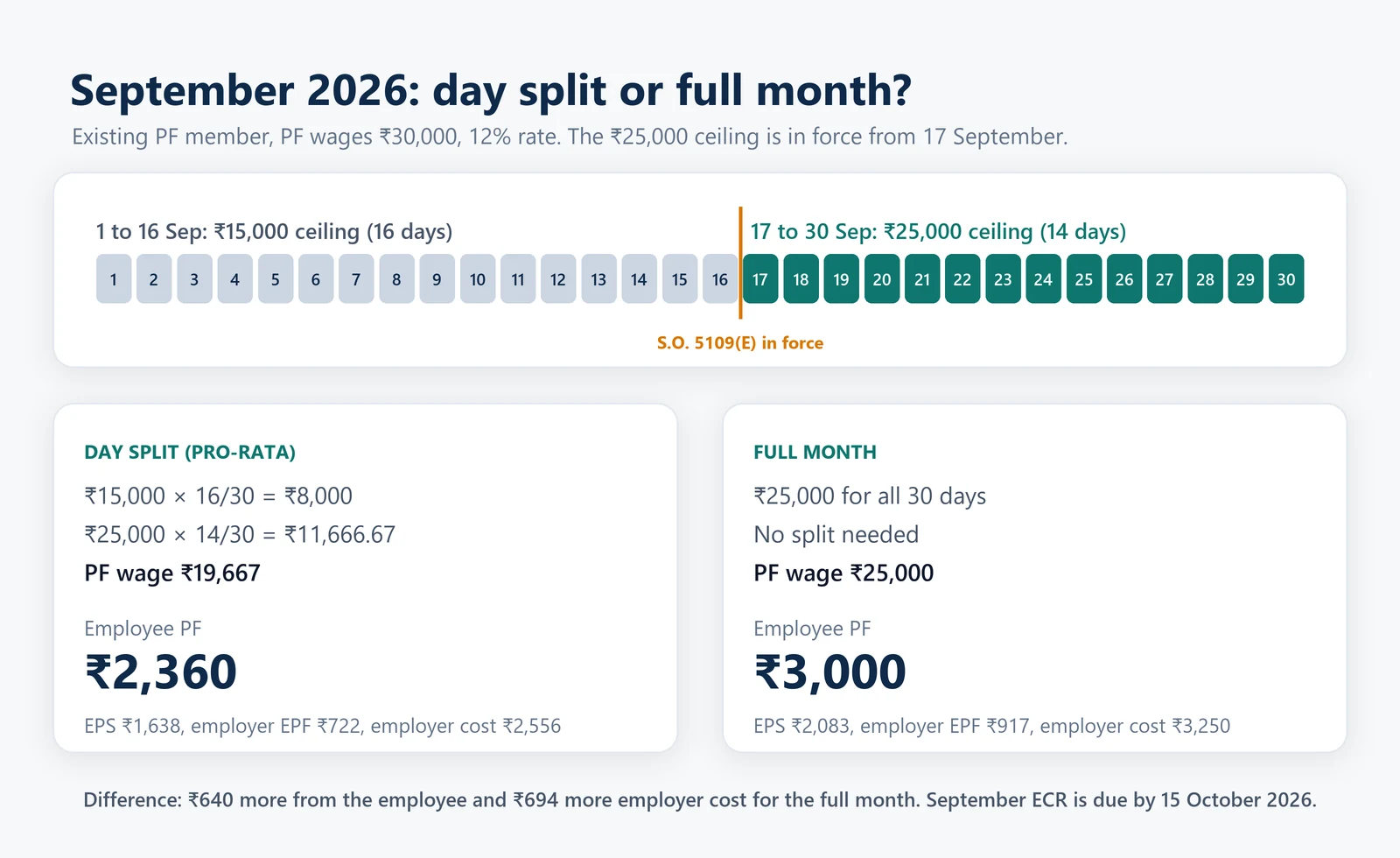
- Day split (pro-rata): 1 to 16 September on the ₹15,000 ceiling and 17 to 30 September on ₹25,000. This follows the start date to the day.
- Full month: all of September on the ₹25,000 ceiling, on the view that PF is a monthly contribution due for the month as a whole.
The EPF calculator works out both. Here is the full working for an existing member with PF wages of ₹30,000:
| Step | Day split | Full month |
|---|---|---|
| PF wage for 1 to 16 September | ₹15,000 × 16/30 = ₹8,000 | Not split |
| PF wage for 17 to 30 September | ₹25,000 × 14/30 = ₹11,666.67 | Not split |
| September PF wage | ₹19,667 | ₹25,000 |
| Employee PF (12%) | ₹2,360 | ₹3,000 |
| Employer EPS (8.33%) | ₹1,638 | ₹2,083 |
| Employer share to EPF | ₹722 | ₹917 |
| EDLI + admin charges | ₹98 + ₹98 | ₹125 + ₹125 |
| Employer cost | ₹2,556 | ₹3,250 |
The full month deducts ₹640 more from the employee and costs the employer ₹694 more, for September only. From October both methods give the same answer.
Newly covered employees in September
For someone like Rohit, who enters PF only because of the new ceiling, the day split counts wages from 17 September onwards: ₹20,000 × 14/30 = ₹9,333. That gives ₹1,120 of employee PF, ₹777 of EPS, ₹343 of employer EPF and ₹47 each for EDLI and admin charges. The full month method uses his whole ₹20,000 and gives ₹2,400. The EPF calculator shows both figures when you choose September and the newly covered option.
Which September method should you file?
The Gazette sets 17 September as the start date but does not print a September formula, and as of 27 September 2026 EPFO has not issued an ECR instruction for a month with two ceilings. Here is how the choices compare:
- Day split matches the notification's start date exactly and is the method many payroll advisers are applying.
- Full month never leaves a shortfall, because it always pays at least as much as the day split.
- The old ₹15,000 ceiling for all of September is the one choice that can leave a short payment, because it ignores 17 to 30 September completely.
The September contribution is due by 15 October 2026. Run both methods in the EPF calculator now, keep the working with your payroll records, and follow EPFO's instruction if one arrives before you file. Our guide to the new EPF limit of ₹25,000 covers the notification, the wage definition and how payroll software is handling the change.
EPS or EPF only: who gets the pension share?
The employer's 12% is split only when you are an EPS member. EPFO's rules send the whole employer share to your EPF account in these cases:
- You are 58 or older. EPS membership ends at 58, so the full employer contribution goes to EPF. EDLI continues for as long as PF is paid.
- You joined PF for the first time on or after 1 September 2014 with wages above the ceiling at that time. These members are EPF only, and the pension part is added to their EPF.
- You already draw a reduced EPS pension and rejoin work. No fresh pension contribution is paid.
In every other case the employer pays 8.33% of wages up to the ceiling into EPS, which is ₹2,083 a month at ₹25,000, up from ₹1,250 under the old ceiling. Employees newly brought in by the ₹25,000 ceiling get EPF, EPS and EDLI cover under the scheme rules.
| Your situation | Employer EPS | Employer share to EPF |
|---|---|---|
| EPS member under 58 | ₹2,083 | ₹917 |
| 58 or older | ₹0 | ₹3,000 |
| EPF-only member | ₹0 | ₹3,000 |
Not sure which applies to you? Your EPF passbook on the EPFO member portal shows a separate pension column. If it has been zero every month, choose "EPF only" in the EPF calculator.
Capped wages or full wages: which basis applies?
The law only requires PF on wages up to the ceiling. Anything above that is a choice, and it can be made separately for each side. Each option below matches a setting in the EPF calculator:
- Both on capped wages. The most common setup. At PF wages of ₹25,000 or more, each side pays ₹3,000.
- Employee on full wages, employer capped. EPFO lets an employee contribute at a higher rate without the employer matching it. The extra deduction goes into your EPF account.
- Both on full wages. This needs the joint request under paragraph 26(6) of the EPF Scheme. Admin charges then apply on the higher wages, while EPS and EDLI stay capped at ₹25,000.
Voluntary PF (VPF) is the simplest way to save more. It is an extra percentage of PF wages that you choose, with no employer match, and it earns the same EPF interest.
What the new ceiling does to take-home pay and employer cost
The table shows an existing member on capped wages at the 12% rate, in EPS. Anyone on PF wages of ₹15,000 or less sees no change at all. Run your own wages through the EPF calculator to see your exact change.
| PF wages | Employee PF | Take-home pay | Employer cost |
|---|---|---|---|
| ₹15,000 | ₹1,800 → ₹1,800 | No change | ₹1,950 → ₹1,950 |
| ₹20,000 | ₹1,800 → ₹2,400 | ₹600 lower | ₹1,950 → ₹2,600 |
| ₹25,000 | ₹1,800 → ₹3,000 | ₹1,200 lower | ₹1,950 → ₹3,250 |
| ₹40,000 | ₹1,800 → ₹3,000 | ₹1,200 lower | ₹1,950 → ₹3,250 |
| ₹1,00,000 | ₹1,800 → ₹3,000 | ₹1,200 lower | ₹1,950 → ₹3,250 |
The money is not lost. It moves from take-home pay into your EPF account, where it earns interest every year. If your cost-to-company (CTC) includes the employer's PF, your gross pay may be restructured as well, so compare a full payslip with our take-home salary calculator.
How your EPF balance grows at 8.25% interest
EPF interest for 2025-26 is 8.25%, recommended by EPFO's Central Board of Trustees on 2 March 2026 and the same rate as the two years before it. EPFO works out interest on your monthly running balance and credits it once a year, after the financial year closes. Each month's contribution starts earning interest from the following month.
The projection card in the EPF calculator follows the same method. Take Ananya again: she is 30, already has ₹2,00,000 in EPF and puts ₹3,917 a month into her account on the new ceiling. At 8.25% her balance grows like this:
| Age | New ₹25,000 ceiling |
|---|---|
| 35 | ₹5,84,893 |
| 40 | ₹11,57,003 |
| 45 | ₹20,07,394 |
| 50 | ₹32,71,427 |
| 55 | ₹51,50,303 |
| 58 | ₹66,91,807 |
On the old ₹15,000 ceiling, the same 28 years would have built about ₹47.5 lakh. The new ceiling adds roughly ₹19 lakh to her retirement savings. Because her wages are above the ceiling, pay rises do not change her capped contribution; they would only matter if she moved to full wages.
Change the age, balance and pay rise in the second card of the EPF calculator to see your own path. The projection assumes today's ceiling, rate and rules for the whole period, and no withdrawals. Use it as a planning figure: the interest rate is declared every year and the ceiling can change again.
EPF calculator FAQs
How is EPF calculated on salary?
EPF is 12% of your PF wages from you and 12% from your employer. PF wages are basic pay plus dearness allowance and retaining allowance, counted up to the ₹25,000 ceiling unless PF is paid on full wages. Of the employer's 12%, 8.33% goes to your pension (EPS) and the rest goes to your EPF account. The EPF calculator above does this split for you.
What is the maximum PF deduction under the ₹25,000 ceiling?
₹3,000 a month on capped wages, which is 12% of ₹25,000. You pay more only if you contribute on full wages or add voluntary PF. The EPF calculator shows the exact figure for your wages.
How is PF calculated for September 2026?
Two methods are in use. The day split applies ₹15,000 to 1 to 16 September and ₹25,000 to 17 to 30 September, which gives ₹2,360 at PF wages of ₹30,000. The full month applies ₹25,000 to all of September, which gives ₹3,000. The EPF calculator shows both side by side.
Is PF calculated on basic salary or gross salary?
On PF wages, which are basic pay plus dearness allowance and retaining allowance. Under the new wage definition, excluded allowances above half of your total pay are added back, so PF wages can be higher than basic pay but are usually lower than gross pay.
How much of the employer's 12% goes into my EPF account?
For an EPS member, 3.67% of PF wages, which is ₹917 a month at the ₹25,000 ceiling. The other 8.33%, ₹2,083, goes to the pension fund. If you are EPF only, or 58 or older, the full 12% goes into your EPF account.
Do EDLI and admin charges come out of my salary?
No. EDLI (0.50%) and EPF admin charges (0.50%) are paid by the employer on top of its 12%. They do not reduce your take-home pay and are not credited to your EPF balance.
My PF wages are below ₹15,000. Does the new ceiling change anything?
No. Your contributions are already calculated on your full PF wages, so the old and new ceilings give the same result.
What is the EPF interest rate for 2025-26?
8.25% a year, the same as 2023-24 and 2024-25. EPFO credits it on the monthly running balance after the financial year closes.
When is the September 2026 PF payment due?
By 15 October 2026, together with the September ECR. PF for every wage month is due by the 15th of the following month.
Is this EPF calculator updated for the ₹25,000 ceiling?
Yes. The EPF calculator uses the ₹25,000 ceiling notified by S.O. 5109(E) from 17 September 2026, the 12% and 10% contribution rates, the 8.33% EPS share, 0.50% for EDLI and admin charges, and 8.25% interest.
Related payroll calculators and guides
Use the EPF calculator alongside these tools and guides for the rest of the payslip:
- New EPF limit ₹25,000: the notification, the wage rules and payroll software checks.
- New wage definition and the 50% rule: what counts as PF wages.
- Take-home salary calculator: your in-hand pay after PF and tax.
- Gratuity calculator: the other retirement benefit an employer owes.
- Statutory bonus calculator: bonus eligibility and amount under the Code on Wages.
- Professional tax calculator: the state deduction on the same payslip.
- Zoho Payroll setup guide: setting up EPF in payroll software.
Sources
- Ministry of Labour and Employment, Gazette notification S.O. 5109(E), 17 September 2026, wage ceiling of ₹25,000 for Chapter III of the Code on Social Security, 2020.
- Press Information Bureau, Cabinet approves higher EPFO wage ceiling of ₹25,000, 16 September 2026.
- Press Information Bureau, EPFO Imphal briefing on the enhanced wage ceiling, 23 September 2026.
- Press Information Bureau, EPFO Berhampore briefing: maximum EPS contribution of ₹2,083, 23 September 2026.
- EPFO, Present rates of contribution (EPF, EPS, EDLI, admin charges and rounding).
- EPFO, Interest rates on PF accumulations and paragraph 60 of the EPF Scheme.
- Press Information Bureau, 239th meeting of the Central Board of Trustees: 8.25% interest for 2025-26, 2 March 2026.
- EPFO, Employees' Provident Funds Scheme, 1952.
- India Code, The Code on Social Security, 2020.