
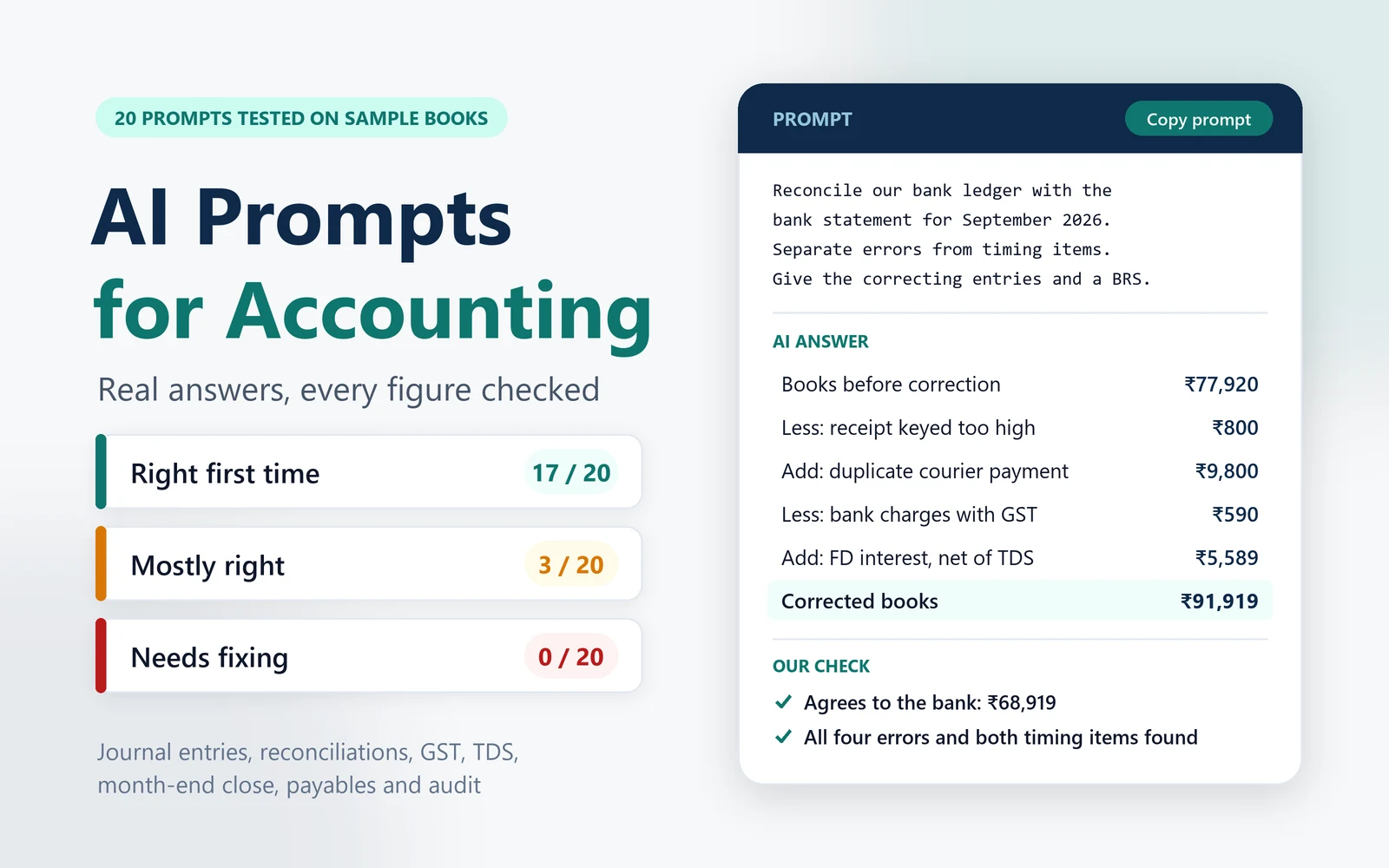
Most lists of AI prompts for accounting stop at the prompt. We ran twenty of them on a set of sample books, checked every answer line by line, and kept a record of what the AI got right and where it slipped.
These AI prompts for accounting cover the work that fills an accountant’s month: journal entries, accruals, depreciation, bank, vendor, GSTR-2B, TDS and payroll reconciliations, the month-end close, payables, collections and audit checks. Each prompt comes with the sample data we used, the answer Claude Opus 5.5 gave, and our check against the figures and the law. Copy a prompt, swap in your own numbers, and you start from something that has already been tested.
How we tested
- Model: Claude Opus 5.5, in a fresh session for every prompt, with no files, memory or web search. It saw only the prompt you can copy below.
- Data: a fictional distributor, Acme Traders Private Limited in Pune, with invented vendors, customers and GSTINs. We planted the traps real books have: a receipt keyed ₹800 too high, a duplicate payment, TDS due on an advance, a blocked GST credit, an MSME supplier past 45 days and an entry posted by someone who had left.
- Check: we reworked every figure and checked every rule against the CGST Act, the Income-tax Act, 2025, the MSMED Act, Ind AS 115 and Schedule II of the Companies Act.
- Date: 27 September 2026. Rules change, so confirm the current position before you rely on any answer.
AI prompts for accounting: the scorecard
Of the 20 AI prompts for accounting we ran, 17 came back right first time, 3 were mostly right and 0 needed fixing. The arithmetic and the accounting held up almost everywhere: every reconciliation balanced, every schedule added up and every blocked GST credit was caught. What slipped were rules that changed recently and details of the new Income-tax Act, which is why the prompts below state the rule instead of trusting the model to know it.
| # | Prompt | Result | What to watch |
|---|---|---|---|
| 1 | Classify bank transactions into ledger heads | Right | Nothing; correct first time |
| 2 | Draft journal entries from business events | Right | Nothing; correct first time |
| 3 | Review a junior’s journal entries | Right | Nothing; correct first time |
| 4 | Month-end accruals with working | Right | Nothing; correct first time |
| 5 | Prepaid insurance amortisation schedule | Right | Nothing; correct first time |
| 6 | Depreciation: Companies Act vs income tax | Right | Nothing; correct first time |
| 7 | Bank reconciliation with the errors found | Right | Nothing; correct first time |
| 8 | Vendor statement reconciliation | Right | Nothing; correct first time |
| 9 | GSTR-2B vs purchase register | Right | Nothing; correct first time |
| 10 | TDS receivable vs Form 26AS | Right | Nothing; correct first time |
| 11 | Payroll reconciliation: register, bank and challans | Mostly right | Used the old ₹15,000 PF ceiling |
| 12 | Month-end close calendar with Indian due dates | Mostly right | Old Maharashtra PT date; confirm on the state portal |
| 13 | Trial balance flux analysis | Right | Nothing; correct first time |
| 14 | Revenue cut-off review | Right | Nothing; one sound judgement call explained |
| 15 | Payables ageing with the MSME 45-day check | Right | Nothing; confirm the RBI Bank Rate for interest |
| 16 | Find duplicate invoices before payment | Right | Nothing; correct first time |
| 17 | Collections plan and reminder emails | Right | Nothing; correct first time |
| 18 | TDS section and rate check under the Income-tax Act, 2025 | Mostly right | No Table serial numbers (said so honestly) |
| 19 | GST input tax credit: eligible or blocked | Right | Nothing; correct first time |
| 20 | Journal entry testing for audit | Right | Nothing; correct first time |
How to write AI prompts for accounting
Every prompt on this page follows the same six parts. Keep them and you can write your own for any task.
- Who and where. Name the entity, the state, the year and the law: “a private company in Maharashtra, tax year 2026-27, Income-tax Act, 2025”. GST, TDS and professional tax all turn on these.
- The data, as a table. Paste both sides of a reconciliation, or the list you want reviewed. Tables beat descriptions; the model matches rows the way you would.
- The rule you want applied. Spell out useful lives, rates, thresholds and cut-off terms. The model follows your rule; it may not know a change notified last month.
- The exact output. Columns, entries, totals, or an email. “Return one table with these columns” saves a second round.
- What not to do. “Do not guess a ledger head, write Ask.” “Do not invent explanations.” “If you are not sure of a section number, say so.” These lines prevented most of the errors we looked for.
- Show the working. Ask for the arithmetic, the days counted and the clause relied on, so you can check the answer in a minute instead of redoing it.
For the longer guide to prompt writing, with finance examples such as forecasting, cash flow and variance commentary, see our AI prompts for finance.
AI prompts for bookkeeping and journal entries
These AI prompts for bookkeeping are the place to start if you want AI to take the first pass at posting. Give it the narration, the state, the GST rule and the TDS rule, and it drafts entries you only need to review.
1. Classify bank transactions into ledger heads
Use it for: the first pass over a month’s bank statement before you post, with GST and TDS flags on every line.
You are helping the accountant of Acme Traders Private Limited, a distributor of office supplies in Pune, Maharashtra (GST state code 27), financial year 2026-27 (tax year 2026-27 under the Income-tax Act, 2025). Below are the September 2026 lines from our current account statement.

For each line, suggest:
1. the ledger head to post it to,
2. whether GST input tax credit is likely available (Yes, No or Check invoice), with a one-line reason,
3. whether TDS may apply, and what to check.

Rules: if a narration is unclear, do not guess the ledger head; write "Ask" and say what to ask. Blocked credits under section 17(5) of the CGST Act get "No". Use the Income-tax Act, 2025 for TDS and give the old 1961 section in brackets.

Return one table with the columns: Date | Narration | Amount (₹) | Dr/Cr | Ledger head | GST ITC | TDS | Note.

| Date | Narration | Debit (₹) | Credit (₹) |
|---|---|---|---|
| 02-09-2026 | NEFT CR ALPHA RETAIL LLP INV 1043 | | 1,18,000 |
| 03-09-2026 | UPI DR CAFE ORCHID TEAM LUNCH | 3,450 | |
| 05-09-2026 | ACH DR ELECTRICITY BOARD CONS 0923 | 14,280 | |
| 10-09-2026 | NEFT DR REDLINE COURIERS SEP | 9,800 | |
| 15-09-2026 | CHQ 000412 KAVYA AND ASSOCIATES CA | 45,000 | |
| 18-09-2026 | NEFT DR ZEN PROPERTIES OFFICE RENT SEP-26 | 90,000 | |
| 20-09-2026 | BANK CHARGES INCL GST | 590 | |
| 25-09-2026 | NEFT DR SALARY SEP-26 BULK | 4,85,000 | |
| 28-09-2026 | FD INT CR 5021 | | 5,589 |
| 29-09-2026 | GST PMT CPIN 26092700012345 | 72,340 | |
| 30-09-2026 | UPI DR 98XXXXXX21 | 12,000 | |
| Date | Narration | Amount (₹) | Ledger head | GST ITC | TDS |
|---|---|---|---|---|---|
| 03-09-2026 | UPI DR CAFE ORCHID TEAM LUNCH | 3,450 | Staff welfare expenses | No. Food and beverages are blocked under s. 17(5)(b)(i). | No. […] |
| 18-09-2026 | NEFT DR ZEN PROPERTIES OFFICE RENT SEP-26 | 90,000 | Rent: office premises | Yes. […] if Zen is unregistered, you pay it under reverse charge and still claim it. | Yes. s. 393(1) (old s. 194-I): 10% on building rent above ₹50,000 a month. Check whether ₹90,000 is net (₹1,00,000 less ₹10,000 TDS) or the full rent (then ₹9,000 TDS was due and missed). |
| 28-09-2026 | FD INT CR 5021 | 5,589 | Interest on fixed deposits (other income) | No. […] | Yes, by the bank, not by you. […] |
| 30-09-2026 | UPI DR 98XXXXXX21 | 12,000 | Ask | Check invoice. […] | Check once known. […] |
[…] ₹5,589 is exactly ₹6,210 less 10% (₹621).
- ✓ Every ledger head, ITC call and TDS flag agrees with ours, and the unclear UPI payment was marked Ask instead of guessed.
- ✓ It spotted the rent trap: ₹90,000 paid in full means ₹9,000 of TDS was probably missed, unless the rent is really ₹1,00,000.
- ✓ It added a point we had not planted: if the 29 September GST payment settles August’s GSTR-3B, it is late and carries interest.
Prompt tip: The “write Ask if the narration is unclear” rule matters most here. Without it, models happily invent a ledger head for a payment to a phone number.
2. Draft journal entries from business events
Use it for: turning a week of events (purchases, bills, advances, returns) into draft entries with GST and TDS.
You are the accountant of Acme Traders Private Limited, a distributor of office supplies in Pune, Maharashtra (GST state code 27), financial year 2026-27 (tax year 2026-27 under the Income-tax Act, 2025). Pass journal entries for these September 2026 events.

Rules:
- GST: CGST and SGST for suppliers and customers in Maharashtra, IGST for other states.
- TDS: apply the Income-tax Act, 2025 (give the old 1961 section in brackets). When GST is shown separately on an invoice, deduct TDS on the amount before GST.
- Show each entry with Dr and Cr lines, amounts in rupees and a one-line narration. Then list your assumptions.

Events:
1. 12 Sep: bought a laptop for office use from Blue Pine Computers, Pune, on credit: ₹84,000 plus GST at 18%.
2. 18 Sep: received an invoice from Silverleaf Consultants, Bengaluru (Karnataka), a partnership firm, for professional fees of ₹1,20,000 plus GST at 18%. We paid them ₹30,000 for earlier work in May, and deducted no TDS then. Record the invoice and the TDS.
3. 22 Sep: paid Greenfield Security Services Private Limited ₹50,000 by NEFT as an advance for October security services.
4. 26 Sep: customer Alpha Retail LLP (Maharashtra) returned goods sold earlier for ₹20,000 plus GST at 18%. We issued a credit note.
2(b). 18 Sep 2026: TDS on Silverleaf’s fees
| Dr/Cr | Account | Dr (₹) | Cr (₹) |
|---|---|---|---|
| Dr | Silverleaf Consultants | 15,000 | |
| Cr | TDS payable: professional fees | 15,000 |
Working: Fees in tax year 2026-27 = ₹30,000 (May) + ₹1,20,000 (18 Sep) = ₹1,50,000. This crosses the ₹50,000 annual threshold, so TDS applies to the whole ₹1,50,000 at 10% = ₹15,000. […]
3. 22 Sep 2026: advance to Greenfield Security Services Private Limited
| Dr/Cr | Account | Dr (₹) | Cr (₹) |
|---|---|---|---|
| Dr | Advance to suppliers: Greenfield Security Services Pvt Ltd | 50,000 | |
| Cr | TDS payable: contractors | 1,000 | |
| Cr | Bank (NEFT) | 49,000 |
[…] TDS applies to the advance because it is due at the earlier of credit or payment.
- ✓ All four entries agree with ours: the laptop with CGST and SGST, IGST on the Bengaluru invoice, the advance and the credit note.
- ✓ It caught both TDS traps: the ₹3,000 catch-up on the May payment once the year’s fees crossed ₹50,000, and TDS on the advance at the time of payment.
- ✓ Section references are right for the new Act: 393(1) Table Sl. No. 6(iii) for professional fees and 6(i) for contracts, and section 398 (old 201) for interest on late deduction.
Prompt tip: Mention earlier payments to the same party in the prompt. TDS thresholds work on the year’s total, and the model can only apply that if it knows the history.
3. Review a junior’s journal entries
Use it for: reviewing a junior’s vouchers before the month is closed, or training new staff on why an entry is wrong.
You are the finance controller of Acme Traders Private Limited, a distributor of office supplies in Pune, Maharashtra (GST state code 27), financial year 2026-27 (tax year 2026-27 under the Income-tax Act, 2025). A junior accountant passed these five entries in September 2026. Review them.

For each entry: say whether it is right or wrong, explain the error in one or two lines, and give the corrected entry. Do not change entries that are right. Use the Income-tax Act, 2025 for TDS (old 1961 section in brackets).

| # | Date | Entry passed | Narration |
|---|---|---|---|
| 1 | 08-09-2026 | Dr Repairs and Maintenance 65,000 / Cr Bank 65,000 | New split AC for the conference room, invoice ₹65,000 including GST at 18% |
| 2 | 12-09-2026 | Dr Professional Fees 94,400 / Cr TDS Payable 9,440 / Cr Kavya and Associates 84,960 | Tax audit fee: invoice ₹80,000 plus GST ₹14,400 |
| 3 | 30-09-2026 | Dr Rent 3,00,000 / Cr Bank 3,00,000 | Rent for the Hinjewadi warehouse, ₹50,000 a month, paid in advance for October 2026 to March 2027 |
| 4 | 15-09-2026 | Dr Alpha Retail LLP 50,000 / Cr Bank 50,000 | Received payment from Alpha Retail against invoice 1043 |
| 5 | 25-09-2026 | Dr Salary Payable 4,85,000 / Cr Bank 4,85,000 | September net salary paid |
| # | Entry | Verdict | Fix |
|---|---|---|---|
| 1 | Split AC, ₹65,000 | Wrong | Capitalise ₹55,084.75 and take the ₹9,915.25 GST as input credit |
| 2 | Tax audit fee, Kavya and Associates | Wrong | TDS ₹8,000 on ₹80,000 only; the ₹14,400 GST is input credit |
| 3 | Warehouse rent, Oct 2026 to Mar 2027 | Wrong | Prepaid Rent, released at ₹50,000 a month; no TDS; RCM if the landlord is unregistered |
| 4 | Receipt from Alpha Retail LLP | Wrong | Sides reversed: Dr Bank, Cr Alpha Retail LLP |
| 5 | September net salary | Right | No change |
[…] No TDS is due: section 393(1) (old section 194-I) applies only when rent exceeds ₹50,000 for a month, and paying six months at once does not change the monthly rent.
- ✓ All five verdicts and corrections agree with ours, down to the paisa on the AC and its GST.
- ✓ It got the subtle one right: rent of exactly ₹50,000 a month does not exceed the threshold, so a ₹3,00,000 advance attracts no TDS.
- ✓ It added the reverse charge point on commercial rent from an unregistered landlord and showed the RCM entry.
Prompt tip: Give the narration and the invoice facts, not just the entry. The model judges an entry by what it was for.
Prompts for accruals, prepaids and depreciation
Period-end arithmetic is where AI saves the most time, as long as you give it the method: days or months, the rounding rule, and the useful life or tax rate you want.
4. Month-end accruals with working
Use it for: month-end provisions for bills that have not arrived: audit fees, utilities, goods received not invoiced, retainers and loan interest.
You are closing the books of Acme Traders Private Limited, a distributor of office supplies in Pune, Maharashtra (GST state code 27), financial year 2026-27 (tax year 2026-27 under the Income-tax Act, 2025) for September 2026. Prepare the month-end accrual entries at 30 September 2026 for the items below.

For each item show the working, the journal entry, and whether it should be reversed on 1 October. Do not book input GST on an accrual; GST is taken only when the invoice arrives. Add a short note on when TDS will apply once each invoice is booked. Round to the nearest rupee.

1. The statutory audit fee for 2026-27 is agreed at ₹3,00,000 plus GST, billed after the year end. April to August have already been accrued.
2. The September electricity bill has not arrived. The last three bills were ₹14,280 (August), ₹13,960 (July) and ₹15,100 (June).
3. Goods worth ₹2,40,000 plus GST were received on 29 September under GRN 2291. The supplier's invoice has not arrived.
4. Our marketing consultant's retainer is ₹40,000 a month. The September invoice will arrive on 5 October.
5. We have a term loan of ₹10,00,000 at 10.5% a year. The bank charges interest on the 5th of the next month. Work out September interest on actual days (30/365).

End with a summary table of all accruals and the total.
| # | Accrual at 30 September 2026 | Basis | Amount (₹) | Reverse on 1 Oct? | TDS once invoiced |
|---|---|---|---|---|---|
| 1 | Statutory audit fee | ₹3,00,000 ÷ 12 | 25,000 | No; provision now ₹1,50,000 | 10%: ₹30,000 on the full fee |
| 2 | Electricity | Average of last 3 bills | 14,447 | Yes | None |
| 3 | Goods, GRN 2291 | GRN value before GST | 2,40,000 | No; cleared against the invoice | 0.1% above ₹50 lakh, if the conditions apply |
| 4 | Marketing consultant | Monthly retainer | 40,000 | Yes | 10%: ₹4,000 |
| 5 | Term loan interest | ₹10,00,000 × 10.5% × 30/365 | 8,630 | Yes | None (bank loan) |
| Total | 3,28,077 |
[…] Watch the year end: at 31 March 2027 the full fee will sit in a provision for a named auditor, and a credit to any account, a provision included, counts as a credit to the payee.
- ✓ All five amounts and the total of ₹3,28,077 agree with ours.
- ✓ Its reversal choices are sensible and explained: the audit provision builds up over the year, and the GRN accrual is cleared against the invoice rather than reversed.
- ✓ It kept GST out of every accrual, and raised the year-end TDS point on the audit provision that many teams miss.
Prompt tip: State the averaging and day-count method for estimates. “Average of the last three bills” and “30/365” leave no room for a different assumption.
5. Prepaid insurance amortisation schedule
Use it for: prepaid insurance, rent, AMC or software subscriptions paid in advance.
You are the accountant of Acme Traders Private Limited, a distributor of office supplies in Pune, Maharashtra (GST state code 27), financial year 2026-27 (tax year 2026-27 under the Income-tax Act, 2025). On 16 August 2026 we paid ₹1,80,000 plus GST for the annual fire insurance of our warehouse, covering 16 August 2026 to 15 August 2027. The GST is claimed as input tax credit.

1. Build the monthly amortisation schedule for the full policy period on a daily basis (365 days). Show days, expense for the month and the closing prepaid balance.
2. Round each month to the nearest rupee and put any rounding difference in the last month so the total is exactly ₹1,80,000.
3. Give the journal entries for the payment on 16 August and the expense for September 2026.
4. State the prepaid balance on 31 March 2027 and the insurance expense for the financial year 2026-27.
Basis: ₹1,80,000 over 365 days (16 August 2026 to 15 August 2027; February 2027 has 28 days) = ₹493.1507 per day. […]
| Month | Days | Expense for the month (₹) | Closing prepaid balance (₹) |
|---|---|---|---|
| Aug 2026 (16 to 31 Aug) | 16 | 7,890 | 1,72,110 |
| Sep 2026 | 30 | 14,795 | 1,57,315 |
| […] | |||
| Mar 2027 | 31 | 15,288 | 67,560 |
| […] | |||
| Aug 2027 (1 to 15 Aug) | 15 | 7,394 | 0 |
Rounded one by one, the 13 months add up to ₹1,80,003. The ₹3 excess comes off the last month […]
- Prepaid insurance balance on 31 March 2027: ₹67,560, covering 137 days (1 April to 15 August 2027).
- Insurance expense for FY 2026-27: ₹1,12,440, covering 228 days.
- ✓ Every month agrees with our schedule: 493.15 a day, 7,890 for August, 14,795 for September, 67,560 left at 31 March 2027.
- ✓ It handled the rounding exactly as asked and pushed the ₹3 difference into August 2027.
- ✓ It kept GST out of the prepaid asset and noted that fire insurance is not a blocked credit under section 17(5).
- ✓ It added an Excel formula for the schedule without being asked, which is useful.
Prompt tip: Spell out the day count and the rounding rule. Without them, models switch between 12 equal months and a day basis.
6. Depreciation: Companies Act vs income tax
Use it for: the fixed asset register at month end or year end, and the deferred tax working for the tax audit.
You are the accountant of Acme Traders Private Limited, a distributor of office supplies in Pune, Maharashtra (GST state code 27), financial year 2026-27 (tax year 2026-27 under the Income-tax Act, 2025). Work out depreciation for 2026-27 on two assets, first for the books and then for income tax, and the deferred tax on the difference.

Assets:
- Laptop: ₹84,000, put to use on 12 September 2026.
- Office furniture: ₹2,00,000, put to use on 20 December 2026.

Rules to apply:
- Books (Companies Act, 2013, Schedule II): straight line, residual value 5%, useful life 3 years for laptops and 10 years for furniture, pro-rata by days from the date put to use.
- Income tax (Income-tax Act, 2025): written down value at the block rates, 40% for computers and 10% for furniture. If an asset is put to use for less than 180 days in the tax year, only half the rate is allowed.
- Deferred tax at 25.168%.

Show the days you counted, the depreciation both ways, the carrying amount and tax written down value at 31 March 2027, the timing difference, and the deferred tax entry.
Result: book depreciation ₹19,958, tax depreciation ₹43,600, timing difference ₹23,642, deferred tax liability ₹5,950.
| Laptop | Furniture | Total | |
|---|---|---|---|
| Days in use | 201 | 102 | |
| Depreciation 2026-27 (books) | 14,648 | 5,310 | 19,958 |
| Rate allowed for tax | 40% (full) | 5% (half of 10%) | |
| Depreciation 2026-27 (tax) | 33,600 | 10,000 | 43,600 |
For tax, the days do not pro-rate the charge. They only decide whether the full or half rate applies. […]
Cost is taken net of GST. […] It cannot take the credit and also depreciate the GST (section 16(3) of the CGST Act).
- ✓ Days (201 and 102), book depreciation, tax depreciation and the deferred tax of ₹5,950 all agree with our working.
- ✓ It applied the half-rate rule only to the furniture, which was used for fewer than 180 days.
- ✓ It flagged the day-count convention: if your policy starts the day after purchase, book depreciation becomes ₹19,833.
- ✓ It noted that tax depreciation runs on the whole block, not the single asset.
Prompt tip: Give the useful lives, residual value and tax rates in the prompt. The model then applies your rules instead of recalling older tables.
Reconciliation prompts: bank, vendor, GSTR-2B, TDS and payroll
Reconciliations are where AI prompts for accounting pay off fastest. Paste both sides as tables and ask for three buckets: matched, timing and errors. The AI is fast at matching; your job is to confirm the errors before anyone passes an entry.
7. Bank reconciliation with the errors found
Use it for: the monthly bank reconciliation, especially when the difference will not close.
You are the accountant of Acme Traders Private Limited, a distributor of office supplies in Pune, Maharashtra (GST state code 27), financial year 2026-27 (tax year 2026-27 under the Income-tax Act, 2025). Reconcile our bank ledger with the bank statement for September 2026. Both showed ₹5,00,000 on 31 August 2026 and agreed then.

1. Match the entries. Treat an entry as matched only if the amount agrees; list every entry you could not match.
2. Separate the differences into (a) errors or omissions to correct in our books and (b) timing items that will clear on their own.
3. Give the correcting journal entries, the corrected book balance, and a bank reconciliation statement that agrees to the bank balance.

Our bank ledger, September 2026:
| Date | Particulars | Receipts (₹) | Payments (₹) |
|---|---|---|---|
| 02-09 | Alpha Retail LLP, invoice 1043 | 1,18,800 | |
| 05-09 | Electricity, auto debit | | 14,280 |
| 10-09 | Redline Couriers | | 9,800 |
| 11-09 | Redline Couriers | | 9,800 |
| 15-09 | Kavya and Associates, cheque 412 | | 45,000 |
| 25-09 | Salaries, September | | 4,85,000 |
| 28-09 | Blue Pine Computers, cheque 415 | | 32,000 |
| 30-09 | Cash deposited | 55,000 | |

Bank statement, September 2026:
| Date | Narration | Credit (₹) | Debit (₹) |
|---|---|---|---|
| 02-09 | NEFT CR ALPHA RETAIL LLP | 1,18,000 | |
| 05-09 | ACH ELECTRICITY BOARD | | 14,280 |
| 10-09 | NEFT REDLINE COURIERS | | 9,800 |
| 16-09 | CHQ 000412 | | 45,000 |
| 20-09 | BANK CHARGES INCL GST | | 590 |
| 25-09 | SALARY BULK | | 4,85,000 |
| 28-09 | FD INT CR 5021 | 5,589 | |
Summary. At 30 September 2026 our books show ₹77,920 and the bank shows ₹68,919, a gap of ₹9,001. Four items are errors or omissions in our books. Once they are corrected, the book balance is ₹91,919. Two timing items take that figure to the bank balance of ₹68,919. […]
| Ref | What happened | Effect on book balance (₹) |
|---|---|---|
| L1 / B1 | […] we recorded ₹800 more than the bank received. | Less 800 |
| L2 | This is a duplicate posting of the 10-09 payment. | Add 9,800 |
| B2 | Bank charges were not recorded: ₹500 plus 18% GST of ₹90. | Less 590 |
| B3 | Interest on FD 5021 was not recorded. | Add 5,589 |
[…] Cheques 413 and 414 do not appear in the ledger, so check the counterfoils. […] If one of them was the 11-09 Redline payment, that entry is an unpresented cheque, not a duplicate.
- ✓ Both balances, all four book errors and both timing items agree with our working. Corrected books ₹91,919, reconciled to the bank’s ₹68,919.
- ✓ It grossed up the FD interest (₹5,589 received, ₹6,210 income, ₹621 TDS) and split the bank charges into ₹500 plus GST.
- ✓ Beyond what we planted: it noticed cheques 413 and 414 are missing from the ledger and showed how the answer changes if the 11 September entry was a cheque.
Prompt tip: Ask for errors and timing items in separate lists. It stops the AI from “fixing” a timing item with a journal entry.
8. Vendor statement reconciliation
Use it for: vendor statement reconciliations at month end, before the payment run, or when a vendor chases a balance you do not owe.
You are the accounts payable lead at Acme Traders Private Limited, a distributor of office supplies in Pune, Maharashtra (GST state code 27), financial year 2026-27 (tax year 2026-27 under the Income-tax Act, 2025). Our books show nil owed to Beta Logistics Private Limited at 30 September 2026, but their statement says we owe ₹63,040. Reconcile the two.

1. Explain every item that makes up the ₹63,040 difference, and say which side needs to act.
2. Classify each item as timing, missing entry, or dispute.
3. Draft a short, polite email to Beta Logistics listing what they need to update and what we need from them.

Our ledger for Beta Logistics (credit = we owe):
| Date | Particulars | Debit (₹) | Credit (₹) |
|---|---|---|---|
| 01-09 | Opening balance | | 1,20,000 |
| 05-09 | Invoice BL/0912 (freight ₹40,000 + GST ₹7,200) | | 47,200 |
| 05-09 | TDS on BL/0912 at 2% on ₹40,000 | 800 | |
| 12-09 | Payment, NEFT | 1,20,000 | |
| 20-09 | Debit note DN-17, shortage in delivery | 4,000 | |
| 29-09 | Payment, NEFT | 42,400 | |

Beta Logistics' statement for us (debit = we owe):
| Date | Particulars | Debit (₹) | Credit (₹) |
|---|---|---|---|
| 01-09 | Opening balance | 1,20,000 | |
| 05-09 | Invoice BL/0912 | 47,700 | |
| 12-09 | Receipt | | 1,20,000 |
| 18-09 | Invoice BL/0937 | 15,340 | |
| | Closing balance | 63,040 | |
In short: the ₹63,040 is made up of five items. […]
| Particulars | ₹ |
|---|---|
| Balance as per our books | Nil |
| Add: our NEFT payment of 29-09, not in Beta’s statement | 42,400 |
| Add: TDS deducted on BL/0912, not in Beta’s statement | 800 |
| Add: our debit note DN-17 of 20-09, not in Beta’s statement | 4,000 |
| Add: BL/0912 at ₹47,700 in Beta’s statement, ₹47,200 in our books | 500 |
| Add: Beta’s invoice BL/0937 of 18-09, not in our books | 15,340 |
| Balance as per Beta’s statement | 63,040 |
By type: timing ₹43,200, dispute ₹4,500, missing entry ₹15,340. […]
Subject: Reconciliation of our account as at 30 September 2026 […]
- ✓ All five items and the ₹63,040 agree with our working, and each item says which side has to act.
- ✓ It worked out that BL/0937 is ₹13,000 plus GST and booked TDS of ₹260 on it, since the year’s total with this transporter is already over ₹1,00,000.
- ✓ The email is ready to send once you fill in the UTR, and it asks for proof of delivery before we book the missing invoice.
Prompt tip: Tell the AI which side each ledger is written from (“credit = we owe”). Vendor statements are the mirror image of your books, and that is where most mix-ups start.
9. GSTR-2B vs purchase register
Use it for: the monthly GSTR-2B match before GSTR-3B, including the Invoice Management System (IMS) actions.
You are the GST accountant of Acme Traders Private Limited, a distributor of office supplies in Pune, Maharashtra (GST state code 27), financial year 2026-27 (tax year 2026-27 under the Income-tax Act, 2025). Match our purchase register for September 2026 with GSTR-2B and tell me how much input tax credit we can claim in the September GSTR-3B.

Rules:
- Match on supplier GSTIN and invoice number. Invoice numbers may be written differently (INV-045, INV/045); treat those as the same invoice but mention it.
- Claim ITC only for invoices that appear in GSTR-2B, and only up to the tax shown there.
- Blocked credits under section 17(5) of the CGST Act are not claimable even if they are in GSTR-2B.
- For each invoice give: status, ITC claimable now (₹), and the action (for example, follow up with the supplier, or accept, reject or keep pending in the Invoice Management System).

Purchase register, September 2026 (₹):
| # | Supplier | GSTIN | Invoice no. | Date | Taxable | IGST | CGST | SGST |
|---|---|---|---|---|---|---|---|---|
| 1 | Blue Pine Computers | 27AAAAA0000A1Z5 | INV-045 | 12-09 | 84,000 | | 7,560 | 7,560 |
| 2 | Northgate Software | 29AAAAB0000B1Z3 | NS/2026/771 | 14-09 | 50,000 | 9,000 | | |
| 3 | Redline Couriers | 27AAAAC0000C1Z1 | RC-3321 | 10-09 | 8,000 | | 720 | 720 |
| 4 | Silverleaf Consultants | 29AAAAD0000D1Z9 | SC/118 | 18-09 | 1,20,000 | 21,600 | | |
| 5 | Metro Motors (service of the director's car) | 27AAAAE0000E1Z7 | MM-889 | 21-09 | 18,000 | | 1,620 | 1,620 |
| 6 | Sunrise Packaging | 27AAAAF0000F1Z5 | SP/2209 | 22-09 | 60,000 | | 5,400 | 5,400 |
| 7 | Crystal Office Supplies | 27AAAAG0000G1Z3 | COS-77 | 25-09 | 12,500 | | 1,125 | 1,125 |

GSTR-2B, September 2026 (₹):
| Supplier GSTIN | Invoice no. | Date | Taxable | IGST | CGST | SGST |
|---|---|---|---|---|---|---|
| 27AAAAA0000A1Z5 | INV/045 | 12-09 | 84,000 | | 7,560 | 7,560 |
| 29AAAAB0000B1Z3 | NS/2026/771 | 14-09 | 50,000 | 9,000 | | |
| 27AAAAC0000C1Z1 | RC-3321 | 10-09 | 8,000 | | 720 | 720 |
| 29AAAAD0000D1Z9 | SC/118 | 18-09 | 1,20,000 | 21,600 | | |
| 27AAAAE0000E1Z7 | MM-889 | 21-09 | 18,000 | | 1,620 | 1,620 |
| 27AAAAG0000G1Z3 | COS-77 | 25-09 | 12,050 | | 1,084.50 | 1,084.50 |
| 27AAAAH0000H1Z1 | LP-5512 | 22-09 | 9,000 | | 810 | 810 |
ITC you can claim in the September 2026 GSTR-3B: ₹49,329 IGST ₹30,600 + CGST ₹9,364.50 + SGST ₹9,364.50 […]
| # | Supplier and invoice | Status | ITC claimable now (₹) |
|---|---|---|---|
| 1 | Blue Pine Computers, INV-045 | Matched. The invoice number is INV-045 in our register and INV/045 in GSTR-2B. […] | 15,120 |
| 5 | Metro Motors, MM-889 | Matched, but blocked under section 17(5)(ab). […] | 0 (₹3,240 blocked) |
| 6 | Sunrise Packaging, SP/2209 | In our books, missing from GSTR-2B. No ITC until it shows there (section 16(2)(aa)). | 0 (₹10,800 deferred) |
| 8 | LP-5512 (in GSTR-2B only) | In GSTR-2B, not in our books. […] | 0 (₹1,620 on hold) |
[…] Mark it Pending in IMS before filing. Left alone, it counts as accepted and ₹1,620 flows into Table 4(A)(5).
- ✓ ITC of ₹49,329 agrees with ours, with the right treatment for all eight lines: the format difference, the blocked car service, the missing invoice, the short-reported one and the stranger in GSTR-2B.
- ✓ The IMS actions are right: accept the blocked but valid invoice and reverse it in Table 4(B)(1), and keep the unknown invoice Pending so it is not deemed accepted.
- ✓ It filled in GSTR-3B Table 4 and reminded us of the 180-day payment rule and the 30 November cut-off for claiming credit.
Prompt tip: Tell the AI to claim only what GSTR-2B shows and to treat blocked credits separately. It then produces the Table 4 split, not just a matched list.
10. TDS receivable vs Form 26AS
Use it for: the pre-return check of TDS credit (Form 26AS now, Form 168 from tax year 2026-27) against the books.
You are the accountant of Acme Traders Private Limited, a distributor of office supplies in Pune, Maharashtra (GST state code 27), financial year 2026-27 (tax year 2026-27 under the Income-tax Act, 2025). Before we file the income tax return for 2025-26 (assessment year 2026-27), reconcile the TDS our customers and our bank deducted from us, as recorded in our books, with Form 26AS.

1. Match by deductor. Show matched, short, missing and extra items.
2. Say how much TDS credit we can claim in the return and why.
3. List the action for each difference, including what to ask each customer.

TDS receivable in our books, 2025-26 (₹):
| Deductor | Section (1961 Act) | TDS |
|---|---|---|
| Alpha Retail LLP | 194Q | 30,000 |
| Orbit Hypermart Private Limited | 194Q | 12,500 |
| Kiran Enterprises | 194C | 4,200 |
| Nova Hotels Private Limited | 194Q | 8,000 |
| Zenith Schools Trust | 194C | 2,600 |
| Bank (interest on fixed deposit) | 194A | 6,210 |
| Total | | 63,510 |

Form 26AS, Part I, 2025-26 (₹):
| Deductor | Section | TDS deposited |
|---|---|---|
| Alpha Retail LLP | 194Q | 30,000 |
| Orbit Hypermart Private Limited | 194Q | 12,500 |
| Kiran Enterprises | 194C | 2,400 |
| Zenith Schools Trust | 194C | 2,600 |
| Bank | 194A | 6,210 |
| Sunlight Traders | 194Q | 1,500 |
| Total | | 55,210 |
Claim ₹55,210, the Form 26AS figure, once the Sunlight Traders entry is confirmed as ours. Until it is, claim ₹53,710. Do not claim the ₹63,510 in the books.
| Result | Deductors | Books (₹) | 26AS (₹) |
|---|---|---|---|
| Matched | Alpha, Orbit, Zenith, Bank | 51,310 | 51,310 |
| Short | Kiran | 4,200 | 2,400 |
| Missing | Nova | 8,000 | nil |
| Extra | Sunlight | nil | 1,500 |
[…] ₹4,200 against ₹2,400 is the same digits swapped, and the ₹1,800 gap divides by 9, the usual sign of a transposition slip, ours or theirs.
- ✓ Matched, short, missing and extra items all agree with ours, and so does the claim: ₹55,210, or ₹53,710 until Sunlight is confirmed.
- ✓ It applied the right law for the return: assessment year 2026-27 still runs under the 1961 Act (section 199 and rule 37BA).
- ✓ The customer requests are specific (TRACES Form 16A, challan details, PAN check), and it spotted the swapped digits in Kiran’s figure.
Prompt tip: Say which year’s return you are preparing. The model then picks the right Act, which matters in 2026 because two income tax laws are running side by side.
11. Payroll reconciliation: register, bank and challans
Use it for: the monthly payroll tie-out before PF, ESIC and PT challans are paid.
You are the payroll accountant of Acme Traders Private Limited, a distributor of office supplies in Pune, Maharashtra (GST state code 27), financial year 2026-27 (tax year 2026-27 under the Income-tax Act, 2025). Tie out the September 2026 salary register with the bank transfer file and the statutory challans. List every difference, its likely cause, and what to do.

Salary register, September 2026 (15 employees):
| Item | ₹ |
|---|---|
| Gross salary | 6,20,000 |
| Employee PF | 39,600 |
| Employee ESIC | 1,125 |
| Professional tax (Maharashtra) | 2,800 |
| TDS on salary | 41,475 |
| Net pay | 5,35,000 |

Other records:
- Bank salary transfer file: 14 transfers, total ₹5,11,000. One employee's salary of ₹24,000 is on hold at the manager's request.
- PF ECR for September: employee share ₹38,400.
- ESIC challan: employee share ₹1,125, employer share ₹4,875.
- Maharashtra professional tax challan: ₹2,600.
- TDS on salary deposited on 7 October: ₹41,475.
Bottom line: there are two real gaps and one difference that has an explanation. PF is short by ₹1,200 and professional tax is short by ₹200. The ₹24,000 bank difference is the held salary. ESIC and TDS tie. […]
₹25,400 = held net pay ₹24,000 + PF gap ₹1,200 + PT gap ₹200.
That total looks like one person’s whole month. […] So the most likely single cause is that the PF ECR and the PT challan were prepared from the bank transfer file (14 people paid) instead of the salary register (15 people). […]
Pay the ₹1,200 employee share, the matching employer share (EPS at 8.33% of wages up to ₹15,000, balance to EPF), and the admin and EDLI charges.
- ✓ All three differences are right (₹24,000 held, PF ₹1,200 short, PT ₹200 short), and ESIC and TDS tie.
- ✓ Its best insight: one held employee explains all three gaps, because the challans were built from the bank file instead of the register.
- ✗ It used the old ₹15,000 PF wage ceiling for the EPS split and in one of its examples. From 17 September 2026 the ceiling is ₹25,000 (S.O. 5109(E)), so September needs our EPF calculator‘s split or full-month working.
Prompt tip: Add the rules that changed recently: “PF wage ceiling ₹25,000 from 17 September 2026”. A model’s training can be months behind a gazette notification.
Month-end close prompts
Use these to plan the close, review the trial balance and test cut-off. The rule that matters most: tell the AI to ask questions, not to invent reasons for a movement.
12. Month-end close calendar with Indian due dates
Use it for: planning the month-end close around holidays and statutory due dates.
You are the financial controller of Acme Traders Private Limited, a distributor of office supplies in Pune, Maharashtra (GST state code 27), financial year 2026-27 (tax year 2026-27 under the Income-tax Act, 2025). Build a close calendar for September 2026 for our team of five: the CFO, the financial controller, an accounts payable accountant, an accounts receivable accountant and a payroll executive.

We work Monday to Friday. 2 October 2026 is a public holiday (Gandhi Jayanti).

Tasks, in no particular order:
bank reconciliation; vendor statement reconciliation; GSTR-2B matching; accruals and prepaid entries; depreciation run; payroll entries; sales cut-off check; debtors ageing review; TDS payment for September; GSTR-1 for September; GSTR-3B for September; PF and ESIC payment; trial balance review; management accounts pack to the CFO.

1. Lay out the calendar by working day (Day 1 = the first working day of October), with owner, task and what it depends on.
2. Put every statutory payment and return on its due date and flag any due date that falls on a weekend or holiday, with the day you would actually file or pay.
3. Keep the management pack to the CFO by working day 5.
Day 1 is Thursday 1 October. Gandhi Jayanti (Friday 2 October) and the weekend then shut the office for four days, so Day 5 lands on Thursday 8 October […]
| September return or payment | Legal due date | Weekend or holiday? | We file or pay |
|---|---|---|---|
| TDS deposit, salary and non-salary (Income-tax Act, 2025) | Wed 7 Oct (Day 4) | No | Wed 7 Oct, before noon |
| GSTR-1 | Sun 11 Oct | Yes, a Sunday | Fri 9 Oct (Day 6) |
| PF: ECR and payment | Thu 15 Oct (Day 10) | No | Thu 15 Oct |
| GSTR-3B and GST payment | Tue 20 Oct (Day 13) | Probably: Dussehra | Mon 19 Oct (Day 12) |
[…] | Day 0, Wed 30 Sep | Payroll | Salaries paid. Maharashtra professional tax for September, if you pay PTRC monthly (due today) |
- ✓ Working days, the holiday gap and every due date agree with ours: TDS on 7 October, GSTR-1 moved to Friday 9 October because the 11th is a Sunday, PF and ESIC on the 15th, GSTR-3B on the 20th. The pack reaches the CFO on day 5.
- ✓ It saw what we had not asked: 20 October is likely Dussehra, and the quarterly TDS statements and MSME Form 1 are due on 31 October.
- ⚠ It added a Maharashtra professional tax payment “due today” on 30 September, the old monthly date. Maharashtra notified new PTRC dates on 28 February 2026, so confirm the current date on the state’s GST portal before you rely on it.
Prompt tip: List your holidays and your state in the prompt, and ask the model to mark any due date it is not sure of. Due dates are where training data goes stale first.
13. Trial balance flux analysis
Use it for: the monthly trial balance review before the management pack goes out.
You are reviewing the September 2026 trial balance of Acme Traders Private Limited, a distributor of office supplies in Pune, Maharashtra (GST state code 27), financial year 2026-27 (tax year 2026-27 under the Income-tax Act, 2025) against August.

1. For every line, compute the change in rupees and in percent.
2. Flag lines where the change is more than 10% AND more than ₹50,000, in either direction.
3. Compute the gross margin for both months: (Sales - Purchases - Freight inward) / Sales.
4. For each flagged line, and for anything else that looks odd, write the question you would ask the owner. Do not invent explanations; if you do not know why something moved, ask.

| Account | August 2026 (₹) | September 2026 (₹) |
|---|---|---|
| Sales | 48,20,000 | 53,40,000 |
| Purchases | 36,10,000 | 41,90,000 |
| Freight inward | 1,12,000 | 1,09,500 |
| Salaries | 6,20,000 | 6,20,000 |
| Rent | 90,000 | 90,000 |
| Electricity | 14,280 | 21,950 |
| Professional fees | 45,000 | 1,65,000 |
| Repairs and maintenance | 18,000 | 83,000 |
| Marketing | 75,000 | 40,000 |
| Bank charges | 1,200 | 590 |
| Interest on term loan | 8,918 | 8,630 |
| Depreciation | 42,000 | 42,000 |
In short: Sales rose 10.79%, but purchases rose faster (16.07%), so gross profit fell by ₹57,500 and gross margin dropped from 22.78% to 19.49%. […] Four lines are flagged: Sales, Purchases, Professional fees, and Repairs and maintenance.
| Account | Change (₹) | Change (%) | Flag |
|---|---|---|---|
| Professional fees | +1,20,000 | +266.67% | Yes |
| Repairs and maintenance | +65,000 | +361.11% | Yes |
| Electricity | +7,670 | +53.71% | No |
[…] Was anything replaced, upgraded or newly installed? Spend that adds a new asset […] should be capitalised and depreciated, not expensed, and September depreciation (the same ₹42,000 as August) would then change too. […]
Interest on term loan (-₹288, -3.23%): The fall is exactly the day count: ₹8,918 × 30/31 = ₹8,630.
- ✓ Every change, percentage and flag agrees with ours, and it applied the “10% and ₹50,000” test exactly.
- ✓ Gross margin 22.78% to 19.49%, and it pointed out that the extra ₹5.2 lakh of sales added nothing at the gross level.
- ✓ It asked questions instead of inventing reasons, linked the repairs jump to a possible capital item and flat depreciation, and explained the interest dip by the day count.
Prompt tip: Say “do not invent explanations; ask”. Without that line, models tend to fill the gaps with plausible reasons that nobody has checked.
14. Revenue cut-off review
Use it for: the month-end or year-end revenue cut-off test, and preparing for the auditor’s cut-off sample.
You are the auditor-minded accountant of Acme Traders Private Limited, a distributor of office supplies in Pune, Maharashtra (GST state code 27), financial year 2026-27 (tax year 2026-27 under the Income-tax Act, 2025). We follow Ind AS 115: revenue from goods is recognised when the customer obtains control, which under our terms happens on delivery at the customer's site unless the invoice says ex-works.

Review these invoices raised around the September 2026 year-to-date close and tell me which revenue belongs in September. Give the adjustment for each item that is in the wrong month, and the evidence you would check.

| Invoice | Invoice date | Amount (₹, before GST) | Terms | What happened |
|---|---|---|---|---|
| 1101 | 28-09-2026 | 2,40,000 | Delivered | Delivered 28-09 |
| 1102 | 29-09-2026 | 1,80,000 | Delivered | Dispatched 29-09, delivered 02-10 |
| 1103 | 30-09-2026 | 95,000 | Ex-works | Collected by the customer's truck 30-09 |
| 1104 | 01-10-2026 | 60,000 | Delivered | Delivered 30-09, invoice raised late |
| 1105 | 30-09-2026 | 3,20,000 | Delivered | Customer asked in writing to hold the goods in our warehouse until 10-10; goods packed and labelled with the customer's name; normal payment terms |
| 1106 | 27-09-2026 | 45,000 | Delivered | Delivered 27-09; customer returned the goods on 03-10 for a quality issue |
| 1107 | 30-09-2026 | 1,10,000 | Delivered | Furniture ₹1,00,000 delivered 30-09; installation ₹10,000 scheduled for 05-10 |
| 1108 | 02-10-2026 | 75,000 | Delivered | Delivered 02-10 |
Under Ind AS 115, ₹8,15,000 of this batch is September revenue. That is ₹8,60,000 of sales, less a ₹45,000 provision for the 1106 return. […] This assumes 1105 passes the bill-and-hold tests. If it fails them, September drops by another ₹3,20,000 […]
| Invoice | Amount (₹) | Belongs in | Why |
|---|---|---|---|
| 1102 | 1,80,000 | October | Delivered terms, and the goods were still in transit on 30-09. Control passed on delivery, 02-10 |
| 1104 | 60,000 | September | Delivered 30-09. The late invoice doesn’t move the revenue |
| 1106 | 45,000 | Sale in September, return provided in September | The sale was complete on 27-09, but the defect existed at delivery and we know about the return before closing |
| 1107 | 1,10,000 | Split | Furniture delivered 30-09. Installation is a separate performance obligation, due 05-10 |
[…] 1104 is a GST lapse. The invoice was due when the goods left, so the time of supply fell in September, not on 01-10.
- ✓ Every invoice is in the right month on our facts: 1102 and 1108 in October, 1104 accrued in September, 1107 split, and 1105 in September only if all four bill-and-hold tests are met.
- ✓ On 1106 it went further than our key. It treated the 3 October return of goods that were defective on delivery as evidence about 30 September and provided for it. That is a sound judgement, and it explained it.
- ✓ It caught a point we had not planted: invoice 1104 was raised a day after the goods left, which is a GST time-of-supply lapse with interest.
Prompt tip: State your delivery terms and ask for the evidence to check for each invoice. Cut-off is decided by documents (POD, LR, gate pass), not by invoice dates.
Payables and receivables prompts
Ageing, duplicate checks and collections are rule-heavy and repetitive, which suits AI. The MSME rules are the part to state in the prompt every time.
15. Payables ageing with the MSME 45-day check
Use it for: the weekly payables review and the half-yearly MSME Form 1, so no micro or small supplier crosses the 45-day line.
You are the accounts payable lead at Acme Traders Private Limited, a distributor of office supplies in Pune, Maharashtra (GST state code 27), financial year 2026-27 (tax year 2026-27 under the Income-tax Act, 2025). Age our unpaid bills as at 30 September 2026 and flag every bill that is past the payment deadline under section 15 of the MSMED Act, 2006.

Rules to apply:
- Section 15 protects micro and small enterprise suppliers. The payment deadline is the agreed credit period, capped at 45 days from acceptance; with no written agreement it is 15 days.
- For every overdue bill to a protected supplier, note the interest risk under section 16 and the income tax effect under section 37(2)(g) of the Income-tax Act, 2025 (old section 43B(h)) if it is still unpaid at the end of the tax year.
- Say which suppliers are not protected and why.

| Vendor | Udyam category | Activity | Bill date (accepted the same day) | Written credit terms | Amount (₹) |
|---|---|---|---|---|---|
| Sunrise Packaging | Micro | Manufacturing | 01-08-2026 | 30 days | 60,000 |
| Crystal Office Supplies | Small | Wholesale trade | 10-07-2026 | 60 days | 38,000 |
| Greenfield Security Services | Small | Services | 15-08-2026 | None | 50,000 |
| Northgate Software | Medium | Services | 01-07-2026 | 45 days | 1,50,000 |
| Lotus Printers | Micro | Manufacturing | 20-09-2026 | 45 days | 9,000 |
| Redline Couriers | Not registered | Services | 01-08-2026 | 30 days | 9,800 |
| Silverleaf Consultants | Small | Services | 18-09-2026 | 30 days | 1,29,600 |
| Kavya and Associates | Micro | Services | 25-07-2026 | 90 days | 45,000 |

Return a table with: vendor, days outstanding, payment deadline, days overdue, protected (yes or no, with reason), action.
Bottom line: three bills totalling ₹1,55,000 are past the section 15 deadline: Sunrise Packaging, Greenfield Security Services and Kavya and Associates. […]
| Vendor | Days outstanding | Payment deadline | Days overdue | Protected |
|---|---|---|---|---|
| Greenfield Security Services (₹50,000) | 46 | 30-08-2026 (no written terms, so 15 days) | 31 | Yes |
| Northgate Software (₹1,50,000) | 91 | None under section 15 | Not covered | No: medium enterprise |
| Kavya and Associates (₹45,000) | 67 | 08-09-2026 (90 days agreed, cut to the 45-day cap) | 22 | Yes |
[…] Crystal Office Supplies (small, wholesale trade). The Ministry of MSME’s office memorandum of 2 July 2021 let retail and wholesale traders register on Udyam, but only for priority sector lending.
- ✓ Deadlines, days overdue and the ₹1,55,000 flagged all agree with ours, including the 45-day cap on Kavya’s 90-day terms and the 15-day default for Greenfield.
- ✓ It correctly left out the wholesale trader, the medium enterprise and the unregistered courier, and gave the reason for each.
- ✓ The tax point is right: the add-back under section 37(2)(g) bites only if a bill is still unpaid at 31 March, and paying before the return date does not save it. It also noted MSME Form 1 is due by 31 October.
- ✓ Its interest estimate assumed an RBI Bank Rate of 5.50%, the same rate our MSME calculator used when we checked it on 12 August 2026, and it told us to recheck the rate.
Prompt tip: Put the Udyam category and activity (manufacturing, services or trade) in the data. The protection depends on both, and the model cannot guess them.
16. Find duplicate invoices before payment
Use it for: every payment run, before the bank file goes out.
You are the accounts payable lead at Acme Traders Private Limited, a distributor of office supplies in Pune, Maharashtra (GST state code 27), financial year 2026-27 (tax year 2026-27 under the Income-tax Act, 2025). Before this week's payment run, check this list of booked bills for possible duplicates.

For each possible duplicate, give the rows involved, why they look like duplicates, a confidence (high, medium or low), and what to check before paying. Do not flag bills that only share a vendor.

| # | Vendor | Invoice no. | Invoice date | Amount (₹) |
|---|---|---|---|---|
| 1 | Blue Pine Computers | INV-045 | 12-09-2026 | 99,120 |
| 2 | Redline Couriers | RC-3321 | 10-09-2026 | 9,440 |
| 3 | Redline Couriers | RC3321 | 11-09-2026 | 9,440 |
| 4 | Silverleaf Consultants | SC/118 | 18-09-2026 | 1,41,600 |
| 5 | Crystal Office Supplies | COS-77 | 25-09-2026 | 14,750 |
| 6 | Crystal Office Supplies | COS-78 | 25-09-2026 | 14,750 |
| 7 | Sunrise Packaging | SP/2209 | 22-09-2026 | 70,800 |
| 8 | Sunrise Packaging | SP-2209 | 30-09-2026 | 70,800 |
| 9 | Metro Motors | MM-889 | 21-09-2026 | 21,240 |
| 10 | Lotus Printers | LP-5512 | 22-09-2026 | 10,620 |
| 11 | Lotus Printers | LP-5512 | 22-09-2026 | 1,062 |
| 12 | Greenfield Security Services | GS/501 | 15-08-2026 | 59,000 |
| 13 | Greenfield Security Services | GS/501 | 15-09-2026 | 59,000 |
Five pairs look like possible duplicates. Three are high confidence and two are medium. Rows 1, 4 and 9 have nothing matching them. […]
| Rows | Vendor | What matches | Confidence |
|---|---|---|---|
| 2 and 3 | Redline Couriers | Invoice number (except for a hyphen) and amount, dates one day apart | High |
| 7 and 8 | Sunrise Packaging | Invoice number (except “/” vs “-“) and amount, dates eight days apart | High |
| 10 and 11 | Lotus Printers | Invoice number and date, amounts differ by exactly ten times | High |
| 12 and 13 | Greenfield Security Services | Invoice number and amount, dates exactly one month apart | Medium |
| 5 and 6 | Crystal Office Supplies | Date and amount, consecutive invoice numbers | Medium |
[…] ₹1,062 is exactly 10% of ₹10,620, so it could be a credit or debit note for 10% of the bill.
- ✓ It found all four pairs we planted and cleared the three single bills.
- ✓ It rated the consecutive Crystal invoices medium, where we would say low, but it explained why (a reissued or split bill) and said what would prove them genuine.
- ✓ The fixes are practical: check the IRN or GSTR-2B, match GRNs, and strip hyphens and slashes in your duplicate check.
Prompt tip: Ask for a confidence level and the check that would settle each pair. You get a work list, not just a list of suspects.
17. Collections plan and reminder emails
Use it for: the weekly collections call list and reminder emails that stay firm without overstepping.
You are the accounts receivable lead at Acme Traders Private Limited, a distributor of office supplies in Pune, Maharashtra (GST state code 27), financial year 2026-27 (tax year 2026-27 under the Income-tax Act, 2025). We are registered on Udyam as a small enterprise in wholesale trade. Our standard terms are 30 days and our invoices do not provide for interest on late payment.

1. Rank these overdue customers for follow-up this week, with a one-line reason each.
2. Draft three short emails I can adapt: a friendly reminder, a firm follow-up and a final notice before we stop supplies.
3. Tell me what not to put in these emails.

| Customer | Overdue amount (₹) | Days past due | Notes |
|---|---|---|---|
| Alpha Retail LLP | 4,72,000 | 42 | Usually pays at about 45 days; no disputes |
| Orbit Hypermart Private Limited | 2,95,000 | 15 | Good payer |
| Nova Hotels Private Limited | 1,18,000 | 80 | Promised payment twice; last contact 12 Sep |
| Kiran Enterprises | 38,000 | 5 | New customer |
| Zenith Schools Trust | 84,000 | 18 | Says it never received the invoice |
| Sunlight Traders | 12,000 | 170 | Small balance, no reply to calls |
| Rank | Customer | Overdue (₹) | Days past due | Why here |
|---|---|---|---|---|
| 1 | Nova Hotels | 1,18,000 | 80 | The largest balance at real risk: two broken promises and silent since 12 Sep. |
| 2 | Alpha Retail | 4,72,000 | 42 | Nearly half of all overdue money. […] |
| 3 | Zenith Schools Trust | 84,000 | 18 | Held up by paperwork, not money […] |
[…] MSMED Act rights you don’t have. No “interest at three times the bank rate”, no “45-day MSME payment rule”, and no mention of the MSE Facilitation Council or the Samadhaan portal. Udyam registration of a wholesale or retail trader counts only for priority sector lending (Ministry of MSME office memorandum of 2 July 2021) […]
- ✓ A sensible ranking by risk, not just by amount, with a concrete action for each customer this week.
- ✓ It avoided the trap we set: as a wholesale trader, Acme has no MSMED Act interest to threaten, and it said why.
- ✓ The three emails are ready to adapt, and the “what not to put” list (no interest the invoices do not provide for, no criminal threats, no new bank details) is the most useful part.
Prompt tip: Tell the AI what your terms do and do not say (credit days, interest, MSME status). Collection emails go wrong when they claim rights you do not have.
Tax, GST and audit prompts
These are the AI prompts for accountants to double-check most. The law changed on 1 April 2026, so name the Act you want applied and ask for the old section alongside the new one.
18. TDS section and rate check under the Income-tax Act, 2025
Use it for: checking the TDS section, rate and threshold on a batch of payments before the 7th.
You are the tax accountant of Acme Traders Private Limited, a distributor of office supplies in Pune, Maharashtra (GST state code 27), financial year 2026-27 (tax year 2026-27 under the Income-tax Act, 2025), a company whose turnover in tax year 2025-26 was ₹48 crore. For each payment below, made in September 2026, tell me:
- the TDS provision under the Income-tax Act, 2025 (section and table serial number), with the old 1961 section in brackets,
- the rate and the threshold, and whether the threshold is crossed,
- the TDS amount on this payment.
If you are not sure of a section number, say so rather than guess.

| # | Payee and payment | Amount (₹) |
|---|---|---|
| 1 | Individual contractor, warehouse painting, single bill | 40,000 |
| 2 | Individual landlord, office rent for September | 90,000 |
| 3 | Chartered accountants' firm, tax audit fee (first payment to them this year) | 60,000 |
| 4 | IT support services from a company (technical services) | 80,000 |
| 5 | Sales commission to an individual agent (total paid to him this year so far: ₹15,000 including this) | 15,000 |
| 6 | Interest on an unsecured loan from an individual (total for the year) | 55,000 |
| 7 | Purchase of goods from a resident supplier: this bill ₹10,00,000; purchases from him earlier this year ₹65,00,000, with TDS already deducted on the amount above ₹50 lakh | 10,00,000 |
| 8 | Sitting fee to an independent director | 25,000 |
Table serial numbers: I’m not sure of the exact serial number of each entry in the section 393(1) Table, so rather than guess I’ve named the entry. […]
| # | Payment | Provision under the 2025 Act (old 1961 section) | Rate | Threshold | TDS (₹) |
|---|---|---|---|---|---|
| 1 | Painting contractor (individual), ₹40,000 | s. 393(1), payment to contractors (old s. 194C) | 1% | ₹30,000 for a single bill, or ₹1,00,000 in the tax year | 400 |
| 2 | Office rent to an individual landlord, ₹90,000 | s. 393(1), rent (old s. 194-I(b)) | 10% | ₹50,000 for a month or part of a month | 9,000 |
| 5 | Sales commission to an individual agent, ₹15,000 | s. 393(1), commission or brokerage (old s. 194H) | 2% | ₹20,000 in the tax year | Nil |
| 6 | Interest on an unsecured loan from an individual, ₹55,000 | s. 393(1), interest other than interest on securities (old s. 194A) | 10% | ₹10,000 in the tax year | 5,500 |
| Total | 26,000 |
- ✓ Every rate, threshold and amount is right, ₹26,000 in total, including the recent changes: the ₹50,000 monthly rent test, the ₹50,000 professional fee limit and the ₹10,000 interest limit for non-banks.
- ✗ It did not give the Table serial numbers. It said so instead of guessing, which is exactly what the prompt asked for, but you still need them for the challan and the TDS statement: Sl. No. 6(i), 2(ii), 6(iii), 6(iii), 1(ii), 5(ii) or 5(iii), 8(ii) and 6(iii). Our Section 393 TDS lookup has every one, with the payment codes.
Prompt tip: Keep the line “if you are not sure of a section number, say so rather than guess”. It turned a likely wrong answer into an honest gap you can fill.
19. GST input tax credit: eligible or blocked
Use it for: sorting a month’s purchase invoices into eligible and blocked credit before GSTR-3B.
You are the GST accountant of Acme Traders Private Limited, a distributor of office supplies in Pune, Maharashtra (GST state code 27), financial year 2026-27 (tax year 2026-27 under the Income-tax Act, 2025). For each September 2026 purchase below (all with valid tax invoices in our name and GSTIN), tell me whether the input tax credit is eligible or blocked under section 17(5) of the CGST Act, quote the clause, and give the ITC amount we can take. Mention any exception that could change the answer. End with the total eligible ITC.

| # | Purchase | GST on invoice (₹) |
|---|---|---|
| 1 | Team lunch at a restaurant | 165 |
| 2 | Laptop for office use | 15,120 |
| 3 | Five-seater sedan for a director's official use | 4,80,000 |
| 4 | Annual insurance for that sedan | 5,040 |
| 5 | Diwali gift hampers for customers | 10,800 |
| 6 | Group health insurance for employees (no law requires us to provide it) | 21,600 |
| 7 | Office chairs | 8,100 |
| 8 | Courier services | 1,440 |
| 9 | Annual membership of a business club | 4,500 |
| 10 | Construction of an extra office floor, capitalised to the building | 1,44,000 |
3. Five-seater sedan for a director’s official use (GST ₹4,80,000): Blocked. ITC ₹0
- Clause: Section 17(5)(a): “motor vehicles for transportation of persons having approved seating capacity of not more than thirteen persons (including the driver) […]”
- Exceptions: […] “Official use” is not an exception. […]
6. Group health insurance for employees (GST ₹21,600): Blocked. ITC ₹0
- Exceptions: The second proviso allows credit “where it is obligatory for an employer to provide the same to its employees under any law for the time being in force” […]
Total eligible ITC for September 2026: ₹24,660 (laptop ₹15,120 + office chairs ₹8,100 + courier ₹1,440). The remaining ₹6,66,105 is blocked.
- ✓ All ten items are classified correctly with the right clause, and the eligible total of ₹24,660 agrees with ours.
- ✓ It gave the exceptions that could change each answer, such as health insurance a law makes compulsory, or a car used to carry passengers for hire.
- ✓ It knew that the Finance Act, 2025 amended clause (d) with retrospective effect, so the Supreme Court’s Safari Retreats reading does not help an office building.
Prompt tip: Ask for the clause and the exception for every line. It makes the answer auditable and shows you where your facts could change the result.
20. Journal entry testing for audit
Use it for: selecting manual journals for audit testing, or a CFO’s own monthly review of manual entries.
You are helping the internal auditor of Acme Traders Private Limited, a distributor of office supplies in Pune, Maharashtra (GST state code 27), financial year 2026-27 (tax year 2026-27 under the Income-tax Act, 2025) test manual journal entries for September 2026. The month was closed and locked on 5 October 2026. Manual entries above ₹5,00,000 need CFO approval. Priya (AP accountant) left the company on 31 August 2026.

Rank the entries below by audit risk (high, medium, low), give the reasons for each, and list the evidence you would ask for. These are flags for review, not accusations; do not assume fraud.

| JE | Date posted | Time | Posted by | Dr | Cr | Amount (₹) | Description | Approved by |
|---|---|---|---|---|---|---|---|---|
| 1 | 25-09-2026 | 11:05 | Payroll executive | Salaries | Salary payable | 6,20,000 | September payroll | CFO |
| 2 | 27-09-2026 | 22:48 | Financial controller | Customer: Nova Hotels | Sales | 4,99,500 | Adjustment | None |
| 3 | 30-09-2026 | 16:20 | AR accountant | Bank | Customer: Alpha Retail | 1,18,000 | Receipt | None |
| 4 | 30-09-2026 | 18:40 | CFO | Suspense | Sales | 10,00,000 | Year-to-date adjustment | CFO |
| 5 | 06-10-2026 | 09:15 | Financial controller | Provision for expenses | Professional fees | 1,20,000 | Reverse provision, Sep | None |
| 6 | 13-09-2026 | 10:30 | Priya | Vendor: Sunrise Packaging | Bank | 70,800 | Payment | None |
| 7 | 30-09-2026 | 17:55 | AP accountant | Repairs and maintenance | Vendor: Metro Motors | 21,240 | Car service | None |
| 8 | 29-09-2026 | 12:10 | Financial controller | Discount allowed | Customer: Orbit Hypermart | 4,95,000 | Special discount | None |
| Rank | JE | Risk | Main reasons |
|---|---|---|---|
| 1 | 4 | High | CFO posted and approved own entry; round ₹10,00,000 into Sales from Suspense; half-year-end evening; vague narration |
| 2 | 2 | High | ₹500 under the approval limit; Sunday 22:48; revenue by manual JE with no GST; narration just “Adjustment” |
| 3 | 6 | High | Posted under the ID of an employee who left 13 days earlier; Sunday; cash out of the bank |
| 4 | 8 | High | ₹5,000 under the limit; large unapproved discount that clears a receivable; no GST line |
| 5 | 5 | Medium | Posted 6 October, after the 5 October lock; reduces expenses; no approval |
[…] JE 2 and JE 8 almost offset. Sales rise ₹4,99,500 and Discount allowed rises ₹4,95,000, so profit and total receivables move by only ₹4,500, while about ₹4.95 lakh of receivable shifts from Orbit to Nova.
- ✓ Every flag we planted was found: the self-approved round entry, the Sunday night entries, the leaver’s login, the post-lock posting and the amounts just under the ₹5 lakh limit.
- ✓ It rated the unapproved ₹4.95 lakh discount high where we had medium, and gave a better reason than ours: that entry and the Sunday sales entry nearly cancel out, moving a receivable from one customer to another.
- ✓ It stayed fair (“every flag could have an ordinary explanation”) and asked for the right evidence: audit trail, lock log, user access list and customer confirmations.
Prompt tip: Give the control rules (approval limit, lock date, leavers) in the prompt. The model tests entries against rules you state; it cannot know your policy.
Where the AI went wrong, and the line that fixes it
Across the twenty AI prompts for accounting we tested, Claude Opus 5.5 did not make an arithmetic mistake or post an entry to the wrong side. Its misses came from the calendar, not the ledger:
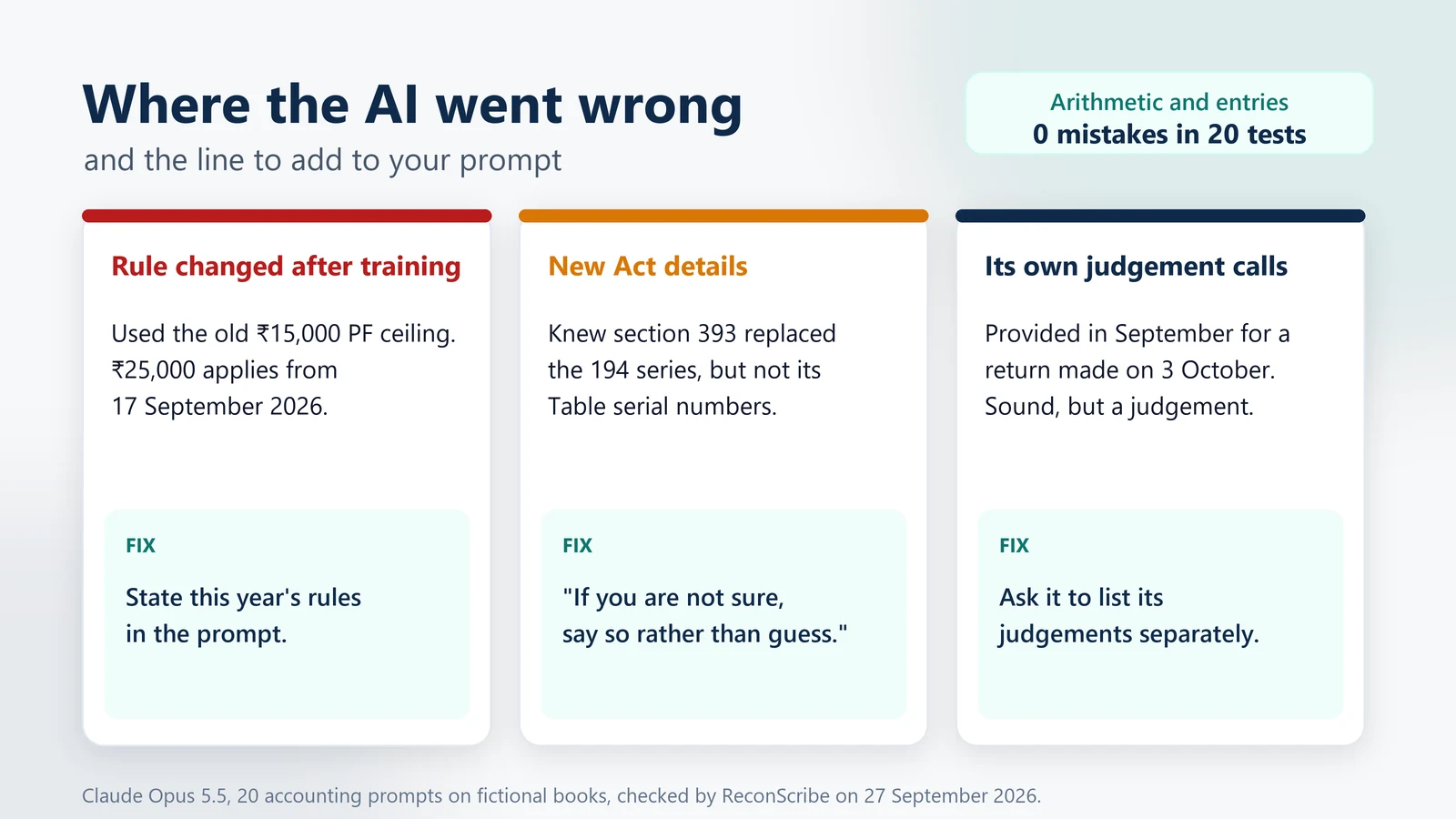
- Rules that changed after the model was trained. In the payroll tie-out it used the old ₹15,000 PF wage ceiling, although the ceiling is ₹25,000 from 17 September 2026, and in the close calendar it used Maharashtra’s old professional tax date. Fix: write the current rule into the prompt.
- Details of the Income-tax Act, 2025. It knew section 393 replaced the old 194 series and applied every rate and threshold correctly, but it did not know the Table serial numbers. It said so rather than guess, because the prompt asked it to. Fix: keep the “say so rather than guess” line, and look the numbers up in our Section 393 TDS lookup.
- Judgement calls it made on its own. On the cut-off test it treated a return of defective goods as a September adjustment. That was a sound call, but it was a call. Fix: ask the model to list its judgements separately so you can accept or reject each one.
The pattern is the useful part. AI is now reliable at the mechanics of accounting: matching, scheduling, classifying and drafting. It is not a source of truth for this month’s rates, thresholds and due dates. Give it those, and check anything it says about them.
Keep client data safe when you use AI
Accounting files are full of personal and confidential details. A few habits keep you on the right side of your clients and of the Digital Personal Data Protection Act, 2023:
- Strip identifiers before you paste. Replace names, PAN, Aadhaar, bank account numbers and GSTINs with codes such as Vendor A or Employee 12. Every one of these AI prompts for accounting works just as well with codes.
- Use a business plan with training switched off. The business and enterprise plans of the main AI tools say they do not train on your chats by default and give you admin and retention controls. Check the current terms of the tool you use.
- Keep the AI out of the ledger. Let it draft entries, schedules and reconciliations; a person reviews and posts. Keep the prompt and the answer with your working papers.
- Treat every rate and date as a claim to check. Confirm tax rates, thresholds and due dates on the official portal before you file or pay. The Reserve Bank’s FREE-AI framework makes the same point for regulated entities: keep a human accountable for AI outputs.
Please note: we update this page from time to time, but AI tools and tax rules change and there can be a gap between a change and our update. Check any rate, threshold or due date on the official portal before you rely on an answer. These AI prompts for accounting and the tested answers help you work faster; they are not legal or tax advice, and ReconScribe is not responsible for decisions made on them.
Frequently asked questions
What are the best AI prompts for accounting?
The ones that give the AI your data, the rule to apply and the exact output you want. In our test, the reconciliation prompts (bank, vendor, GSTR-2B, TDS), the schedules (prepaid, depreciation, accruals) and the review prompts (trial balance flux, duplicate invoices, cut-off) all came back right first time in Claude Opus 5.5. Copy them from this page and swap in your own figures.
Do these work as ChatGPT prompts for accountants?
Yes. They are plain text, so they work in ChatGPT, Gemini, Copilot or Claude. We tested them in Claude Opus 5.5, and results in other tools can differ, especially on recent Indian rules, so keep the step where you check the answer against the law and your own totals.
Which AI prompts for bookkeeping save the most time?
Classifying a month of bank lines, drafting journal entries with GST and TDS, month-end accruals, prepaid and depreciation schedules, and checking a payment run for duplicate invoices. Each takes an hour or more by hand and a minute to review when the AI has done the first pass.
Is it safe to paste client data into an AI tool?
Only with care. Replace names, PAN, Aadhaar, bank account numbers and GSTINs with codes, use a business plan that does not train on your chats, and keep a person responsible for every entry that is posted. Personal data of employees and customers is covered by the Digital Personal Data Protection Act, 2023.
Does AI know the Income-tax Act, 2025?
Partly. In our test Claude Opus 5.5 knew that section 393 replaced the old 194 series and applied every TDS rate and threshold correctly, but it did not know the Table serial numbers and said so. Give the section in your prompt, or look it up in our Section 393 TDS lookup.
Why does AI get recent rules wrong?
A model learns from text up to a cut-off date, so a change notified after that date is invisible to it. In our payroll test it used the old ₹15,000 PF wage ceiling, although the ceiling is ₹25,000 from 17 September 2026. Put any rule that changed this year into the prompt.
How do I stop AI from making up numbers or reasons?
Ask it to show its working, to write “Ask” when the data is unclear, to say when it is not sure of a section, and not to invent explanations for movements. Then tie its totals back to your source. Those four lines prevented every made-up answer we looked for.
Will AI replace accountants?
No. In our test the AI did the matching, arithmetic and drafting well, but every useful answer ended with checks only a person can make: look at the invoice, call the vendor, confirm this month's rate and sign off the entry. AI takes the first pass; the accountant still owns the books.
Sources
We checked the answers to these AI prompts for accounting against these official texts on 27 September 2026.
- Central Goods and Services Tax Act, 2017, section 17, including the blocked credits in section 17(5) (CBIC tax information portal).
- Income-tax Act, 2025, as amended by the Finance Act, 2026, sections 33, 37, 392, 393 and 398 (Income Tax Department).
- Income-tax Rules, 2026.
- Micro, Small and Medium Enterprises Development Act, 2006, sections 15, 16 and 23 (India Code).
- Ministry of MSME office memorandum of 2 July 2021 on retail and wholesale traders.
- Ind AS 115, Revenue from Contracts with Customers (Ministry of Corporate Affairs).
- GSTN FAQs on the Invoice Management System.
- Digital Personal Data Protection Act, 2023 (Ministry of Electronics and Information Technology).
More tested prompts: AI prompts for Excel, AI prompts for auditors and AI prompts for tax.
Related tools: AI prompts for finance, finance question solver, Section 393 TDS lookup, GSTR-2B reconciliation template, prepaid expense schedule template, accounts payable template, MSME delayed payment interest calculator and the EPF calculator.