
UPI MDR is back, and it lands only on the big-ticket end of merchant payments. From 15 October 2026, a UPI payment above ₹2,000 to a larger merchant carries a 0.4% fee, capped at ₹300. Everything else stays free, and the customer never pays a rupee extra.
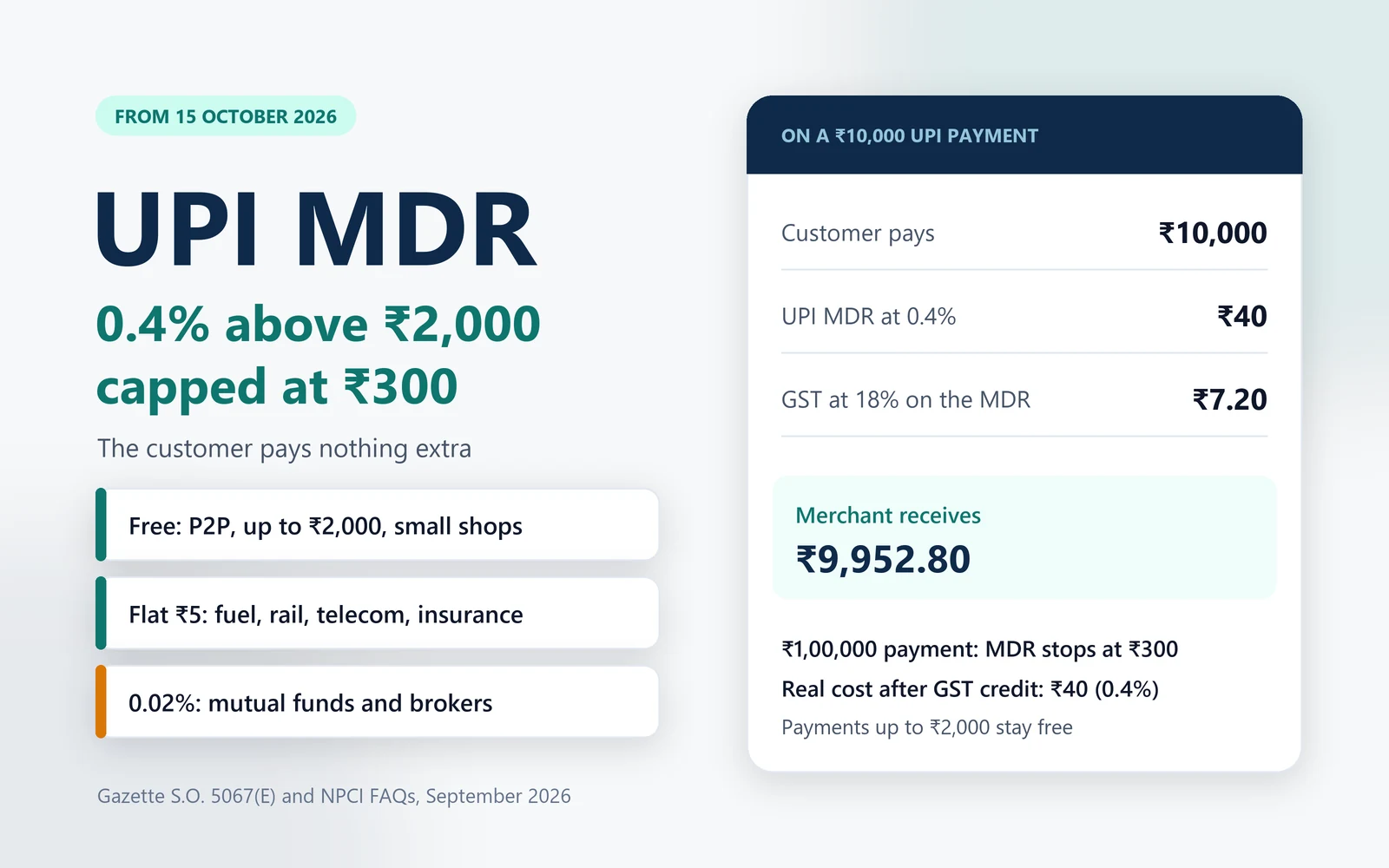
MDR, short for merchant discount rate, is the fee a merchant’s bank keeps for handling a digital payment. Card payments have always carried one. UPI has carried none since January 2020, because the law barred it and the government paid banks instead. That changes now: the new UPI MDR applies to about 4% of merchant transactions, while person-to-person transfers, merchant payments up to ₹2,000 and small shops on personal-account QR codes remain free. This guide explains every UPI MDR rate, who pays and who is exempt, how GST applies to the fee, the entries your accountant will pass, and what to change before 15 October. The UPI MDR calculator above works out the charge on any payment.
What the law says now: the Taxation and Other Laws (Amendment) Act, 2026 (No. 21 of 2026, assented on 17 August 2026) rewrote Section 10A of the Payment and Settlement Systems Act, 2007. Until then, Section 10A barred any charge on the payment modes prescribed under Section 269SU of the Income-tax Act, 1961, which covered all UPI payments. Now the Central Government names the charge-free modes by notification. Its notification S.O. 5067(E) of 14 September 2026 names two: debit cards powered by RuPay, at any amount, and UPI transactions up to ₹2,000. The Finance Ministry and NPCI published the MDR above ₹2,000 on 15 September 2026, effective 15 October 2026.
On 28 September 2026 the Supreme Court issued notice on a public interest petition against the charge and gave the Centre, RBI and NPCI four weeks to reply, but refused to stay it. Every rate on this page is taken from the gazette notification, the Finance Ministry’s release and NPCI’s FAQs as they stood on 28 September 2026.
What is UPI MDR? The fee explained simply
Every UPI payment to a shop passes through several hands. Your bank, called the issuer bank, takes the money out of your account. The shop’s bank, called the acquiring bank, puts it into the shop’s account. NPCI (National Payments Corporation of India), which runs UPI, switches the payment between the two. The app you pay with, such as your bank’s own app or a third-party app like PhonePe or Google Pay, connects you to UPI through a partner bank known as the payment service provider (PSP) bank.
All of that costs money: servers, fraud checks, customer support and round-the-clock uptime. NPCI puts the industry’s cost of running UPI at about ₹20,000 crore a year. The merchant discount rate is how card networks have always paid for this work: the merchant’s bank keeps a small slice of each payment. UPI MDR is the same idea applied to UPI.
Think of UPI as a national highway. Since 2020 the government paid the toll for every vehicle, through incentives to banks. From 15 October 2026, the trucks on long trips (larger merchants receiving payments above ₹2,000) pay a small toll themselves. Cars and scooters (people sending money to each other, small payments and small shops) still ride free.
Five terms come up again and again:
- P2P (person to person): money you send to a friend, a family member or your own other account. Always free.
- P2M (person to merchant): a payment to a business that takes UPI through a merchant QR code, a soundbox, a card machine or a payment gateway. This is where UPI MDR can apply.
- P2PM (person to person merchant): a small seller who takes UPI through a QR code linked to their own savings account and receives up to ₹1 lakh a month. Zero MDR.
- Acquiring bank or payment aggregator: the bank or payment gateway that signed the merchant up. It collects the MDR from the merchant.
- Surcharge: an extra amount a shop adds to your bill for paying by a particular method. A UPI surcharge is not allowed.
UPI MDR rates from 15 October 2026
The UPI MDR depends on two things: the size of the payment and who receives it. Here is the full rate card, row by row.
| Payment amount | Who receives it | UPI MDR |
|---|---|---|
| Any amount | A person (P2P), including transfers to your own accounts | Free |
| Up to ₹2,000 | Any merchant | Free, and the law bars any charge |
| Any amount | A small merchant on a personal-account QR receiving up to ₹1 lakh a month (P2PM) | Free |
| Any amount | A UPI AutoPay mandate (subscriptions, SIPs, recurring bills) | Free |
| Above ₹2,000 | Railways, telecom, insurance, fuel, farm inputs and utility bills | Flat ₹5 |
| Above ₹2,000 | Mutual funds, stockbrokers and securities dealers | 0.02%, capped at ₹300 |
| Above ₹2,000 | Education fees (schools, colleges, exams) | A concessional flat or capped fee (figure not yet published) |
| Above ₹2,000 | All other merchants | 0.4% of the full amount, capped at ₹300 |
The 0.4% applies to the whole payment, not just the part above ₹2,000
₹2,000 is a switch, not a deduction. Once a payment crosses it, the UPI MDR is charged on the full amount. A ₹3,000 payment costs the merchant ₹12, which is 0.4% of ₹3,000, not ₹4 on the ₹1,000 above the line. NPCI’s own worked table uses exactly these numbers: ₹2,000 costs nothing, ₹3,000 costs ₹12 and ₹50,000 costs ₹200. One rupee matters at the edge: a ₹2,000 payment is free, while ₹2,001 costs ₹8.
Where the ₹300 cap starts
0.4% of ₹75,000 is exactly ₹300, so every payment of ₹75,000 or more costs the same ₹300. On a ₹1,00,000 payment that works out to 0.3%, and on ₹3,00,000 it is just 0.1%. For mutual funds and brokers, 0.02% reaches the same ₹300 ceiling only at ₹15 lakh, so almost every capital market payment costs a few rupees at most.
The sectors that pay a flat ₹5
Businesses that run on thin margins or provide essential services pay ₹5 per payment above ₹2,000 instead of a percentage: railways, telecommunications, insurance premiums, fuel at petrol pumps, agricultural inputs, and utility bills such as electricity, water and piped gas. NPCI’s FAQs add “among others”, so the final list sits with your acquiring bank, which decides it from your merchant category code. That is a four-digit code the bank gives your business type when it signs you up.
Small merchants on P2PM stay at zero
A tea stall, a vegetable seller or a small kirana shop that takes UPI through a QR code linked to its own savings account, and receives up to ₹1 lakh a month that way, pays zero UPI MDR on every payment, even one above ₹2,000. No GST registration is needed to qualify, and no QR code or soundbox has to change; if you need a fresh QR for your UPI ID, our free UPI QR code generator makes one in seconds. The bank watches the monthly total: a P2PM merchant that receives more than ₹1 lakh a month for three months in a row is moved to the regular P2M category, where the 0.4% applies above ₹2,000.
AutoPay, credit cards and RuPay debit cards
UPI AutoPay mandates, the standing instructions behind SIPs, OTT subscriptions and monthly bills, carry no MDR. Credit-linked UPI, meaning a RuPay credit card linked to UPI or a bank’s pre-sanctioned credit line, is outside this framework and keeps following credit card rules. And debit cards powered by RuPay stay charge-free by law at any amount, because they are the other mode named in the 14 September notification.
UPI MDR worked examples with real numbers
These examples use the rates above and GST at 18% on the fee. “Merchant receives” assumes the bank deducts the MDR and GST from the settlement; some banks bill it once a month instead, which changes the timing but not the cost.
| Payment | Received by | UPI MDR | GST at 18% | Merchant receives |
|---|---|---|---|---|
| ₹1,500 | Any merchant | ₹0 | ₹0 | ₹1,500 |
| ₹2,500 | Small shop on P2PM | ₹0 | ₹0 | ₹2,500 |
| ₹6,500 | Petrol pump | ₹5 | ₹0.90 | ₹6,494.10 |
| ₹10,000 | Regular merchant | ₹40 | ₹7.20 | ₹9,952.80 |
| ₹48,000 | Electronics store | ₹192 | ₹34.56 | ₹47,773.44 |
| ₹1,00,000 | Mutual fund | ₹20 | ₹3.60 | ₹99,976.40 |
| ₹1,20,000 | Electronics store | ₹300 | ₹54 | ₹1,19,646 |
Arjun’s electronics store: a ₹48,000 laptop
Arjun runs a GST-registered electronics store in Pune. A customer pays ₹48,000 for a laptop by UPI. The payment is above ₹2,000 and Arjun is a regular merchant, so the UPI MDR is 0.4% × ₹48,000 = ₹192. GST at 18% on ₹192 is ₹34.56. If his bank deducts both from the settlement, ₹48,000 minus ₹192 minus ₹34.56 leaves ₹47,773.44 for his current account. Arjun claims the ₹34.56 back as input tax credit, so his real cost is ₹192, exactly 0.4% of the sale.
Later the same day he sells a ₹1,20,000 television. 0.4% would be ₹480, but the cap stops the UPI MDR at ₹300, plus ₹54 GST. His real cost on that sale is ₹300, or 0.25%.
Dr Meena’s clinic: ₹12,000 for a root canal
Dr Meena’s dental clinic in Jaipur collects ₹12,000 by UPI. The UPI MDR is ₹48 and the GST on it is ₹8.64. Healthcare services by a clinic are exempt from GST, and GST paid on costs linked to exempt services cannot be claimed back as input tax credit. So the clinic’s real cost is the full ₹56.64, about 0.47% of the fee, not 0.4%. Schools and other businesses with exempt income are in the same position.
Ramesh’s petrol pump: ₹6,500 of diesel
A truck driver pays ₹6,500 for diesel at Ramesh’s pump. Fuel is an essential sector, so the MDR is a flat ₹5, plus ₹0.90 GST. Petrol and diesel are still outside GST, so the pump usually cannot claim the ₹0.90 back: its cost is ₹5.90 on a ₹6,500 sale, under 0.1%. A ₹1,500 scooter fill-up stays free because it is under ₹2,000.
Sunita’s vegetable stall: a ₹2,500 bulk order
Sunita sells vegetables in Nagpur with a QR code linked to her savings account and takes about ₹70,000 a month by UPI. A hotel pays her ₹2,500 for a bulk order. She is a P2PM merchant, so the UPI MDR is zero even though the payment is above ₹2,000. If her UPI receipts cross ₹1 lakh a month for three months in a row, her bank will move her to the P2M category, and from then on payments above ₹2,000 cost 0.4%.
Priya’s mutual fund investments
Priya invests a ₹1,00,000 lump sum in a mutual fund through UPI. The fund house pays a UPI MDR of 0.02%, which is ₹20 plus ₹3.60 GST; Priya pays nothing, and all ₹1,00,000 is invested for her. Her ₹5,000 monthly SIP runs on UPI AutoPay, which carries no MDR at all.
Who pays UPI MDR, and who gets the money
The merchant pays the UPI MDR, and the customer never does. The Finance Ministry has told banks to make sure merchants do not pass the charge on, and NPCI’s FAQs say it plainly: merchants cannot pass MDR to customers, and UPI apps may not charge any platform fee or other charge on a UPI payment. If a shop adds “UPI charges” to your bill, report it to the bank named on its QR stand or through the complaint option in your UPI app.
The fee is not a tax, and neither the government nor NPCI keeps it. It is shared among the players who make the payment work: the acquiring bank, the customer’s bank, the PSP bank and the UPI app provider. One slice goes back to small businesses: an amount equal to 5% of all UPI MDR collected will go into a dedicated fund that pays for merchant onboarding and UPI incentives in Tier 3 to 6 centres, the North East, Jammu and Kashmir and Ladakh, and for schemes such as PM SVANidhi and PM Vishwakarma. NPCI says the fund’s detailed rules will be settled with the Reserve Bank of India within three months.
What stays free on UPI
- Every person-to-person transfer, at any amount, including transfers between your own accounts.
- Every merchant payment of ₹2,000 or less. These make up more than 95% of UPI merchant transactions by volume.
- Every payment to a small merchant on the P2PM category, whatever the amount.
- UPI AutoPay mandates for subscriptions, SIPs and recurring bills.
- Debit cards powered by RuPay, at any amount.
- Scanning a QR code: the customer side of a UPI payment never costs anything.
There are no monthly quotas either. The daily limits you see, typically ₹1 lakh to ₹5 lakh depending on the payment category, are security limits set by banks and NPCI, not charging thresholds.
UPI vs Visa, Mastercard and RuPay: how the fees compare
Even with the new fee, UPI stays one of the cheapest ways for a merchant to get paid; only RuPay debit cards and bank transfers are cheaper, and both are free. Cards run on card networks. Visa and Mastercard are global private networks, while RuPay is India’s own network, run by NPCI, the same organisation that runs UPI. What a merchant pays depends on the type of card, and only debit cards have an RBI cap.
| Payment mode | Fee the merchant pays | On ₹10,000 | On ₹1,00,000 |
|---|---|---|---|
| UPI, regular merchant (from 15 October 2026) | 0.4% above ₹2,000, capped at ₹300 | ₹40 | ₹300 |
| RuPay debit card | Zero, by law | ₹0 | ₹0 |
| Visa or Mastercard debit card | Up to 0.90%, capped at ₹1,000 (up to 0.40%, capped at ₹200, for merchants with turnover up to ₹20 lakh) | Up to ₹90 | Up to ₹900 |
| Credit card (Visa, Mastercard, RuPay and others) | Usually 1.5% to 2.5%, with no RBI cap | ₹150 to ₹250 | ₹1,500 to ₹2,500 |
| Bank transfer (NEFT, RTGS, IMPS) | No MDR | ₹0 | ₹0 |
- Who sets the fee. The RBI caps debit card MDR; its circular of 6 December 2017 set the 0.40% and 0.90% ceilings. The government exempts RuPay debit cards and UPI payments up to ₹2,000 by notification, and NPCI’s UPI steering committee sets UPI MDR above ₹2,000. Credit card fees are set commercially by banks and card networks.
- For most merchants, UPI is cheaper than Visa or Mastercard. At 0.4%, UPI above ₹2,000 costs less than half the 0.90% debit card ceiling for merchants with turnover above ₹20 lakh, and a fraction of a typical credit card fee. Its ₹300 cap is also lower than the ₹1,000 debit card cap.
- Credit on UPI follows card rules. RuPay credit cards linked to UPI and pre-sanctioned bank credit lines run on UPI, but NPCI’s FAQs say they follow credit card rules, so card fees apply rather than UPI MDR.
- Reach. Visa and Mastercard cards work almost everywhere in the world. UPI is live in 11 countries outside India, and at home it handled 2,451 crore transactions in August 2026 alone.
The practical takeaway: UPI remains a low-cost default for most businesses, and for the biggest tickets a RuPay debit card or a bank transfer costs nothing at all.
Why UPI MDR is coming back now
MDR on UPI is not new. Until December 2019, NPCI allowed an MDR of up to 0.30% on UPI merchant payments. From January 2020 the government made MDR zero on UPI and RuPay debit cards by amending Section 10A of the Payment and Settlement Systems Act and Section 269SU of the Income-tax Act, 1961. To keep banks and apps investing, it then paid them incentives out of the budget.
| Period | UPI MDR on merchant payments | Who paid for UPI |
|---|---|---|
| Until December 2019 | Up to 0.30% | Merchants |
| January 2020 to 14 October 2026 | Zero, by law | The government, through yearly incentives to banks |
| From 15 October 2026 | 0.4% above ₹2,000 for regular merchants, capped at ₹300, with lower sector rates | Larger merchants, with small merchants still exempt |
The incentives grew with UPI. The government paid ₹957 crore for BHIM-UPI in 2021-22, ₹1,802 crore in 2022-23 and ₹3,268 crore in 2023-24. For 2024-25 it approved a ₹1,500 crore scheme that paid 0.15% only on small-merchant payments up to ₹2,000. Meanwhile UPI kept growing: 2,451 crore transactions worth ₹29.9 lakh crore in August 2026 alone. NPCI’s FAQs describe the yearly subsidy as short-term bridge funding and argue that a small fee on bigger merchant payments gives banks and fintechs steady money for fraud prevention, cybersecurity and uptime. The Finance Ministry adds that the framework matches the Standing Committee on Finance’s 32nd Report, which stressed the need for a viable revenue model.
How the change happened:
- 6 August 2026: the Lok Sabha passed the Taxation and Other Laws (Amendment) Bill, 2026.
- 17 August 2026: the Act received assent, turning Section 10A into a power to notify charge-free modes.
- 14 September 2026: notification S.O. 5067(E) named RuPay debit cards and UPI up to ₹2,000 as charge-free.
- 15 September 2026: the Finance Ministry and NPCI published the MDR rates and FAQs.
- 22 September 2026: NPCI clarified how GST applies to the fee.
- 28 September 2026: the Supreme Court issued notice on a challenge but did not stay the charge.
- 15 October 2026: UPI MDR starts.
GST on UPI MDR and input tax credit
GST applies to the UPI MDR, not to the payment. The MDR is the bank’s fee for a service, so the bank adds GST at 18% on the fee alone. NPCI’s own example: on a ₹10,000 payment the MDR is ₹40, and GST of 18% on ₹40 is ₹7.20, not 18% of ₹10,000. Payments of ₹2,000 or less carry no MDR, so they carry no GST either. You can check the arithmetic on any figure with our GST calculator.
Three rules matter for businesses:
- Your own GST on the sale does not change. Arjun still pays output GST on the full ₹48,000 laptop, not on ₹47,773.44. The MDR is a cost of collecting the money, not a discount on the price.
- A GST-registered merchant making taxable sales can claim the GST on MDR as input tax credit and set it off against the GST it collects. Give your GSTIN to your acquiring bank or payment gateway so its GST invoice carries it. Banks may issue one consolidated tax invoice for the month (Rule 54(2) of the CGST Rules), and the credit should then appear in your GSTR-2B.
- If your sales are exempt or outside GST, or you are not registered, the GST is a cost. That is why Dr Meena’s clinic and Ramesh’s pump pay 18% more than the bare MDR.
Match the bank’s monthly GST to GSTR-2B before you claim it; our GSTR-2B reconciliation template does that match line by line.
How to account for UPI MDR: entries and reconciliation
Record the sale at its full price and the UPI MDR as an expense. Never book only the net amount that reached the bank as your sale, because that understates revenue and your GST on it. The cleanest method uses a UPI clearing account: a ledger that holds the payment between the sale and the bank settlement, and should be zero once everything is settled.
Arjun’s ₹48,000 laptop, which includes 18% GST, goes through two entries:
| When | Account | Debit | Credit |
|---|---|---|---|
| At the sale | UPI clearing account | ₹48,000.00 | |
| Sales | ₹40,677.97 | ||
| Output GST | ₹7,322.03 | ||
| At settlement | Bank (current account) | ₹47,773.44 | |
| UPI MDR charges (bank charges) | ₹192.00 | ||
| Input GST on bank charges | ₹34.56 | ||
| UPI clearing account | ₹48,000.00 |
If your bank bills the UPI MDR once a month instead, the settlement credits the full ₹48,000 to the bank, and at month end you debit UPI MDR charges and input GST and credit the bank for the invoice total. Tally and Zoho Books both handle this with an ordinary journal or a bank charges voucher; our Zoho Books vs TallyPrime comparison covers how each one reconciles bank feeds.
A monthly reconciliation takes six steps:
- Download the settlement report from your bank or payment gateway. It lists every UPI payment with its reference number (RRN or UTR), gross amount, MDR, GST and net amount.
- Match each gross amount to your sales register or billing software by date and reference number.
- Recalculate the UPI MDR on each line: zero up to ₹2,000, then 0.4% capped at ₹300, or your sector’s rate.
- Flag any charge on a payment of ₹2,000 or less, on an AutoPay mandate, or on a P2PM account, and raise it with the bank in writing.
- Match the month’s total GST on MDR to the bank’s tax invoice and to GSTR-2B.
- Post the entries and check that the UPI clearing account is back to zero.
For income tax, UPI MDR is a deductible business expense like any other bank charge. TDS is less settled. Card MDR paid to a scheduled bank has been outside TDS since 2013 under CBDT Notification 56/2012, which names credit card and debit card commission; UPI MDR is not named in it, and we have not yet seen a CBDT clarification for UPI. Settle the TDS position with your tax adviser before the first MDR invoice arrives. Under the Income-tax Act, 2025, the old 194-series TDS sections now sit together in Section 393.
UPI MDR checklist for merchants before 15 October 2026
- Find your category. If your QR code pays into your savings account and you receive under ₹1 lakh a month, you are probably P2PM and pay nothing. If it pays into a business current account through a bank, soundbox provider or payment gateway, you are P2M. Ask your bank to confirm in writing.
- Size the cost. Pull three months of UPI receipts, count the payments above ₹2,000 and note their average size, then put those numbers into the calculator above for a monthly figure.
- Check your merchant category code. Fuel, telecom, insurance, railways, farm inputs, utilities and education pay concessional rates only if the bank has coded your business that way.
- Ask how the UPI MDR will be recovered: deducted from each settlement or billed monthly, and when the GST invoice arrives. Give the bank your GSTIN.
- Set up three ledgers: UPI clearing account, UPI MDR charges and input GST on bank charges.
- Do not add a UPI surcharge, and tell your billing staff the same. Price the cost into your margins instead.
- Route large payments sensibly. For big B2B invoices, bank transfers (NEFT, RTGS or IMPS) carry no MDR, and RuPay debit cards stay charge-free at any amount.
Can you avoid UPI MDR? Split payments, personal UPI IDs and the risks
Two shortcuts are already doing the rounds: asking customers to pay a big bill in pieces of ₹2,000 or less, and collecting shop payments on a personal UPI ID instead of a merchant QR. Both look free on paper. Both carry risks that cost more than the fee they save, and a third idea, adding a UPI charge to the bill, is simply not allowed.
Splitting one bill into payments of ₹2,000 or less
To pay a ₹10,000 bill this way, the customer makes five payments and enters the UPI PIN five times. For a GST-registered shop the saving is ₹40, because the GST on the fee comes back as credit anyway. Here is what it puts at risk:
- The sale itself. Five payments at the counter mean five chances for a timeout, a failed payment or a customer who gives up. A single lost ₹10,000 sale costs more margin than splitting saves on dozens of bills.
- A pattern banks can see. Several payments from the same customer to the same merchant within minutes stand out in settlement data, and NPCI’s FAQs already describe banks running velocity checks on what merchants receive. Card networks have long barred merchants from splitting one sale into several transactions, and a bank can question the pattern under its merchant agreement or review the account.
- Messier books. One invoice settled by five receipts is harder to reconcile, and it invites questions in an audit.
Collecting shop payments on a personal UPI ID
A payment to a person is free at any amount, so some businesses will print a QR code for the owner’s personal UPI ID. For a genuinely small seller this already works within the rules: it is the P2PM category, which stays at zero MDR up to ₹1 lakh a month. Beyond that, the risks grow:
- Reclassification. Banks already track P2PM accounts and move them to the P2M category, where the 0.4% applies, after three months in a row above ₹1 lakh. A personal ID that works like a shop till invites the same scrutiny.
- Questions from your bank. A savings account that receives hundreds of customer payments a month behaves like a business account, and the bank can ask for more KYC, ask you to open a current account or restrict the account.
- Tax and records. The money is still business income. It belongs in your books and, if you are registered, in your GST returns; mixing it with personal money makes reconciliation, audits and any income-tax scrutiny harder.
- Weaker protection. A personal ID gives you no merchant settlement reports and no merchant dispute process, and customers may hesitate to pay an individual’s name at a shop counter.
Adding a UPI charge to the bill
Not allowed. The Finance Ministry has told banks to make sure merchants do not pass MDR on to customers, and NPCI’s FAQs say merchants cannot do it. A shop that adds a UPI surcharge can face complaints to its bank, and customers can report it through their UPI app.
The legitimate ways to pay less UPI MDR
- Get your category right. A small seller on a personal-account QR under ₹1 lakh a month is P2PM and pays nothing. A fuel, telecom, insurance, utility or farm-input business pays ₹5, not 0.4%, as long as the bank has coded it correctly.
- Steer big payments to free modes. RuPay debit cards are free by law at any amount, and bank transfers (NEFT, RTGS and IMPS) carry no MDR. Print your bank details on B2B invoices so business customers pay by transfer.
- Use UPI AutoPay for recurring payments such as monthly fees and subscriptions. Mandates carry no MDR.
- Claim the GST back. A GST-registered business with taxable sales gets the 18% on the fee back as input tax credit, so its real cost is 0.4% at most.
- Compare it with cards. 0.4%, capped at ₹300, is still cheaper than debit cards (up to 0.90%) and credit cards (usually 1.5% to 2.5%). On a ₹1,00,000 sale, UPI costs ₹300; the same sale on a credit card at 1.5% costs ₹1,500.
Is UPI MDR final? The Supreme Court challenge
A public interest petition by Delhi advocate Anjan Datta challenges the new charge. On 28 September 2026, a bench led by Chief Justice Surya Kant issued notice to the Centre, the Reserve Bank of India and NPCI and asked for their replies within four weeks, but refused the petitioner’s request for an interim stay. The bench asked whether the charge is a fee or a tax and who earns from it. The petition argues that the 0.4% rate appears in the Finance Ministry’s release and NPCI’s documents rather than in the gazette notification itself, and that the amended Section 10A hands too much power to the executive.
What this means for you: unless the court orders otherwise, UPI MDR starts on 15 October 2026 as planned. Plan for it, and watch for the next hearing once the government files its reply.
Please note: we update this page from time to time, but payment rules change and there can be a gap between a change and our update. Check your bank’s merchant terms and the official NPCI and Finance Ministry releases before you act. This guide and calculator help with estimates; they are not legal or tax advice, and ReconScribe is not responsible for decisions made on them.
UPI MDR: frequently asked questions
Will customers pay any charge for UPI payments after 15 October 2026?
No. UPI MDR charges fall on merchants, not customers. You pay only the listed price, a shop may not add a UPI surcharge, and UPI apps are barred from charging platform fees or hidden charges on UPI payments.
What is the UPI MDR on payments above ₹2,000?
0.4% of the full payment for regular merchants, capped at ₹300 for payments of ₹75,000 and above. Fuel, railways, telecom, insurance, farm inputs and utility bills pay a flat ₹5 per payment, and mutual funds and brokers pay 0.02%, also capped at ₹300.
Is UPI MDR charged on the whole amount or only on the part above ₹2,000?
On the whole amount. A ₹3,000 payment attracts ₹12, which is 0.4% of ₹3,000, and a ₹50,000 payment attracts ₹200, exactly as in NPCI's worked table. Payments of ₹2,000 or less attract nothing.
Which small merchants pay zero UPI MDR?
Merchants in the P2PM category: small sellers who take UPI through a QR code linked to their own savings account and receive up to ₹1 lakh a month. They pay zero MDR on every payment, need no GST registration to qualify, and move to the regular category only after crossing ₹1 lakh a month for three months in a row.
Is GST charged on UPI MDR?
Yes, at 18%, but only on the fee. On a ₹10,000 payment the UPI MDR is ₹40 and the GST is ₹7.20. A GST-registered merchant making taxable sales can claim that GST back as input tax credit.
Does UPI AutoPay or a SIP attract MDR?
No. UPI AutoPay mandates, used for SIPs, subscriptions and recurring bills, carry no MDR. A one-time mutual fund purchase above ₹2,000 carries 0.02%, which the fund house pays, not the investor.
Does UPI MDR apply if I pay with a RuPay credit card on UPI?
The new framework covers payments from a bank account to a merchant. RuPay credit cards linked to UPI and pre-sanctioned credit lines keep following credit card rules. RuPay debit card payments stay charge-free at any amount by law.
Can I split a payment into amounts under ₹2,000 to avoid UPI MDR?
Splitting one bill on purpose to dodge the fee is risky for the merchant. The customer has to approve several payments, banks can spot repeated payments from the same customer within minutes, and card networks have long barred split sales. The saving is small: ₹40 on a ₹10,000 bill for a GST-registered shop, which gets the GST on the fee back as credit.
Can a shop use a personal UPI ID to avoid UPI MDR?
A genuinely small seller on a personal-account QR under ₹1 lakh a month is already in the zero-MDR P2PM category. A bigger business that runs shop sales through a personal ID risks being moved to the P2M category, questions from its bank about business use of a savings account, and messier books, and the money is still business income for tax.
Is UPI cheaper than Visa or Mastercard for merchants?
For most merchants, yes. From 15 October 2026 UPI costs a regular merchant nothing up to ₹2,000 and 0.4% above it, capped at ₹300. Visa and Mastercard debit cards cost up to 0.90%, capped at ₹1,000, and credit cards usually 1.5% to 2.5%. RuPay debit cards and bank transfers are free.
Is UPI MDR a tax?
No. Neither the government nor NPCI keeps it. It is shared among the banks, payment service providers and app providers that process the payment, and an amount equal to 5% of all UPI MDR collected goes into a fund that brings more small merchants onto UPI.
When does UPI MDR start, and can the Supreme Court stop it?
It starts on 15 October 2026. On 28 September 2026 the Supreme Court issued notice on a challenge and gave the Centre, RBI and NPCI four weeks to reply, but refused an interim stay, so the charge applies unless the court orders otherwise.
Will my existing UPI QR code or soundbox stop working?
No. Existing QR codes and soundboxes keep working without any change. Only the fee on eligible payments above ₹2,000 is new, and your bank settles it through your merchant account.
Sources
- Ministry of Finance, UPI continues to remain free for peer to peer transactions and 96% of merchant transactions, press release, 15 September 2026.
- NPCI, Merchant Discount Rate (MDR) on select UPI (P2M) transactions: FAQs, 15 September 2026.
- Ministry of Finance (Department of Financial Services), notification S.O. 5067(E) under Section 10A of the Payment and Settlement Systems Act, 2007, Gazette of India, 14 September 2026.
- Union Cabinet, incentive scheme for promotion of low-value BHIM-UPI transactions (P2M), 19 March 2025, including the year-wise incentive payouts.
- Reserve Bank of India, Rationalisation of Merchant Discount Rate (MDR) for debit card transactions, circular of 6 December 2017.
- CBDT, Notification No. 56/2012 (no TDS on credit and debit card commission paid to scheduled banks).
- Taxation and Other Laws (Amendment) Act, 2026 (No. 21 of 2026), assented on 17 August 2026.
- NPCI statement on GST on UPI MDR, 22 September 2026, and the Supreme Court's order of 28 September 2026 on the public interest petition challenging UPI MDR.