
Claude Sonnet 5.5 gets you within touching distance of Opus 5.5 for half the price. It scores 1844 Elo on GDPval-AA, the test built on real professional work, just two points behind Opus 5.5’s 1846. It beats Opus 5.5 outright on Terminal-Bench 4.0, 70.6% against 66.4%. And it costs $2 per million input tokens and $10 per million output tokens, against $4 and $20 for Opus 5.5.
Anthropic released Claude Sonnet 5.5 on 28 September 2026, six days after Opus 5.5, as the second model in the Claude 5.5 family. It keeps Sonnet 5’s price, writes more than 30% faster, and costs up to 30% less per task because it needs fewer tokens for the same job. Against Sonnet 5 the jumps are huge: Terminal-Bench 4.0 goes from 10.3% to 70.6%, and OSWorld computer use from 57.0% to 80.1%.
Opus 5.5 is still the stronger model for complex, open-ended work that needs sustained judgment, and Anthropic says so itself. But for everyday coding, documents, spreadsheets and slides, Claude Sonnet 5.5 is now the model to start with. Below you will find every benchmark Anthropic published, the cost per task at every effort level, the full price list, and what it all means for a finance team.
Claude Sonnet 5.5: the short answer
Claude Sonnet 5.5 against Opus 5.5, Sonnet 5 and GPT-6 Sol at a glance:
Vendor-reported scores from Anthropic’s launch page. Teal marks the best score in each row. Opus 5.5’s Terminal-Bench score is at xhigh effort, its best.
| Fact | Claude Sonnet 5.5 |
|---|---|
| Released | 28 September 2026 |
| Family | Second model in the Claude 5.5 family, after Opus 5.5 on 22 September. Claude Haiku 5.5 followed on 7 October |
| Model ID | claude-sonnet-5-5 (Amazon Bedrock: anthropic.claude-sonnet-5-5) |
| Where you can use it | Claude apps, Claude Code, Claude API, Amazon Bedrock, Claude Platform on AWS, Google Cloud, Microsoft Foundry |
| Input / output price | $2 / $10 per 1M tokens, unchanged from Sonnet 5 (Opus 5.5: $4 / $20) |
| Cache reads | $0.10 per 1M tokens since 7 October 2026 (was $0.20) |
| Cache writes | $2.50 per 1M tokens for 5 minutes, $4 for 1 hour |
| Batch processing | Half price: $1 / $5 per 1M tokens |
| Context window | 1M tokens, billed at the standard rate across the full window |
| Max output | 128K tokens (up to 300K on the Batches API with a beta header) |
| Reliable knowledge cutoff | June 2026 |
| Thinking | Adaptive, on by default. The new between_tools setting is the lowest level |
| Effort levels | low, medium, high, xhigh, max. Default is Medium in the Claude apps and Claude Code, and High on the API |
| Speed | More than 30% faster output than Sonnet 5, the fastest Sonnet yet |
| Cost per task | Up to 30% less than Sonnet 5 |
| Fast mode | Not offered; Anthropic lists fast mode for Opus models only |
| Available until | At least 28 September 2027 on Anthropic’s own platforms |
Want to see what Claude Sonnet 5.5 can build? We gave it short prompts, kept the five best scenes and recorded the single HTML file it wrote for each, with no edits to the code: northern lights over a frozen lake, bioluminescent jellyfish, wind sculpting sand dunes, a trading day as a candlestick chart, and ink blooming in water.
To see how Claude Sonnet 5.5 compares with every other major model on independent tests, with prices and filters for budget and job, open our live AI leaderboard.
Five motion pieces, each one Claude Sonnet 5.5’s reply to a single prompt. Prefer it vertical? Watch the Short.
What is new in Claude Sonnet 5.5
Anthropic pitches Claude Sonnet 5.5 as the faster, cheaper partner to Opus 5.5. Opus is built for complex work that needs careful judgment. Sonnet 5.5 is strongest at well-scoped everyday tasks: fixing bugs, and producing polished documents, slides and spreadsheets. Anthropic also says it has a sharp eye for design.
Five things changed from Sonnet 5:
- Much better results. The biggest jumps are in agentic coding, computer use and chart reading. It is also the first Sonnet model to beat Pokémon Red working only from screenshots, a playful but real test of long, visual, multi-step work.
- Clearer writing. Like Opus 5.5, it writes more clearly than the previous generation, and early testers called it a better partner for collaboration than Sonnet 5.
- Lower cost per task. The price per token did not change, but it needs far fewer tokens to finish the same work, so a typical task costs up to 30% less.
- Faster. Output comes back more than 30% faster than Sonnet 5, which makes it Anthropic’s fastest Sonnet yet.
- Stronger safeguards. It is the first Sonnet model to launch with cyber safeguards like those on Anthropic’s top models, and the first with classifiers that block attempts to extract its reasoning.
Early testers noticed two more things. It reads a codebase quickly, and it batches tool calls together more than Sonnet 5 did, so it takes fewer steps. It also adds polish to user interfaces and can follow a slide template to build a deck that needs little editing. In one of Anthropic’s internal tests, it turned a listed company’s quarterly earnings materials and call transcripts into a 10-slide operating review, and two experts judged the first draft ready to send as it was.
Anthropic is careful not to oversell it. Benchmark scores capture only one side of a model, it says, and in its own testing and that of outside testers, Opus 5.5 remains clearly stronger at complex, open-ended work that needs sustained judgment. We agree with that framing: make Sonnet 5.5 the default, and keep Opus 5.5 for the hard problems.
Claude Sonnet 5.5 benchmarks: the official launch table
Here are the launch benchmarks exactly as Anthropic published them, with a plain note on what each test measures:
| Benchmark | What it tests | Sonnet 5.5 | Sonnet 5 | Opus 5.5 | GPT-6 Sol |
|---|---|---|---|---|---|
| Terminal-Bench 4.0 | Agentic coding in a command line | 70.6% | 10.3% | 66.4% (xhigh, its best) | not reported |
| FrontierCode 1.1 (Main) | Whether an agent’s code changes would be merged | 46.2% at max, 52.1% at xhigh | 42.4% | 54.4% | 49.3% |
| CursorBench 4.0 | Ambiguous multi-file tasks from real Cursor sessions | 55.5% | 34.1% | 57.8% | not reported |
| GDPval-AA v2.1 | Real work across 44 occupations (Elo) | 1844 | 1449 | 1846 | 1487 |
| AA-Briefcase v1.1 | Long-horizon knowledge work (Elo) | 1811 | 1359 | 1822 | 1483 |
| Humanity’s Last Exam | Multidisciplinary reasoning, with tools | 64.5% | 54.9% | 67.7% | not reported |
| OSWorld 2.1 | Computer use, partial credit | 80.1% | 57.0% | 81.8% | not reported |
| Chartography | Reading charts, no tools | 61.6% | 15.6% | 64.4% | 53.6% |
Opus 5.5 still tops seven of the eight rows. But look at the size of the gaps: on every percentage row, Claude Sonnet 5.5 is within 3.2 points of Opus 5.5, and on GDPval-AA the two are just two Elo points apart. For a model that costs half as much per token, that is a very small gap.
Where Sonnet 5.5 beats Opus 5.5
The headline is Terminal-Bench 4.0, which tests whether a model can finish complex, multi-step professional tasks in a command line on its own. Claude Sonnet 5.5 scores 70.6%, the highest score in Anthropic’s table, ahead of Opus 5.5’s best of 66.4%. Against Sonnet 5, which scored 10.3%, it is a different model altogether. There is a catch, covered in the cost section below: that 70.6% comes at max effort and costs about $12.54 per attempt, more than Opus 5.5 spends for its best score.
The system card adds more wins. On HealthBench Professional, a test of answers for health professionals, Sonnet 5.5 scores 69.2% against 65.6% for Opus 5.5. On AutomationBench, Zapier’s test of business workflows across connected apps, it scores 44.7% against 42.5%. It also edges Opus 5.5 on reading charts when it can use tools, 90.2% against 89.0%, and ties it on Toolathlon, a test of real tool use across 32 apps, at 77.8% each.
Where Opus 5.5 still leads
Opus 5.5 keeps the lead on the harder coding tests. It scores 89.9% on SWE-Bench Pro against 81.3%, 91.2% on ProgramBench against 79.7%, and 57.8% on CursorBench 4.0 against 55.5%. It leads on reasoning without tools, with 64.4% on Humanity’s Last Exam against 56.9%, and it stays ahead on computer use, chart reading without tools, the GDPval-AA and AA-Briefcase knowledge work tests, and every multilingual test. The gaps are mostly small, but they are consistent, which matches Anthropic’s own view that Opus 5.5 is the model for the hardest work.
The fine print behind the table
- Sonnet 5.5 results use adaptive thinking at max effort, averaged over five trials, unless a row says otherwise. Opus 5.5’s Terminal-Bench 4.0 score is at xhigh effort, its best.
- On FrontierCode, Sonnet 5.5 scored lower at max effort (46.2%) than at xhigh (52.1%). At max it more often ran Claude Code’s code review skill across many subagents, which in two cases led to a timeout or to edits outside the task, and FrontierCode penalises out-of-scope changes.
- Artificial Analysis ran GDPval-AA and AA-Briefcase on a pre-release deployment with a bug that could degrade structured outputs. It has since been fixed, and Anthropic expects any effect to be small and to understate Sonnet 5.5.
- OpenAI recently fixed an image understanding bug in GPT-6 Sol, so its published AA-Briefcase, GDPval-AA and Chartography scores may not reflect the latest version yet. Artificial Analysis does not expect a big change.
- Sonnet 5.5 was tested with its production safeguards switched on. On Terminal-Bench 4.0, the cyber fallback to Sonnet 5 fired on 1.2% of requests.
Every other Claude Sonnet 5.5 benchmark in the system card
The launch page shows eight results. Anthropic’s 148-page Claude Sonnet 5.5 system card has many more. Here is every capability result it reports with a number, grouped by the kind of work, with the closest comparisons it gives. First, the system card’s own summary table, all at max effort and averaged over five trials:
| Benchmark | Sonnet 5.5 | Sonnet 5 | Opus 5.5 | GPT-6 Sol |
|---|---|---|---|---|
| SWE-Bench Pro | 81.3% | 63.2% | 89.9% | not reported |
| SWE-Bench Multilingual | 90.3% | 78.3% | 93.9% | not reported |
| SWE-Bench Multimodal | 54.3% | 28.1% | 61.4% | not reported |
| FrontierCode v1.1 (Main) | 46.2% | 42.4% | 54.4% | 49.3% |
| Humanity’s Last Exam, no tools | 56.9% | 43.1% | 64.4% | not reported |
| Humanity’s Last Exam, with tools | 64.5% | 54.9% | 67.7% | not reported |
| OSWorld 2.1 | 80.1% | 57.0% | 81.8% | not reported |
| HealthBench Professional | 69.2% | 57.8% | 65.6% | not reported |
| GDPval-AA v2.1 (Elo) | 1844 | 1449 | 1846 | 1487 |
| AA-Briefcase v1.1 (Elo) | 1811 | 1359 | 1822 | 1483 |
| AutomationBench | 44.7% | 10.7% | 42.5% | 32.0% |
Coding and agents
| Benchmark | What it tests | Claude Sonnet 5.5 | For comparison |
|---|---|---|---|
| DeepSWE v1.1 | 113 long software engineering tasks written from scratch | 71.0% | Average of five trials |
| FrontierCode Extended | A longer, harder FrontierCode task set | 64.4% at xhigh, 59.1% at max | Main set: 52.1% at xhigh |
| Terminal-Bench-Science 0.1 | 70 research tasks from the life, physical, earth, maths and engineering sciences | 59.9% | Opus 5.5 58.7%, Fable 5.1 52.6%, Opus 5 29.0% |
| FrontierSWE v2 | 34 very long engineering and research tasks; top models work for nearly 20 hours per task | 61.9% | GPT-6 Astra 65.5%, Opus 5.5 62.3%, Fable 5.1 56.3% |
| ProgramBench | Rebuilding a program from its binary and documentation, with up to 1M tokens of context | 79.7% | Opus 5.5 91.2%, Sonnet 5 77.3% |
| Toolathlon-Verified | 108 real tool use tasks across 32 apps | 77.8% on the first try | Opus 5.5 77.8%, Fable 5.1 77.8%, Sonnet 5 74.7% |
| OSWorld 2.1, strict | Computer use where every checkpoint must pass | 43.5% | 80.1% with partial credit |
Office, legal and knowledge work
| Benchmark | What it tests | Claude Sonnet 5.5 | For comparison |
|---|---|---|---|
| GDPval-AA v2.1 | Real work across 44 occupations and nine industries (Elo) | 1844 at max, 1725 at xhigh | Opus 5.5 1846, Sonnet 5 1449 |
| AA-Briefcase v1.1 | Long-horizon knowledge work (Elo) | 1811 at max, 1746 at xhigh | At xhigh it used about 61% fewer output tokens than at max |
| OfficeQA | Finding the right tables in long U.S. Treasury Bulletin documents and calculating from them | 76.9% | Opus 5.5 78.9%, Sonnet 5 75.1% |
| OfficeQA Pro | The harder 133-question subset | 65.6% | Opus 5.5 67.7%, Sonnet 5 62.1% |
| Legal Agent Benchmark | Harvey’s legal tasks from a partner’s request, graded against expert criteria (held-out set) | 11.7% met every criterion; 92.1% of criteria met on average | High effort; 10% and 93.1% at max |
| AutomationBench | Zapier’s business workflows across connected apps | 44.7% | Opus 5.5 42.5%, GPT-6 Sol 32.0%, Sonnet 5 10.7% |
Reasoning, maths and vision
| Benchmark | What it tests | Claude Sonnet 5.5 | For comparison |
|---|---|---|---|
| Humanity’s Last Exam | Very hard questions across many subjects | 56.9% without tools, 64.5% with tools | Opus 5.5 64.4% and 67.7% |
| ArXivMath (August 2026) | 57 research-level maths problems from recent arXiv papers | 86.8% without tools, 95.2% with tools | Final answers only |
| Chartography | Reading values off complex charts | 61.6% without tools, 90.2% with tools | Opus 5.5 64.4% and 89.0%; Fable 5.1 44.8% and 88.4% |
| BenchCAD Vision2Code | Writing CAD code from multi-view drawings (1.0 is a perfect match) | 0.747 without tools, 0.963 with tools | Voxel overlap score |
Health, science and languages
| Benchmark | What it tests | Claude Sonnet 5.5 | For comparison |
|---|---|---|---|
| HealthBench Professional | Answers to questions from health professionals, adjusted for length | 69.2% | GPT-6 Astra 70.3%, Opus 5.5 65.6%, Fable 5.1 62.1% |
| HealthBench | General health questions, adjusted for length | Ahead of Opus 5.5 and Fable 5.1 at every effort level | 69.4% against 68.1% for Opus 5.5 before adjustment, at max |
| PhysicianBench | 100 physician tasks in an electronic health record | 63.2% | Opus 5.5 68.4%, Fable 5.1 61.0%, Opus 5 57.6%, Sonnet 5 37.4% |
| GMMLU | General knowledge in 42 languages | 92.1% | Opus 5.5 94.3%, Fable 5.1 94.0%, Sonnet 5 89.2% |
| MILU | Ten Indian languages plus English | 91.6% | Opus 5.5 93.1%, Fable 5.1 93.0%, Sonnet 5 89.3% |
| BioMysteryBench | Biology questions that need computation on real experimental data | 89.2% human-solvable, 44.7% human-difficult | Sonnet 5 87.5% and 32.9% |
| LatchBio | Spatial and single-cell biology data analysis | 72.5% and 59.1% | Opus 5.5 72.0% and 61.2% |
| Protein design | Generating new protein sequences, and ranking designs for lab testing | 51.0% and 54.8% | Sonnet 5 20.2% and 44.0% |
| De novo protein binder design | A 24-hour design campaign against 15 protein targets | 82.3% | Opus 5.5 82.6% |
| Medicinal chemistry | Judging absorption, distribution and metabolism of drug candidates | 65.3% | Opus 5.5 63.5% |
| Biomedical image analysis | Quantitative analysis of CT, MRI, microscopy and other images | 72.2% | GPT-6 Astra 77.5%, Opus 5.5 71.4% |
| Morphology-to-molecule matching | Matching cell images to the molecule doses that treated them | 25.0% | Fable 5.1 25.8%, Sonnet 5 6.8% |
| Lab protocols | Troubleshooting and understanding real lab protocols | 67.3% and 66.6% | Sonnet 5 49.9% and 58.9% |
Anthropic also charted DRACO and WANDR, Perplexity’s deep and wide research tests, and a multi-agent version of ProgramBench, but published those as charts without headline numbers. The multi-agent result is still worth knowing: a team of Sonnet 5.5 subagents given one hour beat a single Sonnet 5.5 agent given four.
Two results stand out for finance teams. On OfficeQA, which is about finding the right table in long government documents and doing exact arithmetic on it, Sonnet 5.5 gets 76.9%, close to Opus 5.5’s 78.9%. And its language results are strong: 92.1% on GMMLU across 42 languages, and 91.6% on MILU, which covers Bengali, Gujarati, Hindi, Kannada, Malayalam, Marathi, Odia, Punjabi, Tamil and Telugu, plus English.
Claude Sonnet 5.5 cost per task at every effort level
The single table hides the most useful part of this launch. Anthropic also published charts that plot each model’s score against the cost of running one task, at every effort level. Higher effort means the model thinks and works for longer, so each task costs more and usually scores higher. The closer a point sits to the top left, the more you get per dollar.
Two defaults matter while you read them: effort is Medium by default in the Claude apps and Claude Code, and High by default on the Claude API. Those are the points most people will actually get.
We have turned all four charts into tables below. Anthropic’s Terminal-Bench and CursorBench charts show OpenAI’s older GPT-5.6 Sol, because no public GPT-6 Sol score exists on those two tests, so we have left that older model out of our tables. These costs use Sonnet 5.5’s launch price for cache reads, $0.20 per million tokens; Anthropic halved it to $0.10 on 7 October, which cuts the cost of most agentic tasks by around 20%.
First, the spread on one test. Here is what each effort level costs and scores on Terminal-Bench 4.0, where the range is widest:
Claude Sonnet 5.5 cost per attempt and score on Terminal-Bench 4.0 at each effort level, read from Anthropic’s chart. Medium is the default in the Claude apps and Claude Code; High is the default on the API.
Terminal-Bench 4.0: agentic coding in a terminal
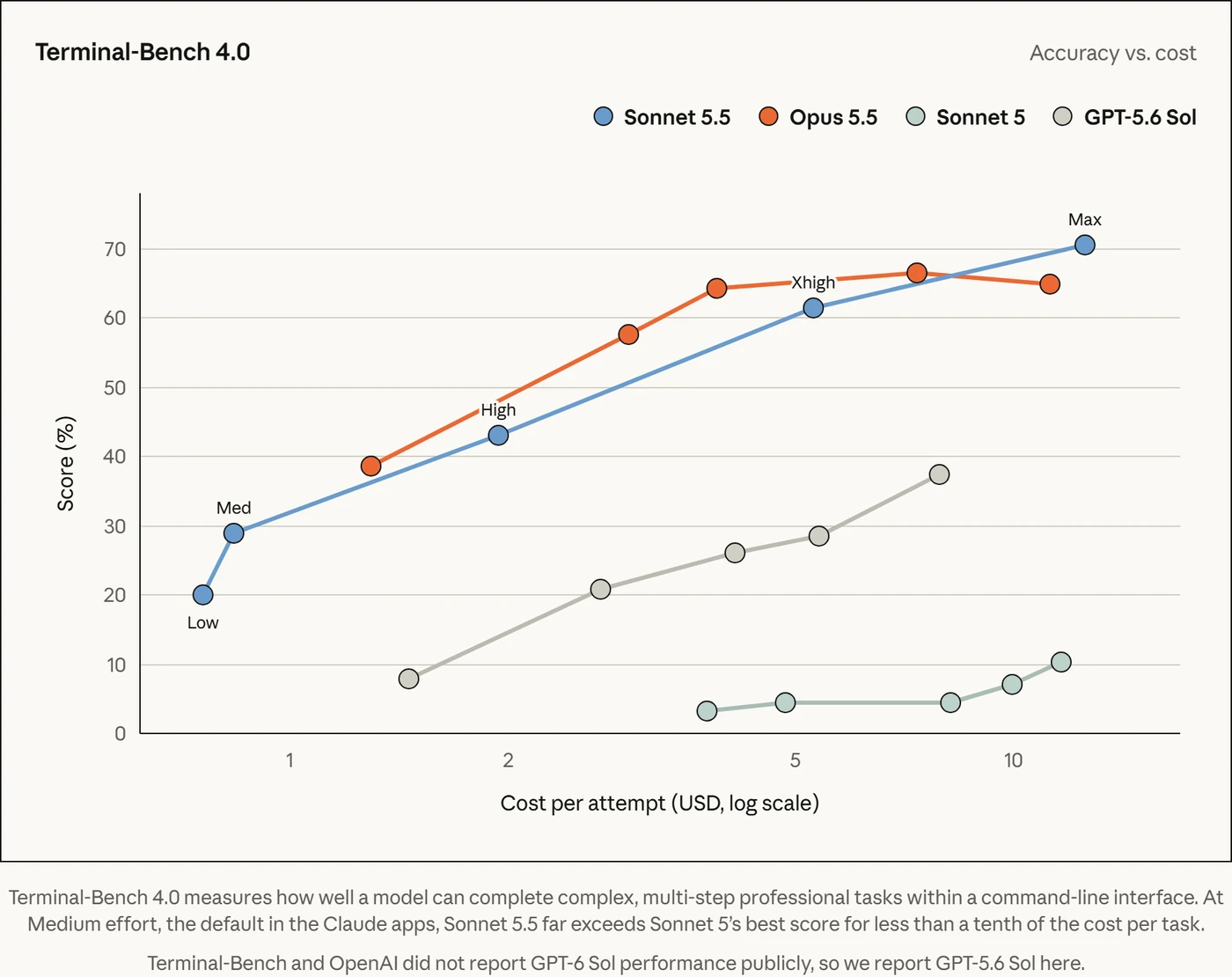
| Effort | Claude Sonnet 5.5 | Claude Opus 5.5 | Claude Sonnet 5 |
|---|---|---|---|
| Low | 20.0% at $0.76 | 38.5% at $1.29 | 3.2% at $3.78 |
| Medium | 28.8% at $0.83 | 57.6% at $2.94 | 4.4% at $4.83 |
| High | 43.0% at $1.94 | 64.2% at $3.88 | 4.5% at $8.20 |
| Xhigh | 61.5% at $5.30 | 66.4% at $7.35 | 7.0% at $9.95 |
| Max | 70.6% at $12.54 | 64.8% at $11.24 | 10.3% at $11.62 |
At Medium effort, the default in the Claude apps, Sonnet 5.5 scores 28.8% for $0.83 an attempt, already far above Sonnet 5’s best of 10.3%, which cost $11.62. That is less than a tenth of the cost. At Max it reaches 70.6%, the top score on the chart.
In the middle, though, Opus 5.5 gives more for the money on this test. Opus 5.5 at High scores 64.2% for $3.88, while Sonnet 5.5 at Xhigh scores 61.5% for $5.30. If your work looks like Terminal-Bench, with long command-line tasks of many steps, compare the two models at the same budget before you default to the cheaper one.
FrontierCode: code changes that get merged
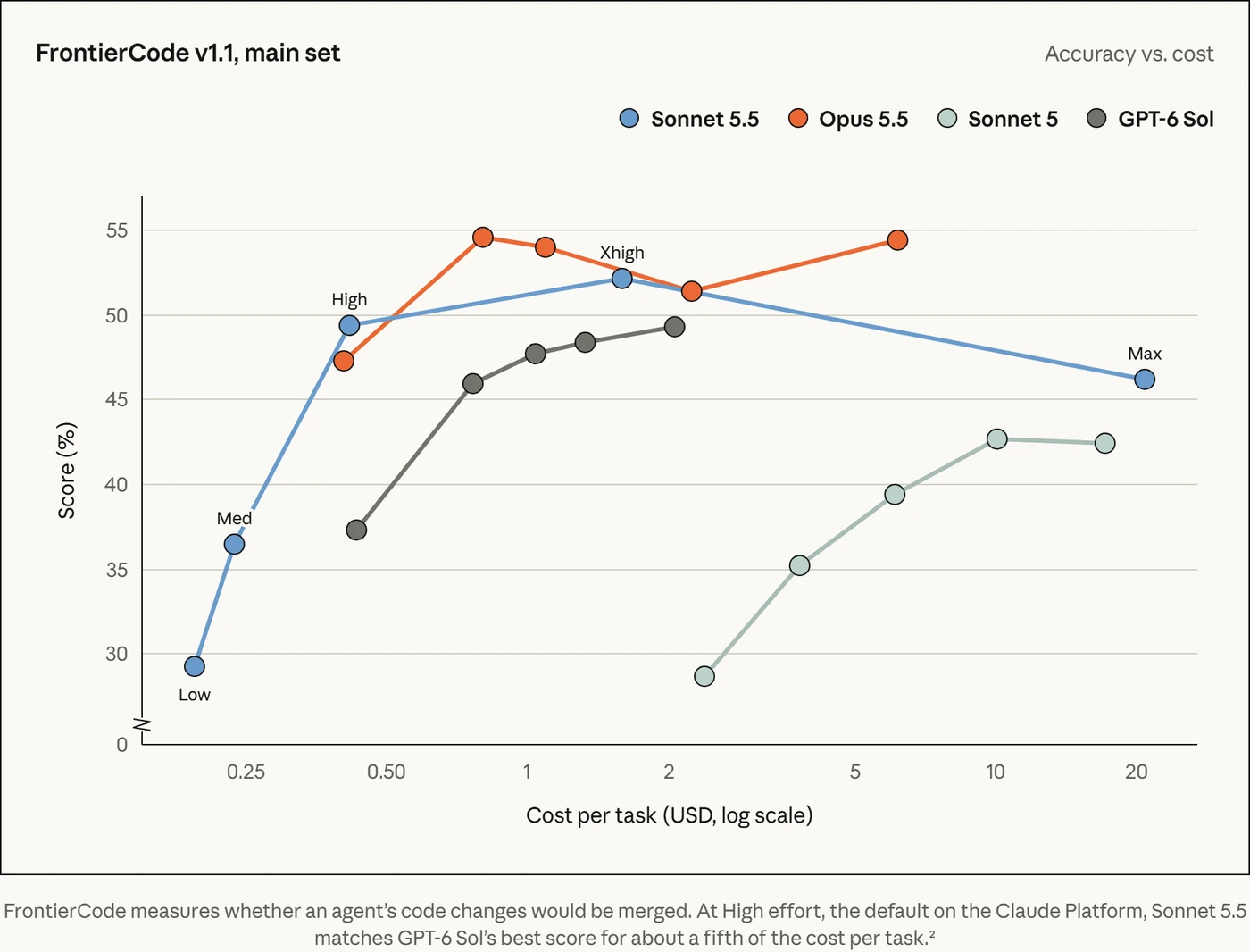
| Effort | Claude Sonnet 5.5 | Claude Opus 5.5 | Claude Sonnet 5 | GPT-6 Sol |
|---|---|---|---|---|
| Low | 29.3% at $0.19 | 47.3% at $0.40 | 28.7% at $2.39 | 37.3% at $0.43 |
| Medium | 36.5% at $0.24 | 54.6% at $0.80 | 35.2% at $3.81 | 45.9% at $0.77 |
| High | 49.4% at $0.42 | 54.0% at $1.09 | 39.4% at $6.10 | 47.7% at $1.04 |
| Xhigh | 52.1% at $1.59 | 51.4% at $2.25 | 42.7% at $10.07 | 48.4% at $1.32 |
| Max | 46.2% at $20.78 | 54.4% at $6.19 | 42.4% at $17.12 | 49.3% at $2.07 |
This is where Sonnet 5.5 is cheapest. At High effort, the API default, it scores 49.4% for $0.42 a task, level with GPT-6 Sol’s best of 49.3%, which costs $2.07, so about a fifth of the cost. Against Sonnet 5 at the same High setting, it scores 10 points higher at about a fifteenth of the cost.
Two cautions. Max effort does not help here: Sonnet 5.5 drops to 46.2% and costs $20.78 a task, for the reason in the fine print above. And Opus 5.5 at Medium, 54.6% for $0.80, beats Sonnet 5.5’s best score for about half of what Sonnet 5.5 spends at Xhigh. For merge-ready code changes, Sonnet 5.5 at High is the budget pick and Opus 5.5 at Medium is the value pick.
CursorBench 4.0: real coding sessions
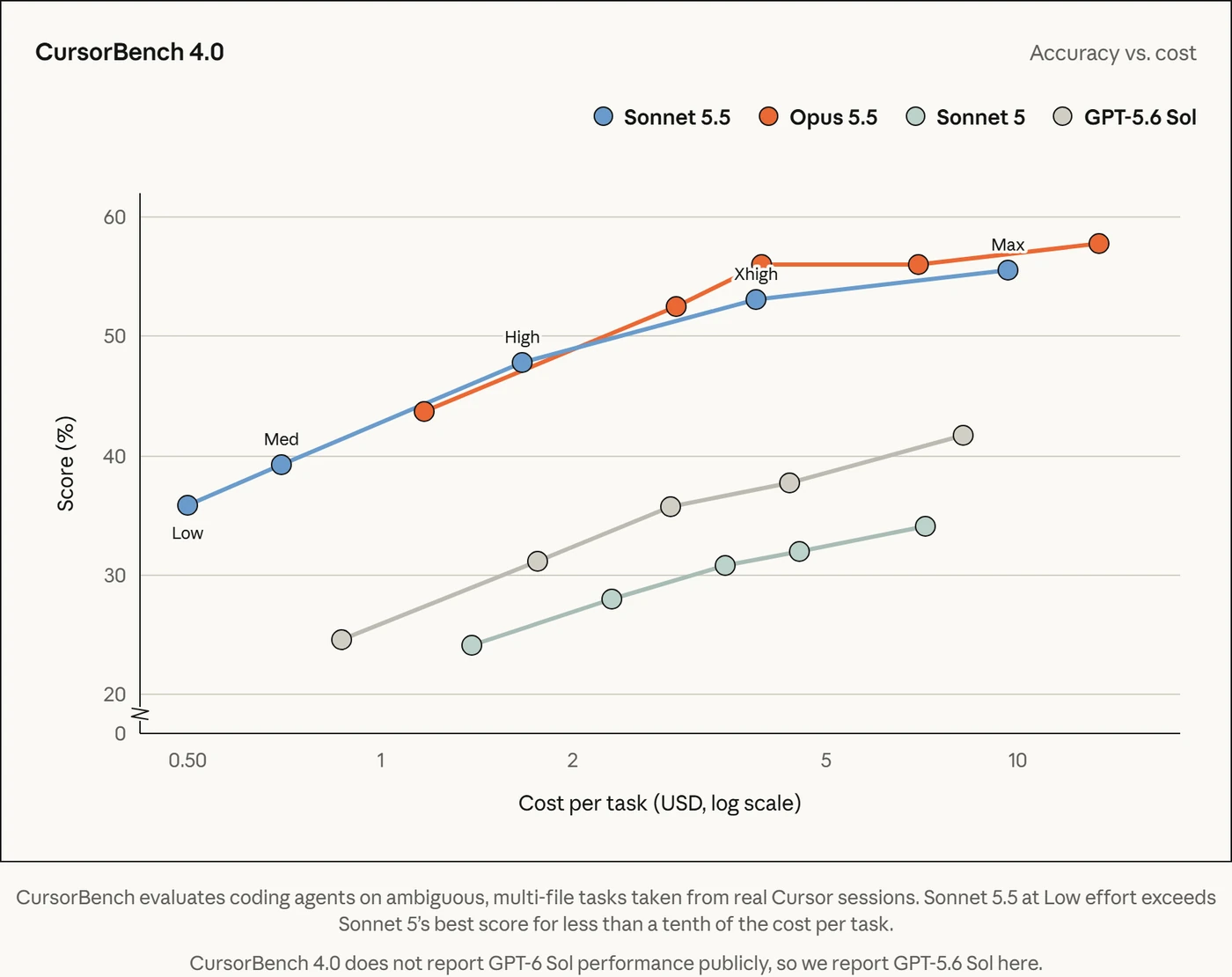
| Effort | Claude Sonnet 5.5 | Claude Opus 5.5 | Claude Sonnet 5 |
|---|---|---|---|
| Low | 35.8% at $0.50 | 43.7% at $1.17 | 24.1% at $1.39 |
| Medium | 39.2% at $0.70 | 52.5% at $2.91 | 28.0% at $2.31 |
| High | 47.8% at $1.67 | 56.0% at $3.97 | 30.8% at $3.48 |
| Xhigh | 53.1% at $3.88 | 56.0% at $6.98 | 32.0% at $4.55 |
| Max | 55.5% at $9.67 | 57.8% at $13.43 | 34.1% at $7.17 |
At Low effort, Sonnet 5.5 scores 35.8% for $0.50 a task, already above Sonnet 5’s best of 34.1% at $7.17, again less than a tenth of the cost. Its best score, 55.5% at Max, is within about two points of Opus 5.5’s best.
At the top end, though, the maths favours Opus. Opus 5.5 at High scores 56.0% for $3.97, higher than Sonnet 5.5 at Max for about 40% of the cost. Up to about $2 a task, Sonnet 5.5 is level with or slightly ahead of Opus 5.5; beyond that, Opus 5.5 is the better buy.
AA-Briefcase: long knowledge work
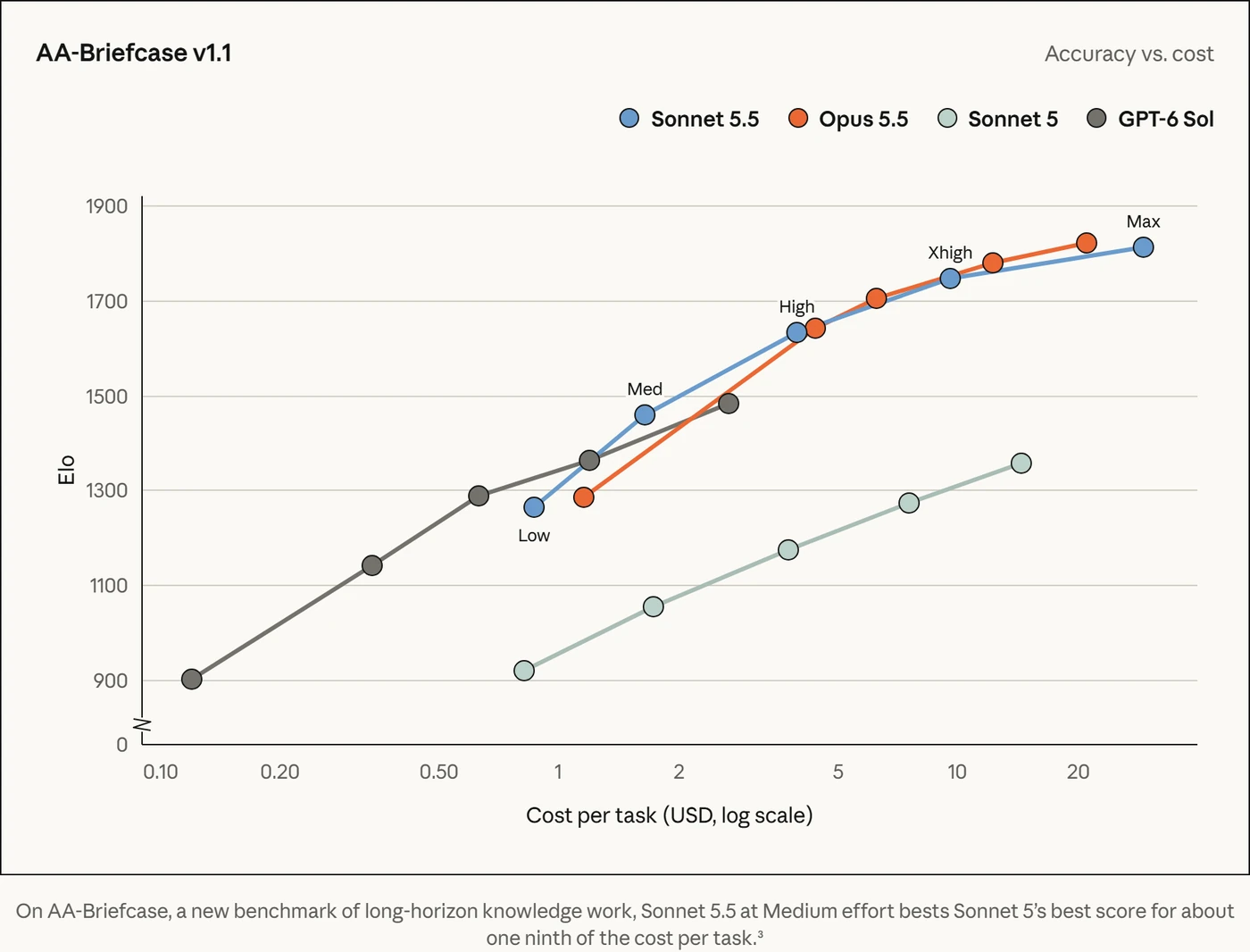
| Effort | Claude Sonnet 5.5 | Claude Opus 5.5 | Claude Sonnet 5 | GPT-6 Sol |
|---|---|---|---|---|
| Low | 1264 at $0.87 | 1285 at $1.15 | 923 at $0.82 | 905 at $0.12 |
| Medium | 1461 at $1.64 | 1642 at $4.40 | 1056 at $1.73 | 1142 at $0.34 |
| High | 1634 at $3.95 | 1705 at $6.27 | 1177 at $3.76 | 1289 at $0.63 |
| Xhigh | 1746 at $9.63 | 1780 at $12.27 | 1274 at $7.56 | 1364 at $1.19 |
| Max | 1811 at $29.19 | 1822 at $21.05 | 1359 at $14.43 | 1483 at $2.67 |
AA-Briefcase is Artificial Analysis’s new test of long-horizon knowledge work, the kind of multi-hour analysis and document work a finance team does. Sonnet 5.5 at Medium reaches 1461 Elo for $1.64 a task, above Sonnet 5’s best of 1359 at $14.43, for about a ninth of the cost. At High, 1634 for $3.95, it roughly matches Opus 5.5 at Medium, 1642 for $4.40.
At Max the picture flips: Opus 5.5 scores higher, 1822 against 1811, and costs less, $21.05 against $29.19 a task. GPT-6 Sol is far cheaper at every level, topping out at 1483 for $2.67, close to what Sonnet 5.5 reaches at Medium for $1.64.
What the four charts say together
Anthropic’s own summary is that Sonnet 5.5 complements Opus 5.5 best at lower effort settings, where it costs less per task, while at higher settings it performs comparably at a similar cost. Our reading of the numbers is a little sharper:
- Low, Medium and High are where Sonnet 5.5 shines. On every chart it beats Sonnet 5’s best score for a small fraction of the cost.
- Before you pay for Xhigh or Max, compare with Opus 5.5. Opus 5.5 at High beats Sonnet 5.5 at Xhigh on Terminal-Bench (64.2% against 61.5%) and on CursorBench (56.0% against 53.1%) for the same or less money, and on AA-Briefcase Opus 5.5 at Max outscores Sonnet 5.5 at Max for about $8 less per task. The exception is Terminal-Bench at Max, where Sonnet 5.5’s 70.6% is the top score.
- Max is not always best. On FrontierCode, Sonnet 5.5 scores less at Max than at Xhigh and costs 13 times as much.
- Simple questions do not need high effort. On general health questions, all five effort levels scored within 0.7 points of each other, while Max took about 36 seconds an answer against 8 to 13 seconds.
- Judge cost per finished task, not price per token. A model that needs fewer tokens and fewer retries can beat a cheaper-per-token one on the real bill.
Claude Sonnet 5.5 pricing and what a month costs
The price per token is exactly what Sonnet 5 costs, and exactly half of Opus 5.5 for input, output and cache writes. Since 7 October 2026, cache reads cost $0.10 per million tokens, also half of Opus 5.5’s $0.20. Here is the full picture, with Anthropic’s cheapest and most expensive current models for context:
| Price per 1M tokens | Input | Output | Cache reads | 5-minute cache writes | Batch (in / out) |
|---|---|---|---|---|---|
| Claude Sonnet 5.5 | $2 | $10 | $0.10 | $2.50 | $1 / $5 |
| Claude Sonnet 5 | $2 | $10 | $0.20 | $2.50 | $1 / $5 |
| Claude Opus 5.5 | $4 | $20 | $0.20 | $5 | $2 / $10 |
| Claude Haiku 4.5 | $1 | $5 | $0.10 | $1.25 | $0.50 / $2.50 |
| Claude Haiku 5.5 | $0.10 | $0.50 | $0.01 | $0.125 | $0.05 / $0.25 |
| Claude Fable 5.1 | $10 | $50 | $0.25 | $12.50 | $5 / $25 |
What a month of work costs
Say your team sends 50 million input tokens and gets back 10 million output tokens in a month, with no caching. Here is what that month costs on five Claude options, before any local taxes:
| Model | Price per 1M (in / out) | Month’s bill |
|---|---|---|
| Claude Fable 5.1 | $10 / $50 | $1,000 |
| Claude Opus 5.5 | $4 / $20 | $400 |
| Claude Sonnet 5.5 | $2 / $10 | $200 |
| Sonnet 5.5 batch | $1 / $5 | $100 |
| Claude Haiku 4.5 | $1 / $5 | $100 |
At the same token count, Claude Sonnet 5.5 halves the bill, saving $200 a month over Opus 5.5 in this example. The real gap depends on the work: the cost charts above show Opus 5.5 sometimes finishing a task with fewer tokens, so compare cost per finished task on your own jobs. Sonnet 5.5 on batch costs the same as Haiku 4.5, which is worth knowing for overnight jobs that do not need an instant answer. Claude Haiku 5.5, released on 7 October, would cost $10 for the same month if the work suits a small model.
Caching, batch and long prompts
- Cache reads cost a twentieth of fresh input. If 40M of those 50M input tokens were the same long material, such as a chart of accounts or a policy manual sent with every request, and came from the cache, input would fall from $100 to $24 (10M at $2 plus 40M at $0.10, the cache-read price since 7 October). The month would come to about $124, plus the cost of writing the cache.
- Caching starts sooner. The smallest prompt that can be cached is 512 tokens, down from 1,024 on Sonnet 5.
- Batch is half price. $1 input and $5 output per million tokens, for work that can wait for its results.
- Long prompts cost the same per token. The full 1M token context is billed at the standard rate, so a 900K token request costs the same per token as a 9K one. GPT-6 Sol has the same $2 and $10 list price, but OpenAI’s model page lists a surcharge of double the input rate and 1.5 times the output rate on prompts over 272K input tokens.
- No fast mode. Anthropic’s pricing page lists fast mode for Opus models only.
What early testers found
Anthropic’s page carries results from early access customers. These are vendor and customer claims, but they are specific enough to be useful:
| Company | What they reported |
|---|---|
| Epic Games | Cleared the quality bar of a higher-tier model on a system design audit and a data flow review, and handled tens of thousands of lines of gameplay code and multi-hour tasks |
| CodeRabbit | Better judgment than Sonnet 5 with far fewer output tokens, so it plans to move simple and moderate code reviews over now |
| SpaceXAI | Measured 55.5% on CursorBench 4.0, second only to Opus 5.5 |
| Base44 | Across 118 real app builds, matched Opus 5’s app quality in 3.6 iterations per build against 7.7, with the fewest failed tool calls of any model it compared |
| Unity | Completed 90% of tasks in its multi-step Unity Editor and coding benchmark, and most of its work passed runtime checks |
| Slack | Beat Sonnet 5 on almost all offline Slackbot tests with no prompt changes, in fewer steps and with about 14% fewer output tokens |
| Zendesk | Made fewer wrong decisions on hundreds of real support cases, and tickets were processed 20% faster |
| Balyasny Asset Management | On 2,441 finance tasks, scored ahead of Sonnet 5 using about 121k tokens per answer against 497k, the best quality-to-cost result of the seven models it ran for high-volume work |
| Box | More accurate than the previous model, 2.4x faster and 12% fewer tokens; it rechecks data in source documents and caught errors Sonnet 5 missed |
| Lovable | A third fewer tool calls and about half the shell runs to finish a coding task |
| Atlassian | Rovo Agents run up to 30% faster than on Sonnet 5 |
Two themes run through almost all of them: the same or better quality with fewer tokens and fewer steps, and noticeably faster turnaround. Tyler Nishida, a designer at Every, summed it up in four words: “Claude Sonnet 5.5 cooks.”
Claude Sonnet 5.5 for finance and accounting teams
Benchmarks are useful, but the real question is what changes at your desk on Monday. Here is how we would use Claude Sonnet 5.5 in a finance or accounting team.
Month-end packs, decks and spreadsheets
This is the work Anthropic says Sonnet 5.5 does best: polished documents, slides and spreadsheets. The 10-slide operating review built from earnings materials is the closest thing in the launch to a finance team’s month-end pack. Give it your trial balance movements, the budget and your slide template, and ask for the commentary and the deck. Then check every number against the books. Our AI prompts for Excel list has ready prompts for the spreadsheet side.
High-volume work at a lower cost
Balyasny Asset Management’s result is the most relevant one for finance: on 2,441 finance tasks covering questions, extraction, analysis and forecasting, Sonnet 5.5 scored ahead of Sonnet 5 while using about 121k tokens per answer against 497k. Fewer tokens means a smaller bill on repetitive work such as classifying bank transactions, drafting vendor follow-ups or summarising contracts. Run that kind of work at Low or Medium effort, and at the batch rate if it can wait overnight. Our AI prompts for accounting are a good place to start.
Checking figures against source documents
Box reports that Sonnet 5.5 rechecks data in source documents and caught errors Sonnet 5 missed, and on OfficeQA, which means finding the right table in long government documents and calculating from it, Sonnet 5.5 scores 76.9%. That points to better support for reconciliations and audit checks. Keep the matching itself in rules or a proper tool, and use the model to explain the exceptions that are left and to draft the follow-ups.
Work in other languages
On GMMLU, a general knowledge test in 42 languages, Sonnet 5.5 scores 92.1%, against 89.2% for Sonnet 5 and 94.3% for Opus 5.5. MILU, which covers ten Indian languages plus English, shows the same pattern at 91.6%. That is good enough for drafting client reminders, payment follow-ups and plain explanations in a client’s own language. Have a fluent speaker review anything formal before it goes out.
Where to be careful
- Its knowledge stops at June 2026. It will not know tax, payment or reporting rules that changed after that. Give it the current rule text, or check the official source yourself.
- Do not let it do the tax arithmetic alone. Use it to explain, draft and check, and let a proper calculator or your accounting system produce the numbers.
- Protect client data. Use a business account with zero data retention where you can, and never paste client data into a personal account.
- A person signs off. Anything that reaches the books, a filing or a client needs human review, however good the draft looks.
For more ideas, see our Claude for finance and accounting guide and the wider AI in finance and accounting guide.
Sonnet 5.5 vs Opus 5.5 vs GPT-6 Sol: which should you use?
| If you need | Our pick | Why |
|---|---|---|
| A default model for everyday work | Claude Sonnet 5.5 | Within 3.2 points of Opus 5.5 on every percentage row of the launch table, at half the price |
| Decks, documents and spreadsheets | Claude Sonnet 5.5 | Anthropic’s named strength for it; its 10-slide review draft was judged ready to send |
| Coding at Low to High effort | Claude Sonnet 5.5 | Beats Sonnet 5’s best on CursorBench and Terminal-Bench for under a tenth of the cost |
| Complex, open-ended work that needs judgment | Claude Opus 5.5 | Anthropic says Opus 5.5 remains clearly stronger here |
| Top effort (xhigh or max) | Claude Opus 5.5 | Often matches or beats Sonnet 5.5 at its top setting for similar or less money |
| The top Terminal-Bench score | Claude Sonnet 5.5 at max | 70.6% against Opus 5.5’s best of 66.4%, though at $12.54 an attempt |
| Very high volume at the lowest price | Claude Haiku 5.5 | $0.10 and $0.50 per 1M tokens for prompts up to 100K, released 7 October 2026 |
| Same price, other vendor | GPT-6 Sol | Same $2 and $10 token price, but Sonnet 5.5 scores higher on GDPval-AA, AA-Briefcase, Chartography and AutomationBench |
If you run Opus 5.5 for everything today, test Sonnet 5.5 on your routine tasks first. For a lot of everyday work it will do the job faster and for half the price. For the full Opus picture, see our Claude Opus 5.5 review.
Claude Sonnet 5.5 vs GPT-6 Sol at the same price
GPT-6 Sol, which OpenAI launched on 22 September 2026, lists the same $2 and $10 per million tokens, so this is a straight contest on quality. On every benchmark in Anthropic’s launch table and system card where both are scored, Claude Sonnet 5.5 comes out ahead at its best setting:
| Claude Sonnet 5.5 | GPT-6 Sol | |
|---|---|---|
| Price per 1M tokens (in / out) | $2 / $10 | $2 / $10 |
| Long prompts | Standard rate across the full 1M context | Surcharge above 272K input tokens |
| Context window | 1M tokens | 1.05M tokens |
| Knowledge cutoff | June 2026 | April 2026 |
| FrontierCode (best run) | 52.1% | 49.3% |
| GDPval-AA (Elo) | 1844 | 1487 |
| AA-Briefcase (Elo) | 1811 | 1483 |
| Chartography, no tools | 61.6% | 53.6% |
| AutomationBench | 44.7% | 32.0% (OpenAI reports 33.2%) |
Two notes. These are Anthropic’s published figures, and OpenAI recently fixed an image bug in GPT-6 Sol that some of the third-party scores may not reflect yet. And GPT-6 Sol is much cheaper per task at low effort on AA-Briefcase, so for bulk, simple work it can still make sense. For the Opus side of this contest, see Claude Opus 5.5 vs GPT-6 Sol; our GPT-6 Sol guide covers Sol on its own.
What changes for developers moving from Sonnet 5
Switching is mostly a one line change, and the price and tokenizer are unchanged, so token counts stay the same. But Anthropic lists five breaking changes that can make existing Sonnet 5 code fail. Read them before you flip the model ID.
| What changed | Claude Sonnet 5 | Claude Sonnet 5.5 |
|---|---|---|
| Model ID | claude-sonnet-5 |
claude-sonnet-5-5 |
| Turning thinking off | disabled |
between_tools (disabled returns a 400 error) |
Forced tool use (any or a named tool) |
Supported | Returns a 400 error |
| Computer use on the Claude API and Google Cloud | computer_20251124 |
computer_toolset_20260801 only |
| Advisor tool | Accepts Opus 4.8, Opus 4.7 and Sonnet 5 advisors | Those return an error; use Opus 5, Opus 5.5, Sonnet 5.5, Fable or Mythos |
| Text between tool calls | Text blocks | Thinking blocks, empty by default |
| Smallest cacheable prompt | 1,024 tokens | 512 tokens |
| Effort on the API | Default High | Default High, levels recalibrated |
| Price per 1M tokens | $2 / $10 | $2 / $10 |
The five breaking changes
- Thinking cannot be set to disabled. A request with
thinking: {"type": "disabled"}now returns a 400 error. To turn off up-front thinking, send the new{"type": "between_tools"}setting instead. It is the lowest thinking level, works at low, medium and high effort, and needs no beta header. Manual thinking budgets also return an error. - Forced tool use is not supported. Setting
tool_choicetoanyor to a named tool returns a 400 error. Keep it onauto, use strict tool use or structured outputs for schema-valid JSON, and say in the prompt when a tool should be used. - Thinking blocks are tied to the model, the conversation and the account. Sonnet 5.5 reads thinking blocks from Sonnet 5, Opus 4.8, Haiku 4.5 and earlier models, but not from Opus 5, Opus 5.5, Fable or Mythos models, and no other model reads Sonnet 5.5’s blocks. For accounts created on or after 31 August 2026, editing anything before a thinking block and replaying it returns an error, so keep conversations append-only.
- The older computer use tool is rejected on the Claude API and Google Cloud. Move from
computer_20251124to thecomputer_toolset_20260801toolset. Amazon Bedrock still accepts the older tool. - The advisor tool accepts fewer advisors. With a Sonnet 5.5 executor, Opus 4.8, Opus 4.7 and Sonnet 5 advisors return an error. Use Opus 5, Opus 5.5, Sonnet 5.5, or a Fable or Mythos model.
Other changes you will notice
- Text between tool calls moves into thinking blocks. Longer notes the model writes between tool calls now come back as thinking blocks, empty by default, so an app that streams them as progress updates can go quiet until you set a display option or switch to
between_tools. - Effort levels are recalibrated. A level no longer produces the same amount of thinking as it did on Sonnet 5, so re-run your effort tests instead of carrying settings over. Anthropic suggests starting at High unless the work is agentic or needs fast replies; Medium for well-specified agentic coding, moving to High for harder or longer tasks; and Medium or Low for chat.
- Five refusal categories. A declined request comes back as a normal response with
stop_reason: "refusal"and a category: cyber, bio, help building competing AI models, reasoning extraction, or general harms. Server-side fallback, in beta, retries cyber and competing-model declines on Sonnet 5.
New features Sonnet 5 did not have
Sonnet 5.5 adds per-message effort (beta), so you can raise or lower effort mid-conversation without losing the prompt cache, plus mid-conversation system messages, mid-conversation tool changes (beta), compaction on demand (beta) and tool definitions inside a message (beta). Batch processing, the Files API, PDF support, vision, structured outputs and the server tools all carry over. The model string change itself is as simple as it gets:
model = "claude-sonnet-5"      # before
model = "claude-sonnet-5-5"    # after
Full details are in Anthropic’s What’s new in Claude Sonnet 5.5 page and the Sonnet 5.5 migration guide.
Claude Sonnet 5.5 safety and data handling
Anthropic says Sonnet 5.5 does not push the frontier of its models’ capabilities, so its safety work focused on risks that apply at any capability level: acting against users’ interests, misleading users and helping with high-stakes misuse. The main points:
- Alignment. On Anthropic’s automated behavioural audit of about 1,850 scenarios, it improves on or matches Sonnet 5 on most measures of alignment, misuse resistance and honesty. Opus 5.5 still does slightly better overall.
- Containment. It comes close to Opus 5.5 in how rarely it tries to escape its sandbox, and it is the least likely of any Anthropic model to probe the limits of its container.
- Prompt injection. The system card calls it Anthropic’s most robust Sonnet-class model yet against prompt injection, especially in coding and browser use.
- Cybersecurity. Its cyber skills are a big step up from Sonnet 5, so it is the first Sonnet to ship with safeguards like Opus 5.5’s. Higher-risk cyber tasks visibly fall back to Sonnet 5, while finding and fixing bugs in your own code works as normal.
- Biology. It uses the same safeguards as Sonnet 5. Most research, education and clinical work is unaffected, and organisations can apply to a Life Sciences Verification Program for wider access.
- Distillation. It is the first Sonnet with classifiers that stop attempts to extract its reasoning, and it expands preserved thinking, so its thinking cannot be separated from the account that created it.
- Scaling policy. Anthropic’s Responsible Scaling Policy tests found it broadly less capable than Opus 5.5, and it does not cross any new thresholds.
- Data handling. Zero data retention is available, as with Opus 5.5 and Sonnet 5.
Anthropic is candid about the limits too. No set of tests catches every failure, it says, and the system card notes that Sonnet 5.5’s thinking is harder to read than that of many earlier models. For finance work, the prompt injection gains matter most: an assistant that reads supplier emails and PDF invoices is safer when hidden instructions inside those documents are less likely to work. Keep payment approvals with a person anyway.
How to start using Claude Sonnet 5.5
- In the Claude apps: pick Sonnet 5.5 from the model menu. The default effort is Medium.
- In Claude Code: choose Sonnet 5.5 as your model. It also defaults to Medium effort, which suits everyday coding. Our Claude Code tutorial helps if you are new to it.
- Through the API: change your model string to
claude-sonnet-5-5, check the five breaking changes above, and set effort explicitly, since the API defaults to High. See Claude API pricing for the full price list. - Through a cloud provider: it is on Amazon Bedrock as
anthropic.claude-sonnet-5-5, and on Claude Platform on AWS, Google Cloud and Microsoft Foundry asclaude-sonnet-5-5. - Test on real work: run ten of your own past tasks through Sonnet 5.5 and Opus 5.5 at the same effort, and compare both the output and the cost per task.
What came next
Claude Haiku 5.5 joined the Claude 5.5 family on 7 October 2026. It costs $0.10 per million input tokens and $0.50 per million output tokens for prompts up to 100,000 tokens, a twentieth of Sonnet 5.5’s price, and it is built for high-volume work such as classification, extraction, summaries and subagent jobs. Our Claude Haiku 5.5 review has every benchmark and cost chart. The same day, Anthropic halved Sonnet 5.5’s cache-read price to $0.10 per million tokens, which makes Sonnet 5.5 around 20% cheaper on most agentic work. Anthropic has also committed to keeping Sonnet 5.5 available until at least 28 September 2027 on the platforms it runs, which helps if you are building something that needs a stable model.
Key takeaways
- Claude Sonnet 5.5 launched on 28 September 2026 at $2 input and $10 output per million tokens, the same as Sonnet 5 and half of Opus 5.5, with a 1M token context window.
- It scores 70.6% on Terminal-Bench 4.0, ahead of Opus 5.5’s 66.4%, and 1844 Elo on GDPval-AA, two points behind Opus 5.5.
- Opus 5.5 still leads seven of the eight launch rows, but by 3.2 points or less on every percentage row.
- At Low to High effort, Sonnet 5.5 beats Sonnet 5’s best scores for a fraction of the cost. At Xhigh and Max, Opus 5.5 is often the better buy.
- For finance teams it is a strong default for decks, spreadsheets, document checks and high-volume drafting, with a person still signing off.
- Developers must handle five breaking changes, including the new
between_toolsthinking setting and no forced tool use. - GPT-6 Sol costs the same per token, but Claude Sonnet 5.5 scores higher on GDPval-AA, AA-Briefcase, Chartography and AutomationBench, and on FrontierCode at its best setting.
Please note: we update this page from time to time, but AI models, prices and benchmark results change quickly, and there can be a gap between a change and our update. Check Anthropic’s official pages before you act. This guide helps you compare and estimate; it is not legal, tax or investment advice, and ReconScribe is not responsible for decisions made on it.
Claude Sonnet 5.5: frequently asked questions
What is Claude Sonnet 5.5?
Claude Sonnet 5.5 is Anthropic's newest Sonnet model, released on 28 September 2026 as the second model in the Claude 5.5 family. It is the faster, lower-cost partner to Claude Opus 5.5 and is strongest at well-scoped everyday tasks, fixing bugs, and producing documents, slides and spreadsheets.
How much does Claude Sonnet 5.5 cost?
On the API it costs $2 per million input tokens and $10 per million output tokens, the same as Sonnet 5. Cache reads are $0.10 per million tokens since 7 October 2026 (previously $0.20), 5-minute cache writes are $2.50 and 1-hour cache writes are $4. Batch processing is half price at $1 and $5.
What is the Claude Sonnet 5.5 model ID?
The model ID is claude-sonnet-5-5 on the Claude API, Claude Platform on AWS, Google Cloud and Microsoft Foundry. On Amazon Bedrock it is anthropic.claude-sonnet-5-5.
What is the Claude Sonnet 5.5 context window?
Claude Sonnet 5.5 has a 1M token context window, billed at the standard rate across the whole window, and up to 128K output tokens, or 300K on the Batches API with a beta header. Its reliable knowledge cutoff is June 2026.
Is Claude Sonnet 5.5 better than Claude Opus 5.5?
Not overall. Opus 5.5 leads seven of the eight rows in Anthropic's launch table, but Sonnet 5.5 is within 3.2 points on every percentage row and beats Opus 5.5 on Terminal-Bench 4.0, 70.6% against 66.4%. Sonnet 5.5 costs half as much per token, while Anthropic says Opus 5.5 remains clearly stronger at complex, open-ended work.
Is Claude Sonnet 5.5 better than GPT-6 Sol?
On the benchmarks where Anthropic reports both, yes. Sonnet 5.5 scores 1844 Elo on GDPval-AA against 1487, 1811 on AA-Briefcase against 1483, and 61.6% on Chartography against 53.6%. Both cost $2 and $10 per million tokens. These are vendor-published figures, so test on your own work.
How much better is Claude Sonnet 5.5 than Sonnet 5?
A lot. Terminal-Bench 4.0 rises from 10.3% to 70.6%, GDPval-AA from 1449 to 1844 Elo, and OSWorld computer use from 57.0% to 80.1%. It also writes output more than 30% faster and costs up to 30% less per task, at the same price per token.
What is the default effort level for Claude Sonnet 5.5?
Medium in the Claude apps and Claude Code, and High on the Claude API. You can choose low, medium, high, xhigh or max. The levels are recalibrated, so a setting that suited Sonnet 5 may not suit Sonnet 5.5.
Can I turn thinking off on Claude Sonnet 5.5?
Not with the old disabled setting, which now returns an error. Use the new between_tools setting instead. It turns off up-front thinking, works at low, medium and high effort, and still returns short progress notes between tool calls.
Does Claude Sonnet 5.5 have a fast mode?
No. Anthropic's pricing page lists fast mode for Opus models only. Sonnet 5.5 is already more than 30% faster than Sonnet 5 at its standard price.
Is Claude Sonnet 5.5 good for accounting and finance work?
It is a strong default for decks, spreadsheets, commentary, document checks and high-volume drafting, and it scores 92.1% on GMMLU across 42 languages. Its knowledge stops at June 2026, so check newer rules yourself, keep client data in a business account, and have a person review anything that reaches the books, a filing or a client.
Is Claude Haiku 5.5 out yet?
Yes. Anthropic released Claude Haiku 5.5 on 7 October 2026 at $0.10 per million input tokens and $0.50 per million output tokens for prompts up to 100,000 tokens. It is built for high-volume, cost-sensitive work, while Sonnet 5.5 stays the stronger choice for agentic coding and complex documents.
Related reading
- Claude Haiku 5.5: benchmarks, pricing and best uses
- Claude Opus 5.5: benchmarks, pricing and how it compares
- Claude Opus 5.5 vs GPT-6 Sol
- GPT-6 Sol guide
- GPT-6 Astra vs Claude Fable 5.1: best fit and real cost
- Best AI models in India for finance workflows
- Claude Code tutorial for finance teams
- Claude for Startups: free Claude Team and API credits
- AI prompts for finance
Sources
- Anthropic: Introducing Claude Sonnet 5.5
- Claude Sonnet 5.5 system card
- What's new in Claude Sonnet 5.5
- Claude Sonnet 5.5 migration guide
- Claude models overview
- Claude API pricing
- GPT-6 Sol model page (OpenAI API docs)