
Claude Opus 5.5 is the rare upgrade that costs less. It beats Claude Opus 5 on every benchmark in the launch table, matches Claude Fable 5.1 on most work, and still comes in 20% cheaper per token than the model it replaces.
Anthropic released it on 22 September 2026 as the first model in the Claude 5.5 family, at $4 per million input tokens and $20 per million output tokens. It takes the top agentic coding score with 66.4% on Terminal-Bench 4.0, well clear of GPT-6 Astra’s 57.9%, and reaches 1846 Elo on GDPval-AA, the test built on real professional work, against Astra’s 1542. It writes more than 30% faster than Opus 5 and costs 40% less to run on a typical workload.
OpenAI launched GPT-6 Sol the same day at half the price, $2 and $10 per million tokens, but Opus 5.5 still scores higher on the benchmarks both companies report.
Claude Opus 5.5: the short answer
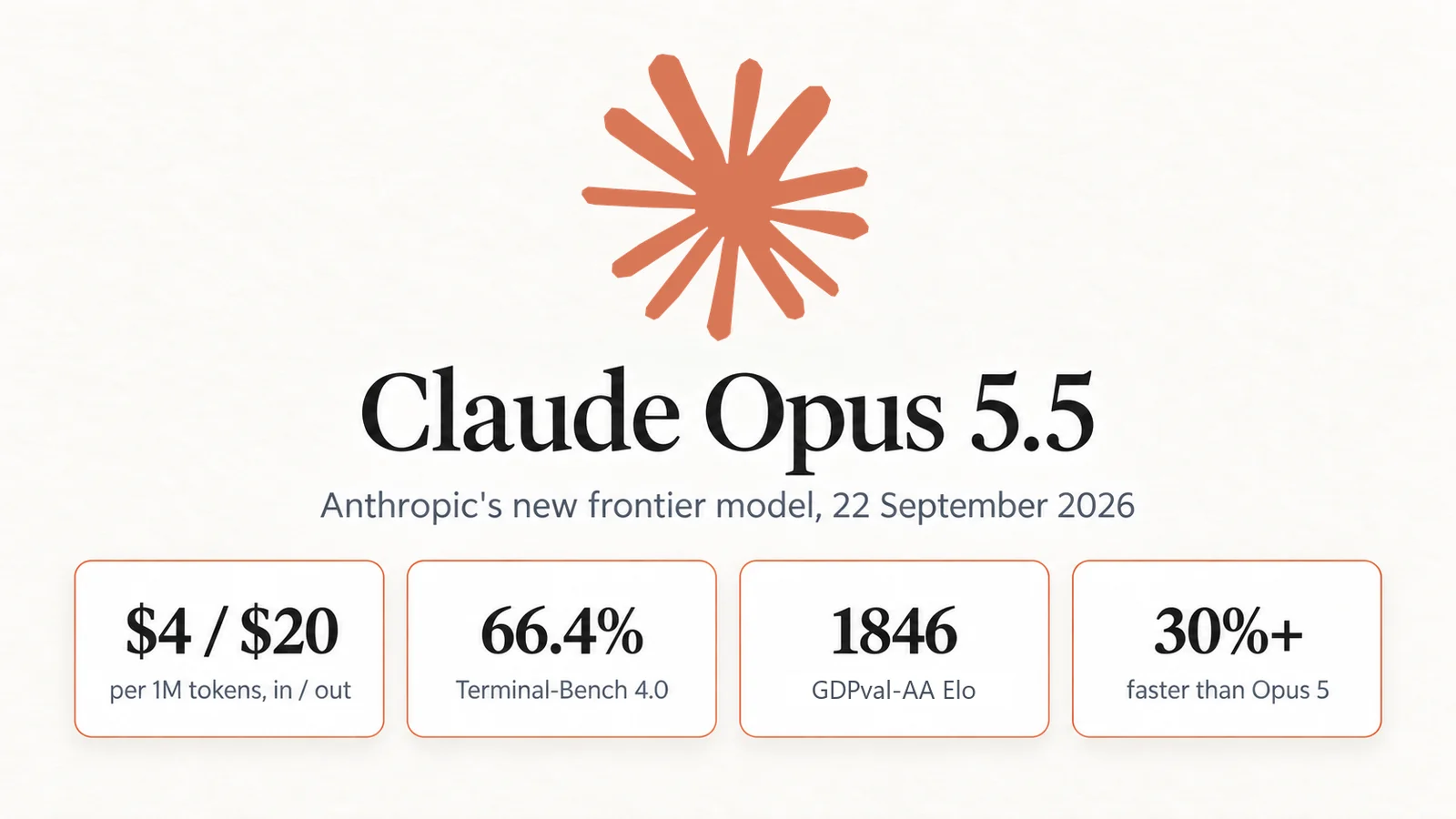
| Fact | Claude Opus 5.5 |
|---|---|
| Released | 22 September 2026 |
| Family | First model in the Claude 5.5 family. Claude Sonnet 5.5 followed on 28 September and Claude Haiku 5.5 on 7 October |
| Model ID | claude-opus-5-5 (Amazon Bedrock: anthropic.claude-opus-5-5) |
| Where you can use it | Claude apps, Claude API, Amazon Bedrock, Claude Platform on AWS, Google Cloud, Microsoft Foundry |
| Input / output price | $4 / $20 per 1M tokens (Opus 5: $5 / $25) |
| Cache reads | $0.20 per 1M tokens (Opus 5: $0.50) |
| Cache writes | $5 per 1M tokens for 5 minutes, $8 for 1 hour |
| Batch processing | Half price: $2 / $10 per 1M tokens |
| Fast mode | $8 / $40 per 1M tokens, up to 2.5x speed |
| Context window | 1M tokens |
| Max output | 128K tokens |
| Reliable knowledge cutoff | June 2026 |
| Thinking | Adaptive thinking, always on |
| Effort levels | low, medium, high, xhigh, max. Default is medium (Opus 5 defaulted to high) |
| Speed | Generates output more than 30% faster than Opus 5 |
| Typical cost change | 40% less than Opus 5 on typical workloads at default settings |
What Claude Opus 5.5 actually is
Anthropic’s lineup has had two top tiers for a while. Opus is the strong, general model most paying users reach for. Fable sits above it as the most capable and most expensive option, at $10 per million input tokens and $50 per million output tokens. Opus 5.5 closes most of the gap between the two.
For a live ranking of Claude Opus 5.5 against every other major model, by test, price and speed, see our AI leaderboard.
Anthropic’s own developer docs now say it plainly: if you are unsure which model to use, start with Claude Opus 5.5 for most workloads, and move to Fable 5.1 for demanding reasoning and long agentic work, or when Opus 5.5 at higher effort still falls short. That is a big shift. For a lot of teams, the job they sent to Fable 5.1 because Opus 5 was not quite good enough can now run on a model that costs 60% less per token.
Four changes matter most:
- Better at long, messy, multi-step work. The biggest gains are in agentic coding and in real business tasks that take many steps, not in simple chat.
- Cheaper per token and per task. Every line of the price table dropped. Cache reads fell 60%, and the model also uses fewer tokens to finish the same job, which is where the 40% saving comes from.
- Faster. Output comes back more than 30% faster than Opus 5, and fast mode goes up to 2.5x speed if you pay for it.
- Clearer writing. Testers say it puts the most important information first, uses less jargon and follows the writing rules you give it. We show Anthropic’s side by side example further down.
One honest line from Anthropic is worth repeating before we get to the numbers. At this level of capability, it says, benchmark margins have become a less reliable guide to real-world differences, and in its own use the gap between Opus 5.5 and Fable 5.1 is narrower than the scores suggest. We agree with that framing. Read the tables for direction, then test on your own work.
Claude Opus 5.5 explained like you’re 5
Imagine you have a very clever helper who can read, write, do sums and build things on a computer. Last year you had a good helper called Opus 5. You also had a super helper called Fable, but Fable asked for a lot more pocket money for every job.
Now there is a new helper called Opus 5.5. It is nearly as clever as Fable. It works faster than Opus 5, and it asks for less pocket money than Opus 5 did. When you give it a big job with lots of steps, like tidying a whole toy room, it is much better at finishing without getting lost halfway, and it tells you clearly what it did.
There is one rule that never changes. Even a very clever helper can make mistakes, so a grown up still checks the homework before it goes to school.
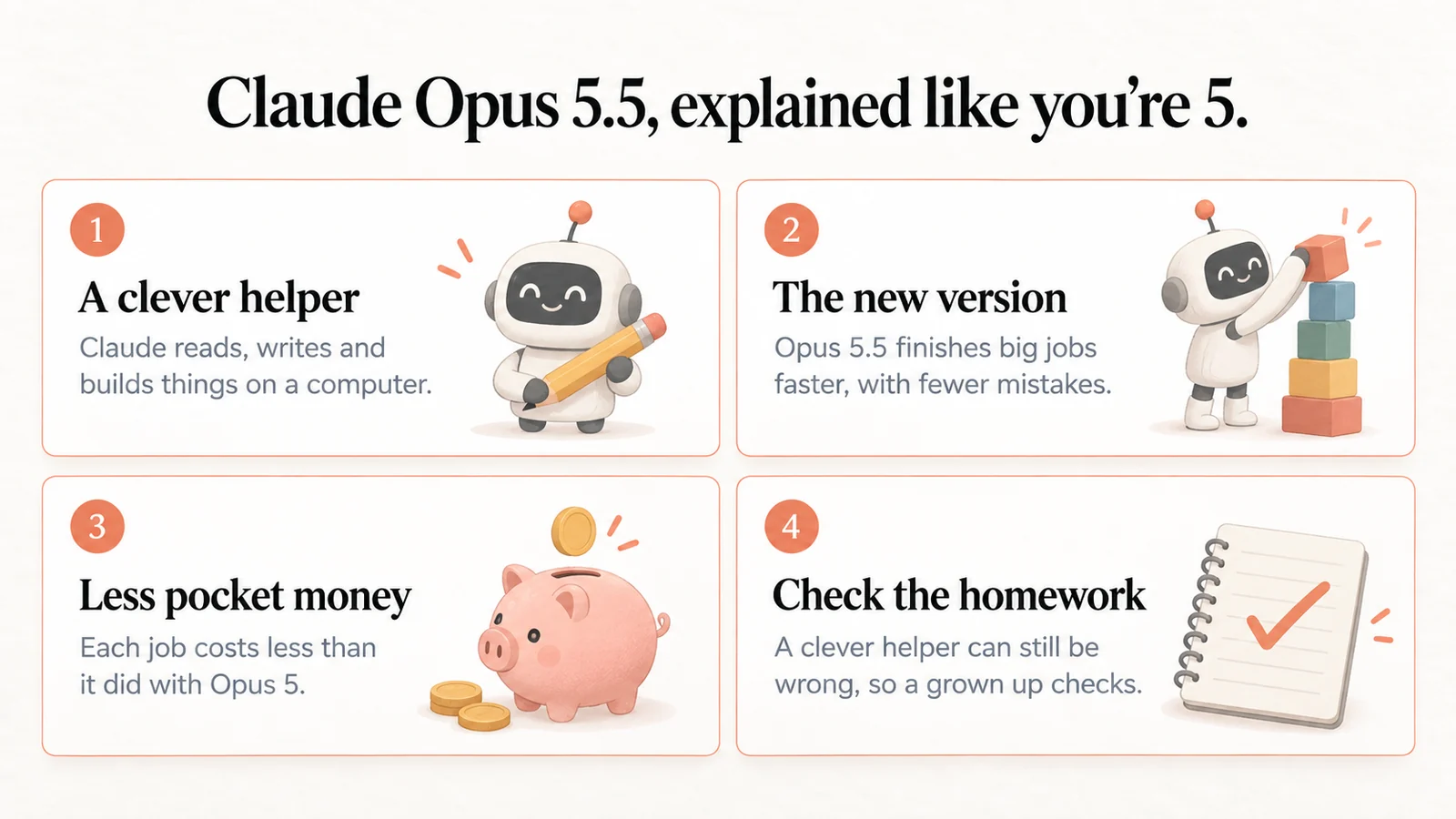
That is really the whole story. The rest of this guide is the grown up version, with the numbers.
Claude Opus 5.5 benchmarks: the full official table
Here is the benchmark table exactly as Anthropic published it. The orange column is Opus 5.5. The grey cells are the two rows where a rival scored higher.
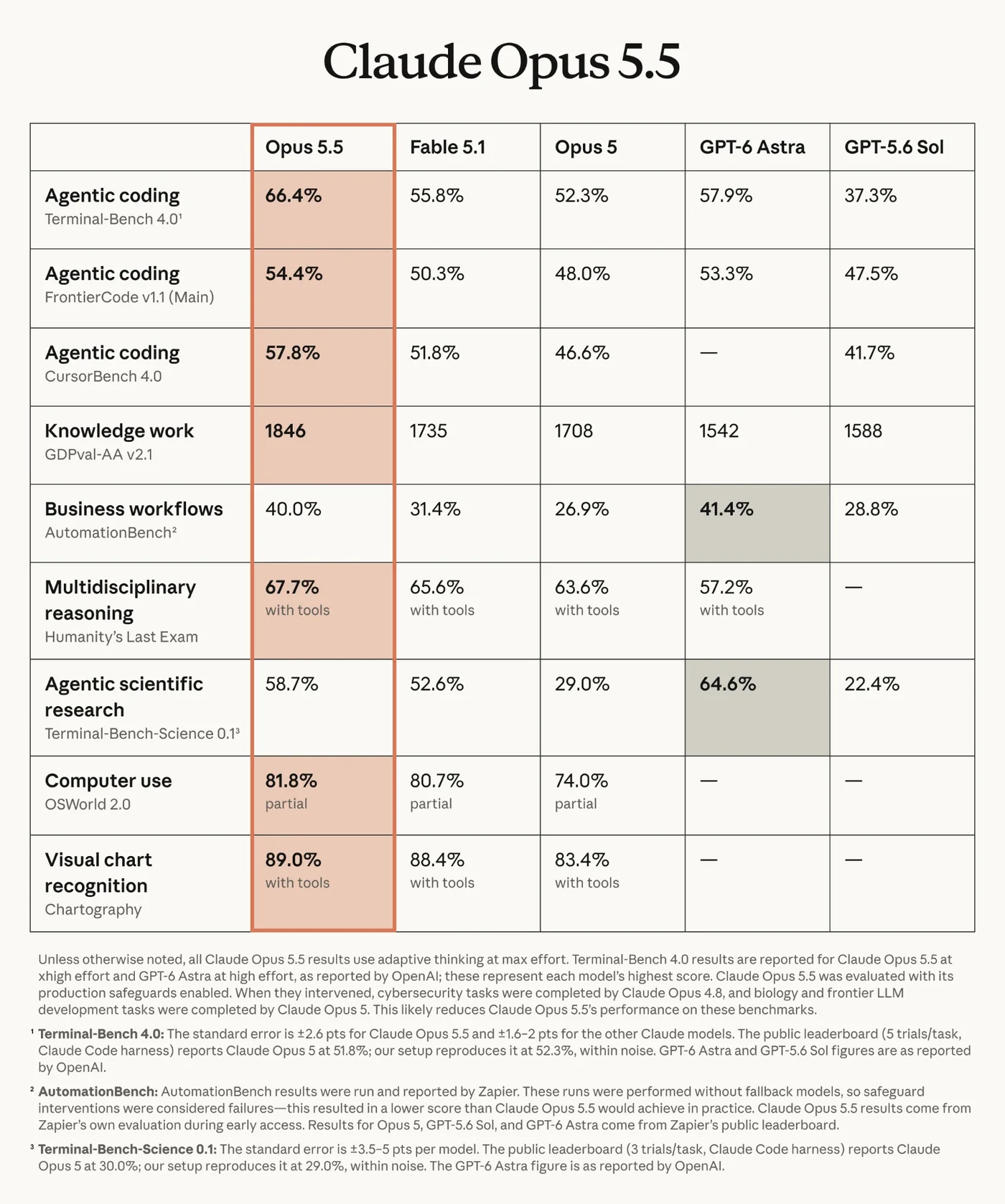
The same numbers as text, so they are easy to search and compare. Anthropic’s charts also include GPT-5.6 Sol, OpenAI’s previous Sol model. We have left it out of our own tables and cards, because the Sol model that matters now is GPT-6 Sol, covered below.
| Benchmark | What it tests | Opus 5.5 | Fable 5.1 | Opus 5 | GPT-6 Astra |
|---|---|---|---|---|---|
| Terminal-Bench 4.0 | Agentic coding in a terminal | 66.4% | 55.8% | 52.3% | 57.9% |
| FrontierCode v1.1 (Main) | Whether an agent’s code changes would be merged | 54.4% | 50.3% | 48.0% | 53.3% |
| CursorBench 4.0 | Ambiguous multi-file coding from real Cursor sessions | 57.8% | 51.8% | 46.6% | not reported |
| GDPval-AA v2.1 | Real professional work across 44 occupations (Elo) | 1846 | 1735 | 1708 | 1542 |
| AutomationBench | Business workflows across connected apps (Zapier) | 40.0% | 31.4% | 26.9% | 41.4% |
| Humanity’s Last Exam | Multidisciplinary reasoning, with tools | 67.7% | 65.6% | 63.6% | 57.2% |
| Terminal-Bench-Science 0.1 | Agentic scientific research | 58.7% | 52.6% | 29.0% | 64.6% |
| OSWorld 2.0 | Computer use (partial) | 81.8% | 80.7% | 74.0% | not reported |
| Chartography | Reading charts, with tools | 89.0% | 88.4% | 83.4% | not reported |
Where Claude Opus 5.5 clearly leads
The standout number is Terminal-Bench 4.0. Opus 5.5 scores 66.4%, which is 8.5 points above GPT-6 Astra and more than 10 points above Fable 5.1. Terminal-Bench measures whether a model can finish complex, multi-step professional tasks in a command line on its own, which is close to how tools like Claude Code are used every day.
The second big one is GDPval-AA, Artificial Analysis’s test of real professional work across 44 occupations: reports, analyses, documents and the like. Opus 5.5 reaches an Elo of 1846. GPT-6 Astra sits at 1542. That is a wide gap on the benchmark closest to ordinary office and finance work.
Humanity’s Last Exam, a very hard multidisciplinary reasoning test, is also a clear lead at 67.7% against 57.2% for GPT-6 Astra.
Where GPT-6 Astra still wins
Two rows go to OpenAI. On AutomationBench, Zapier’s test of business workflows across many connected apps, GPT-6 Astra scores 41.4% against 40.0%. That is close, and Anthropic points out that Zapier ran Opus 5.5 without fallback models, so any time a safeguard stepped in it counted as a failure. On Terminal-Bench-Science, GPT-6 Astra leads more clearly, 64.6% against 58.7%.
We like that Anthropic shaded its own losses in grey rather than leaving them out. It makes the rest of the table easier to trust.
The fine print that matters
- Opus 5.5 results use adaptive thinking at max effort, except Terminal-Bench 4.0, where the best score came at xhigh. GPT-6 Astra is shown at high effort, as reported by OpenAI.
- Opus 5.5 was tested with its production safeguards switched on. When they stepped in, cybersecurity tasks were completed by Claude Opus 4.8, and biology and frontier AI development tasks by Claude Opus 5. Anthropic says this likely lowers Opus 5.5’s scores.
- The standard error on Terminal-Bench 4.0 is plus or minus 2.6 points for Opus 5.5, and 3.5 to 5 points per model on Terminal-Bench-Science. Gaps smaller than that are not real wins.
- Anthropic reproduced the public leaderboard scores for Opus 5 within noise (52.3% against 51.8% on Terminal-Bench 4.0, 29.0% against 30.0% on Terminal-Bench-Science), which is a useful sanity check on its setup.
Opus 5.5 vs GPT-6 Astra vs GPT-6 Sol: the scorecards
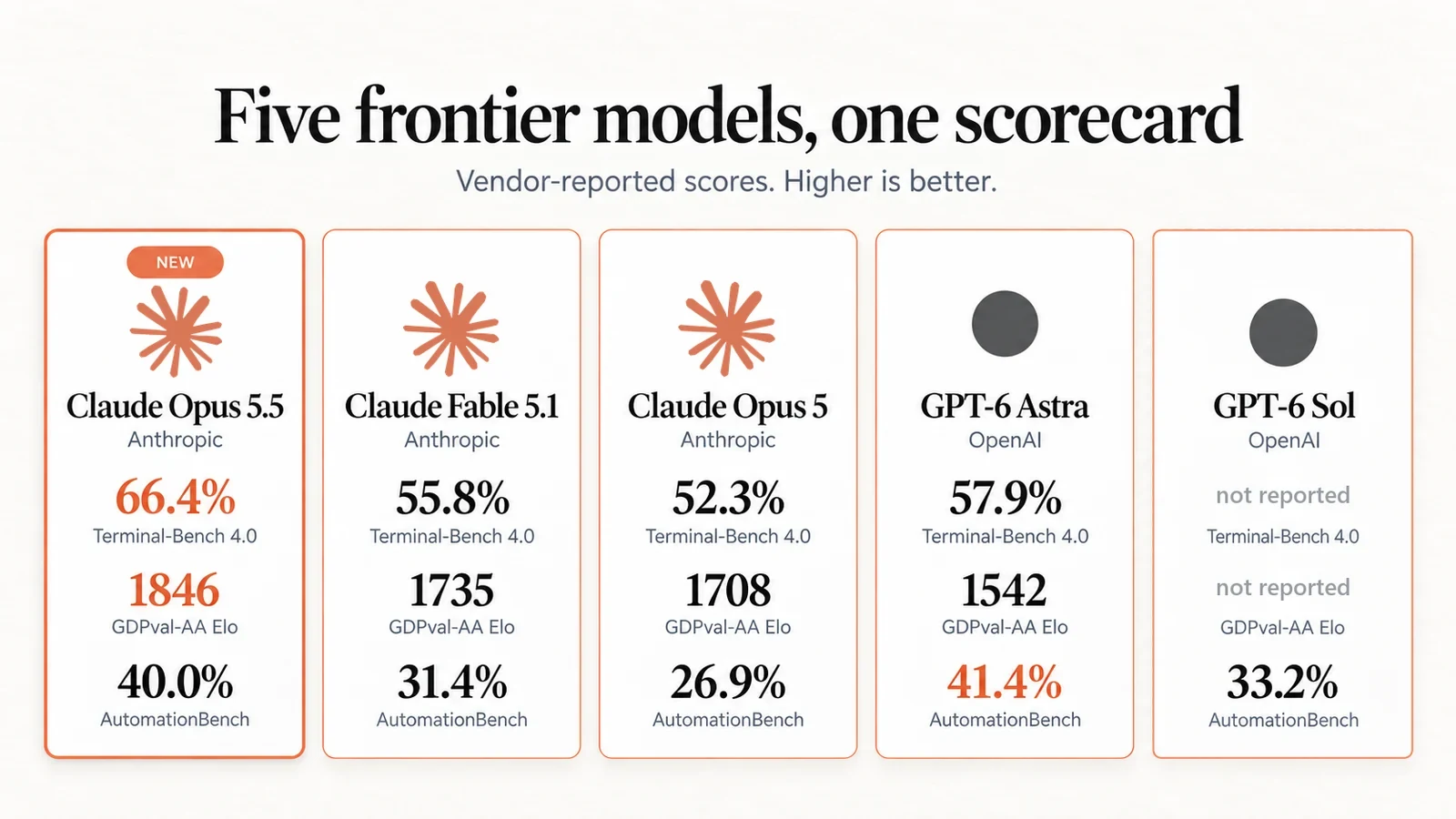
We turned the headline rows into one card per model, so you can see each profile at a glance. The fifth card is GPT-6 Sol, with the scores OpenAI published at launch.
How GPT-6 Sol compares
OpenAI launched GPT-6 Sol alongside GPT-6 Luna on 22 September 2026, the same day as Opus 5.5, and priced Sol at half of Opus 5.5. On the two benchmarks both companies report, Opus 5.5 is ahead:
| Claude Opus 5.5 | GPT-6 Sol | |
|---|---|---|
| Price per 1M tokens (in / out) | $4 / $20 | $2 / $10 |
| AutomationBench (best run) | 40.0% | 33.2% |
| FrontierCode (best run) | 54.6% | 49.3% |
| Context window | 1M tokens | 1.05M tokens |
| Knowledge cutoff | June 2026 | April 2026 |
FrontierCode is the telling one. Opus 5.5 reaches 54.6% at its default medium effort for under $1 a task, while GPT-6 Sol’s best run is 49.3% at $2.14 a task, so the lower token price does not make Sol cheaper on that job. Sol pays off on high-volume work that does not need the top score.
For the full side by side, see Claude Opus 5.5 vs GPT-6 Sol. Our GPT-6 Sol guide covers Sol and Luna on their own.
Claude Opus 5.5 by effort level: the cost charts
The single table hides the most useful part of this launch. Anthropic also published charts that plot each model’s score against the cost of running one task, at every effort level. These show what you actually get for your money, not just who wins at the very top.
One detail to keep in mind while reading them: the default effort on Opus 5.5 is medium. So the medium point on each orange line is what you get if you change nothing.
Agentic terminal coding (Terminal-Bench 4.0)
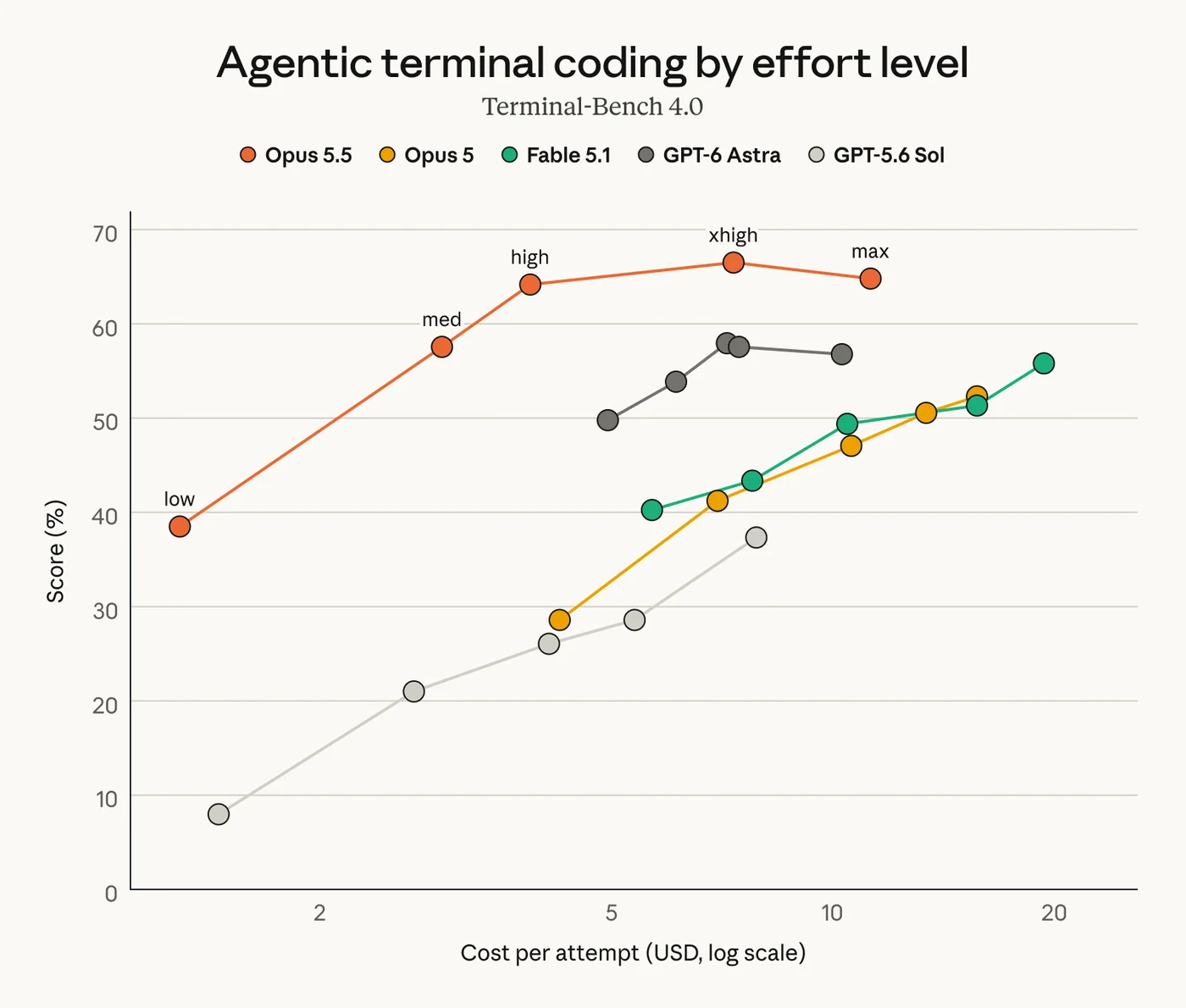
This is the most striking chart. According to Anthropic, Opus 5.5 at default effort beats Opus 5 at max effort for about a fifth of the cost, and matches GPT-6 Astra for about 40% of the cost. Reading the chart, Opus 5.5 at medium lands near 58% at roughly $3 an attempt, while GPT-6 Astra needs around $7 to reach the same level and Fable 5.1 needs close to $20 to reach 56%. The whole orange line sits above and to the left of the others, which means better results for less money.
Real knowledge work (GDPval-AA)
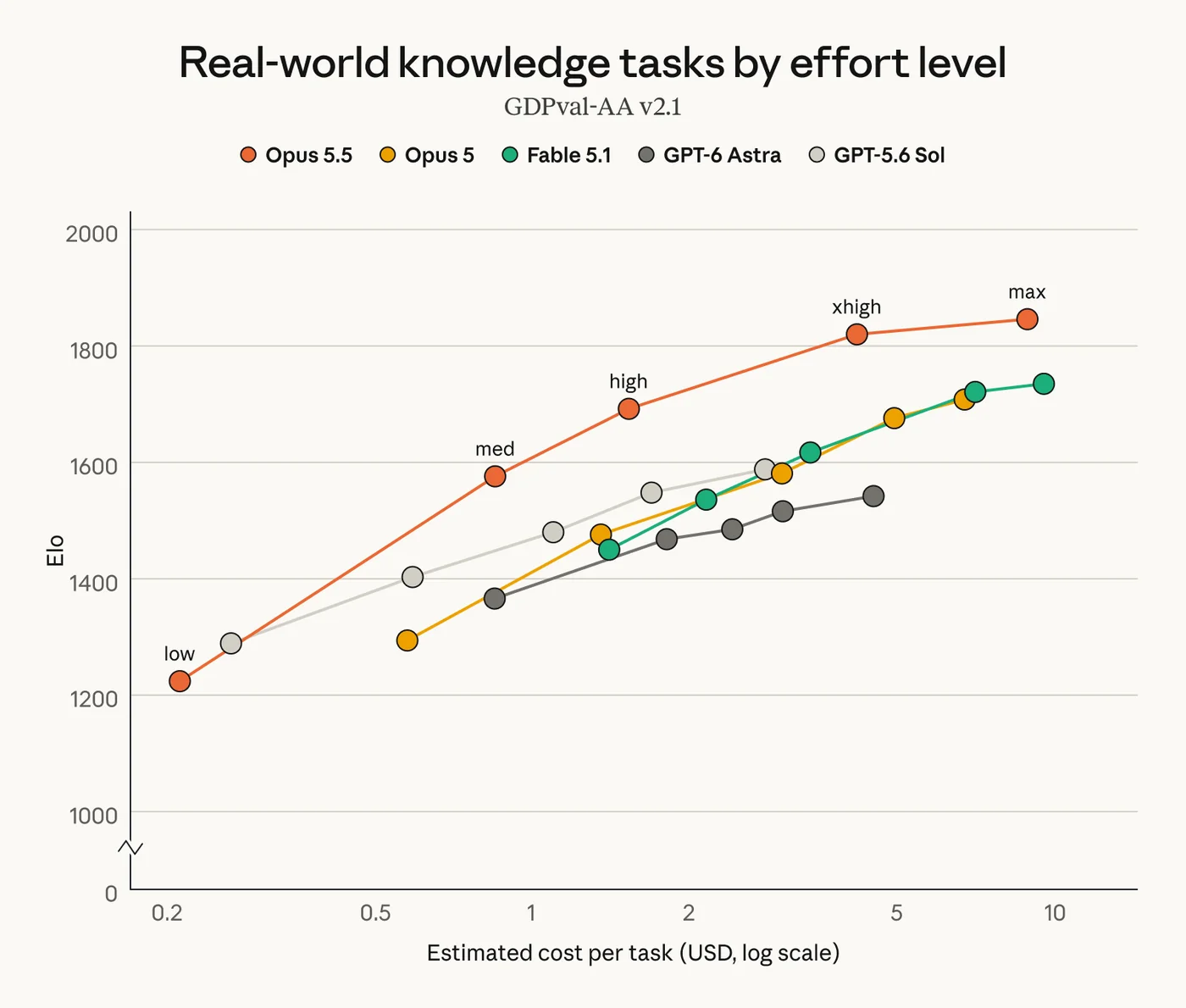
For finance teams this is the chart that matters most, because GDPval-AA is built around the kind of work analysts and accountants produce. Anthropic says Opus 5.5 at default medium effort beats GPT-6 Astra at max effort for about a fifth of the cost per task. On the chart, medium sits near 1577 Elo at under $1 a task, while GPT-6 Astra tops out at 1542 at about $4.50. At xhigh and max, Opus 5.5 pulls further ahead, reaching 1846.
Hard coding (FrontierCode)
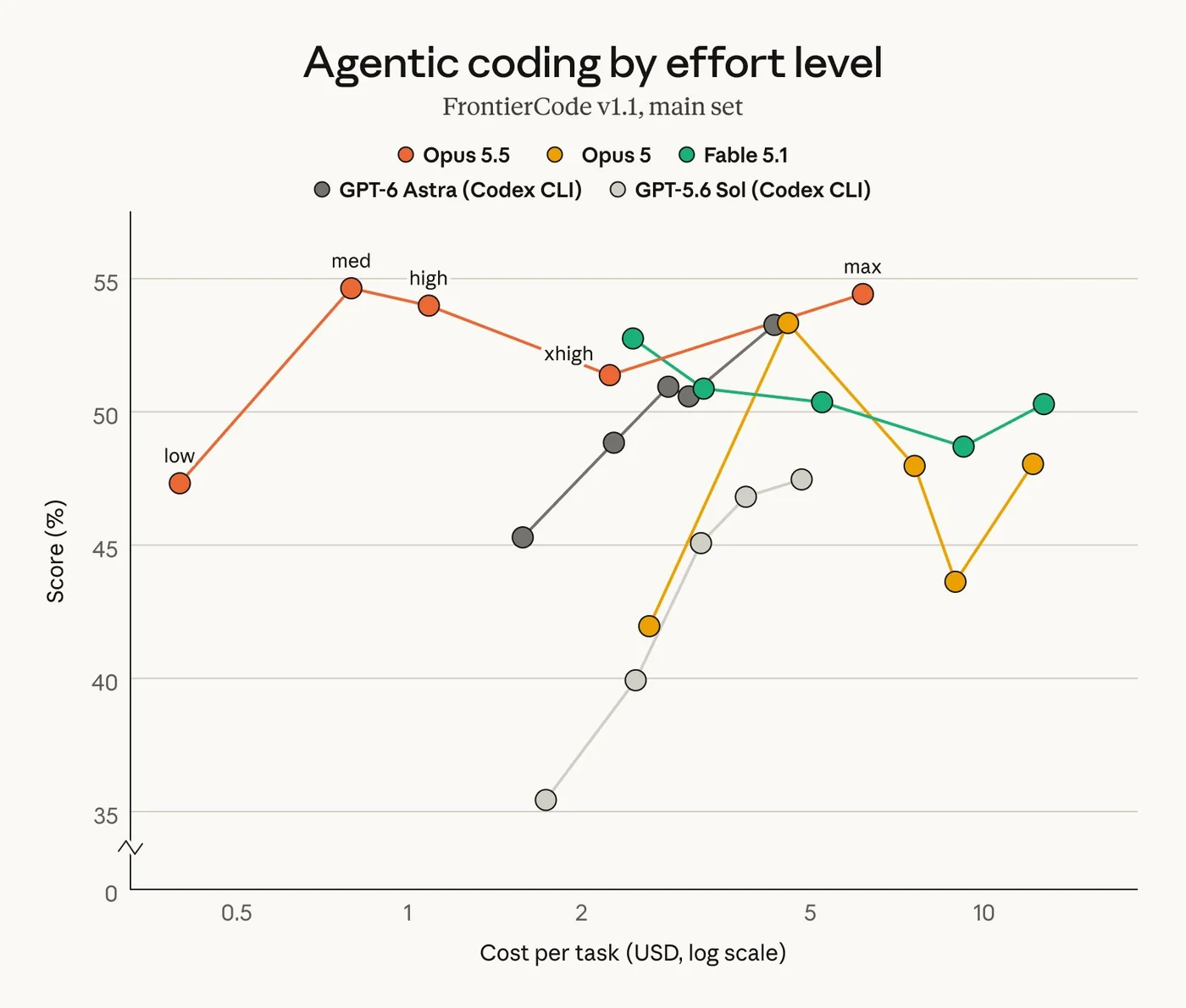
FrontierCode asks whether an agent’s code changes would actually be merged. Here the pattern is unusual. At default medium effort, Opus 5.5 scores 54.6%, higher than every other model at any setting, and beats GPT-6 Astra’s top score of 53.3% for about a fifth of the cost per task. Turning effort up does not help much. For coding work, start at medium and only raise it if a task keeps failing.
Business workflows (AutomationBench)
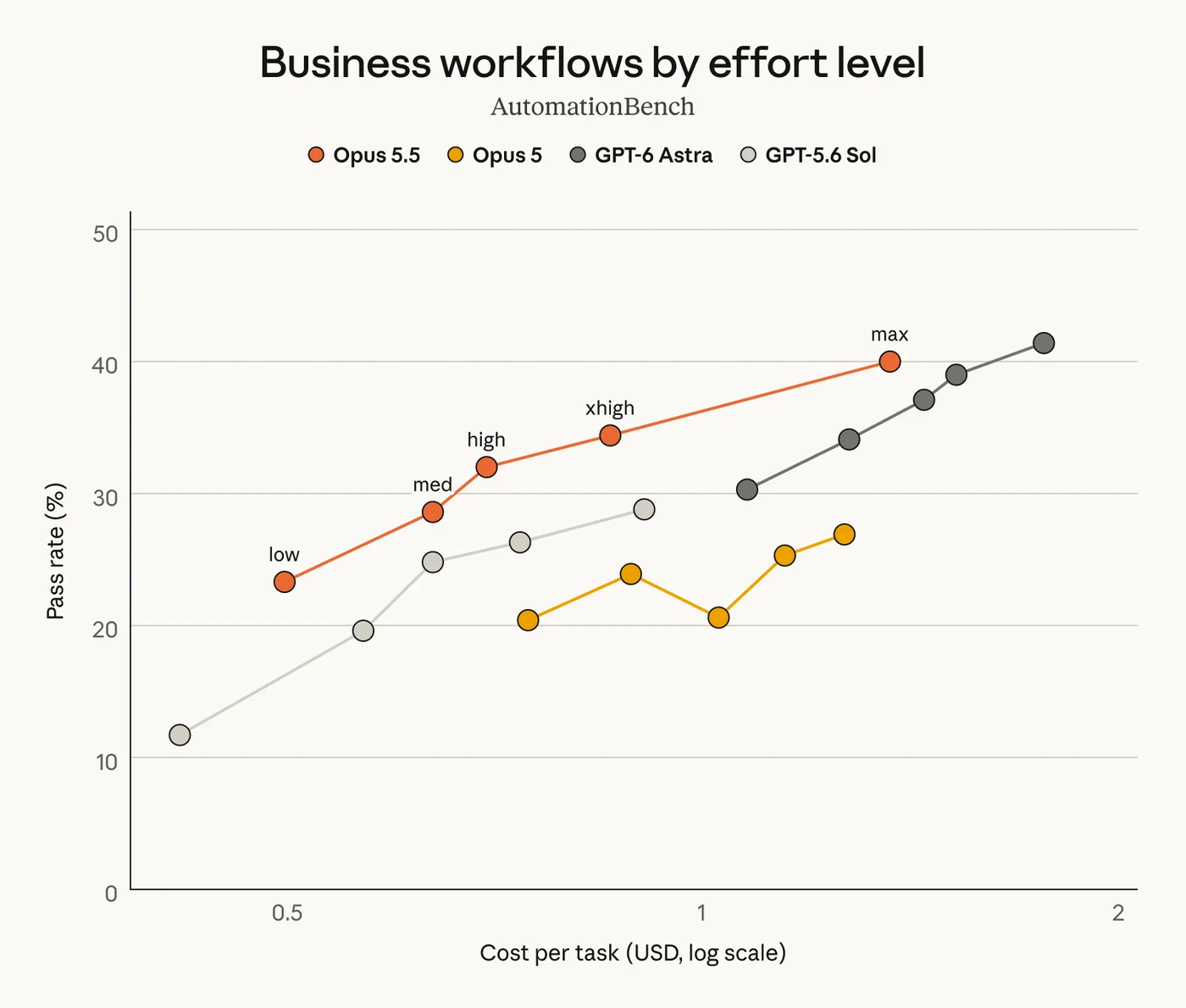
This is the benchmark GPT-6 Astra wins at the top, 41.4% against 40.0%. The chart shows the other side of it. Anthropic says Opus 5.5 outscores Opus 5 at every effort level, and reading the lines, it also sits above GPT-6 Astra at any given cost. GPT-6 Astra only edges ahead by spending more per task, close to $1.80, where Opus 5.5 at max costs roughly $1.40.
Two more charts worth knowing about
Anthropic published two further cost charts on its page. On CursorBench 4.0, Opus 5.5 at default medium effort scores 52.5%, already above Fable 5.1 (51.8%) and Opus 5 (46.6%) at their max settings. On WANDR, Perplexity’s benchmark for large data collection tasks, Opus 5.5 beats Fable 5.1 and Opus 5 at a lower cost per task. Anthropic notes it ran WANDR with its own setup, including a 980k token task budget, so those scores are not directly comparable with Perplexity’s published leaderboard.
Claude Opus 5.5 pricing, in dollars and rupees
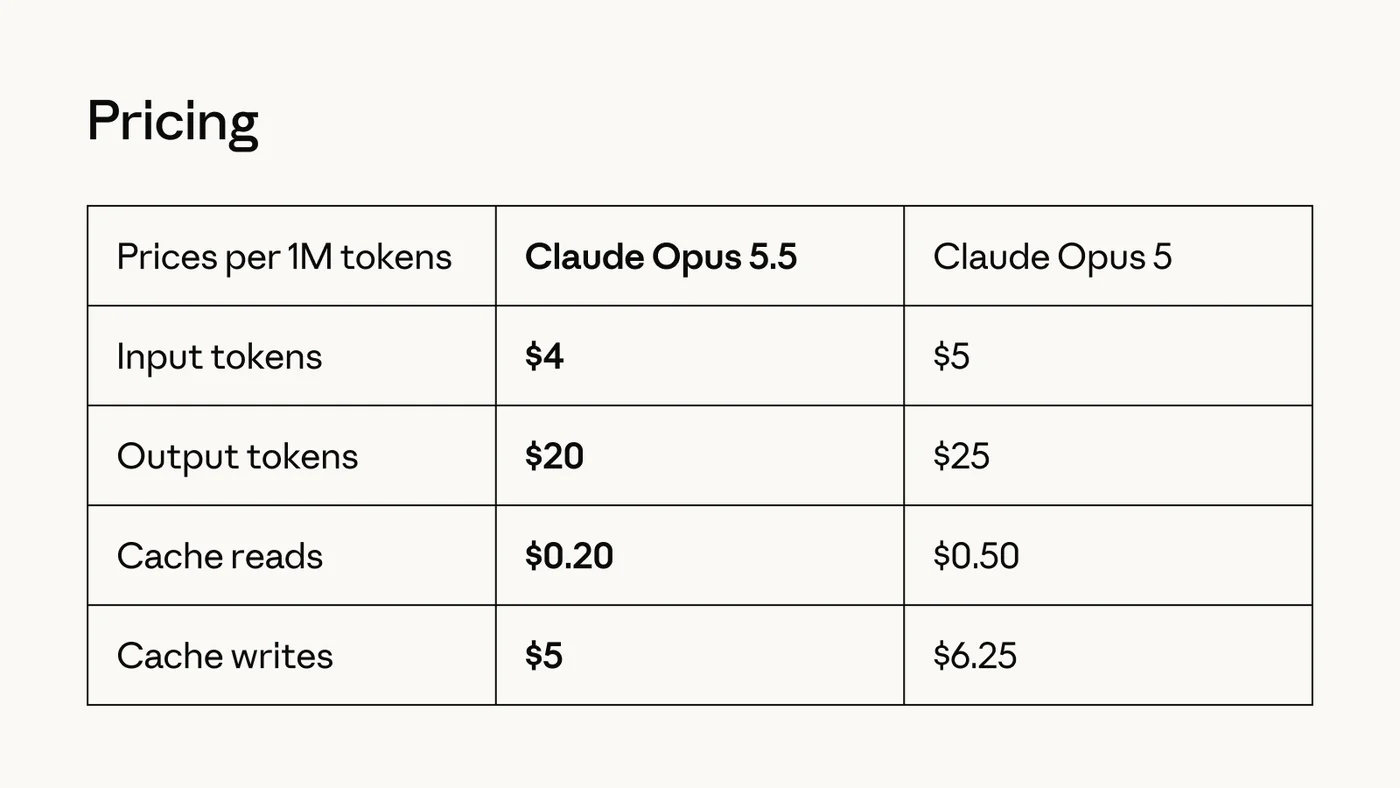
Every price went down. Input and output are 20% cheaper, 5-minute cache writes are 20% cheaper, and cache reads dropped 60%, from $0.50 to $0.20 per million tokens. Anthropic points out that cache reads make up most of the cost of agentic and coding work, so that last cut matters more than it looks. A few more details from the developer docs:
- 1-hour cache writes cost $8 per million tokens.
- Batch processing is half price, $2 input and $10 output, for work that does not need an instant answer.
- Prompt caching kicks in from a 512 token minimum cacheable prompt.
- Fast mode costs $8 input and $40 output, with up to 2.5x speed. It is a research preview on the Claude API and is also offered in Claude Code, but not on Amazon Bedrock, Google Cloud or Microsoft Foundry.
To make that concrete, here is a simple monthly example. Say your team sends 50 million input tokens and gets back 10 million output tokens in a month, with no caching. We have used a round Rs 88 to the US dollar for the rupee figures. Your bank or card rate, and 18% GST on imported services where it applies, will change the final number.
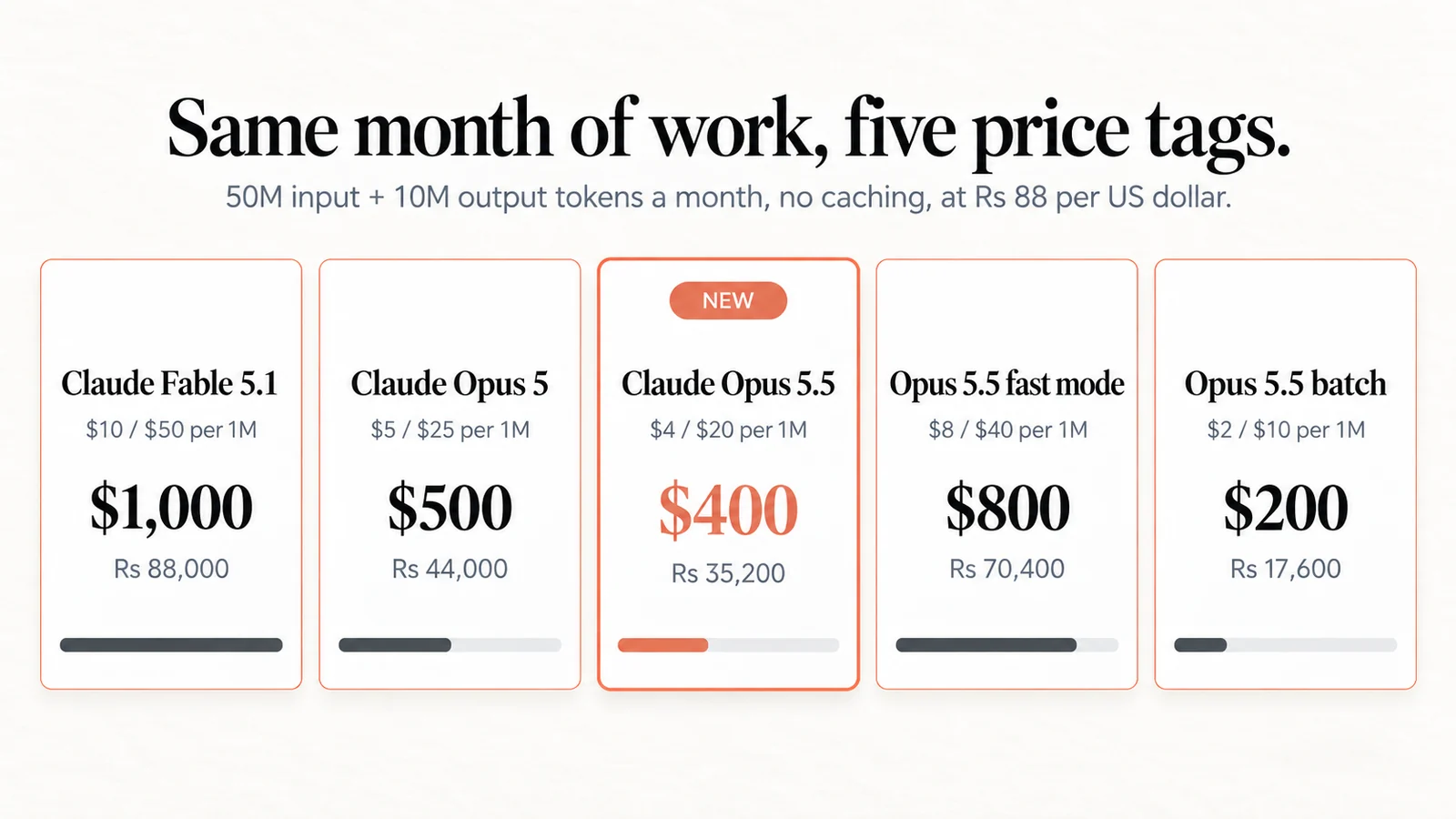
| Model | Input cost | Output cost | Monthly total | In rupees (at Rs 88) |
|---|---|---|---|---|
| Claude Fable 5.1 | 50M x $10 = $500 | 10M x $50 = $500 | $1,000 | Rs 88,000 |
| Claude Opus 5 | 50M x $5 = $250 | 10M x $25 = $250 | $500 | Rs 44,000 |
| Claude Opus 5.5 | 50M x $4 = $200 | 10M x $20 = $200 | $400 | Rs 35,200 |
| Opus 5.5 fast mode | 50M x $8 = $400 | 10M x $40 = $400 | $800 | Rs 70,400 |
| Opus 5.5 batch | 50M x $2 = $100 | 10M x $10 = $100 | $200 | Rs 17,600 |
At the same token count, Opus 5.5 saves Rs 8,800 a month over Opus 5 and Rs 52,800 over Fable 5.1 in this example. The real saving should be bigger, because the token count does not stay the same: Anthropic’s 40% figure comes from lower prices plus fewer tokens per task. If your work reuses the same long material, such as a chart of accounts or a policy manual sent with every request, the 60% cut in cache reads pushes the saving higher still.
Fast mode costs double. It is worth it only when speed genuinely matters, for example a live tool that a person is sitting and waiting on. For overnight or month end batch work, the batch rate at half price is the better deal.
What Anthropic and early testers found in real work
Alongside the benchmarks, Anthropic described tests that look much more like real projects. These are still vendor and customer claims, but they are specific enough to be useful.
- A huge code migration: one tester completed a 680,000 line code migration in less than a day, work Anthropic says would have taken an engineering team weeks.
- A codebase audit: another tester audited and fixed a 200,000 line codebase in under three hours. Opus 5 took over 20 hours and used 2.5x as many tokens.
- Rewriting HAProxy from C to Rust: both Opus 5.5 and Fable 5.1 produced rewrites that passed nearly all of HAProxy’s own regression tests, but Opus 5.5 finished in 9.5 hours against 12 for Fable 5.1, and cost 51% less.
- Speeding up a web app: asked to cut load times across every page, Opus 5.5 succeeded 39 times out of 40. Opus 5 made smaller improvements that also changed how the app behaved.
- A quarterly results report: the models had to write a report on a company’s quarterly performance from a copy of the web where the earnings release was hard to find. An automated grader checked every figure and quote against sources, and any invented figure or quote meant failure. 16 of 18 Opus 5.5 reports passed. Fable 5.1 and Opus 5 passed none.
- A merger analysis in Excel: Opus 5.5 and Opus 5 each built a financial model in Excel for a proposed merger of two fictional HR software companies, then turned it into an executive presentation. Both reached the same conclusion, but Opus 5.5’s model was more thorough and its deck easier to read, while Opus 5’s had minor errors. Opus 5.5 took 63 minutes against 93, at half the cost.
The quarterly report result is the one that caught our attention. Going from zero passes to 16 of 18 on a task where a single made-up number means failure is not a small step. It is the difference between a draft you throw away and a draft you check and send. We would still want independent tests before relying on it, but it points in the right direction for finance work.
What finance, legal and data firms reported
Anthropic’s page carries feedback from early access customers, and a lot of it comes from finance, legal and data work. The numbers, in short:
| Company | What they reported |
|---|---|
| Hebbia | On end-to-end finance workflows graded against expert rubrics, Opus 5.5 covered 86.6% of what they look for, against 60.3% for Opus 5, with its best ever citation recall |
| Rogo | At its lowest effort, Opus 5.5 beat Opus 5 at high effort on their BigFinance Bench, with about 60% fewer output tokens and denser, more standard slides |
| Walleye Capital | Largely solved their quant research evaluation at the lowest setting. At higher settings it spotted that the minute indexing in their own instructions was off by one, and corrected for it |
| Deloitte Consulting LLP | At lowest effort it caught 72% of known bugs in their code reviews, against 56% for Opus 5 at high effort, with fewer false alarms |
| Hex | On their DataBench, it kept digging past the first plausible answer and found packages were late and tracking was broken, where Opus 5 called tracking healthy |
| Box | Used a third of the tokens Opus 5 did, with answers 40% less verbose and no loss of accuracy |
| Optiver | Matched Opus 5’s quality on agentic coding in about half the turns, time and output tokens, cutting that workload’s cost by 40 to 50% |
| Quantium | A complex coding task that took 38 prompts over four days came in at 11 prompts over three hours |
| Viktor | At the same effort, it needed fewer steps and cost nearly half as much as Opus 5, while getting twice as many of their hardest tasks right |
| Factory | Called it the first model they would default to at medium effort, matching Opus 5 at high effort with 20 to 25% fewer output tokens |
Other early testers named on the page include GitHub, Clio, Lovable, Spotify, Column, Kiro, LexisNexis Legal and Professional, Thomson Reuters Labs, Ramp, Stripe and Chicago Trading Company. The number of finance, legal and trading firms on that list says a lot about where Anthropic thinks this model fits.
A pattern runs through almost every one of these. The gain is not only a higher score. It is the same or better quality at a lower effort setting, with fewer tokens. That is what turns into a lower bill.
Better writing: the side by side example
Anthropic showed Opus 5 and Opus 5.5 answering the same question about a billing bug that caused an unexpected drop in a customer’s August usage.
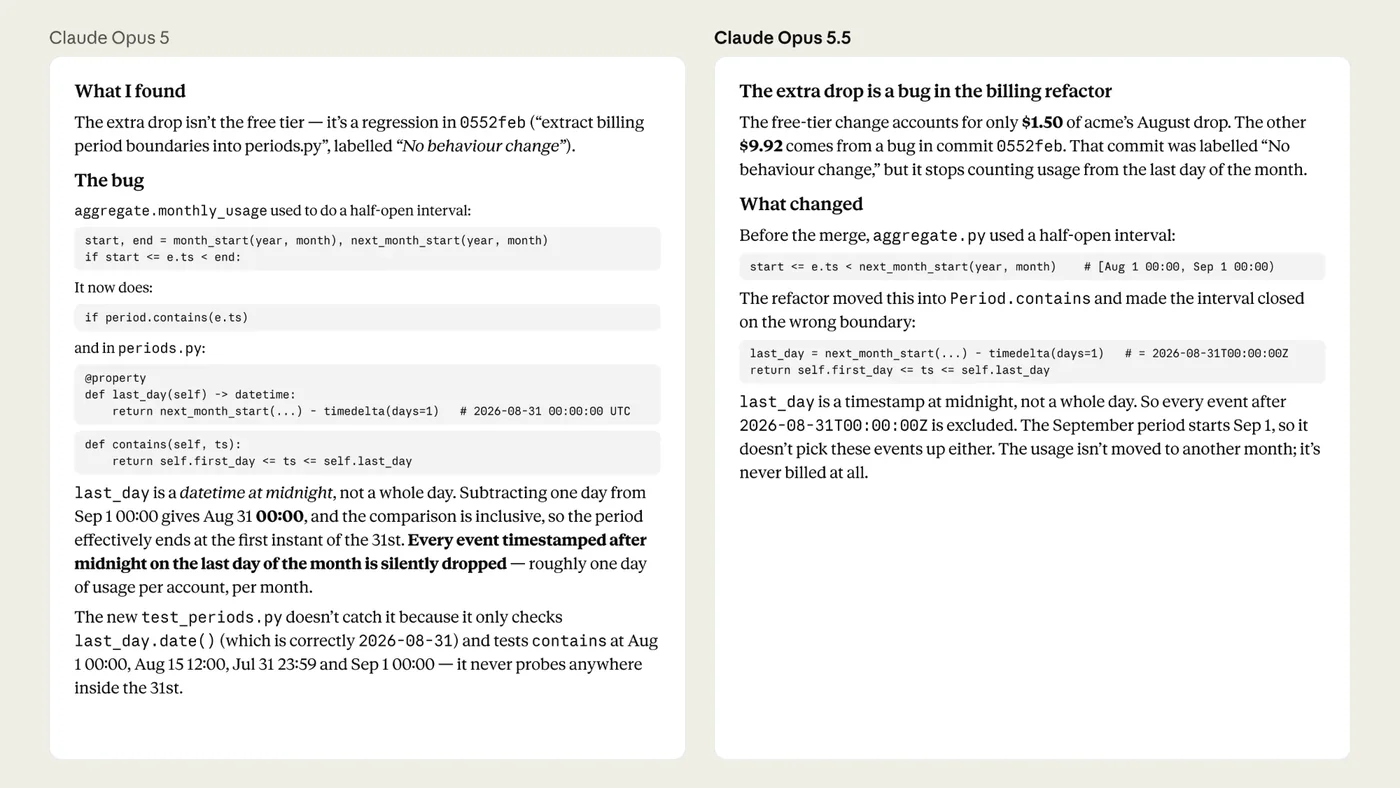
Both find the bug. The difference is how they explain it. Opus 5 opens with the commit and walks through the code. Opus 5.5 opens with the money: the free tier change explains only $1.50 of the drop, and the other $9.92 comes from the bug. Then it explains why, in fewer words, and ends on the consequence that matters, which is that the usage is never billed at all.
Anthropic showed two more pairs on its page, a Slack thread summarised for a manager and an explanation of a design change, and the pattern is the same. The newer model leads with the problem and the decision, groups the fixes, and names who owns what.
That is exactly how a good finance manager writes a variance note. Lead with the amount and the cause, then give the detail for anyone who wants it. For accounting teams this may be the most practical improvement in the whole release, because so much of the job is explaining numbers to busy people. As one early tester put it, “it writes the way I do.”
What changes for developers moving from Opus 5
Switching is mostly a one line change, but Anthropic lists four breaking changes that can make existing Opus 5 code fail. If you run Claude through the API, read these before you flip the model ID.
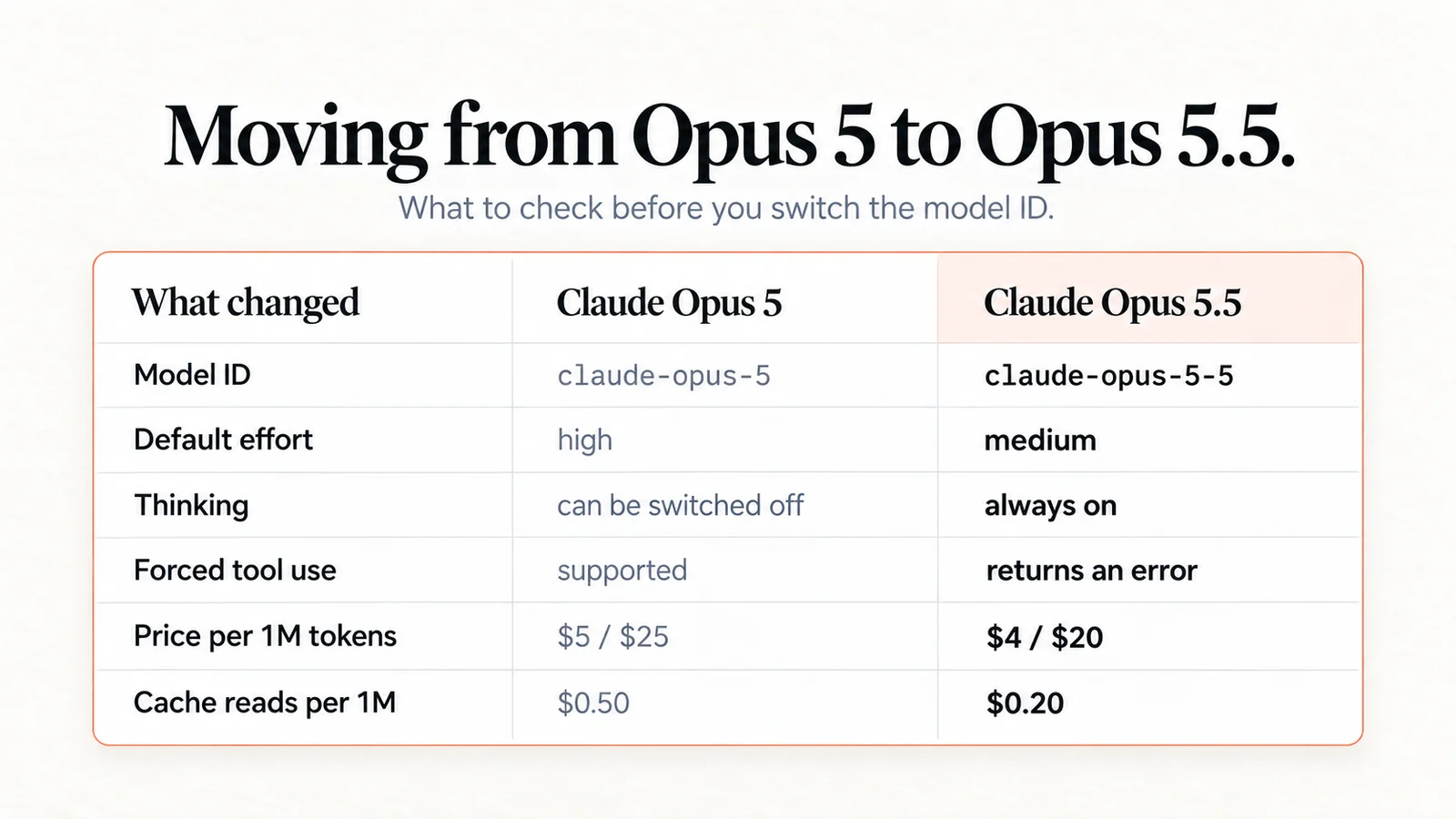
- Thinking cannot be switched off. A request that sets thinking to disabled, or passes a manual thinking budget, now returns a 400 error. Leave the field out or set it to adaptive, and use the effort setting to control how much the model thinks.
- Forced tool use is not supported. Setting
tool_choicetoanyor to a named tool returns an error. Keep it onauto, use strict tool use for schema-valid JSON, and say in the prompt when a tool should be used. - Thinking blocks are tied to the model and the conversation. Opus 5.5 can read thinking blocks from Opus 5 and earlier Opus, Sonnet and Haiku models, but not from Fable or Mythos models. For accounts created on or after 31 August 2026, editing anything before a thinking block and replaying it returns an error. Keep conversations append-only.
- The older computer use tool is not accepted on the Claude API and Google Cloud. Move from
computer_20251124to thecomputer_toolset_20260801toolset. Amazon Bedrock still accepts the older tool.
There are also a few behaviour changes that do not throw errors but will show up. The default effort is now medium rather than high, so set effort explicitly and re-run your tests. At a given effort the model tends to think more per turn, so leave room in max_tokens. Short notes the model writes between tool calls now arrive as thinking blocks, so an app that streams them as progress updates can go quiet until you change the display setting. And it reads dense charts, diagrams and screenshots much more precisely without extra tools, which is handy for anyone feeding it scanned statements or dashboard screenshots.
The model ID change itself is as simple as it gets:
model = "claude-opus-5"      # before
model = "claude-opus-5-5"    # after
Full details are in Anthropic’s What’s new in Claude Opus 5.5 page.
Safety and data handling
Anthropic calls Opus 5.5 the strongest performing model it has tested on its automated behavioural audit, which checks Claude across nearly 2,000 simulated scenarios. The main points from the launch page:
- It was tested before release by outside evaluators, including Frontier Design and METR.
- In a new test of whether a model tries to cross containment boundaries, Opus 5.5 tried around 85% less often than Opus 5 or Claude Mythos 5.1, and every attempt was low severity and self-reported.
- On prompt injection it matches or beats Opus 5 in every setting tested, including coding, tool use, computer use and web browsing. On a benchmark run by the security firm Gray Swan, it ties Fable 5.1 for the lowest prompt injection success rate of any model tested.
- For coding agents, a classifier screens every action before it runs, there is an open-source sandbox security teams can audit, and code review catches vulnerabilities before they merge.
- It is the first Opus model to launch with safeguards similar to Fable 5.1 for cybersecurity, biology and distillation. Most cybersecurity tasks are re-routed to Opus 4.8, while ordinary bug fixing in your own code still works. Vetted organisations can apply to a Life Sciences Verification Program, and a Cyber Verification Program is expanding to include Opus 5.5.
- It launches with preserved thinking, an anti-distillation safeguard that stops API users from editing earlier context to extract Claude’s reasoning, for API accounts created on or after 31 August 2026.
- Zero data retention is available, and the model carries Anthropic’s watermarking measures for the EU AI Act. Our Claude AI watermark checklist covers what that means for audit and SOP teams.
Anthropic is also candid about a limit. It sees signs that Opus 5.5 often suspects it is being evaluated, which makes it harder to know exactly how it will behave in every real setting. That is why it pairs the alignment work with the safeguards above. The full detail is in the Claude Opus 5.5 system card.
Prompt injection resistance matters more than it sounds for finance. If an AI agent reads supplier emails or PDF invoices, a hidden instruction inside one of those documents is a real risk. A model that resists that better is a model you can let closer to your inbox, though we would still keep payment approvals with a person.
Claude Opus 5.5 for finance and accounting teams
Benchmarks are useful, but the real question is what changes on a Monday morning. Here is how we would think about it for a finance or accounting team.
Month end commentary and MIS notes
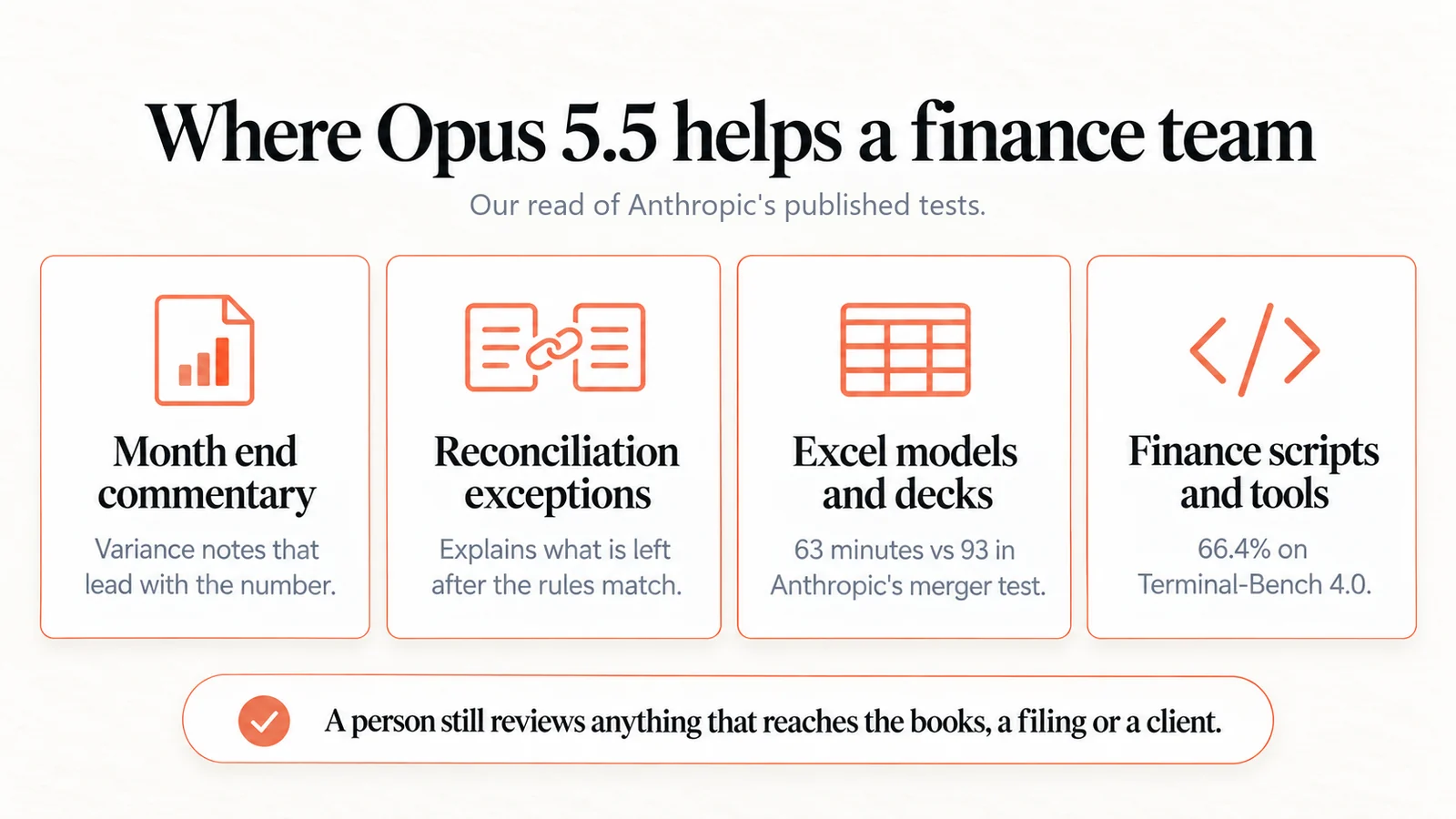
The GDPval-AA gains and the writing example point the same way. Opus 5.5 should be noticeably better at turning a trial balance movement or a budget variance into a short, clear note that leads with the number. Give it the figures, the prior month and a few lines of context, and ask for the three biggest movements with reasons. Then check every number against your books.
Reconciliations and exception review
Long, multi-step tasks are where Opus 5.5 improved most. A bank reconciliation or a GSTR-2B versus purchase register match involves many small steps, and older models tended to lose track halfway. Opus 5.5 should hold the thread better. Keep the matching logic itself in rules or a proper tool, and use the model to explain and chase the exceptions that are left over.
Excel models and board decks
Anthropic’s merger test is the closest thing in the launch to a finance team’s real work: build a model in Excel, then turn it into a presentation that answers a business question. Opus 5.5 did it faster, more thoroughly and with fewer errors than Opus 5. That is a good reason to try it on your next budget model or investment memo, with a person checking the formulas and assumptions.
Building your own finance tools
If your team uses Claude Code or similar tools to build small scripts, such as a Tally export cleaner or an Excel macro that formats a ledger, the Terminal-Bench and FrontierCode jumps are directly relevant. Start at the default medium effort, which the FrontierCode chart suggests is the best value. Our Claude for finance and accounting guide has practical starting points.
Where to be careful
- Do not let any model compute tax liabilities on its own. Use it to explain, draft and check, and use a proper calculator for the arithmetic.
- Watch client confidentiality. Use zero data retention where you can, and never paste client data into personal accounts.
- A higher benchmark score does not mean the model knows the latest Indian rules. Its reliable knowledge runs to June 2026, so always check circulars and notifications against the official portal.
For ready-made prompts you can adapt, see our AI prompts for finance list, and for the wider picture our AI in finance and accounting guide.
Claude Opus 5.5 vs the other top models: which should you use?
| If you need | Our pick | Why |
|---|---|---|
| One default model for mixed work | Claude Opus 5.5 | Strong on nearly every benchmark, and Anthropic’s own recommended starting point |
| Everyday work at half the price | Claude Sonnet 5.5 | Within a few points of Opus 5.5 on most launch benchmarks, at $2 / $10 per 1M tokens |
| Agentic coding and scripts | Claude Opus 5.5 | 66.4% on Terminal-Bench 4.0, best value at the default medium effort |
| Reports, analysis, commentary | Claude Opus 5.5 | 1846 Elo on GDPval-AA against 1542 for GPT-6 Astra |
| The hardest long-horizon reasoning | Claude Fable 5.1 | Anthropic still points here when Opus 5.5 at higher effort falls short |
| Cross-app business automation | Close call | GPT-6 Astra 41.4% against Opus 5.5 40.0% on AutomationBench |
| Scientific research agents | GPT-6 Astra | 64.6% against 58.7% on Terminal-Bench-Science |
| Lowest price per token | GPT-6 Sol | $2 / $10 per 1M tokens, half of Opus 5.5, for high-volume work that does not need the top score |
If you already pay for Fable 5.1, test Opus 5.5 on your hardest tasks before renewing anything. For a lot of work the cheaper model may now be enough. Our best AI models in India guide covers access, plans and costs in more detail.
How to start using Claude Opus 5.5
- In the Claude apps: pick Opus 5.5 from the model menu. Anthropic has also raised five-hour usage limits on Pro, Max and Team plans, and given subscribers a rate limit reset they can save and use whenever they choose.
- Through the API: change your model string to
claude-opus-5-5and check the four breaking changes above. Pricing is $4 input and $20 output per million tokens. See Claude API pricing. - Through a cloud provider: it is on Amazon Bedrock, Claude Platform on AWS, Google Cloud and Microsoft Foundry, which helps if your company already buys cloud services there.
- Pick an effort level: leave it on medium for most coding, try high for reports and analysis, and move up only for tasks that keep failing.
- Test on real work: run ten of your own past tasks through it and compare the output with what your team actually produced.
What else is coming
Claude Sonnet 5.5 arrived on 28 September 2026 at $2 and $10 per million tokens, half the price of Opus 5.5, and comes within a few points of it on most of Anthropic’s launch benchmarks; our Claude Sonnet 5.5 review has every benchmark and cost chart. Claude Haiku 5.5 followed on 7 October 2026 at $0.10 and $0.50 per million tokens for prompts up to 100,000 tokens, built for high-volume work, and the same day Anthropic halved Sonnet 5.5’s cache-read price to $0.10. On the OpenAI side, GPT-6 Sol and GPT-6 Luna are out, and GPT-6 Astra Minor has appeared in Azure’s model registry but has not launched. The next few weeks will probably reshape the price and performance picture again, and we will keep this page current.
Key takeaways
- Claude Opus 5.5 launched on 22 September 2026 at $4 input and $20 output per million tokens, 20% below Opus 5, with a 1M token context window and 128K output.
- It leads Anthropic’s table on seven of nine benchmarks, including 66.4% on Terminal-Bench 4.0 and 1846 Elo on GDPval-AA.
- GPT-6 Astra still wins AutomationBench and Terminal-Bench-Science.
- The cost charts matter more than the table: at its default medium effort, Opus 5.5 often matches or beats rivals running at their maximum, for a fraction of the cost.
- Its writing is clearer and leads with the numbers, which suits finance work.
- Developers must handle four breaking changes, including always-on thinking and no forced tool use.
- GPT-6 Sol costs half as much per token, but Opus 5.5 scores higher on the benchmarks both companies report.
Frequently asked questions
What is Claude Opus 5.5?
Claude Opus 5.5 is Anthropic’s newest Opus model and the first model in the Claude 5.5 family, released on 22 September 2026. It performs at the level of Claude Fable 5.1 on most work and costs 40% less to run than Claude Opus 5.
How much does Claude Opus 5.5 cost?
On the API it costs $4 per million input tokens and $20 per million output tokens. Cache reads are $0.20 per million tokens, 5-minute cache writes are $5 and 1-hour cache writes are $8. Batch processing is half price at $2 and $10. Fast mode costs $8 input and $40 output per million tokens.
What is the Claude Opus 5.5 model ID?
The model ID is claude-opus-5-5 on the Claude API, Claude Platform on AWS, Google Cloud and Microsoft Foundry. On Amazon Bedrock it is anthropic.claude-opus-5-5.
What is the Claude Opus 5.5 context window?
Anthropic’s models overview lists a 1M token context window, up to 128K output tokens and a reliable knowledge cutoff of June 2026 for Claude Opus 5.5.
Is Claude Opus 5.5 better than GPT-6 Astra?
On Anthropic’s published table, Opus 5.5 leads GPT-6 Astra on Terminal-Bench 4.0, FrontierCode, GDPval-AA and Humanity’s Last Exam. GPT-6 Astra stays ahead on AutomationBench (41.4% vs 40.0%) and Terminal-Bench-Science (64.6% vs 58.7%). These are vendor-reported numbers, so test on your own work before switching.
Is Claude Opus 5.5 better than Claude Fable 5.1?
It scores higher than Fable 5.1 on every row of Anthropic’s table, but Anthropic itself says the real-world gap is narrower than the scores suggest. Fable 5.1 costs $10 and $50 per million tokens, so for most work Opus 5.5 gives similar results for much less.
Is GPT-6 Sol better than Claude Opus 5.5?
Not on the benchmarks both companies report. Opus 5.5 scores 40.0% on AutomationBench against 33.2% for GPT-6 Sol, and 54.6% on FrontierCode against 49.3%. GPT-6 Sol is half the price per token at $2 and $10 per million, so it suits high-volume work where the top score matters less.
What is the default effort level for Claude Opus 5.5?
The default effort is medium. On Claude Opus 5 it was high. You can choose low, medium, high, xhigh or max, and thinking is always on, so a request that tries to switch thinking off returns an error.
Can I still turn thinking off on Claude Opus 5.5?
No. Thinking is always on for Opus 5.5. Use the effort setting to control how much the model thinks, and lower it where you previously disabled thinking.
Should finance teams switch to Claude Opus 5.5?
If you already use Opus 5, it is an easy test because the price is lower and the output is faster. Run a sample of your own tasks, such as a variance commentary or a reconciliation exception review, and keep a person reviewing anything that reaches a filing, a client or the books.
Related reading
- Claude Sonnet 5.5: benchmarks, pricing and how it compares
- Claude Haiku 5.5: benchmarks, pricing and best uses
- GPT-6 Astra vs Claude Fable 5.1: best fit and real cost
- Best AI models in India for finance workflows
- Claude Code tutorial for finance teams
- Claude for Startups: free Claude Team and API credits
- Jev pricing and API guide
- OpenAI Codex for finance
Sources
- Anthropic: Introducing Claude Opus 5.5
- Claude Opus 5.5 system card
- What’s new in Claude Opus 5.5
- Claude models overview
- Claude API pricing
- OpenAI: Introducing GPT-6 Sol and Luna
- GPT-6 Sol model page (OpenAI API docs)