
The ITR-6 AY 2026-27 is the mandatory return form for every company registered under the Companies Act, except those claiming exemption under Section 11 (charitable or religious trusts), which file ITR-7. From a one-person company (OPC) to a listed multinational, ITR-6 captures the same financial structure: a full set of statutory accounts, MAT computation, advance tax reconciliation, and Section 44AB tax audit linkage.
This is the most heavily-schemed of all ITR forms, with over 40 schedules, a mandatory digital signature, and a hard requirement that the return tie cleanly to the audited financial statements. Here is how to file ITR-6 without triggering the scrutiny that small and mid-sized companies routinely walk into.
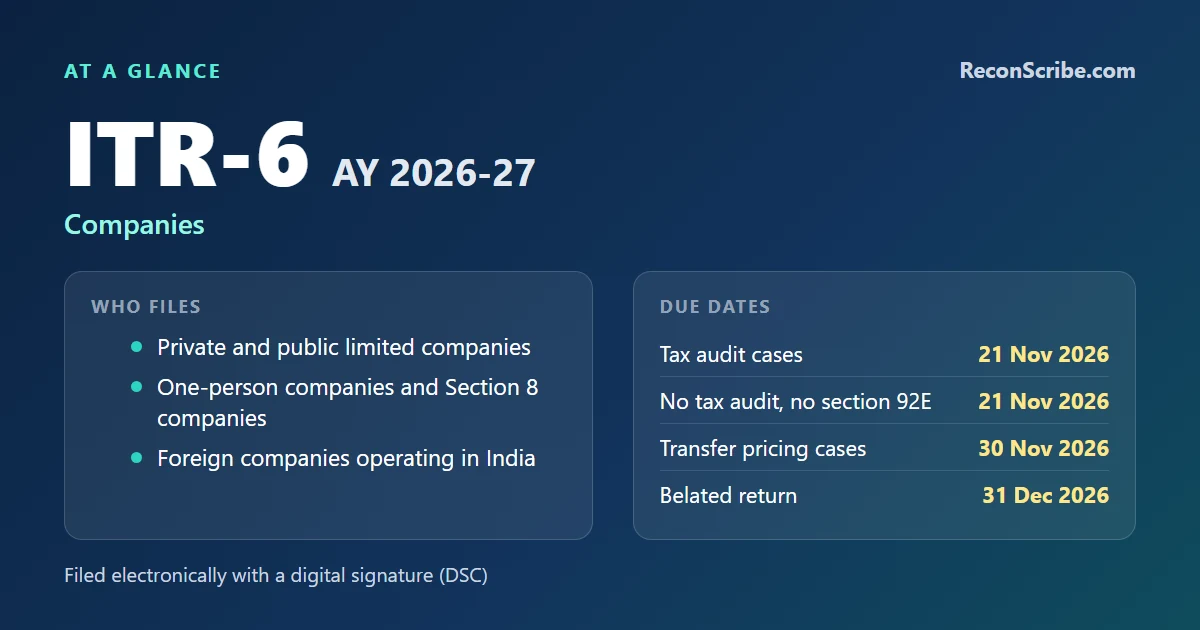
Who Must File ITR-6 for AY 2026-27
ITR-6 is mandatory for:
- All companies registered under the Companies Act, 2013 (or the earlier 1956 Act).
- Private limited companies, public limited companies, one-person companies (OPCs), Section 8 companies (non-profit), and foreign companies operating in India.
ITR-6 cannot be filed by:
- Companies claiming exemption under Section 11 (charitable or religious trusts incorporated as Section 8 companies for charitable purposes). They file ITR-7 instead.
- Any non-company entity. Those file ITR-1 to 5 depending on structure.
Mandatory requirements:
- Filing must be electronic with Digital Signature Certificate (DSC) of the authorized signatory.
- Filing must be after the statutory audit under the Companies Act is signed by the company’s auditor.
- Tax audit under section 44AB is separate from the company’s statutory audit and is required only when its conditions are met. Where applicable, file the audit report by its own deadline, ordinarily one month before the section 139(1) return due date.
Corporate Tax Rates AY 2026-27
The Indian corporate tax regime now offers four concessional pathways alongside the regular rate. The right choice depends on whether the company is new, foreign, or willing to forgo specific deductions.
| Regime / Section | Rate | Surcharge | Cess | Conditions |
|---|---|---|---|---|
| Section 115BAA (domestic company, opted) | 22% | 10% | 4% | Forgo specified deductions; MAT not applicable |
| Section 115BAB (new manufacturing, post-Oct 2019) | 15% | 10% | 4% | Specified new manufacturers only |
| Regular: turnover ≤ ₹400 crore in FY 2023-24 | 25% | 7% (₹1-10 Cr); 12% (>₹10 Cr) | 4% | Default for smaller domestic companies |
| Regular: turnover > ₹400 crore in FY 2023-24 | 30% | 7% or 12% as applicable | 4% | Larger domestic companies |
| Foreign company | 35% | 2% (₹1-10 Cr); 5% (>₹10 Cr) | 4% | Reduced from 40% by Finance Act 2024 |
The Section 115BAA election (22%), once opted, is irrevocable. You cannot return to the regular regime later. It typically benefits companies that do not claim major deductions like SEZ benefits or accelerated depreciation.
Minimum Alternate Tax (MAT) under Section 115JB
Companies that do not opt for Section 115BAA or 115BAB are subject to MAT at:
- 15% of book profit plus applicable surcharge and 4% cess.
MAT applies when the company’s regular tax (under normal provisions) is less than 15% of book profit. The differential is paid as MAT and credited to “MAT Credit”, which can be carried forward and set off against future regular tax liability for up to 15 years.
Companies opting for Section 115BAA or 115BAB are exempt from MAT, which is one of the key advantages of these regimes.
Key Schedules in ITR-6
ITR-6 has the most schedules of any return form, over 40 in total. The most consequential ones:
| Schedule | Purpose |
|---|---|
| Schedule HP | Income from house property |
| Schedule BP | Business profit: start with P&L net, adjust per Income Tax Act |
| Schedule DPM / DOA | Depreciation under Income Tax Act blocks (separate from books) |
| Schedule CG | Capital gains |
| Schedule OS | Other sources |
| Schedule MAT | MAT computation under Section 115JB (book profit method) |
| Schedule MATC | MAT credit brought forward and set off |
| Schedule CFL | Carry-forward of losses (business, capital, speculative) |
| Schedule UD | Unabsorbed depreciation |
| Schedule TDS / TCS | Tax credits from Form 26AS |
| Schedule SI | Special income at flat rates |
| Schedule FA | Foreign assets and income |
| Schedule TR | Tax relief under Sections 90, 90A, 91 |
| Schedule SH-1 / SH-2 | Shareholding pattern (unlisted) for closely held or startup companies |
| Schedule AL-1 | Assets and liabilities (specified companies) |
| Schedule GST | GST turnover reconciliation |
| Schedule 80G | Donations |
| Schedule 80-IA / IB / IC | Section-specific deductions for eligible companies |
| Schedule SEZ | SEZ unit-wise income computation |
Schedule SH-1 / SH-2: Closely-Held Company Disclosures
For unlisted companies, particularly closely-held private companies, Schedule SH-1 and SH-2 require:
- Complete shareholding pattern at year-end with PAN of each shareholder, share count, and percentage holding.
- Changes in shareholding during the year, like issues, transfers, and buybacks.
- DPIIT recognition if the company is a recognized startup.
- ESOPs granted during the year.
Keep the shareholding schedules consistent with statutory registers, the financial statements and applicable startup disclosures. Section 56(2)(viib) angel tax no longer applies from AY 2025-26; do not present it as a current AY 2026-27 share-premium charge.
Tax Audit (Section 44AB) and ITR-6
Every company in business or profession needs to evaluate tax audit applicability:
| Trigger | Threshold |
|---|---|
| Business turnover | Above ₹1 crore |
| Business turnover, with ≥ 95% digital receipts and ≥ 95% digital payments | Above ₹10 crore |
| Profession gross receipts | Above ₹50 lakh |
For companies, statutory audit under the Companies Act, 2013 is mandatory regardless of turnover. The tax audit (44AB) under the Income Tax Act is an additional, separate audit when the above thresholds are crossed. The tax audit report, Form 3CA and 3CD, must be filed before the ITR-6.
ITR-6 Filing Deadline AY 2026-27
| Category | Deadline |
|---|---|
| Tax audit applicable | 21 November 2026 (extended from 31 October by CBDT Circular 07/2026) |
| Form 3CA-3CD upload | 21 October 2026 (extended from 30 September) |
| Transfer pricing cases (Form 3CEB) | 30 November 2026 |
| Form 3CEB upload | 31 October 2026 |
| Company without a section 44AB tax-audit requirement, no section 92E | 21 November 2026 (extended from 31 October) |
| Belated return | 31 December 2026 |
| Revised return | 31 March 2027 |
The company category itself makes the return due on 21 November 2026 this year (31 October, extended by CBDT Circular 07/2026), even without a section 44AB tax-audit requirement. A holding or dormant company does not get a July deadline merely because it has little or no business income. Section 92E cases use 30 November.
The MAT Computation Walkthrough
Section 115JB MAT computation begins with profit before tax as per the audited Statement of Profit & Loss, then adjusts for:
Add back:
- Income tax paid or provided.
- Provisions for unascertained liabilities.
- Provision for losses of subsidiaries.
- Dividend paid or proposed.
- Expenditure relating to exempt income (Section 14A).
- Depreciation (book), to be replaced with allowable depreciation as below.
Reduce by:
- Withdrawals from reserves (if credited to P&L).
- Amount of brought-forward business loss or unabsorbed depreciation, whichever is lower.
- Depreciation excluding revaluation.
- Use only the adjustments expressly permitted by section 115JB. A normal-computation deduction under Chapter VI-A does not automatically reduce MAT book profit.
- Income exempt under Section 10 (excluding 10(38), which is no longer relevant post-LTCG taxation).
- Profits of sick industrial company.
The resulting book profit is taxed at 15% (plus surcharge plus cess). If this MAT amount exceeds regular tax, you pay MAT and earn a MAT credit for 15 years.
Common ITR-6 Mistakes That Trigger Notices
- Difference between book depreciation (Companies Act) and tax depreciation (Income Tax Act). Two completely different rate structures. Schedule DPM/DOA needs Income Tax Act WDV blocks only.
- Schedule MAT incomplete or zero. Even for Section 115BAA companies that do not pay MAT, the schedule must reflect the election.
- Cash payments above ₹10,000 in a day to one party. Section 40A(3) disallowance is highly automated now.
- TDS not deducted on payments to contractors, professionals, rent, brokerage. Section 40(a)(ia) disallows 30% of such payments.
- Cash receipts: Review the section 269ST restriction at Rs 2 lakh or more under the statutory aggregation tests and exceptions. Section 271DA can impose a penalty equal to the prohibited receipt; reasonable-cause provisions need separate review.
- GST turnover mismatch with ITR-6 turnover. GSTN data sharing is now real-time at the entity level.
- Foreign payments without 15CA or 15CB. Many companies miss this because foreign remittance compliance is a separate filing.
- Shareholding disclosures: Complete the applicable SH schedule from the register and notified instructions. Do not describe a missing entry as an automatic angel-tax charge for AY 2026-27.
- Filing without DSC. Hard rejection.
- Missing the auditor’s UDIN. The Form 3CA-3CD must reference a valid CA UDIN. Missing UDIN invalidates the audit report.
Specified Domestic Transactions and Transfer Pricing
Companies with specified domestic transactions above ₹20 crore (related-party transactions with eligible Section 80-IA, 80-IAB, or 80-IAC tax-holiday entities) must file Form 3CEB with their ITR-6.
International transactions of any value between related entities, irrespective of amount, trigger transfer pricing audit obligations. Form 3CEB must be uploaded by October 31, 2026, and the ITR-6 by November 30, 2026 for TP-applicable companies.
A transaction can require Form 3CEB even where the full Rule 10D documentation list is subject to a threshold or exception. Check sections 92B, 92E and Rule 10D for the actual transaction; a small payment does not justify ignoring arm’s-length support.
Prepare the company accounts-to-return bridge
Use the final financial statements and trial balance as the starting point, then retain a schedule of tax adjustments with its supporting evidence. Keep depreciation workings, relevant tax-credit records and any applicable minimum-alternate-tax working identifiable so a reviewer can follow the figures.
Check every import against the selected official utility and retain the validation results. Our ITR forms overview links to the wider filing guides. This article does not import ERP exports, reconcile depreciation blocks or generate filing-ready ITR-6 schedules automatically.
Frequently Asked Questions
Can a Section 8 company file ITR-6?
Section 8 companies registered for non-profit purposes typically file ITR-7 if they claim exemption under Section 11. Section 8 companies that do not claim Section 11 exemption (which is rare) would file ITR-6.
Is MAT applicable to a company under Section 115BAA?
No. Companies that have validly opted for Section 115BAA (22% concessional rate) are exempt from MAT under Section 115JB. This is one of the main advantages of the 115BAA regime.
What if my company has no business activity in FY 2025-26?
A dormant or shell company with no operations still must file ITR-6 declaring nil business income but disclosing any interest, dividend, or other income. Filing is mandatory for every active company on the MCA register.
Is DSC mandatory for ITR-6?
Yes. ITR-6 requires a digital signature from a person legally entitled to verify the return under section 140 and the applicable rules. A board resolution alone does not make every employee or company secretary an eligible verifier.
Can ITR-6 be revised after the audit report is uploaded?
Yes. Revised return can be filed up to March 31, 2027. However, if the revision involves audit-relevant changes, the audit report (Form 3CA-3CD) may also need to be revised through a fresh upload by the auditor.
Related guides:
- 🏠 Master index: ITR Forms AY 2026-27
- 🟡 ITR-5: For Firms, LLPs, and AOPs (Non-Company Entities)
- ⚪ ITR-7: For Section 8 Charitable Companies and Trusts
Last reviewed: May 26, 2026 | CBDT Notification: 49/2026
Official reference: Income Tax Department ITR utilities, schemas and validation documents. Select AY 2026-27 and the relevant form.
This guide covers FY 2025-26 / AY 2026-27 under the 1961 Act. Filing dates depend on the taxpayer and audit/transfer-pricing conditions, not only the ITR number. Belated returns are generally due by 31 December 2026 and revised returns by 31 March 2027, or completion of assessment if earlier. Revision is subject to section 234-I; check the current utility for any fee. A later CBDT extension applies only to the cases it covers.
The corporate rates shown are AY 2026-27 rates. The 15% section 115BAB route requires all statutory conditions, including the eligible manufacturing commencement deadline of 31 March 2024; it is not open to every newly incorporated manufacturer.
Sources: Finance Act 2026, section 5; AY-specific forms and validations; Company guidance; Angel-tax change.
The information and tools on this page are for general information only and are not legal, tax, accounting or financial advice. For advice on your own situation, use the Professional help form on this page.