
This free old vs new regime calculator for FY 2026-27 settles the debate in seconds. Every salaried Indian faces the same fork in the road at tax time: stick with the old regime and its familiar deductions, or jump to the new regime with its lower slab rates. Pick wrong and you could hand the government tens of thousands of rupees you never needed to pay.
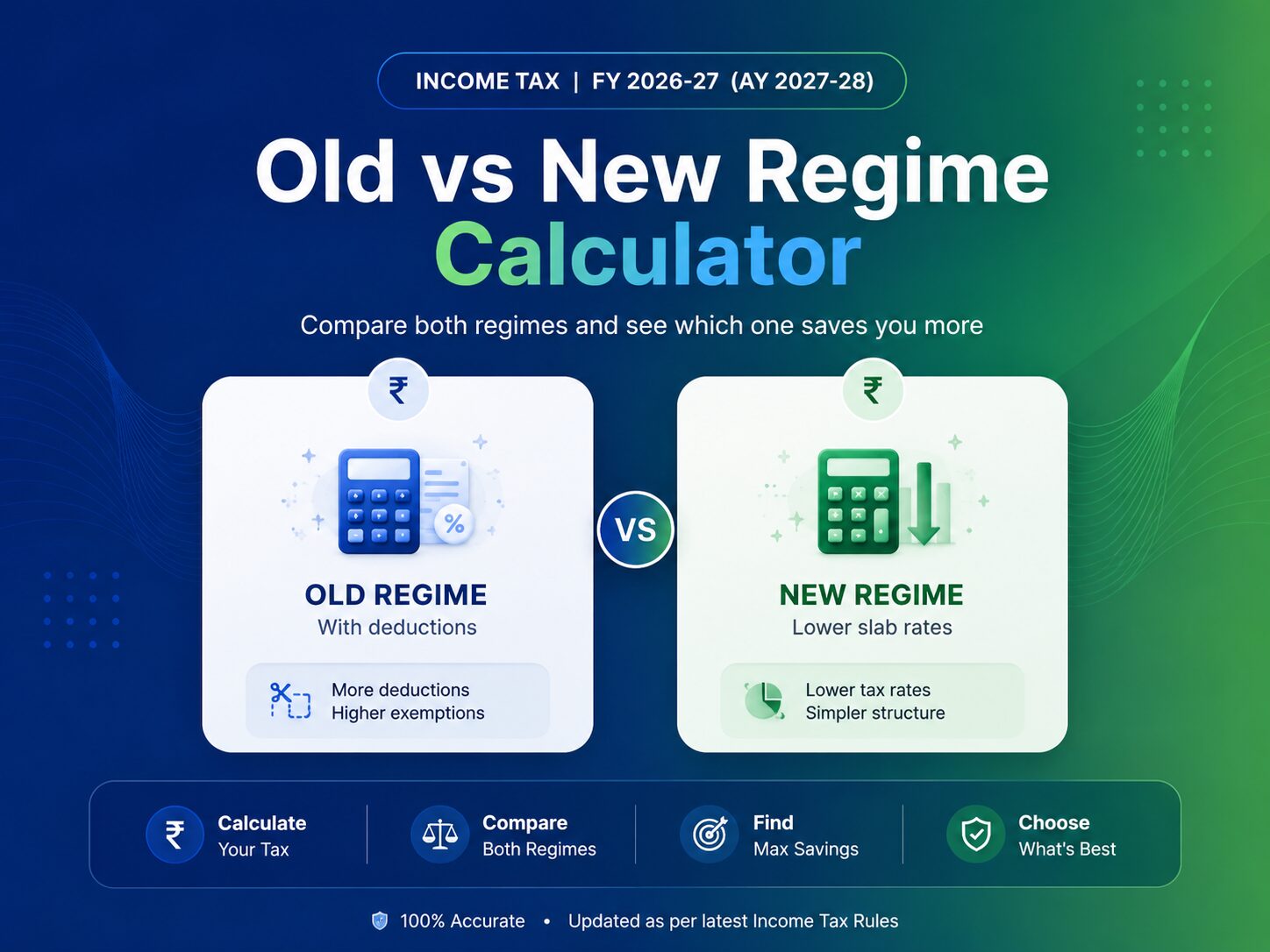
The honest answer is that there is no single winner. The right regime depends entirely on your income, your deductions, and how much you actually invest in tax-saving instruments. That is exactly why we built the calculator below. Punch in your numbers and it shows you both outcomes side by side for FY 2026-27 (Assessment Year 2027-28), then tells you which regime keeps more money in your pocket.
Below the tool, we break down the latest slabs, the deductions that still matter, the Section 87A rebate that makes income up to twelve lakh effectively tax free under the new regime, and real worked examples so you can see the logic for yourself.
💡 Executive Cheat Sheet: FY 2026-27 Tax Rules
- The ₹12.75 Lakh Threshold: If your gross salary is up to ₹12,75,000, the New Regime is a no-brainer. Your net tax will be ₹0 (after the ₹75,000 standard deduction and Section 87A rebate).
- The Break-Even Formula: Break-even depends on your income. Roughly: around ₹5.4 lakh of deductions at a ₹15L salary, ~₹7.1 lakh at ₹20L, ~₹8 lakh at ₹25L. Below ~₹12.75L gross, the new regime almost always wins. Use the live break-even below for your exact figure.
- Default Choice: Remember, the New Regime is now the default. You must actively choose the Old Regime with your employer or during filing to claim deductions.
Table of Contents
ToggleFY 2026-27 (AY 2027-28). Compare both regimes instantly.
Age Group
Income Type
Deductions and Exemptions
Old regime only
Estimates use FY 2026-27 slabs, the Section 87A rebate, surcharge with marginal relief, and 4% Health and Education Cess. Your actual liability can vary with employer structuring and special-rate income. Confirm with a tax professional before filing.
Old Regime vs New Regime: Deductions and Benefits Compared
Hover the question marks below to see what each item means. The old regime rewards you for claiming deductions, while the new regime trades most of them for lower slab rates and a far higher rebate ceiling. You can always confirm the current rules on the official income tax e-filing portal.
| Feature | Old Regime | New Regime |
|---|---|---|
| Section 80C (₹1.5L) ?Investments and payments up to ₹1,50,000 such as EPF, PPF, ELSS, life insurance and home loan principal. Allowed only in the old regime. | ✅ | ❌ |
| Section 80D (health insurance) ?Health insurance premiums for you, your family and senior-citizen parents, up to ₹1,00,000. Old regime only. | ✅ | ❌ |
| HRA exemption ?The tax-exempt part of House Rent Allowance when you live in rented accommodation. Old regime only. | ✅ | ❌ |
| Home loan interest 24(b) ?Interest on a home loan for a self-occupied property, up to ₹2,00,000 a year. Old regime only. | ✅ | ❌ |
| Employer NPS 80CCD(2) ?Your employer’s NPS contribution. Allowed as a deduction under both the old and new regimes. | ✅ | ✅ |
| Standard deduction (salaried) ?A flat deduction every salaried person and pensioner gets with no proof needed. ₹50,000 in the old regime, ₹75,000 in the new regime. | ₹50,000 | ₹75,000 |
| Section 87A rebate ceiling ?The highest taxable income at which the Section 87A rebate cuts your tax to zero. ₹5,00,000 under the old regime, ₹12,00,000 under the new regime. | Taxable income ₹5,00,000 | Taxable income ₹12,00,000 |
The new regime trades away most deductions for lower slab rates and a far higher rebate ceiling. Whether that wins depends on how much you actually claim, use the calculator above.
How the Old vs New Regime Calculator Works
The old vs new regime calculator runs your income through both tax structures at the same time. On the left you enter your details. On the right you instantly see two cards, one for each regime, with a clear verdict banner on top telling you the cheaper option and the exact rupee amount you save.
Here is what each input does:
- Age Group: Your basic exemption limit under the old regime changes with age. The calculator adjusts automatically for senior and super senior citizens.
- Income Type: Salaried employees and pensioners get a standard deduction, so the tool applies the correct figure to each regime.
- Annual Gross Income: Type your full yearly income, salary plus any other taxable income.
- Deductions: Enter what you claim under 80C, 80D, NPS, home loan interest, HRA, and other sections. These reduce your taxable income under the old regime only.
- Employer NPS 80CCD(2): This one is special because it counts as a deduction under both regimes, so it sits in its own field.
New Regime Tax Slabs for FY 2026-27
The new regime is now the default option, as notified by the Income Tax Department. It rewards people who do not claim many deductions, thanks to wider slabs and a generous rebate. For FY 2026-27 the rates are:
| Income Slab | Tax Rate |
|---|---|
| Up to ₹4,00,000 | Nil |
| ₹4,00,001 to ₹8,00,000 | 5% |
| ₹8,00,001 to ₹12,00,000 | 10% |
| ₹12,00,001 to ₹16,00,000 | 15% |
| ₹16,00,001 to ₹20,00,000 | 20% |
| ₹20,00,001 to ₹24,00,000 | 25% |
| Above ₹24,00,000 | 30% |
Salaried taxpayers and pensioners also get a standard deduction of ₹75,000 under the new regime. The headline feature is the Section 87A rebate: if your taxable income stays at or below ₹12,00,000, your tax is effectively zero. With the standard deduction stacked on top, a salaried person earning up to ₹12,75,000 can legally pay nothing.
Old Regime Tax Slabs for FY 2026-27
The old regime keeps its long-standing structure. It works best for people who claim substantial deductions through investments, insurance, home loans, and rent. The slabs for taxpayers below 60 are:
| Income Slab | Tax Rate |
|---|---|
| Up to ₹2,50,000 | Nil |
| ₹2,50,001 to ₹5,00,000 | 5% |
| ₹5,00,001 to ₹10,00,000 | 20% |
| Above ₹10,00,000 | 30% |
Senior citizens between 60 and 80 enjoy a higher basic exemption of ₹3,00,000, and super senior citizens above 80 get ₹5,00,000. The old regime offers a ₹50,000 standard deduction for the salaried, plus a Section 87A rebate that wipes out tax for taxable income up to ₹5,00,000.
The Deductions That Make or Break Your Decision
The whole old versus new debate comes down to one question: are your deductions large enough to beat the new regime’s lower rates? These are the heavy hitters available under the old regime:
- Section 80C (up to ₹1,50,000): Covers EPF, PPF, ELSS funds, life insurance premiums, principal repayment on a home loan, and children’s tuition fees.
- Section 80D (up to ₹1,00,000): Health insurance premiums for yourself, family, and senior citizen parents.
- Section 80CCD(1B) (up to ₹50,000): An extra deduction for contributions to the National Pension System, over and above 80C.
- Section 24(b) (up to ₹2,00,000): Interest paid on a home loan for a self-occupied property.
- House Rent Allowance: A major exemption for those living in rented homes.
Add these up and a salaried person can shield several lakh rupees from tax under the old regime. The new regime strips almost all of this away, keeping only the standard deduction and the employer NPS contribution under 80CCD(2). To plan these cash outflows across the year, our cash flow decision tool can help you see the full picture.
Worked Examples: Seeing the Math in Action
Numbers tell the story better than theory. Here are three salaried scenarios for FY 2026-27, all calculated the same way the old vs new regime calculator above does it.
Example 1: Income ₹12,00,000 with standard deductions
Say you earn ₹12 lakh and claim ₹1,50,000 under 80C, ₹25,000 under 80D, and ₹50,000 in NPS. Under the new regime, your taxable income after the ₹75,000 standard deduction is ₹11,25,000, which falls under the rebate ceiling, so your tax is ₹0. Under the old regime your taxable income is ₹9,25,000 and the tax works out to roughly ₹1,01,400 after cess. The new regime wins comfortably here.
Example 2: Income ₹20,00,000 with standard deductions
At ₹20 lakh with the same ₹2,25,000 of deductions, the new regime gives a taxable income of ₹19,25,000 and a total tax of about ₹1,92,400. The old regime lands at ₹17,25,000 taxable and roughly ₹3,43,200 in tax. The new regime saves you more than ₹1,50,000.
Example 3: Income ₹15,00,000 with heavy deductions of ₹7,00,000
Now flip the script. Imagine you have a home loan, max out 80C, pay hefty health premiums, and claim HRA, totalling ₹7 lakh in deductions. Under the old regime your taxable income drops to ₹7,50,000 and your tax is around ₹65,000. Under the new regime, with only the standard deduction, taxable income is ₹14,25,000 and tax climbs to about ₹97,500. Here the old regime wins by roughly ₹32,500. This is the classic case where heavy deductions tip the balance.
Example 4: Income ₹10,00,000 with standard deductions
Under the new regime, a gross salary of ₹10,00,000 is reduced by the ₹75,000 standard deduction to ₹9,25,000. Since this taxable income is under the ₹12,00,000 rebate ceiling under Section 87A, your net tax liability is ₹0. Under the old regime, even if you claim ₹1,50,000 under 80C and ₹25,000 under 80D (leaving ₹7,75,000 taxable), your tax works out to ₹70,200 after cess. The new regime is the clear winner here, saving you the entire ₹70,200.
Example 5: Income ₹25,00,000 with standard deductions
Say you earn ₹25,00,000 gross. Under the new regime, your taxable income after the ₹75,000 standard deduction is ₹24,25,000, which results in a total tax liability of ₹3,19,800. For the old regime to beat this, your total deductions (excluding the standard deduction) must exceed the break-even threshold of ₹8,00,000. If you claim standard deductions of ₹2,25,000 (80C, 80D, NPS), the new regime wins easily, saving you a massive ₹1,27,400.
So Which Regime Should You Choose?
There is a simple mental shortcut. The more deductions you genuinely claim, the more the old regime favours you. The fewer you claim, the more the new regime pulls ahead.
As a rough guide, the break-even rises with your income: it is about ₹5,43,750 of deductions on a ₹15,00,000 salary, around ₹7,08,333 at ₹20,00,000, and roughly ₹8,00,000 at ₹25,00,000. Below about ₹12,75,000 of gross salary the new regime almost always wins, even with no deductions. Once your deductions cross the break-even figure for your own income, the old regime starts to make sense. But do not rely on rules of thumb when you can get an exact answer. Enter your real numbers in the old vs new regime calculator above and let it do the comparison precisely.
A Word on Surcharge and Cess
High earners need to watch two extra layers. A surcharge applies once taxable income crosses ₹50,00,000, rising in steps of 10%, 15%, and 25%. The old regime can push the surcharge as high as 37% above ₹5 crore, while the new regime caps it at 25%, which is one more reason wealthy taxpayers often prefer the new structure. On top of the tax and surcharge, a 4% Health and Education Cess applies to everyone. The old vs new regime calculator factors in all of this, including marginal relief, so the totals you see are realistic.
Common Mistakes When Comparing Regimes
- Forgetting the standard deduction difference: The new regime gives ₹75,000 while the old gives ₹50,000. That gap matters.
- Counting deductions you never actually claim: Only enter what you really invest or spend. Aspirational numbers lead to a false comparison.
- Ignoring employer NPS: The 80CCD(2) contribution is valuable because it reduces tax under both regimes.
- Assuming last year’s choice still holds: Slabs and rebates change. A regime that won last year may lose this year.
See all our free tax calculators and tools
Frequently Asked Questions (FAQs)
1. Is the new tax regime now the default for FY 2026-27?
Yes. The new regime is the default option. If you want to be taxed under the old regime, you must actively choose it when you file or when you declare investments to your employer. Salaried taxpayers can generally switch between the two each year.
2. Can I really pay zero tax on a twelve lakh income?
Under the new regime, if your taxable income is at or below ₹12,00,000, the Section 87A rebate brings your tax to zero. For a salaried person, the ₹75,000 standard deduction means a gross salary of up to ₹12,75,000 can result in no tax at all, provided no special-rate income is involved.
3. Which regime is better for someone with a home loan?
A home loan often tips the scales toward the old regime because you can claim up to ₹2,00,000 in interest under Section 24(b) plus principal repayment under 80C. Combined with other deductions, this frequently beats the new regime. Run both through the calculator to be sure.
4. Do senior citizens benefit more from the old regime?
Senior citizens get a higher basic exemption under the old regime, ₹3,00,000 for those aged 60 to 80 and ₹5,00,000 for those above 80. If they also claim deductions like 80D for health insurance, the old regime can be attractive. The new regime, however, offers the same flat slabs regardless of age, so the comparison still depends on individual numbers.
5. Does the calculator account for surcharge and cess?
Yes. It applies the 4% Health and Education Cess to both regimes and adds surcharge for incomes above ₹50 lakh, including marginal relief where applicable. This gives you a realistic total rather than just the base tax.
6. How accurate are these results?
The old vs new regime calculator uses the FY 2026-27 slabs, rebate limits, and surcharge rules published by the Income Tax Department, so the core math is precise. That said, your final liability can be affected by special-rate income such as capital gains, employer salary structuring, or specific exemptions unique to your situation. Treat the result as a strong estimate and confirm with a tax professional before filing.
Take Control of Your Tax Planning
Choosing between the old and new regime is one of the most consequential money decisions you make each year, yet most people guess instead of calculating. A few minutes with the old vs new regime calculator above replaces that guesswork with a clear, rupee-exact answer for FY 2026-27.
Once you know your number, you can plan your investments, structure your salary, and time your spending with confidence. For more tools to sharpen your financial decisions, explore our cash flow decision tool and our advanced EMI loan calculator to plan any borrowing alongside your tax strategy.
Related calculators
- HRA exemption calculator for the old regime
- Capital gains tax calculator for shares, property and gold
- Advance tax estimator with due dates
- ITR form finder to pick the right return
Official reference: Income-tax Act, 2025 (as amended by the Finance Act, 2026), Income Tax Department.
Related free calculators: take-home salary calculator, ITR-1 (Sahaj) guide.
For the full slab-by-slab breakdown behind these numbers, see our income tax slab rates FY 2026-27 guide.