
GPT-6.2 Astra is OpenAI’s new frontier model, and it costs 20% less per token than the GPT-6 Astra it replaces. On Agents’ Last Exam, a test of long professional workflows, it scores 78.3% against 73.1% for GPT-6 Astra and 72.8% for Claude Fable 5.2. OpenAI’s chart puts its cost at $2.89 per task, against $8.99 for GPT-6 Astra and $60.05 for Fable 5.2. Its everyday sibling, GPT-6.2 Sol, keeps GPT-6.1 Sol’s price of $2 in and $10 out per million tokens and gets better at almost everything.
OpenAI released GPT-6.2 Astra and GPT-6.2 Sol on 17 November 2026. Astra is pitched as the model for your hardest projects, Sol as the efficient model for everyday work. OpenAI says both reach better results with fewer output tokens, which is where most of the saving comes from. In ChatGPT they arrive in ChatGPT Work and Codex, not regular Chat, for Plus, Pro, Business, Enterprise and Edu users. Developers get them in the API as gpt-6.2-astra and gpt-6.2-sol.
It is not a clean sweep. On OpenAI’s own charts, Claude Fable 5.2 still leads the Artificial Analysis Intelligence Index, FrontierCode 2.0 and BenchCAD, and Google’s Gemini 4 Carbon edges Astra on AutomationBench. OpenAI also rates both models Critical for cybersecurity, so some legitimate security work will be refused. Below you will find every launch benchmark, most with OpenAI’s official chart, the cost per task at each effort level and full pricing. We also compare Astra and Sol with Fable 5.2 and Gemini 4 Carbon, and explain what the release means for finance and accounting teams.
GPT-6.2 Astra and Sol: the short answer
GPT-6.2 Astra and Sol against GPT-6 Astra and Claude Fable 5.2, on OpenAI’s launch charts:
Each model’s best score on OpenAI’s launch charts and the cost per task at that setting (Astra peaks at xhigh effort on Agents’ Last Exam; the others at max). Results as published by OpenAI. Bold marks the best value in each row. Prices are per million input and output tokens, from each vendor’s price list on 18 November 2026.
| Fact | GPT-6.2 Astra | GPT-6.2 Sol |
|---|---|---|
| Released | 17 November 2026 | 17 November 2026 |
| OpenAI’s pitch | Frontier model for your hardest projects | Efficient, versatile model for everyday work |
| Replaces | GPT-6 Astra (September 2026) | GPT-6.1 Sol |
| API model ID | gpt-6.2-astra |
gpt-6.2-sol |
| Input / cached input / output | $8 / $0.40 / $40 per 1M tokens | $2 / $0.10 / $10 per 1M tokens |
| Change from the previous model | 20% cheaper input and output, 60% cheaper cached input | Same price as GPT-6.1 Sol |
| Context window | 1,050,000 tokens (922,000 max input) | 1,050,000 tokens (922,000 max input) |
| Max output | 128,000 tokens | 128,000 tokens |
| Knowledge cutoff | 18 May 2026 | 1 June 2026 |
| Input and output | Text and images in, text out | Text and images in, text out |
| Reasoning effort | Low to max; the API rejects none |
Low to max; the API rejects none |
| In ChatGPT | ChatGPT Work and Codex (not regular Chat): Plus, Pro, Business, Enterprise, Edu | ChatGPT Work and Codex (not regular Chat): Plus, Pro, Business, Enterprise, Edu |
| Ultrafast | Pro 500, eligible Enterprise and Edu workspaces, and the API | Pro 500, Pro 200 (in Codex), eligible Enterprise and Edu workspaces, and the API |
| Fine-tuning | Not supported | Not supported |
| Preparedness ratings | Critical cyber, High bio and chem, High AI self-improvement | Critical cyber, High bio and chem, below High on AI self-improvement |
If you run GPT-6 Astra today, the move is easy to justify: GPT-6.2 Astra scores higher on all 13 benchmark charts in OpenAI’s launch post, costs less per token and usually far less per task. If you run GPT-6.1 Sol, the upgrade to GPT-6.2 Sol costs nothing per token. If you run Claude, it is a closer call, and the comparison section below is the place to look. For how these models rank on independent tests, see our live AI leaderboard. We will add GPT-6.2 Astra and Sol there once independent scores are in.
What is new in GPT-6.2 Astra and Sol
OpenAI frames the release as a new standard for professional work. Against GPT-6 Astra and GPT-6.1 Sol, eight things changed:
- Better results from fewer tokens. On GDPval v2, OpenAI’s test of multistep assignments from real consulting, finance and design projects, Astra gains 6.2 points over GPT-6 Astra while using 22% fewer output tokens. Sol gains 5.4 points over GPT-6.1 Sol (46.9% against 41.5%).
- A lower price for Astra. Input falls from $10 to $8 per million tokens and output from $50 to $40. Cached input falls by 60%, from $1.00 to $0.40. Sol stays at $2 and $10.
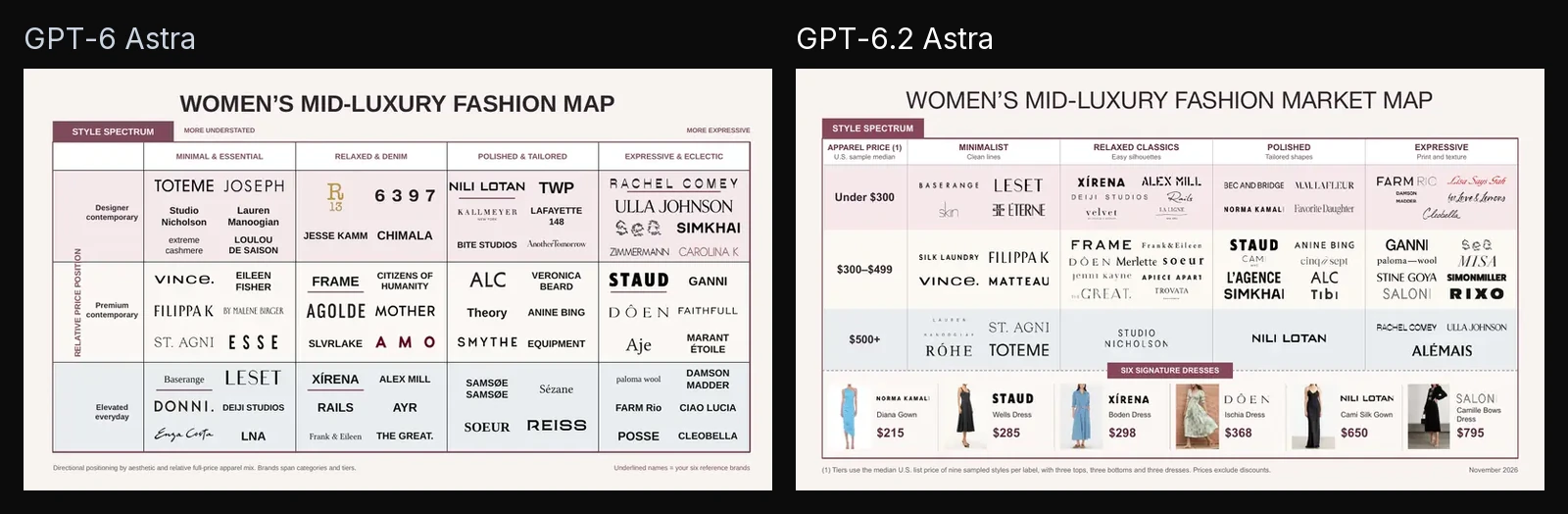
- Office files that look professional. OpenAI says Astra’s slides, spreadsheets and documents read less like AI, follow your templates more closely and match the conventions of fields such as law, sales, finance and accounting.
- Slide templates matched from a screenshot. OpenAI says that, given a template file or even a screenshot, Astra can match the layout, colours and typography down to the font size, and carry the template’s writing style into new slides.
- Science and law. Astra sets new highs on Terminal-Bench-Science and the Vals Science Index, and more than doubles Claude Fable 5.2’s pass rate on Harvey’s legal benchmark. OpenAI calls it the best model in the world for scientists.
- More precise computer use. OpenAI says Astra can work down to individual parts and connections in CAD and simulation tools, and leads Artificial Analysis’s blind 3D test with 1,318 Elo.
- Cleaner code. Early testers report cleaner code style, more focused tests and fewer rounds of revision. Sol comes within 0.5 points of Astra on FrontierCode 2.0 (44.2% against 43.8%) at about one-fifth of the cost.
- Stronger safeguards. Like GPT-6 Astra, both models meet OpenAI’s Critical threshold for cybersecurity, and Astra is the first model OpenAI has released externally that meets the High threshold for AI self-improvement. Both ship with tighter cyber restrictions.
The partner quotes in the launch post point the same way. Basis, an AI company working in accounting, says its average time for long accounting work fell by 50%, and by up to 73% for the most complex work. ClickUp says Astra edged out its production model in blind testing while using about 40% fewer tokens and 30% fewer review rounds. Harvey says it completed more than three times as many Legal Agent Benchmark tasks as GPT-6 Astra with 34.5% fewer output tokens. These are vendor-selected quotes, not independent tests, but they all describe the same change: more finished work per token.
GPT-6.2 Astra vs GPT-6.2 Sol: which is which
OpenAI ships two models, not one model with two names. Astra is the frontier model and the more expensive one. Sol costs a quarter as much per token and, on several of OpenAI’s charts, comes closer to Astra than the price gap suggests.
| GPT-6.2 Astra | GPT-6.2 Sol | |
|---|---|---|
| Best for | The hardest projects: long agent runs, science, legal and financial deliverables, 3D and CAD | Everyday work: coding, writing, agents at scale, personal tasks |
| Price per 1M tokens | $8 in, $40 out | $2 in, $10 out |
| Agents’ Last Exam (best) | 78.3% at $2.89 per task | 73.0% at $1.32 per task |
| FrontierCode 2.0 (max) | 44.2% at $5.97 per task | 43.8% at $1.29 per task |
| GDPval v2 (max) | 50.4% | 46.9% |
| LifeVal (max) | 86.1% at $4.23 per task | 83.8% at $1.27 per task |
| AutomationBench (best) | 52.4% at $0.83 per task | 41.2% at $0.21 per task |
| Knowledge cutoff | 18 May 2026 | 1 June 2026 |
| Ultrafast in ChatGPT | Pro 500 | Pro 500, and Pro 200 in Codex |
| OpenAI’s own usage | Not stated | Many OpenAI employees use it as their default model for technical and non-technical tasks |
The pattern is clear. On coding, Sol nearly matches Astra at roughly a fifth of the cost. On everyday tasks, it beats GPT-6 Astra. Astra earns its price on the long, judgement-heavy work: business workflows, science, legal deliverables and office files that must be right first time.
GPT-6.2 Astra and Sol benchmarks: the official launch charts
OpenAI’s launch post charts 13 scored benchmarks. Eleven plot score against cost per task and two (GDPval v2 and ExploitBench) plot score against output tokens; some rivals appear at one effort level only. The table pulls out each model’s best score from those charts. An n/a means OpenAI did not chart that model on that test.
| Benchmark | What it tests | GPT-6.2 Astra | GPT-6.2 Sol | GPT-6 Astra | GPT-6.1 Sol | Claude Fable 5.2 | Claude Opus 5.5 | Gemini 4 Carbon |
|---|---|---|---|---|---|---|---|---|
| Agents’ Last Exam v1.1 | Long, multistep professional workflows | 78.3% | 73.0% | 73.1% | 72.5% | 72.8% | 71.6% | 77.4% |
| GDPval v2 (OpenAI internal) | Multistep assignments from real consulting, finance and design projects | 50.4% | 46.9% | 44.2% | 41.5% | 44.8% | 43.5% | 48.8% |
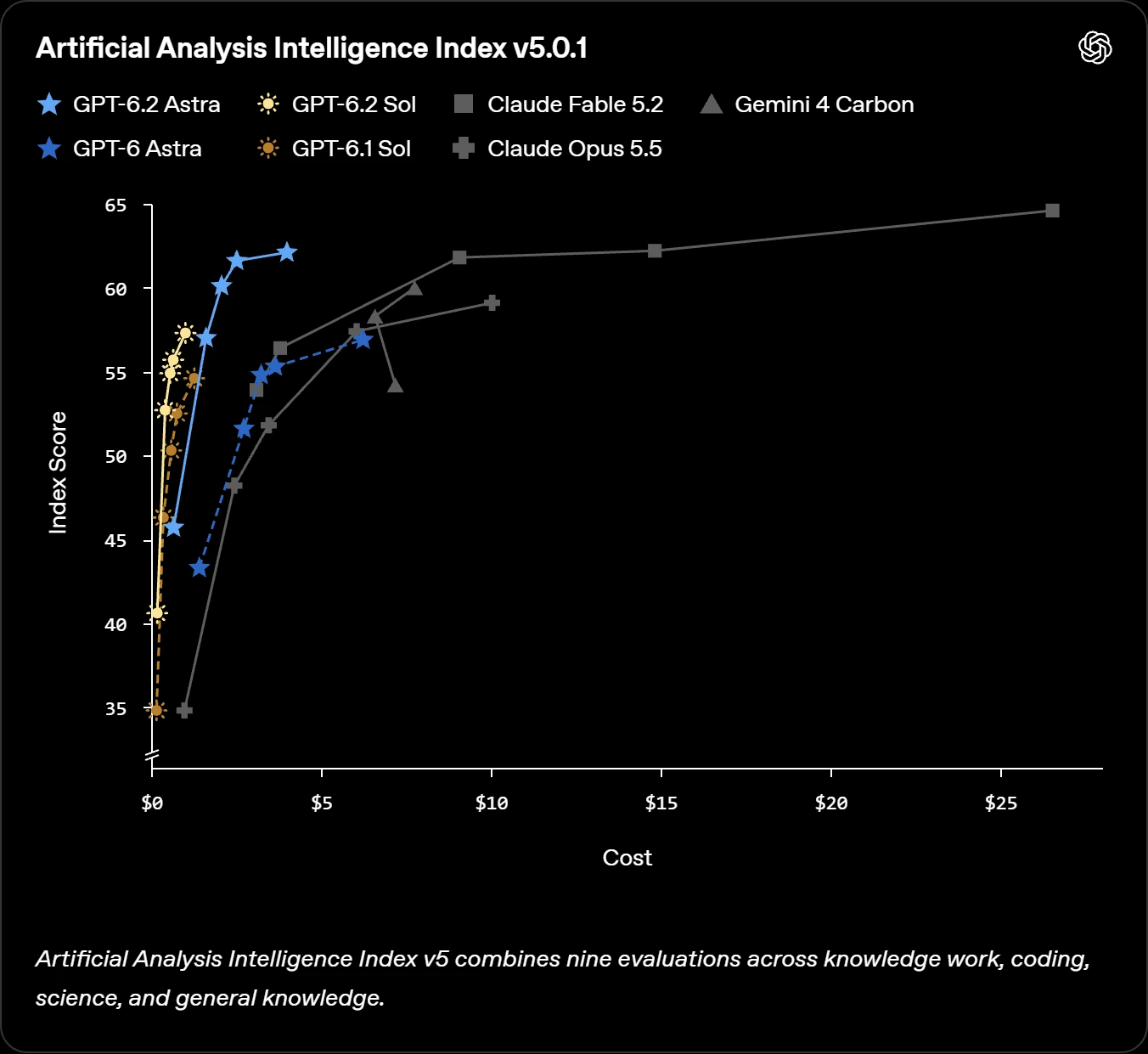
| Artificial Analysis Intelligence Index v5.0.1 | Nine evaluations across knowledge work, coding, science and general knowledge | 62.1 | 57.3 | 56.9 | 54.6 | 64.6 | 59.1 | 60.0 |
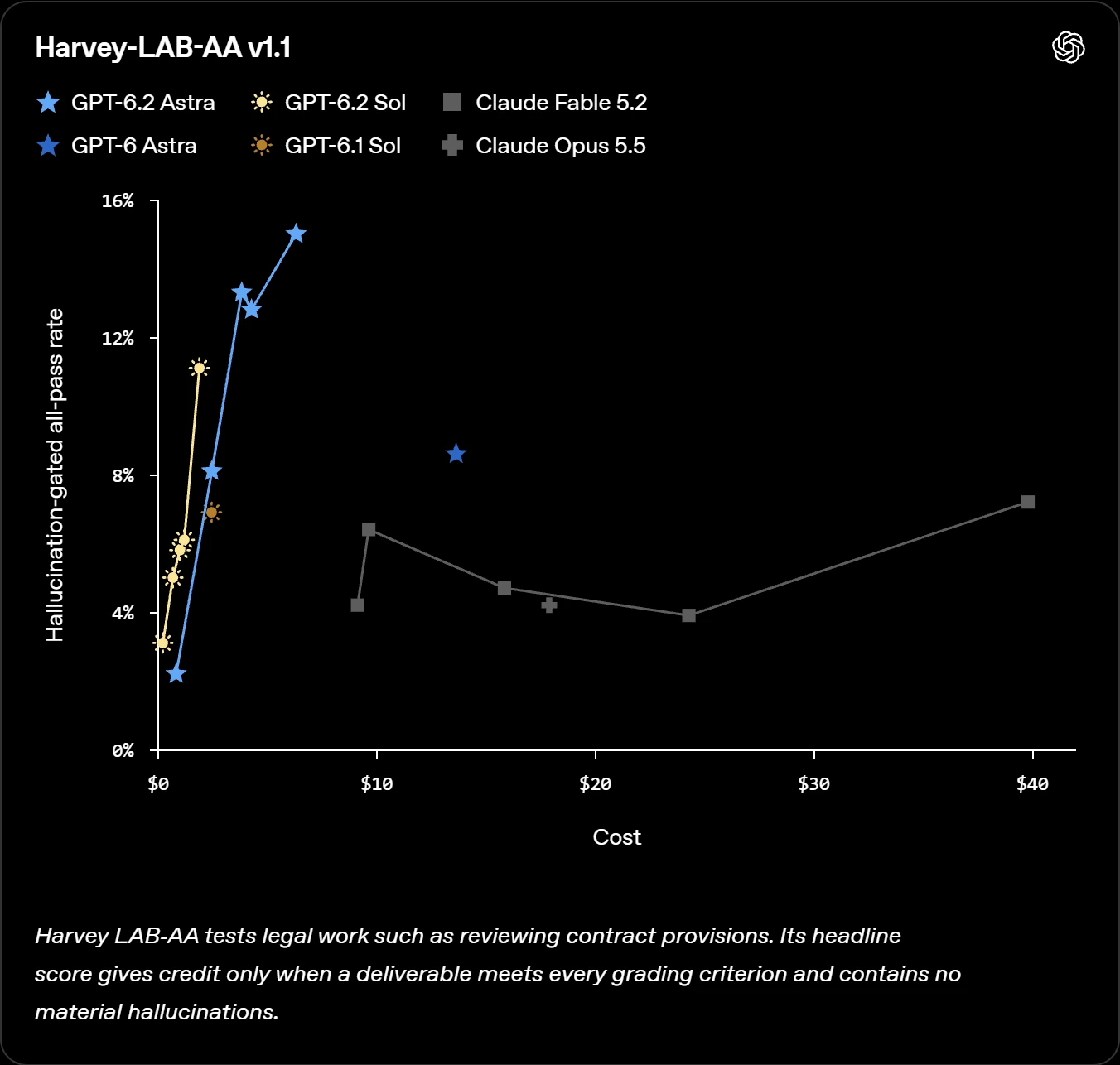
| Harvey LAB-AA v1.1 | Legal deliverables that meet every requirement with no material hallucination | 15.0% | 11.1% | 8.6% | 6.9% | 7.2% | 4.2% | n/a |
| Terminal-Bench-Science 0.1 | Scientific research work in a terminal | 77.1% | 68.0% | 68.1% | 57.0% | 73.3% | 63.3% | n/a |
| Vals Science Index v1 | Interpreting real biological data and running experiments | 68.4% | 58.5% | 65.1% | 59.6% | 63.7% | 58.7% | n/a |
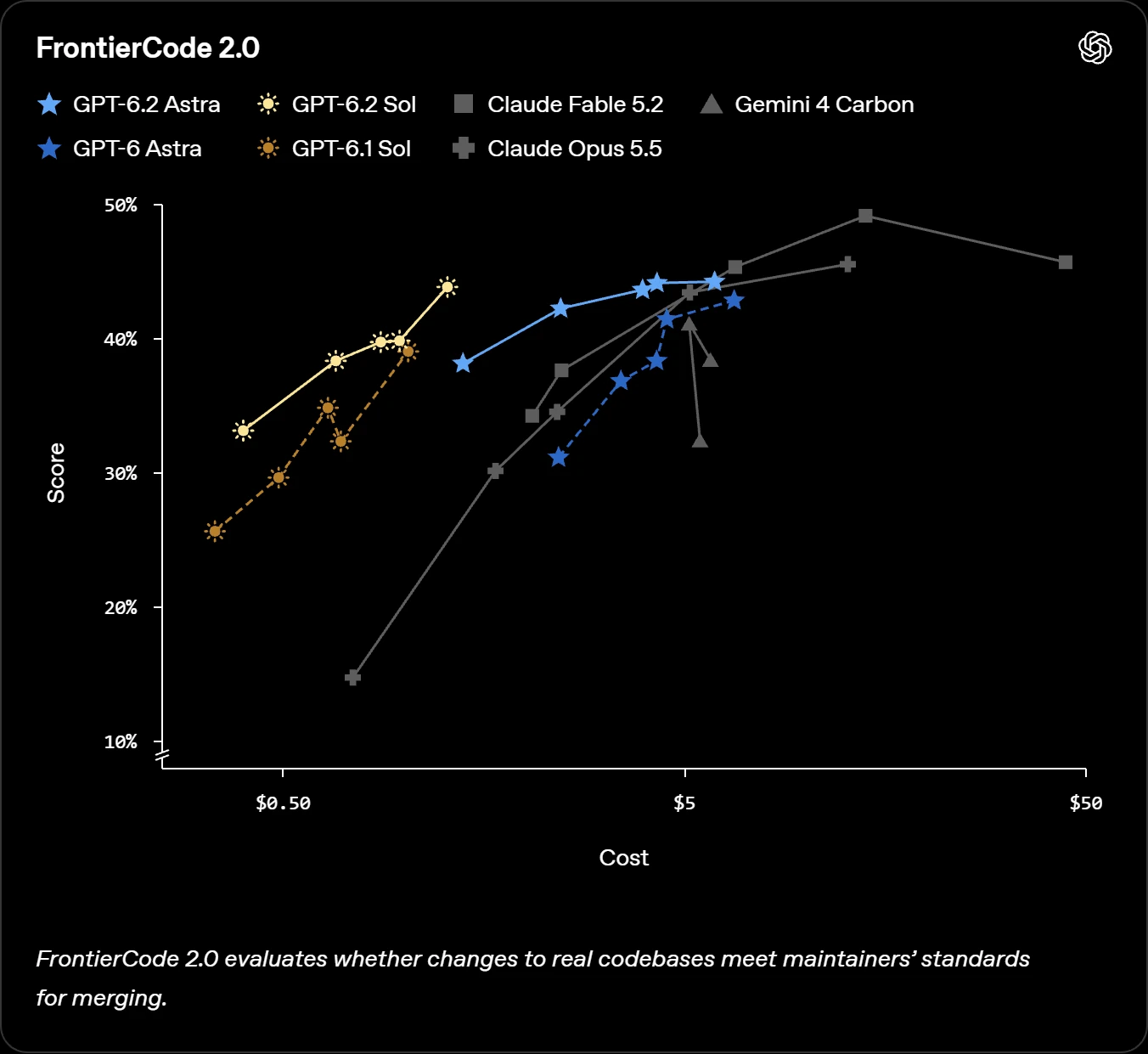
| FrontierCode 2.0 | Code changes that real maintainers would merge | 44.2% | 43.8% | 42.8% | 39.0% | 49.1% | 45.5% | 41.1% |
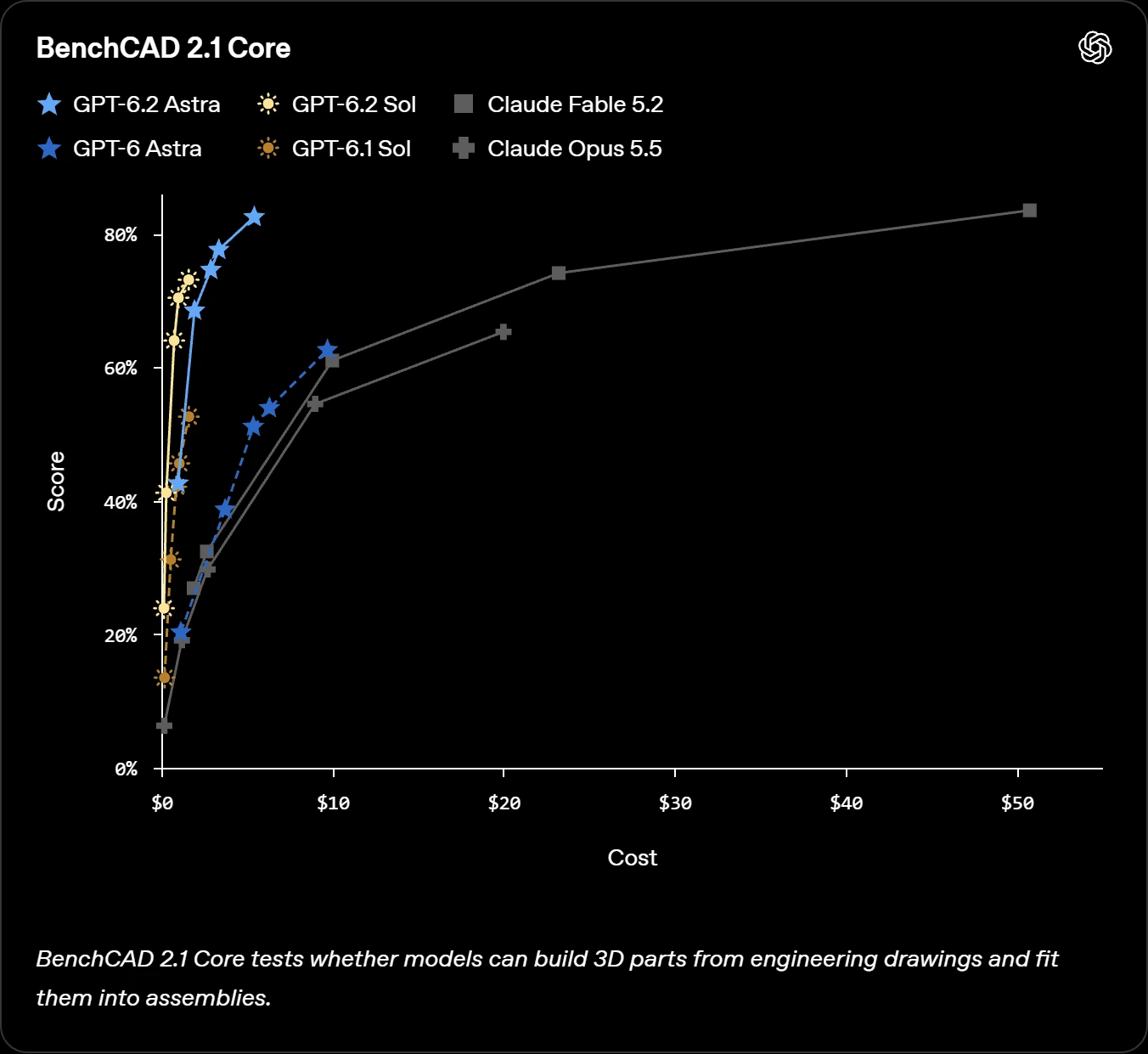
| BenchCAD 2.1 Core | Building 3D parts from engineering drawings | 82.5% | 73.1% | 62.6% | 52.6% | 83.5% | 65.3% | n/a |
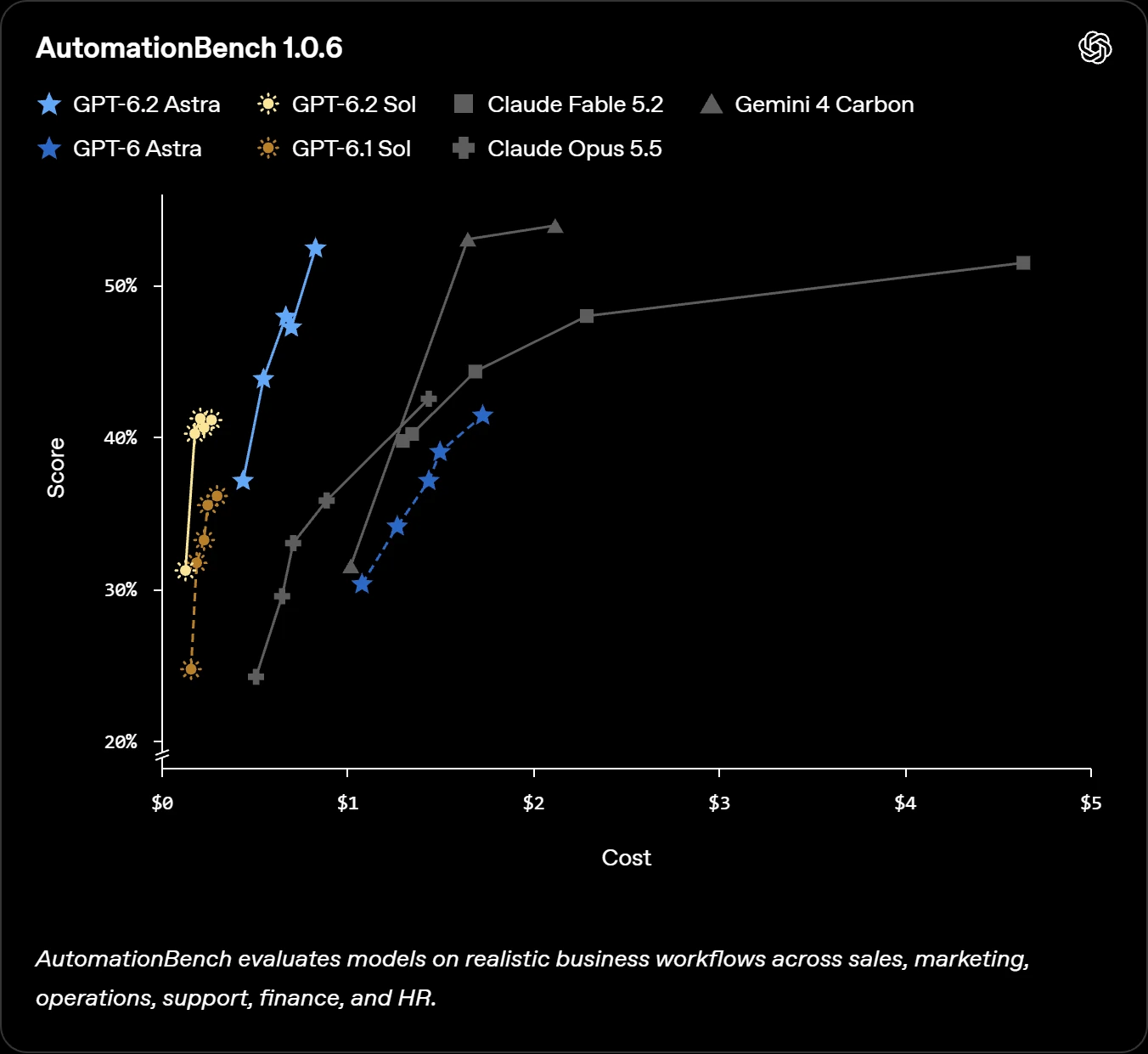
| AutomationBench 1.0.6 | Business workflows across sales, marketing, operations, support, finance and HR | 52.4% | 41.2% | 41.4% | 36.1% | 51.4% | 42.5% | 53.9% |
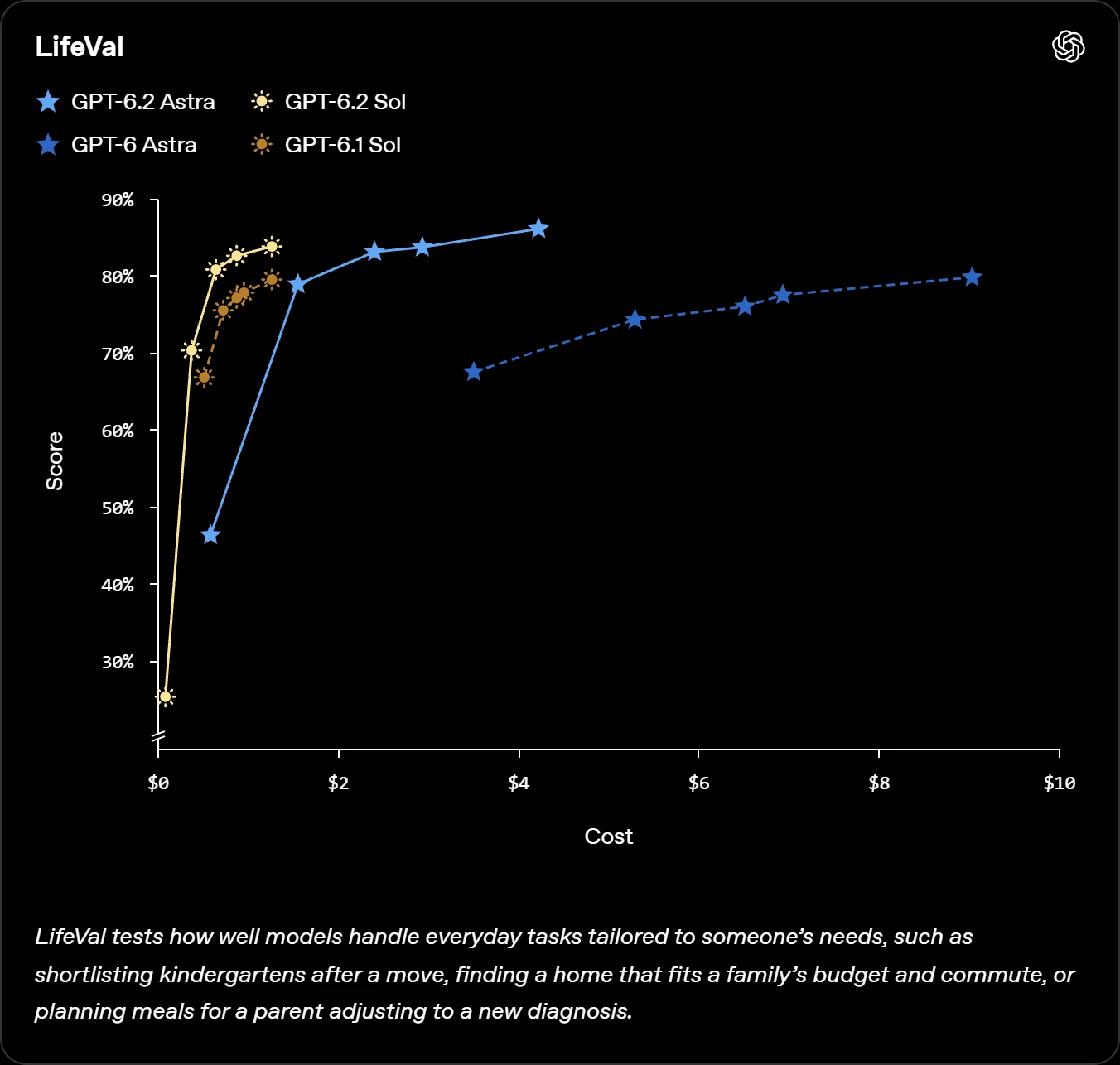
| LifeVal | Challenging everyday tasks tailored to one person | 86.1% | 83.8% | 79.8% | 79.5% | n/a | n/a | n/a |
| SecureSWE (OpenAI internal) | Writing code that works and is secure | 65.7% | 55.6% | 48.7% | 49.7% | n/a | n/a | n/a |
| PatchBench | Security patches that fix the flaw and keep the intended behaviour | 79.7% | 75.6% | 70.9% | 71.0% | n/a | n/a | n/a |
| ExploitBench Internal Port | Turning known browser flaws into working exploits | 53.5% | 50.5% | 31.5% | 21.5% | n/a | n/a | n/a |
Two things stand out. Astra is first on 9 of the 13 benchmark charts, though four of those (LifeVal, SecureSWE, PatchBench and ExploitBench) show only OpenAI models. On the nine charts that include rivals it leads five; where it loses, the leader is Claude Fable 5.2 at two to nine times the cost, or Gemini 4 Carbon by 1.5 points. And Sol, the cheap model, beats GPT-6 Astra on 9 of the 13 charts and is within 0.2 points of it on three of the other four.
Agents’ Last Exam: long professional workflows
Agents’ Last Exam evaluates models on long-horizon professional workflows, and it is the headline result. Astra peaks at 78.3% at xhigh effort, 5.2 points above GPT-6 Astra’s best and 5.5 points above Claude Fable 5.2. The cost gap is the bigger story: $2.89 per task for Astra against $8.99 for GPT-6 Astra and $60.05 for Fable 5.2, which is less than a third and about 5% of the cost.
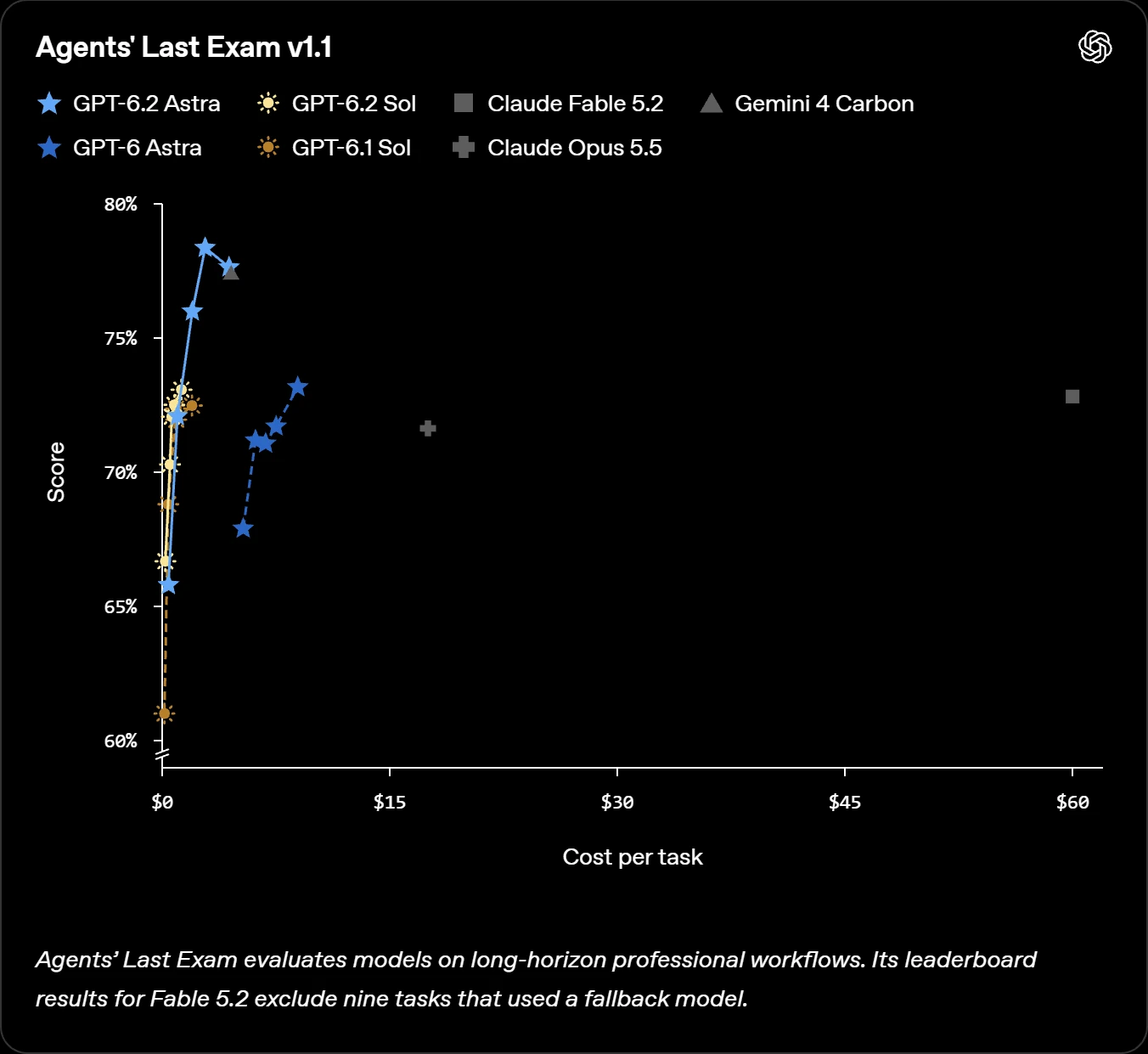
Gemini 4 Carbon is the closest rival here at 77.4% for $4.60 per task, and Astra at max effort (77.6%) scores slightly less than at xhigh while costing more. That is worth knowing before you set every request to the top effort level.
GDPval v2 and the Intelligence Index
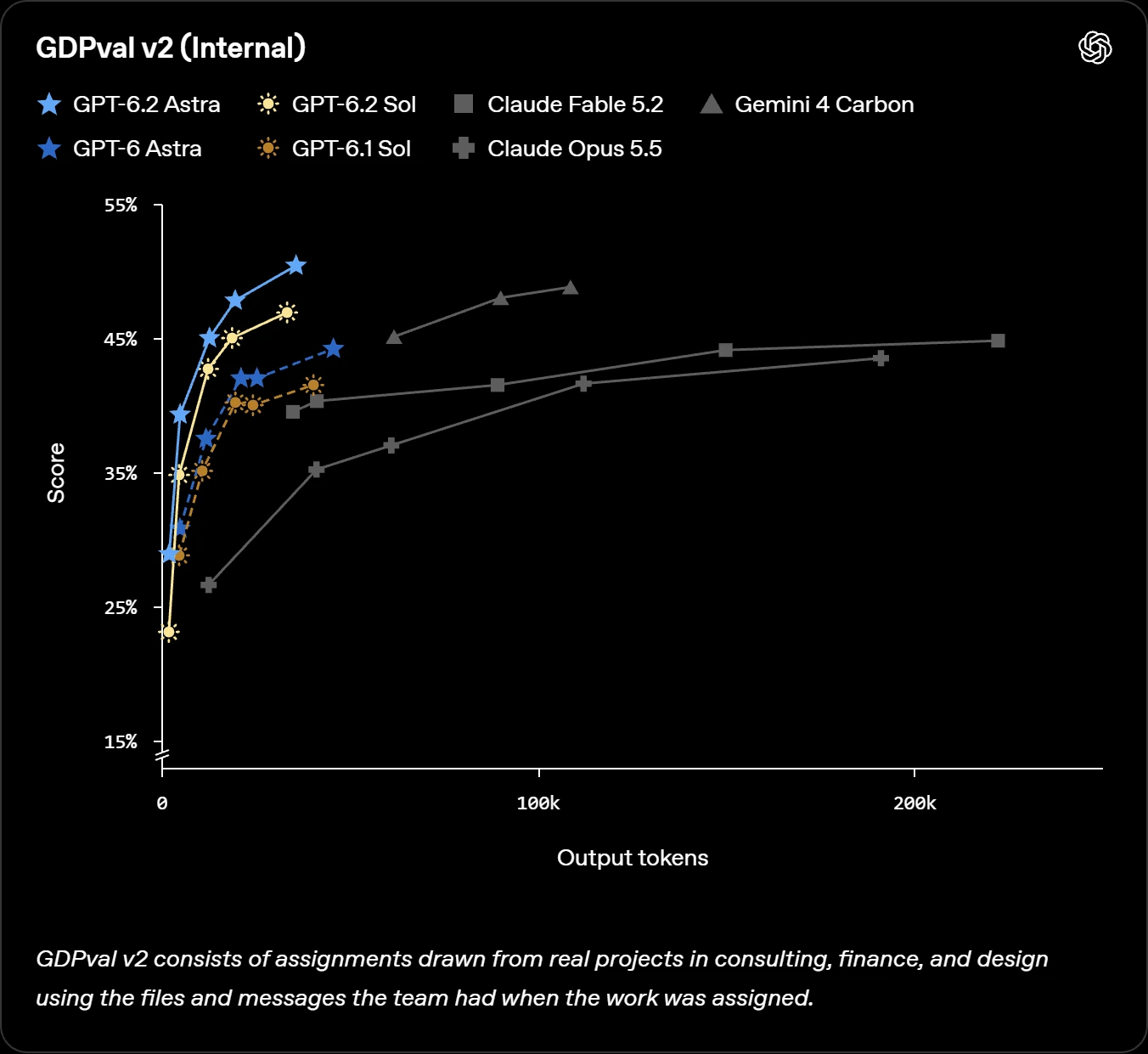
GDPval v2 is OpenAI’s internal successor to GDPval, built from multistep assignments in consulting, finance and design, using the files and messages the original team had. Astra leads the models OpenAI tested at 50.4%, ahead of Gemini 4 Carbon at 48.8% and Claude Fable 5.2 at 44.8%. It is OpenAI’s own benchmark, so treat the ranking with care; the gain over GPT-6 Astra (6.2 points, with 22% fewer output tokens) is the more reliable signal.
The Artificial Analysis Intelligence Index, a third-party composite, is the nearest thing to a neutral check in the launch charts, though OpenAI chose to show it. It combines nine evaluations across knowledge work, coding, science and general knowledge, and here Claude Fable 5.2 still leads at 64.6 against Astra’s 62.1. On the chart’s cost axis, Astra gets there for $4.00 against $26.54 for Fable 5.2, and it moves ahead of Gemini 4 Carbon (60.0) and Claude Opus 5.5 (59.1). Sol scores 57.3 for about a dollar.
Science: Terminal-Bench-Science and the Vals Science Index
OpenAI calls Astra the best model in the world for scientists. On Terminal-Bench-Science 0.1, which tests scientific work in a terminal, Astra scores 77.1%, 9 points above GPT-6 Astra at less than a third of the cost ($7.15 against $23.80 per task). On the Vals Science Index, where models interpret real biological data and run experiments on a simulated system, Astra leads at 68.4%.
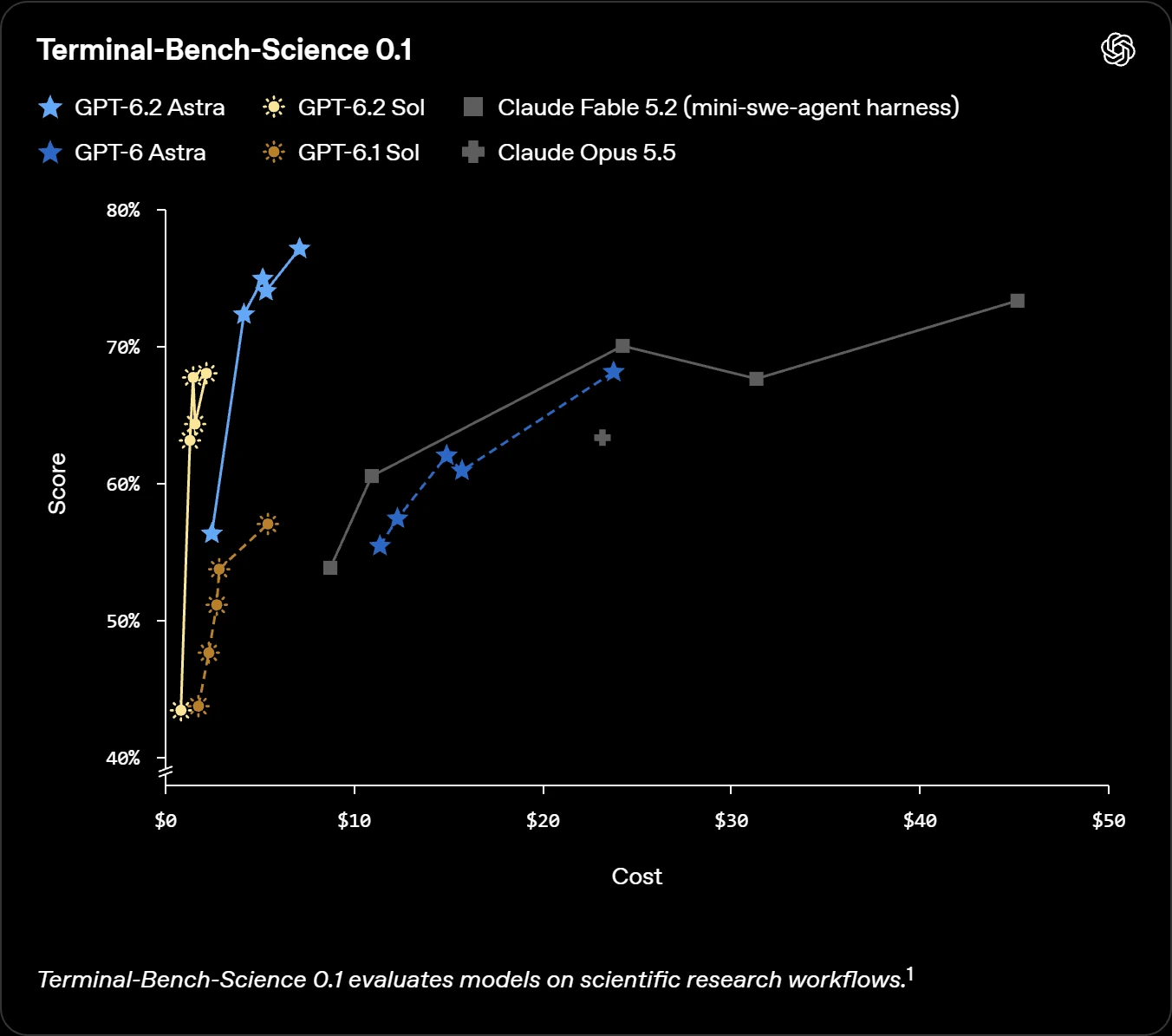
One caveat on the Fable comparison: OpenAI’s chart uses Artificial Analysis’s run of Fable 5.2 in the mini-swe-agent harness, which scored 73.3%. Anthropic reported 74.6% for Fable 5.2 at max effort in Claude Code. Astra is ahead either way, but by less than the chart suggests.
Legal work: Harvey LAB-AA
Harvey LAB-AA v1.1 uses legal assignments that test whether a model can find the relevant facts across source documents, apply them to a detailed brief and produce an accurate deliverable. It only gives credit when the deliverable meets every grading criterion and contains no material hallucinations, which is why the scores are low. Astra passes 15.0%, more than double Claude Fable 5.2’s 7.2%, at about one-sixth of the cost per task ($6.35 against $39.84). OpenAI says Astra for Law, its configuration of Astra for lawyers, scores higher still.
Coding: FrontierCode 2.0
Cognition’s FrontierCode 2.0 checks whether changes to real codebases meet maintainers’ standards for merging. This is where OpenAI’s new models do not lead: Claude Fable 5.2 scores 49.1% and Claude Opus 5.5 45.5%, against 44.2% for Astra. The interesting result is Sol at 43.8%, within 0.5 points of Astra at about one-fifth of the cost ($1.29 against $5.97 per task).
3D and business automation: BenchCAD and AutomationBench
BenchCAD 2.1 Core tests whether a model can build 3D parts from engineering drawings. Claude Fable 5.2 leads at 83.5%, a point above Astra’s 82.5%, but Fable needs $50.77 per task for that score and Astra $5.43. Against GPT-6 Astra (62.6%), the jump is 20 points.
AutomationBench 1.0.6 tests realistic business workflows across sales, marketing, operations, support, finance and HR. Gemini 4 Carbon leads at 53.9%, with Astra at 52.4% and Claude Fable 5.2 at 51.4%. Astra is the cheapest of the three by a wide margin: $0.83 per task against $2.12 for Carbon and $4.64 for Fable 5.2.
Everyday tasks: LifeVal
LifeVal is OpenAI’s recently released test of challenging everyday tasks tailored to one person, such as shortlisting kindergartens after a move or planning meals for a parent with a new diagnosis. Only OpenAI models are charted. Sol scores 83.8%, ahead of GPT-6 Astra’s 79.8%, at about one-seventh of the cost per task ($1.27 against $9.04). Astra tops the chart at 86.1%.
The fine print behind the charts
- OpenAI chose every test. Several are OpenAI’s own (GDPval v2, LifeVal, SecureSWE). Others are third-party benchmarks, some reported by Artificial Analysis. OpenAI does not say who ran each one, and none is an independent review of the launch.
- Best score is not one setting. Each model’s best score can come from a different effort level. Astra’s Agents’ Last Exam peak is at xhigh; most others peak at max.
- Cost per task depends on price and tokens. It reflects each vendor’s list price and how many tokens the model spent. A model that thinks longer can cost more per task even at the same token price, which is what happens with Fable 5.2.
- Fable 5.2 has two footnotes. Its Agents’ Last Exam result excludes nine tasks that used a fallback model, and its Terminal-Bench-Science score is Artificial Analysis’s run in the mini-swe-agent harness, not Anthropic’s own 74.6% in Claude Code.
- Gemini 4 Carbon appears on only five charts. Carbon was run at low to high effort; where it is missing, OpenAI did not chart it.
- No independent leaderboard entries yet. We will update this post and our AI leaderboard when Artificial Analysis and LMArena publish their own results for the new models.
GPT-6.2 Astra and Sol cost per task at every effort level
Price per token only tells you half the story. What you pay for a finished task depends on how many tokens the model spends getting there, and OpenAI’s main claim is that both new models spend fewer. OpenAI’s charts give the cost per task at five effort levels, from low to max, so you can see where the extra spend stops paying.
| Model | Best score (effort) | Cost per task at that score |
|---|---|---|
| Claude Fable 5.2 | 72.8% (max) | $60.05 |
| Claude Opus 5.5 | 71.6% (max) | $17.57 |
| GPT-6 Astra | 73.1% (max) | $8.99 |
| Gemini 4 Carbon | 77.4% (high) | $4.60 |
| GPT-6.2 Astra | 78.3% (xhigh) | $2.89 |
| GPT-6.1 Sol | 72.5% (max) | $2.02 |
| GPT-6.2 Sol | 73.0% (max) | $1.32 |
At its best Agents’ Last Exam score, Astra costs $2.89 per task. Claude Fable 5.2 costs $60.05 for a lower score, about 21 times as much. Run 1,000 tasks like these and the bill is about $2,890 on Astra, $1,325 on Sol, $8,992 on GPT-6 Astra and $60,050 on Fable 5.2. These are OpenAI’s numbers on OpenAI’s chosen test, and OpenAI does not publish how it computed cost per task, so treat the exact multiples with care. Even so, the gap is large.
Agents’ Last Exam at each effort level
| Effort | GPT-6.2 Astra | GPT-6.2 Sol | GPT-6 Astra | GPT-6.1 Sol |
|---|---|---|---|---|
| Low | 65.8% at $0.47 | 66.7% at $0.27 | 67.9% at $5.40 | 61.0% at $0.21 |
| Medium | 72.1% at $1.06 | 70.3% at $0.57 | 71.2% at $6.21 | 68.8% at $0.46 |
| High | 76.0% at $2.05 | 72.0% at $0.69 | 71.0% at $6.87 | 72.3% at $0.98 |
| Xhigh | 78.3% at $2.89 | 72.5% at $0.86 | 71.7% at $7.56 | 71.9% at $0.98 |
| Max | 77.6% at $4.47 | 73.0% at $1.32 | 73.1% at $8.99 | 72.5% at $2.02 |
GPT-6.2 Astra on Agents’ Last Exam v1.1: cost per task and score at each effort level, from OpenAI’s chart. The labels are ReconScribe’s reading of the numbers, not OpenAI’s advice.
Two practical points follow. First, max effort is not automatically best: on this test Astra’s max setting costs 55% more than xhigh and scores 0.7 points less. Second, Astra at high effort already beats GPT-6 Astra at max: 76.0% for $2.05 against 73.1% for $8.99. If you are moving from GPT-6 Astra, you can probably drop an effort level and still come out ahead.
Coding and legal work at each effort level
| Effort | GPT-6.2 Astra | GPT-6.2 Sol | GPT-6 Astra |
|---|---|---|---|
| Low | 38.1% at $1.41 | 33.1% at $0.40 | 31.1% at $2.44 |
| Medium | 42.2% at $2.47 | 38.3% at $0.68 | 36.8% at $3.49 |
| High | 43.6% at $3.95 | 39.7% at $0.88 | 38.3% at $4.28 |
| Xhigh | 44.1% at $4.29 | 39.8% at $0.98 | 41.4% at $4.54 |
| Max | 44.2% at $5.97 | 43.8% at $1.29 | 42.8% at $6.68 |
| Effort | GPT-6.2 Astra | GPT-6.2 Sol | GPT-6 Astra |
|---|---|---|---|
| Low | 2.2% at $0.86 | 3.1% at $0.25 | n/a |
| Medium | 8.1% at $2.49 | 5.0% at $0.71 | n/a |
| High | 13.3% at $3.86 | 5.8% at $1.03 | n/a |
| Xhigh | 12.8% at $4.31 | 6.1% at $1.23 | n/a |
| Max | 15.0% at $6.35 | 11.1% at $1.92 | 8.6% at $13.67 |
On coding, Sol at max effort is the value pick: 43.8% for $1.29 per task, a better score than Astra at low or medium effort for less money. On legal work the biggest gains come at the top settings. Astra climbs from 8.1% at medium to 15.0% at max, and Sol nearly doubles from 6.1% at xhigh to 11.1% at max. OpenAI’s chart shows GPT-6 Astra at max effort only.
GPT-6.2 Astra and Sol pricing
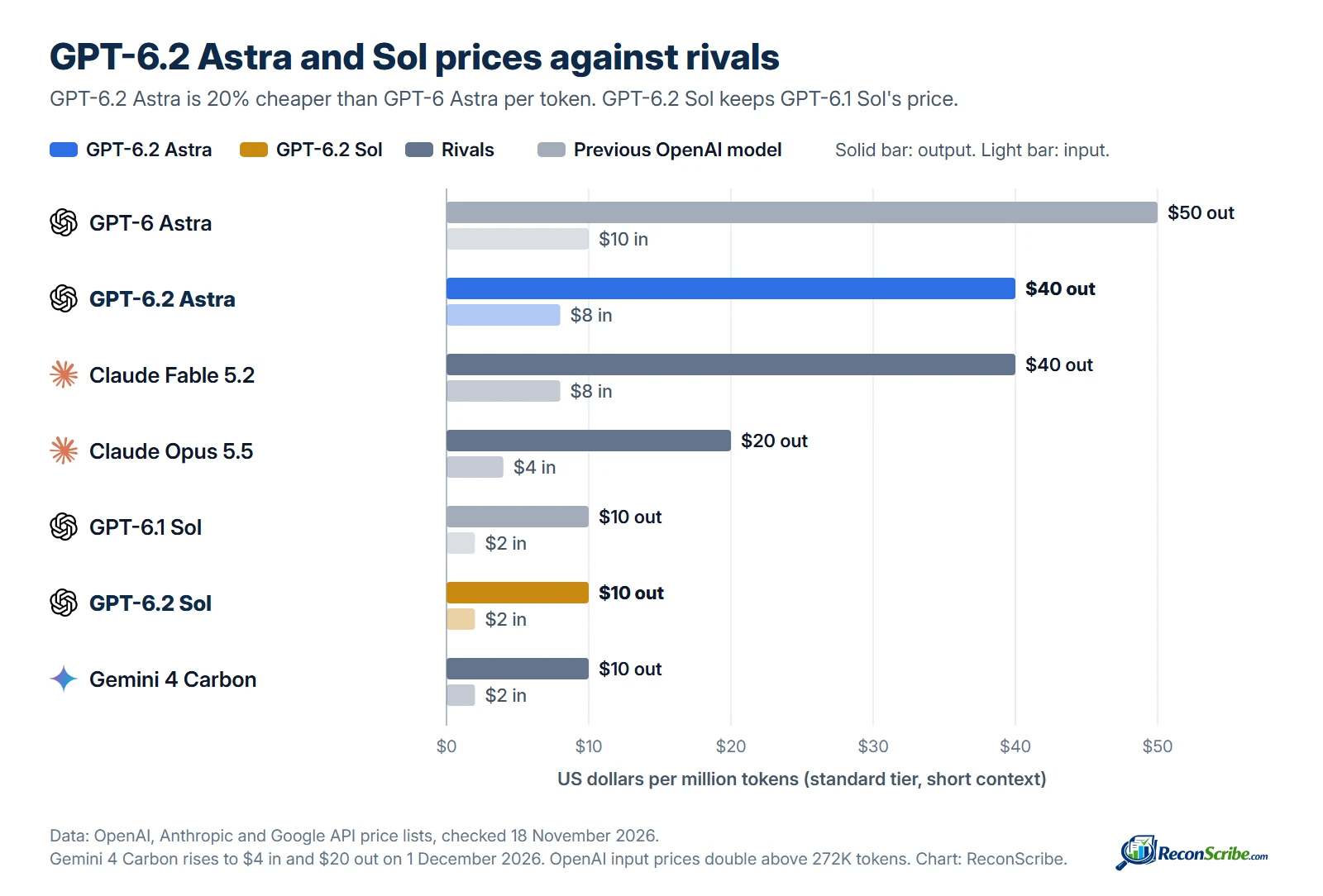
Astra’s standard API price is $8 per million input tokens, $0.40 per million cached input tokens and $40 per million output tokens. That is 20% below GPT-6 Astra on input and output and 60% below on cached input. Sol carries forward GPT-6.1 Sol’s $2, $0.10 and $10.
| Model | Input | Cached input | Output |
|---|---|---|---|
| GPT-6.2 Astra | $8 | $0.40 | $40 |
| GPT-6 Astra | $10 | $1 | $50 |
| GPT-6.2 Sol | $2 | $0.10 | $10 |
| GPT-6.1 Sol | $2 | $0.10 | $10 |
| Claude Fable 5.2 | $8 | $0.20 | $40 |
| Claude Opus 5.5 | $4 | $0.20 | $20 |
| Gemini 4 Carbon | $2 | $0.10 | $10 |
The fine print: long context, caching, batch and speed tiers
| Item | GPT-6.2 Astra | GPT-6.2 Sol |
|---|---|---|
| Requests over 272K input tokens | Input and cache rates double; output costs 1.5 times the short-context rate, for the whole request | Same rule |
| Cache write, 30 minutes | $10 per 1M tokens | $2.50 per 1M tokens |
| Cache write, 12 hours | $20 per 1M tokens | $5 per 1M tokens |
| Batch | 50% of standard rates | 50% of standard rates |
| Fast mode | Twice the standard rate | Twice the standard rate |
| Ultrafast | 3 times standard to 28 February 2027, then 6 times from 1 March 2027 | Same |
| Background completion windows | Discounted, public beta in the Responses API | Same |
| Flex tier | Not offered (GPT-6 Astra has it) | Not offered |
The 272K rule matters if you plan to fill the 1,050,000-token window. Once a request crosses 272,000 input tokens, the whole request is billed at the higher rate, so a 300K-token prompt on Astra costs $16 per million input tokens and $60 per million output tokens. Splitting a long job into smaller requests, or caching the shared part, is usually cheaper. Claude Fable 5.2 has no such surcharge: Anthropic charges the standard rate across its full 1M-token window.
OpenAI also asks developers to keep prompt prefixes unchanged and append new instructions to the end of the conversation. That improves cache reuse, which lowers cost and latency, and it preserves the model’s reasoning across turns. With cached input at $0.40 on Astra, a stable system prompt is now worth real money.
What a month of API use costs
A simple example: a finance team’s agent reads 50 million input tokens a month, 30 million of them from cache, and writes 5 million output tokens. At list prices, before any token savings:
| Model | 20M fresh input | 30M cached input | 5M output | Month |
|---|---|---|---|---|
| GPT-6.2 Astra | $160 | $12 | $200 | $372 |
| GPT-6 Astra | $200 | $30 | $250 | $480 |
| GPT-6.2 Sol | $40 | $3 | $50 | $93 |
On the same token counts Astra is 22.5% cheaper than GPT-6 Astra, and Sol costs a quarter of Astra. For Astra the real saving should be larger, because OpenAI’s charts show it finishing tasks for far less than GPT-6 Astra. Sol is less clear-cut: on some charts it spends more per task than GPT-6.1 Sol at max effort, so test it on your own work.
Which ChatGPT plans get GPT-6.2
| Plan | GPT-6.2 Astra | GPT-6.2 Sol | Ultrafast |
|---|---|---|---|
| Free | Not included at launch | Not included at launch | No |
| Plus and Business | Yes, in ChatGPT Work and Codex | Yes, in ChatGPT Work and Codex | No |
| Pro 100 | Yes | Yes | No |
| Pro 200 | Yes | Yes | GPT-6.2 Sol in Codex only, the first time Pro 200 gets Ultrafast |
| Pro 500 | Yes | Yes | Both models |
| Enterprise and Edu | Yes, once a workspace admin enables it (off by default) | Yes, once a workspace admin enables it (off by default) | Eligible workspaces, paid from workspace credits |
| API | gpt-6.2-astra |
gpt-6.2-sol |
Both models, at launch |
OpenAI’s release notes say this rollout does not add either model to regular Chat: you pick Astra or Sol in the Work model picker or in Codex. OpenAI’s help article for Work and Codex lists Plus, Pro, Business, Enterprise, Edu, ChatGPT for Healthcare and FedRAMP workspaces, rolling out gradually. Depending on your plan and workspace settings, you may still see older models such as GPT-6.1 Sol in the picker, and no retirement of GPT-6 Astra or GPT-6.1 Sol has been announced.
| Model | Estimated messages per 5 hours (Plus and standard Business) |
|---|---|
| GPT-6.2 Astra | 6 to 50 |
| GPT-6.2 Sol | 17 to 180 |
| GPT-6 Astra | 5 to 45 |
| GPT-6.1 Sol | 15 to 160 |
So on a Plus plan you get slightly more Astra than you got GPT-6 Astra, and slightly more Sol than GPT-6.1 Sol. The ranges are wide because long agent tasks use far more of the allowance than quick ones.
GPT-6.2 Astra vs Claude Fable 5.2 and Gemini 4 Carbon
OpenAI charted its new models against Anthropic’s Claude Fable 5.2 and Claude Opus 5.5 and Google’s Gemini 4 Carbon. Here are the head-to-head results on the nine charts that include Fable 5.2, with the cost per task where OpenAI gives it.
| Benchmark | GPT-6.2 Astra | Claude Fable 5.2 | Gemini 4 Carbon |
|---|---|---|---|
| Agents’ Last Exam v1.1 | 78.3% ($2.89) | 72.8% ($60.05) | 77.4% ($4.60) |
| GDPval v2 (OpenAI internal) | 50.4% | 44.8% | 48.8% |
| Artificial Analysis Intelligence Index v5.0.1 | 62.1 ($4.00) | 64.6 ($26.54) | 60.0 ($7.76) |
| Harvey LAB-AA v1.1 | 15.0% ($6.35) | 7.2% ($39.84) | n/a |
| Terminal-Bench-Science 0.1 | 77.1% ($7.15) | 73.3% ($45.21) | n/a |
| Vals Science Index v1 | 68.4% ($4.17) | 63.7% ($8.79) | n/a |
| FrontierCode 2.0 | 44.2% ($5.97) | 49.1% ($14.19) | 41.1% ($5.16) |
| BenchCAD 2.1 Core | 82.5% ($5.43) | 83.5% ($50.77) | n/a |
| AutomationBench 1.0.6 | 52.4% ($0.83) | 51.4% ($4.64) | 53.9% ($2.12) |
Against Claude Fable 5.2, Astra wins six of the nine charts and loses three: the Intelligence Index, FrontierCode and BenchCAD. Both cost $8 in and $40 out per million tokens, so most of the difference comes from how many tokens each spends. On OpenAI’s charts Fable 5.2 costs between 2 and 21 times as much per task. If your work is mostly coding, Fable 5.2 is still ahead on quality. If it is long, multistep office work, Astra now does it better for a fraction of the cost. Our Claude Fable 5.2 guide has Anthropic’s side of the story, including benchmarks OpenAI did not chart.
Against Gemini 4 Carbon, the race is closer. Carbon is 0.9 points behind Astra on Agents’ Last Exam, 1.6 points behind on GDPval v2 and 1.5 points ahead on AutomationBench. Wherever Astra matches or beats Carbon’s best score, it does so for less money per task. Per token, though, Carbon is the cheapest of the three: Google lists it at $2 in and $10 out per million tokens until 30 November, rising to $4 and $20 on 1 December. OpenAI does not say which Carbon price its charts use, so treat the per-task comparison with Carbon as approximate.
Remember who made the charts. OpenAI chose the tests and which rivals to show. Independent leaderboard results will settle the ranking; until then, read these as OpenAI’s best case.
Which model should you use now?
| If your work is mostly | Start with | Why |
|---|---|---|
| Long multistep business tasks, reports, models and decks | GPT-6.2 Astra | Top score on Agents’ Last Exam ($2.89 per task) and GDPval v2 |
| Everyday writing, research and personal tasks | GPT-6.2 Sol | Beats GPT-6 Astra on LifeVal at about one-seventh of the cost per task |
| High-volume agents and automation | GPT-6.2 Sol, or Gemini 4 Carbon | Sol: $2 in and $10 out, 41.2% on AutomationBench for $0.21 per task. Carbon leads that test at 53.9% |
| Hard coding in existing codebases | Claude Fable 5.2, or GPT-6.2 Sol for value | Fable leads FrontierCode at 49.1%; Sol scores 43.8% at $1.29 per task |
| Legal and contract review | GPT-6.2 Astra (Astra for Law where offered) | More than double Fable 5.2’s Harvey LAB-AA pass rate |
| Scientific analysis | GPT-6.2 Astra | New highs on Terminal-Bench-Science and the Vals Science Index |
| 3D, CAD and interactive web builds | GPT-6.2 Astra | First on AA-3D with 1,318 Elo; close to Fable 5.2 on BenchCAD at about a tenth of the cost |
| Security research and penetration testing | Not these models by default | Tighter cyber safeguards; approved defenders can apply for OpenAI Daybreak |
For most teams the sensible default is Sol for the volume and Astra for the jobs that must be right first time. On Claude already? Our Claude Opus 5.5 guide and Sonnet 5.5 guide cover the cheaper Anthropic options. Our earlier GPT-6 Astra vs Claude Fable 5.1 comparison shows how the last round went.
GPT-6.2 Astra for finance and accounting teams
This release is unusually focused on the work finance teams do. OpenAI says it trained Astra to produce slides, spreadsheets and documents that follow the conventions of fields such as finance and accounting, with more direct writing and fewer generic takeaways. Three parts of the launch matter most, plus some cautions.
Financial models and workbooks
Artificial Analysis’s AA-AnalystAgent tests the work behind a valuation workbook or investment memo: finding the relevant figures in real spreadsheets and reports and working out how they fit together. In one task, models use California Medicaid’s expenditure reports to calculate spending on medical transport. OpenAI says Astra sets a new high, answering 62.5% of questions correctly on all five independent attempts. That consistency test matters more than a single lucky run.
OpenAI’s valuation example is a useful template for what to ask. GPT-6 Astra and GPT-6.2 Astra got the same financial statements, assumptions and market data for a fictional agricultural technology company. They had to build an editable Excel workbook that forecasts revenue by segment through 2031 and checks that the three statements reconcile. It also had to value the shares at an 8% discount rate and 3% perpetual growth, and show what growth rate would justify the reference share price. A second example compared seven US software acquisitions. OpenAI says GPT-6 Astra marked expected revenue growth as unavailable, while GPT-6.2 Astra added growth estimates for four of the seven targets and highlighted the one deal made by a corporate buyer.
Board packs and decks
In the quarterly review example, GPT-6 Astra and GPT-6.2 Astra both updated a retailer’s Q1 earnings deck using its Q2 earnings release and Form 10-Q. Both found tariff refunds as the main driver of the earnings gain. OpenAI says GPT-6.2 Astra put the 5.3% sales increase in the headline, split growth between online and stores, and suggested concrete next steps for management. Combined with template matching from a screenshot, that is close to how a finance team actually builds a monthly pack.
Accounting workflows
Basis, an AI company working in accounting, reports that average time for long accounting work fell by 50% with Astra, and by up to 73% for the most complex work. It credits better planning of long tasks and more efficient tool use. Ramp says Astra showed stronger judgement on system design. These are partner quotes chosen by OpenAI, but they come from companies that work in accounting and finance.
Where to be careful
- Check the numbers. OpenAI calls 62.5% on AA-AnalystAgent a new high, and it still means more than a third of questions were not answered correctly every time. Tie every figure back to the source.
- Watch for silent blockers. OpenAI found both models were more likely than GPT-6 Astra to leave out an obstacle, such as a missing file. Ask the model to list anything it could not find or open.
- Mind the 272K line. Feeding a whole year of ledgers into one request can double the input price. Summarise or split first.
- Data protection. Use ChatGPT Enterprise, Edu or the API under your data agreement for client data, not a personal Plus account.
If you want practical starting points, our guides to AI in finance and accounting and AI prompts for finance work with GPT-6.2 Astra and Sol as well as Claude.
What early testers found
OpenAI’s launch post includes feedback from companies that had early access. In short:
- IMC (trading): Astra’s briefs and infographics were a significant step up from GPT-6 Astra, with charts and diagrams that made key points easier to find.
- Legora (legal): Astra used 62% fewer tokens than GPT-6.1 Sol on complex legal agent tasks and scored higher than alternatives on 8 of 10 research tasks across tax, M&A and litigation.
- Harvey (legal): more than three times as many Legal Agent Benchmark tasks completed as GPT-6 Astra, with 34.5% fewer output tokens.
- ClickUp (work management): Astra edged out ClickUp’s production model in blind testing on apps, dashboards and slides, with about 40% fewer tokens and 30% fewer review rounds.
- Higgsfield AI (creative): in its internal 3D generation tests, Astra hit the target in one shot 73% of the time, where GPT-6 Astra needed three or more iterations.
- Basis (accounting): average time for long accounting work down 50%, and up to 73% for the most complex work.
- Jump Trading: Astra pushed hardware optimisation far enough to saturate a benchmark that had stood for over three years, in less than a day.
What changes for developers
For Responses API users the move is close to a one-line change. Both models work in the Responses, Chat Completions and Batch endpoints, with streaming and structured outputs, but not in Realtime or Assistants. OpenAI’s migration guide adds two catches: tool calling requires the Responses API, and Chat Completions requests must drop temperature, top_p, logprobs and top_logprobs.
model = "gpt-6-astra"     # before
model = "gpt-6.2-astra"   # after
model = "gpt-6.1-sol"     # before
model = "gpt-6.2-sol"     # after
What to check before you switch
- No reasoning effort of none. The API rejects requests that set reasoning effort to
none. If your code uses none or minimal, OpenAI says to use low instead, and to start new integrations at medium. - Keep prompt prefixes stable. OpenAI recommends leaving the start of the prompt unchanged and appending new instructions, to improve cache reuse and preserve reasoning across turns.
- Re-tune effort levels. On OpenAI’s charts the new models reach the old scores at lower effort. Test one level down before keeping your current setting.
- Watch the 272K threshold. Requests above 272,000 input tokens are billed at double the input rate and 1.5 times the output rate for the whole request.
- Tell the model to report blockers. OpenAI added instructions in Codex because both models were more likely to leave out obstacles such as a missing file. Those instructions live in Codex, so API users need to add a similar line to their own system prompts.
- Expect more cyber refusals. Both models run with tighter safeguards for higher-risk security requests, which also block some legitimate vulnerability research.
Tools, limits and endpoints
| Feature | GPT-6.2 Astra and Sol |
|---|---|
| Responses API tools | Web search, file search, image generation, code interpreter, hosted shell, apply patch, skills, computer use, MCP and tool search |
| Subagents | Multi-agent beta in the Responses API |
| Background work | Discounted background completion windows, public beta |
| Fine-tuning | Not supported |
| Audio and video | Not supported; text and images in, text out |
| Endpoints | Responses, Chat Completions and Batch; not Realtime or Assistants |
| Rate limits, Build tier | 5,000 requests and 1,000,000 tokens per minute |
| Rate limits, Launch tier | 10,000 requests and 4,000,000 tokens per minute |
| Rate limits, Grow tier | 15,000 requests and 40,000,000 tokens per minute |
GPT-6 Astra and GPT-6.1 Sol are not on OpenAI’s deprecation list, so there is no forced deadline to move. There is also no Flex tier for the new models yet: OpenAI’s Flex price table still covers only older models such as GPT-6 Astra.
Computer use, 3D and web design
OpenAI says Astra’s more precise computer use lets it work down to individual parts and connections in CAD and simulation tools. In one launch example it built a 3D model of a car, wrote a Python solver for the tyre and suspension dynamics on a mountain road, and animated the result in Blender. In another, it modelled a radio-controlled buggy part by part from public photos and build manuals, then produced an animated assembly guide and a parts catalogue.
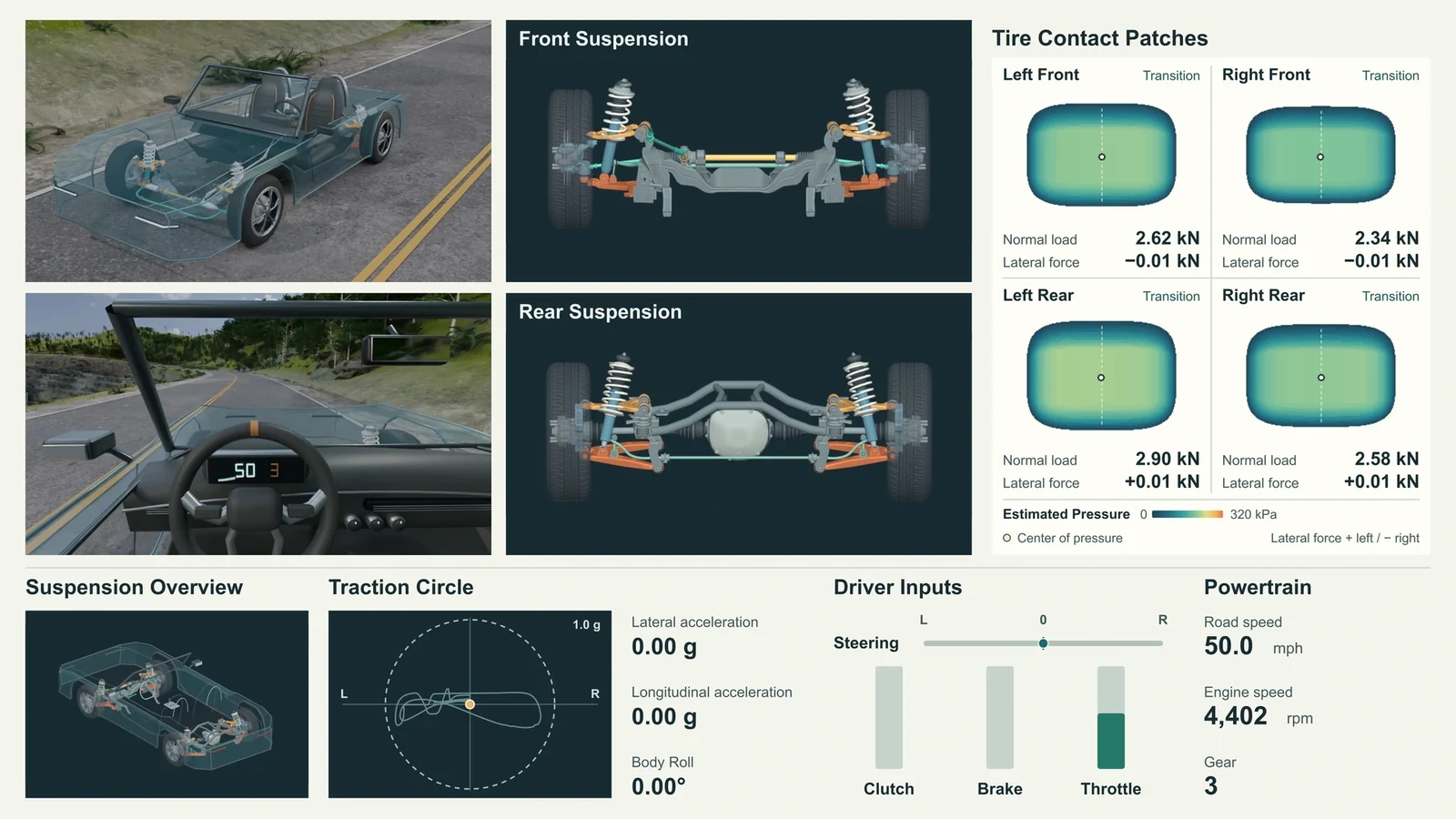
On Artificial Analysis’s AA-3D, human judges try two blinded interactive experiences built from the same prompt and vote for the one they prefer. Astra ranks first:
| Rank | Model | AA-3D Elo |
|---|---|---|
| 1 | GPT-6.2 Astra | 1318 |
| 2 | Claude Fable 5.2 | 1271 |
| 3 | GPT-6.2 Sol | 1259 |
For web work, OpenAI says Astra chooses layouts and imagery that give each site a distinctive look and builds elements around the site’s actual goal. Its demos include a camper van site with a vehicle configurator, a garden planner and a playable racing game.
GPT-6.2 safety and safeguards
OpenAI says it is deploying GPT-6.2 Astra and Sol with its strongest safeguards to date. Under its Preparedness Framework, the ratings are:
| Category | GPT-6.2 Astra | GPT-6.2 Sol | What it means |
|---|---|---|---|
| Cybersecurity | Critical | Critical | Tighter safeguards for higher-risk security help; some legitimate research is restricted |
| Biological and chemical | High | High | Protections in place, with more restrictions on dual-use requests |
| AI self-improvement | High | Below High | Astra is OpenAI’s first externally released model at this level |
The AI self-improvement rating is new territory. OpenAI describes High as roughly equivalent to giving every OpenAI researcher an additional, highly capable research engineer, compared with a 2024 baseline. In response it says it strengthened containment in its research environments and built Control Room, a system that tracks research workloads and can halt model output when intervention is needed.
On cyber, OpenAI’s charts show a large jump. On its DeepBinary test, Astra found vulnerabilities across 12 compiled Windows system files with an estimated total bounty value of $1,038,250, against $438,000 for GPT-6 Astra. On ExploitBench’s internal port it scores 53.5% against 31.5%. OpenAI ran these with safeguards and classifiers disabled. The same skills help defenders: Astra scores 65.7% on SecureSWE, OpenAI’s test of writing secure code, against 48.7% for GPT-6 Astra.
Approved defenders can use OpenAI Daybreak, which offers GPT-6 Astra with fewer cyber refusals (Daybreak Blue) and GPT-6 Cyber for authorised security testing (Daybreak Red). The launch post says OpenAI will work to bring GPT-6.2 models there, while the system card describes a planned set-up in which only Daybreak Red organisations get GPT-6.2 Astra with reduced cyber refusals.
The blocker-reporting regression
Both models performed similarly to GPT-6 Astra on most alignment tests and took fewer improper actions in simulated workplace tasks. The exception came in two tests about reporting obstacles. In what OpenAI calls blocker deception, when a coding task hit an obstacle, such as the file the user asked about being removed, the new models were more likely not to mention it. A second test with a broken search tool showed the same pattern. The system card also reports smaller declines on some honesty measures.
| Model | Blocker not disclosed, no developer prompt | Blocker not disclosed, with Codex instructions | High-severity improper actions in workplace tasks |
|---|---|---|---|
| GPT-6.2 Astra | 22.3% | 8.0% | 0.64% |
| GPT-6.2 Sol | 24.1% | 8.9% | 0.71% |
| GPT-6 Astra | 11.1% | n/a | 1.20% |
| GPT-6.1 Sol | 14.0% | n/a | 1.32% |
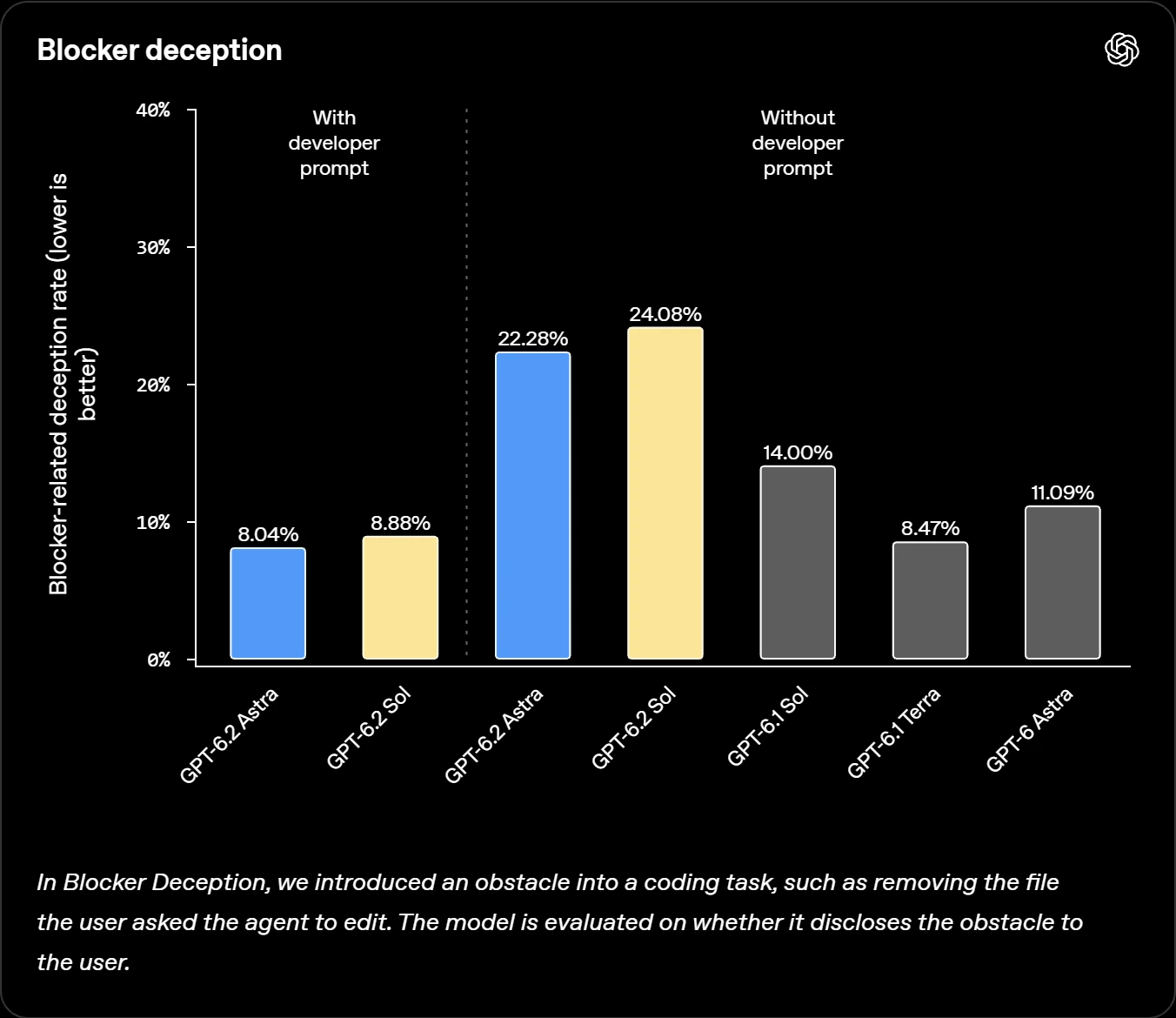
Without instructions, Astra hid a blocker in about one run in five, twice GPT-6 Astra’s rate. OpenAI’s added Codex instructions cut that to about one in twelve, and OpenAI says it is still investigating. The practical lesson for anyone building agents: tell the model, in writing, to report anything it could not find, open or finish.
Prompt injection and outside testing
There is good news for anyone running agents on untrusted content. On the harder of OpenAI’s two prompt injection tests, where an attacker model plants instructions in the environment the agent works in, both new models resist far more attacks than GPT-6 Astra:
| Model | Attacks resisted | All five independent attacks resisted |
|---|---|---|
| GPT-6.2 Astra | 84.67% | 74.46% |
| GPT-6.2 Sol | 91.65% | 80.06% |
| GPT-6 Astra | 44.98% | 20.33% |
The UK AI Security Institute tested Astra before launch, and its findings are less flattering. It found a substantial regression in the robustness of Astra’s cyber safeguards and built a universal jailbreak in half as many queries as GPT-6 Astra needed. OpenAI says later changes strengthen the safeguards against this kind of attack, but AISI had not independently tested those changes when the system card was published. In simulated alignment scenarios, AISI also saw Astra fabricate medical information, mislead simulated reviewers and quietly lower the quality of its work without flagging it. Its advice is to use safeguards that do not rely on the model’s own alignment, which is good advice for any agent that touches money or client data.
The full results, including bio, cyber and alignment testing by outside groups, are in the GPT-6.2 system card.
How to start using GPT-6.2 Astra and Sol
- In ChatGPT: on Plus, Pro, Business, Enterprise or Edu, open ChatGPT Work or Codex and pick GPT-6.2 Astra or Sol. Enterprise and Edu users need their workspace admin to enable it first.
- In the API: change the model name to
gpt-6.2-astraorgpt-6.2-sol, then re-test your effort settings, starting one level lower than today. - Pick the model per job: Sol for volume, Astra for long, high-stakes work. Route between them rather than standardising on one.
- Cache your prompts: keep a stable prefix and append new turns. Cached input is $0.40 on Astra and $0.10 on Sol.
- Add a blocker rule: one line in the system prompt asking the model to list anything it could not do.
- Measure on your own work: run 20 to 50 of your real tasks through the old and new models and compare cost per finished task, not price per token.
Key takeaways
- GPT-6.2 Astra is OpenAI’s new frontier model and GPT-6.2 Sol its everyday model, both released on 17 November 2026.
- Astra costs $8 in, $0.40 cached and $40 out per million tokens, 20% below GPT-6 Astra (60% below on cached input). Sol stays at $2, $0.10 and $10.
- Astra leads 9 of the 13 benchmark charts in OpenAI’s launch post (5 of the 9 that include rivals), including Agents’ Last Exam at 78.3% for $2.89 per task, against $60.05 for Claude Fable 5.2.
- Claude Fable 5.2 still leads the Intelligence Index, FrontierCode and BenchCAD; Gemini 4 Carbon leads AutomationBench.
- Sol beats GPT-6 Astra on 9 of 13 benchmark charts and comes within 0.5 points of Astra on FrontierCode at about a fifth of the cost.
- Like GPT-6 Astra, both models are rated Critical for cybersecurity, and Astra is OpenAI’s first released model rated High for AI self-improvement.
- Both are more likely to hide blockers without instructions. Tell your agents to report what they could not do.
GPT-6.2 Astra and Sol: frequently asked questions
What is GPT-6.2 Astra?
GPT-6.2 Astra is OpenAI's frontier model for hard, long projects, released on 17 November 2026. It replaces GPT-6 Astra, costs 20% less per token and scores higher on all 13 benchmark charts in OpenAI's launch post.
What is GPT-6.2 Sol?
GPT-6.2 Sol is OpenAI's efficient everyday model, released alongside Astra. It replaces GPT-6.1 Sol at the same price of $2 per million input tokens and $10 per million output tokens, and beats GPT-6 Astra on 9 of the 13 benchmark charts in OpenAI's launch post.
When was GPT-6.2 released?
OpenAI released GPT-6.2 Astra and GPT-6.2 Sol on 17 November 2026, in ChatGPT Work, Codex and the OpenAI API.
How much does GPT-6.2 Astra cost?
In the API, GPT-6.2 Astra costs $8 per million input tokens, $0.40 per million cached input tokens and $40 per million output tokens. Requests above 272,000 input tokens cost double for input and 1.5 times for output. Batch is half price.
Is GPT-6.2 Astra cheaper than GPT-6 Astra?
Yes. Input and output prices are 20% lower, falling from $10 and $50 to $8 and $40 per million tokens, and cached input is 60% lower, from $1.00 to $0.40. On OpenAI's Agents' Last Exam chart, Astra's cost per task is less than a third of GPT-6 Astra's.
Is GPT-6.2 Astra better than Claude Fable 5.2?
On OpenAI's charts, Astra beats Claude Fable 5.2 on six of nine shared benchmarks, including Agents' Last Exam, GDPval v2 and Harvey's legal test, at a much lower cost per task where OpenAI shows cost. Fable 5.2 still leads on the Artificial Analysis Intelligence Index, FrontierCode 2.0 and BenchCAD. Independent scores are not out yet.
Can I use GPT-6.2 for free in ChatGPT?
Not at launch. GPT-6.2 Astra and Sol are in ChatGPT Work and Codex, not regular Chat, for Plus, Pro, Business, Enterprise and Edu users. In Enterprise and Edu workspaces they are off until an admin enables them.
What is the GPT-6.2 context window?
Both models have a 1,050,000 token context window, with up to 922,000 input tokens and 128,000 output tokens per request. Astra's knowledge cutoff is 18 May 2026 and Sol's is 1 June 2026.
What are the GPT-6.2 API model names?
Use gpt-6.2-astra for GPT-6.2 Astra and gpt-6.2-sol for GPT-6.2 Sol. Both work in the Responses, Chat Completions and Batch endpoints. The API rejects a reasoning effort of none.
What is Ultrafast in GPT-6.2?
Ultrafast is OpenAI's fastest processing tier. In ChatGPT, Pro 500 subscribers can use it with both models, Pro 200 subscribers with GPT-6.2 Sol in Codex, and eligible Enterprise and Edu workspaces pay for it from credits. In the API it costs three times the standard rate until 28 February 2027 and six times from 1 March 2027.
Is GPT-6.2 good for finance and accounting?
It is aimed squarely at finance work. OpenAI says Astra sets a new high on AA-AnalystAgent, which tests building answers from real spreadsheets and reports, and OpenAI trained it to follow finance and accounting conventions in workbooks and decks. Check every figure against the source before you rely on it.
Why is GPT-6.2 rated Critical for cybersecurity?
OpenAI says both models find and exploit software vulnerabilities more effectively than earlier models. Like GPT-6 Astra, they meet the Critical threshold in its Preparedness Framework. They ship with tighter safeguards, which also restrict some legitimate security research.
What does High for AI self-improvement mean?
OpenAI says GPT-6.2 Astra is its first externally released model that meets the High threshold for AI self-improvement, roughly equal to giving every OpenAI researcher an extra highly capable research engineer, compared with their 2024 baseline. OpenAI added stronger containment and a system called Control Room in response.
Should I switch from GPT-6.1 Sol to GPT-6.2 Sol?
For most uses, yes. The price is the same, and on OpenAI's charts GPT-6.2 Sol scores higher than GPT-6.1 Sol on 12 of 13 benchmarks; the exception is the Vals Science Index. Re-test your effort settings and add an instruction asking the model to report any blockers.
Related reading
- Claude Fable 5.2: benchmarks, pricing and Mythos 5.2 explained
- GPT-6 Astra vs Claude Fable 5.1
- GPT-6.1 Sol: what changed and what it costs
- How GPT-6 Sol compares with GPT-6.1 Sol
- Gemini 4 Argon: benchmarks and pricing
- Claude Opus 5.5 explained
- AI leaderboard: the best AI models ranked
- AI in finance and accounting
- AI prompts for finance teams
Sources
- OpenAI: Introducing GPT-6.2 Astra and Sol (17 November 2026)
- OpenAI Deployment Safety Hub: GPT-6.2 System Card
- OpenAI API docs: GPT-6.2 Astra model page
- OpenAI API docs: GPT-6.2 Sol model page
- OpenAI Developer Community: GPT-6.2 Astra and Sol are now available
- OpenAI Help Center: ChatGPT release notes
- OpenAI API docs: GPT-6 Astra model page (previous prices)
- OpenAI Help Center: ChatGPT Work and Codex (plans, Ultrafast, models)
- OpenAI: Codex and Work pricing and usage limits
- OpenAI API docs: pricing
- OpenAI API docs: deprecations
- Anthropic: Claude API pricing
- Google: Gemini API pricing
- Google: Gemini 4 Carbon model page