
Meta Muse Wonder is the first Meta model priced like a frontier model, and on Meta’s own scorecard it trades wins with Claude Opus 5.5 rather than pulling clear. It costs $4 per million input tokens and $20 per million output tokens on the Meta Model API, the same list price as Opus 5.5. In Meta’s 14-row benchmark table, its higher-capability sibling Muse Wonder Full posts the top score in 6 rows and Muse Wonder takes one more, MemoryBench. Claude Opus 5.5 still tops 6 rows and GPT-6 Astra one.
The independent view is less flattering. On the Artificial Analysis Intelligence Index, Muse Wonder Full scores 56: below Claude Opus 5.5 at 58 and level with Claude Sonnet 5.5 at 56, a model Meta’s own chart leaves out. Muse Wonder, the version you can buy by the token, scores 52: level with OpenAI’s GPT-6.1 Sol and below Claude Sonnet 5.5, both of which cost half as much.
Meta introduced Muse Wonder and Muse Wonder Full on 12 October 2026 as its most capable models, built for personal and professional agents: long coding projects, legal and financial documents, health questions and tasks that run for hours. Muse Wonder is on the Meta Model API and in Muse Code from launch day. Muse Wonder Full, the higher-capability variant, comes only with the $50 Power Usage and $200 Maximum Usage plans of Muse Code, Meta’s command-line coding tool. Meta says Muse Wonder will reach its Muse app later, subscribers first, but by 10 November 2026 it had not named a date; it has said nothing about Full there.
Below you will find Meta’s full benchmark table next to the first independent data from Artificial Analysis and Vals AI, what a task really costs, the data setting every finance team should change first, and which model to pick for which job.
Meta Muse Wonder: the short answer
Both new Meta models against Claude Opus 5.5, which costs the same, and GPT-6 Astra from OpenAI:
 MetaMeta
 Anthropic
 OpenAI
Scores at max reasoning effort from Meta’s table, except the Artificial Analysis (AA) Intelligence Index, which is independent. Teal marks the best score in each row. Muse Wonder Full has no per-token price; it comes with Muse Code plans from $50 a month. Prices are per million input and output tokens.
| Fact | Detail |
|---|---|
| Released | 12 October 2026, announced by @AIatMeta at 17:02 UTC |
| Models and IDs | Muse Wonder (muse-wonder-1.0) and Muse Wonder Full (muse-wonder-full-1.0) |
| Where you can use it | Wonder: the Meta Model API (pay as you go) and Muse Code. Wonder Full: Muse Code Power Usage and Maximum Usage plans only. Muse Wonder in the Muse app: not yet on 10 November 2026 (Meta says soon, subscribers first) |
| API price per 1M tokens | $4 input, $0.20 cached input, $20 output, with no long-context premium |
| Context window | 1,048,576 tokens |
| Inputs and outputs | Text, images, video, audio and PDF in; text out |
| Files on the API | Images, video, audio, PDF, plain text and JSON; no Excel or Word files. PDFs are read as text up to page 100 |
| Reasoning effort | minimal, low, medium, high, xhigh and max |
| Status | Preview on the Meta Model API |
| Rate limits | 3,000 requests and 4 million tokens per minute, per team |
| Weights | Closed; hosted by Meta only |
| Not published | Maximum output length, knowledge cutoff, parameter count |
| Trains on your data? | API: no, Standard mode only. Muse Code plans: yes by default (Contributor mode); turn it off in settings before your first prompt |
The short version: with Meta Muse Wonder, Meta now has a real frontier model, priced exactly like Opus 5.5. By Meta’s numbers Muse Wonder Full is strongest on legal work and very long coding jobs, level on finance research, and behind Anthropic on computer use, terminal coding and the independent index.
Should you switch? If you already pay for Claude Opus 5.5, the token prices are identical; Muse Wonder cost less per task in the first Vals and Artificial Analysis runs but scored lower, so switch only where your own tests show a gain, starting with legal and document work. If you pay for GPT-6 Astra or Claude Fable 5.1, Muse Wonder costs 60% less per token and is worth a trial, alongside Claude Sonnet 5.5, which scores higher on the independent index at half Muse Wonder’s price.
If your team uses AI in a chat app rather than through code, there is nothing to switch to yet. And if you try Muse Code, turn off Contributor mode before your first prompt.
Prefer to watch? Here is Meta Muse Wonder in 50 seconds: the two models, the price, where it leads, where Claude Opus 5.5 still wins, and the fine print.
Muse Wonder vs Muse Wonder Full: who gets which
Meta ships two variants under one name, and they reach you in different ways:
| Muse Wonder | Muse Wonder Full | |
|---|---|---|
| Model ID | muse-wonder-1.0 |
muse-wonder-full-1.0 |
| Meta Model API (pay as you go) | Yes, in Standard mode only, at $4 / $20 per 1M tokens | Not available |
| Muse Code | Pay as you go, and on every plan | Power Usage ($50 a month) and Maximum Usage ($200 a month) plans only |
| Muse app | Not yet on 10 November 2026 (Meta says soon, subscribers first) | Not announced as of 10 November 2026 |
| How Meta describes it | Frontier coding, long-running agents and advanced computer use | Meta’s most advanced model yet, the higher-capability variant |
| AA Intelligence Index | 52 | 56 |
One detail trips people up. Setting reasoning effort to max on Muse Wonder does not switch you to Full; Meta’s models docs say so plainly. They are separate models, and the only door to Full is a Muse Code subscription, used through the Muse Code command line tool.
In practice, developers building their own agents get Muse Wonder through the API, while people who want Meta’s best model for their own coding and agent work pay for Muse Code. Nobody can call Muse Wonder Full from their own app.
Meta Muse Wonder benchmarks: Meta’s full table
Meta tested both models at max reasoning effort against three rivals, also at max: Claude Fable 5.1 and GPT-6 Astra, which both list at $10 and $50 per million tokens, and Claude Opus 5.5. Here are all 14 rows, with what each test measures and where Meta’s model card says each result came from:
| Benchmark and what it measures | Muse Wonder Full | Muse Wonder | Fable 5.1 | GPT-6 Astra | Opus 5.5 |
|---|---|---|---|---|---|
| Personal Superintelligence Index Meta-internalMeta’s composite of seven personal and knowledge work tests, including its own FocusBenchRun by: Meta |
59.1 | 54.3 | 49.9 | 54.5 | 55.2 |
| Harvey LAB-AALegal work products drafted from matter documents; a task counts only if it meets every criterion and passes hallucination checksRun by: Artificial Analysis | 13.1 | 10.0 | 6.4 | 8.6 | 4.2 |
| Vals Finance Agent V2Financial analyst research over filings and market informationRun by: Vals AI (private test set) | 59.1 | 56.6 | 58.9 | 53.5 | 58.6 |
| HealthBench Pro525 professional health questions answered without tools, scored on physician rubricsRun by: Meta; Claude scores from Anthropic | 62.3 | 60.5 | 62.1 | 65.3 | 65.6 |
| AutomationBench-AAEnd-to-end business workflows in simulated apps; a pass means every end-state check passesRun by: Artificial Analysis | 45.4 | 39.1 | 32.1 | 41.6 | 41.2 |
| GDP.pdfProfessional work grounded in supplied PDF source materialRun by: Surge | 33.2 | 30.8 | 27.6 | 34.2 | 30.6 |
| JobBench65 practical work products across 35 white-collar occupations, scored on task rubricsRun by: not named in the model card | 75.3 | 70.5 | 73.1 | 66.1 | 75.4 |
| OSWorld V2.1108 long computer-use workflows on a full desktop; partial credit first, all-or-nothing (binary) secondRun by: Meta; Opus 5.5 from Anthropic (partial only) | 78.4binary 39.4 | 72.6binary 34.3 | 80.7binary 43.1 | 75.8binary 34.3 | 81.8binary none |
| MemoryBench Meta-internalRecall across 64K to 100K token conversations with distractors and later updatesRun by: Meta |
85.5 | 85.6 | 79.0 | 81.4 | 81.5 |
| Terminal-Bench 4.0-AAHarder coding tasks in isolated terminal environmentsRun by: Artificial Analysis | 57.1 | 52.0 | 52.0 | 59.1 | 59.6 |
| DeepSWE 1.1113 long software tasks across 91 repositories and five languagesRun by: Datacurve for the Muse models and Opus 5.5; OpenAI for Astra; Anthropic for Fable 5.1 | 79.0 | 78.8 | 67.4 | 74.1 | 74.2 |
| SWE-MarathonUltra-long software projects, graded by running each project’s testsRun by: Abundant AI; not a common harness | 57.5xhigh | 53.1 | 45.6 | 42.5 | 46.3 |
| ProgramBenchRebuilding a complete program in a clean room; share of runs passing at least 95% of hidden testsRun by: Meta, same agent harness for all | 59.0 | 50.0 | 55.5 | 52.5 | 70.5 |
| Artificial Analysis IndexIndependent composite of ten tests (version 4.3)Run by: Artificial Analysis | 56 | 52 | 53 | 53 | 58 |
Where Muse Wonder Full leads
Muse Wonder Full’s leads on Harvey LAB-AA (13.1 against 8.6 for GPT-6 Astra), Vals Finance Agent V2 (59.1 against 58.9 for Fable 5.1), AutomationBench-AA (45.4 against 41.6), DeepSWE (79.0 against 74.2) and SWE-Marathon (57.5 against 46.3, with Full at xhigh) all rely on outside sources. Its sixth win, the Personal Superintelligence Index (59.1), is Meta’s own composite, and Muse Wonder adds MemoryBench at 85.6.
The legal lead is the most striking: 13.1 is more than three times Opus 5.5’s 4.2. Keep the scale in mind, though. Harvey LAB-AA counts a task only when the work product meets every criterion and passes the hallucination checks, so even the leader fully completes about one task in eight. The finance lead, by contrast, is 0.2 points, a tie, and Vals’ public board ranks Wonder Full fifth at 59.06.
Where Claude Opus 5.5 still wins
Opus 5.5 also tops six rows: HealthBench Pro (65.6 against 62.3), JobBench (75.4 against 75.3, a tie in practice), OSWorld partial credit (81.8 against 78.4), Terminal-Bench 4.0 (59.6 against 57.1), ProgramBench (70.5 against 59.0) and the Artificial Analysis Index (58 against 56). ProgramBench is the widest gap: rebuilding a whole program from scratch is still clearly Anthropic’s ground.
GPT-6 Astra takes GDP.pdf, 34.2 against 33.2. Claude Fable 5.1 has the best all-or-nothing OSWorld score in the table, 43.1. Meta left that cell unshaded, and its table shows no Opus figure for that measure.
The fine print in Meta’s model card
- Score selection. Where a comparable third-party or provider-reported result exists, Meta uses it. Otherwise it uses the highest of its own validated run, the self-reported score or the official leaderboard score.
- Rival runs are best effort. Meta says its own runs of rival models use common settings where practical, but prompts, tools and runtime may not be optimally tuned for them.
- Refusals score zero and stay in the count.
- SWE-Marathon is not a controlled comparison. GPT-6 Astra’s result comes from Codex and Fable 5.1’s from Claude Code, and Muse Wonder Full ran at xhigh while every other cell is at max.
- External coding results keep each vendor’s harness, so the DeepSWE row mixes Datacurve, OpenAI and Anthropic runs.
- Almost everything is at max effort, the most expensive setting; the one exception Meta marks is Full on SWE-Marathon at xhigh. Meta’s table has no results at the lower efforts many teams will run day to day.
- Results can move with the setup. The model card itself warns that performance varies with serving configuration, prompts, tools and the agent harness.
How far apart are Muse Wonder and Wonder Full?
Meta’s developer blog says Muse Wonder brings comparable performance to Full, and Mark Zuckerberg’s launch post called Wonder the fast frontier model and Full the full model. The benchmark gaps tell a more mixed story:
| Test | Muse Wonder Full | Muse Wonder | Full ahead by |
|---|---|---|---|
| FocusBench | 54.2 | 44.9 | +9.3 |
| ProgramBench | 59.0 | 50.0 | +9.0 |
| AutomationBench-AA | 45.4 | 39.1 | +6.3 |
| AA Intelligence Index (unrounded) | 55.8 | 52.4 | +3.4 |
| Harvey LAB-AA | 13.1 | 10.0 | +3.1 |
| Vals Finance Agent V2 | 59.1 | 56.6 | +2.5 |
| GDP.pdf | 33.2 | 30.8 | +2.4 |
They are level on DeepSWE (79.0 against 78.8) and MemoryBench (85.5 against 85.6), but Full is 6 to 9 points ahead on the agent tests that reward persistence: FocusBench, ProgramBench and AutomationBench-AA. For finance and document work the gap is small: 2 to 3 points on Vals Finance Agent V2, GDP.pdf and Harvey LAB-AA. The API model is the sensible place to start; Full’s bigger lead shows up on long agent and coding runs.
Meta Muse Wonder vs independent results
Most rival figures in Meta’s table match the public leaderboards and the rivals’ own reports. A few differ, several strong rivals are missing, and some of Meta’s top results for its own models are not on public boards yet.
What matches
- Artificial Analysis: the AutomationBench-AA, Terminal-Bench 4.0 and Intelligence Index figures, and the rival scores on Harvey LAB-AA, all match AA’s live leaderboard. AA also confirms Muse Wonder Full’s own 45.4 on AutomationBench-AA‘s strict measure (AA’s headline partial-credit score is 71.3%) and 57.1 on Terminal-Bench 4.0.
- Vals AI: Vals’ public board, updated on 12 October, lists Wonder Full at 59.06 and Muse Wonder at 56.64, matching Meta’s 59.1 and 56.6. The rival scores match too: Fable 5.1 58.88, Opus 5.5 58.59 and GPT-6 Astra 53.54.
- DeepSWE: the rival scores match what the vendors report, including Opus 5.5 at 74.2 and Fable 5.1 at 67.4.
- HealthBench Pro: Opus 5.5 at 65.6 and Fable 5.1 at 62.1 match Anthropic’s system cards.
Where other published figures differ from Meta’s table
| Test and model | Meta’s table | Other published figures |
|---|---|---|
| HealthBench Pro, GPT-6 Astra | 65.3 | OpenAI publishes 63.4; Anthropic measured 70.3 |
| OSWorld binary, Claude Opus 5.5 | No figure; Meta says none is available | Anthropic’s Opus 5.5 system card gives 48.7% strict, which would top the row |
| GDP.pdf, all models | Credited to Surge: Astra 34.2, Wonder Full 33.2, Opus 5.5 30.6 | Surge’s board shows the same Astra and Opus 5.5 scores but no Muse entry yet. AA’s all-pass run puts Wonder Full first at 32.6, Astra 32.2 at xhigh and Opus 5.5 26.2 |
Smaller differences sit in other rows. On Terminal-Bench 4.0 Meta uses AA’s runs, while the vendors report Opus 5.5 at 66.4 at xhigh (64.8 at max) from Anthropic and Astra at 57.9 from OpenAI, and OpenAI’s Astra page lists Fable 5.1 at 55.8. OpenAI puts Astra’s DeepSWE 74.1 at xhigh, not max, where it scored 73.2. Anthropic’s re-evaluation gives Fable 5.1 42.8 on OSWorld binary, against Meta’s 43.1. ProgramBench and Harvey LAB come in different metrics and versions across sources, so the vendors’ own figures cannot be compared with Meta’s.
None of these overturns the headline, and they cut both ways. The 48.7% in the Claude Opus 5.5 system card would hand Opus 5.5 the OSWorld binary row too, while AA’s version of GDP.pdf puts Muse Wonder Full first on a row Meta gave to GPT-6 Astra. Anthropic’s 70.3 for Astra on HealthBench Pro comes from the Claude Sonnet 5.5 system card, and OpenAI’s own figures come from its GPT-6 Astra launch page and its GPT-6.1 Sol post.
The rivals Meta left out
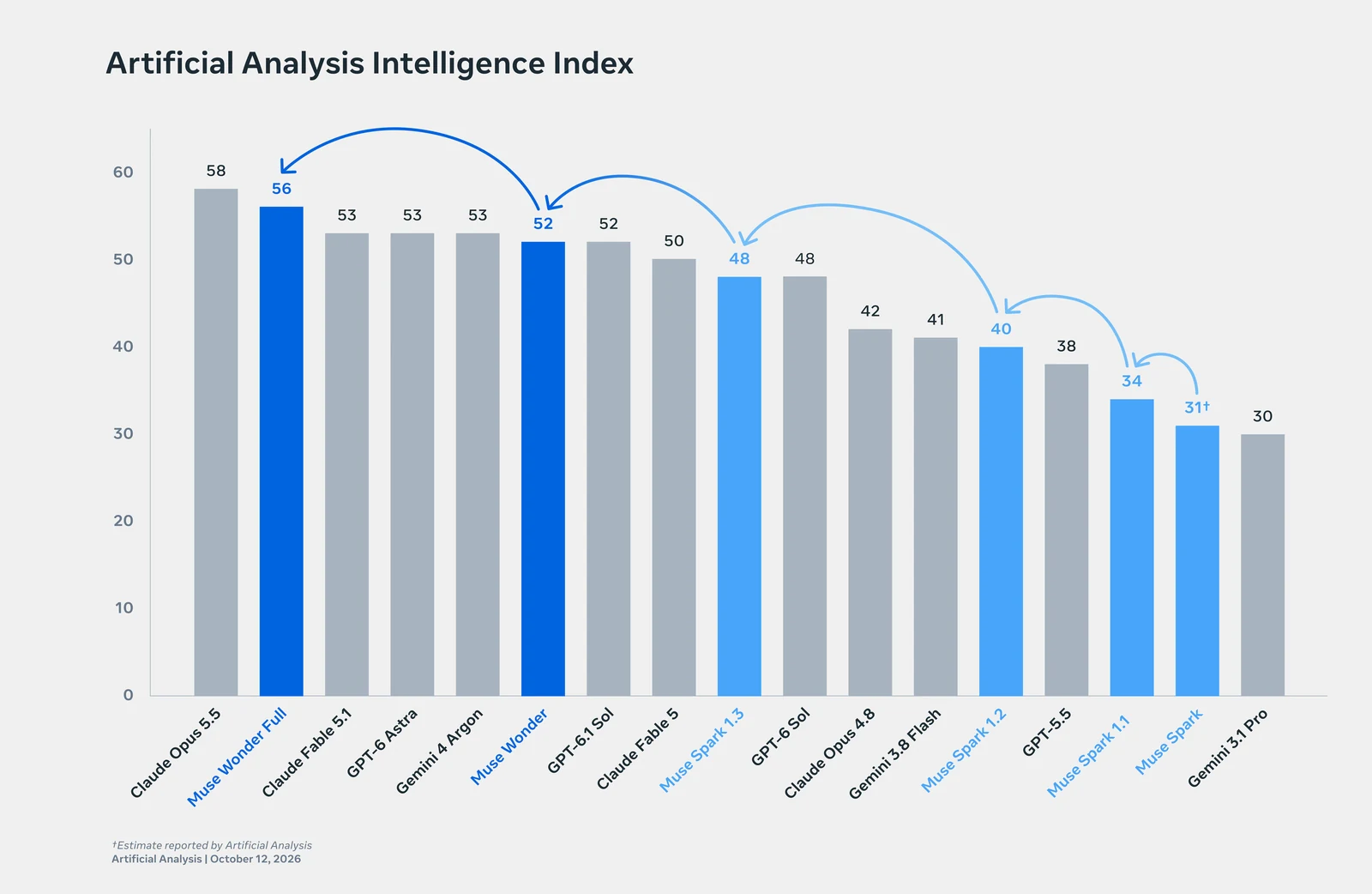
Meta’s chart ranks Muse Wonder Full second behind Opus 5.5. AA’s own leaderboard also lists Claude Sonnet 5.5 at 56.00, a hair above Muse Wonder Full’s unrounded 55.80, so by model family Full is third, not second. Sonnet 5.5 is not the only rival missing from Meta’s comparisons:
| Test | Muse Wonder Full | Left out of Meta’s comparison | Published by |
|---|---|---|---|
| AA Intelligence Index | 56 (55.80 unrounded) | Claude Sonnet 5.5: 56 (56.00) | Artificial Analysis |
| Terminal-Bench 4.0 | 57.1 | Claude Sonnet 5.5: 63.6, first on AA’s board | Artificial Analysis |
| AutomationBench-AA, strict | 45.4 | Gemini 4 Argon: 53.1. Claude Sonnet 5.5: 45.5 | Artificial Analysis |
| Vals Finance Agent V2 | 59.06, fifth on Vals’ board | Gemini 4 Argon 65.40, Gemini 3.8 Flash 61.44, Muse Spark 1.2 60.60, Muse Spark 1.3 Max 59.96 | Vals AI |
| HealthBench Pro | 62.3 | Claude Sonnet 5.5: 69.2 in Anthropic’s run | Anthropic |
| GDPval-AA, not in Meta’s table | 1857 Elo | Claude Opus 5.5: 1866 Elo | Artificial Analysis |
| AA-Briefcase, not in Meta’s table | 1729 Elo | Claude Sonnet 5.5 1823, Claude Opus 5.5 1807 | Artificial Analysis |
Two names stand out. Claude Sonnet 5.5 matches or beats Muse Wonder Full on five of these seven tests at half Muse Wonder’s per-token price, $2 and $10, though it trails on GDPval-AA (1838 against 1857) and on Vals (58.10 against 59.06). Gemini 4 Argon leads both the finance research and the business workflow tests, but Google has only opened it to trusted cyber defenders so far, which may be why Meta left it out. Even Meta’s own older Muse Spark 1.2 (60.60) and Muse Spark 1.3 Max (59.96) rank above Muse Wonder Full on the Vals board.
Still waiting for public leaderboards
- Harvey LAB-AA, 13.1 and 10.0: AA’s public Harvey page has no entry for the new models yet. Its leader there is Grok 4.7 at 9.4%.
- DeepSWE 1.1, 79.0: Meta credits Datacurve, but Datacurve’s public board, last updated on 22 September, has no entry for either new model.
- SWE-Marathon, 57.5: the benchmark’s site says its new leaderboard is coming soon.
- MemoryBench, FocusBench and the Personal Superintelligence Index: Meta’s own internal tests.
So far the confirmed independent numbers come from two places. Artificial Analysis confirms the Intelligence Index, AutomationBench-AA and Terminal-Bench 4.0, plus its own GDP.pdf run (32.6, first place), which differs from the Surge figure Meta used. Vals AI confirms Finance Agent V2: 59.06 for Wonder Full and 56.64 for Muse Wonder. AA has published no speed or latency data yet, and the model has no entry on Arena. We will add both models to our AI leaderboard, which ranks models on independent tests only, as those results arrive.
Active Memory and Active Focus, in plain words
Meta built the launch around two abilities it says personal and work agents need.
Active Memory: remembering what matters
Active Memory means carrying important context about you across conversations and pulling back the right details when they become relevant. Meta measures it with MemoryBench, an internal test of recall across long conversations of 64,000 to 100,000 tokens, with distractor conversations mixed in and later turns that contradict or update the facts. An AI judge marks each answer.
Muse Wonder scores 85.6 and Muse Wonder Full 85.5, against 81.5 for Opus 5.5, 81.4 for GPT-6 Astra and 79.0 for Fable 5.1. For a finance team, the update part is the useful bit: when a client corrects a figure three messages later, the model should use the corrected figure, not the first one.
Active Focus: keeping at a hard task
Active Focus is Meta’s name for persistence: trying other approaches, working through blockers and adapting when things change, while asking for clarification when needed and checking in before important actions. Meta measures it with FocusBench, an internal test of personal agent tasks in areas such as housing, travel, IT and finance, where the agent has to work through real-world blockers over several interactions.
FocusBench is where the two variants differ most: Full scores 54.2 and Muse Wonder 44.9, behind both GPT-6 Astra (47.7) and Opus 5.5 (45.8), with Fable 5.1 at 36.6. If persistence on messy, multi-step tasks is what you need, that gap matters. Meta built and ran both tests, so they show what it optimised for.
Meta Muse Wonder pricing and what a task costs
Muse Wonder costs $4 per million input tokens, $0.20 per million cached input tokens and $20 per million output tokens, in Standard mode only. That is 3.2 times Muse Spark 1.3 on input and about 4.7 times on output, a clear jump into frontier pricing. The full rates are on Meta’s pricing page.
Meta’s AI chief Alexandr Wang told CNBC that API pricing would be meaningfully below the leading OpenAI and Anthropic models. That holds against GPT-6 Astra and Claude Fable 5.1, which list at $10 and $50, but not against Claude Opus 5.5, which lists at exactly the same $4 and $20 on Anthropic’s pricing page.
| Model | Input | Output | Cached input | AA Index | Notes |
|---|---|---|---|---|---|
| Muse Wonder | $4.00 | $20.00 | $0.20 | 52 | Meta Model API, preview; Standard mode only |
| Muse Wonder Full | Plans only | Plans only | Plans only | 56 | Muse Code Power Usage ($50) or Maximum Usage ($200) plan |
| Claude Opus 5.5 | $4.00 | $20.00 | $0.20 | 58 | Same input, cached and output prices; Anthropic adds cache-write charges but offers a 50% batch discount |
| Claude Sonnet 5.5 | $2.00 | $10.00 | $0.10 | 56 | Half the price per token; left out of Meta’s charts |
| Claude Fable 5.1 | $10.00 | $50.00 | $0.25 | 53 | Anthropic’s top-priced model |
| GPT-6 Astra | $10.00 | $50.00 | $1.00 | 53 | 2x input and 1.5x output above 272K input tokens |
| GPT-6.1 Sol | $2.00 | $10.00 | $0.10 | 52 | Same 272K surcharge as GPT-6 Astra |
| Gemini 4 Argon | $2.00 | $10.00 | $0.10 (95% off) | 53 | Introductory price, rising to $4 / $20; trusted cyber defenders only for now |
| Muse Spark 1.3 | $1.25 | $4.25 | $0.15 | 48 | Contributor mode $0.10 / $0.20, where Meta trains on your content |
The fine print on the price
- No long-context premium. The rate is the same whether a prompt is short or fills most of the 1,048,576-token window. GPT-6 Astra and GPT-6.1 Sol, by contrast, charge 2x input and 1.5x output above 272K input tokens.
- Caching is automatic. When the start of a prompt matches a cached prefix, those tokens cost $0.20 per million instead of $4. There is no flag to set, and Meta lists no charge for writing to the cache, unlike Anthropic.
- Reasoning is billed as output. Thinking tokens cost $20 per million like any other output, so higher effort raises the bill fast. Effort runs from minimal to max on Meta’s reasoning settings.
- Web search costs extra: $2.50 per 1,000 searches, on top of tokens. The steering prompt Meta adds to every request is not billed.
- No batch discount and no free credits are published.
- Rate limits: 3,000 requests and 4 million tokens per minute, shared by every key in a team.
- Billing: charged when your balance hits a threshold and on the 1st of each month. There is no hard spending cap, only email alerts, and no refunds.
What a task costs: four worked examples
Token prices only become useful when you turn them into jobs. Here is the arithmetic at list prices:
| Task | The arithmetic at Meta’s list price | Muse Wonder | The same job elsewhere |
|---|---|---|---|
| Review a 100,000-token document pack and write a 10,000-token answer, thinking included | 100,000 × $4 ÷ 1M = $0.40, plus 10,000 × $20 ÷ 1M = $0.20 | $0.60 | Claude Opus 5.5 $0.60; Claude Sonnet 5.5 $0.30; GPT-6 Astra $1.50; Muse Spark 1.3 $0.17 |
| A month of 1,000 contract or invoice checks, each 20,000 tokens in and 2,000 out, with 2 web searches | 1,000 × ($0.08 + $0.04) = $120 in tokens, plus 2,000 searches × $2.50 ÷ 1,000 = $5 | $125 a month | Tokens only: Claude Sonnet 5.5 $60; GPT-6 Astra $300; Muse Spark 1.3 $33.50 |
| A long agent session: 1,500,000 input tokens, 1,200,000 of them read from cache, and 80,000 output tokens | 1.2M × $0.20 = $0.24, plus 0.3M × $4 = $1.20, plus 0.08M × $20 = $1.60 | $3.04 | Muse Spark 1.3 about $0.90; Claude Opus 5.5 about $3.34, because Anthropic also bills the 0.3M new tokens as cache writes at $5 per million |
| One 900,000-token prompt with a 20,000-token answer | 0.9M × $4 = $3.60, plus 0.02M × $20 = $0.40 | $4.00 | Same rate as a short prompt; GPT-6 Astra and GPT-6.1 Sol charge more once input passes 272K tokens |
Two cautions. First, the model is wordy. Artificial Analysis says it generated 130 million tokens while running the Intelligence Index, against a median of 85 million, and puts the average cost of one index task at $4.52. AA’s launch post on X adds that this is about 54,000 output tokens per task, and gives $5.98 per task for Claude Opus 5.5 and $5.46 for Claude Sonnet 5.5.
Second, token prices hide retries and thinking. On Vals Finance Agent V2, Muse Wonder costs $2.67 per test, against $9.22 for Opus 5.5 and $0.76 for Muse Spark 1.3 Max. Judge cost per finished task on your own work, not price per token.
Budget for thinking, too. The invoice example assumes 2,000 output tokens per check. If thinking adds 20,000 more to each check, the month rises from $125 to $525, and Meta offers no hard spending cap, only email alerts. Set alerts and test a lower effort level before you commit.
Muse Code plans: the only way to Muse Wonder Full
Muse Code subscription prices in US dollars a month, from Meta’s Muse Code page. Usage is shown as a multiple of the Everyday Usage plan.
Muse Wonder is on every plan. Muse Wonder Full needs Power Usage or Maximum Usage, and Maximum Usage is new with this launch. The plans work only through the Muse Code command line tool; any other API key you create is billed pay as you go. Upgrades take effect at once and are prorated, there are no refunds when you cancel, and Maximum Usage subscribers who hit the limit must wait for it to refresh.
Meta does not say how fast Muse Wonder Full uses up an allowance, so there is no fair way to turn $50 a month into a token count yet. One setting matters more than the price: every plan starts in Contributor mode, which lets Meta train on your prompts, code, files and the model’s answers in exchange for more usage. Turn it off in Muse Code settings before your first prompt, because switching off only protects what you send afterwards. Both Wonder models still work with it off; you get less usage, and Meta does not say how much less. Muse Code on a pay-as-you-go API key runs Muse Wonder in Standard mode only.
What Meta Muse Wonder means for finance and accounting teams

Meta pitches the models at law, finance and health, and its newsroom post names making sense of someone’s finances as an example. The model card lists domain knowledge work in finance, including preparing drafts for review, as an intended use. Here is what the evidence supports so far.
The finance numbers, read carefully
| Test | What it measures | Muse Wonder Full | Muse Wonder | Best rival |
|---|---|---|---|---|
| Vals Finance Agent V2 | Analyst research over filings and market data, pitched at the depth of a second or third year investment banking analyst | 59.1 (59.06 and fifth on Vals’ board) | 56.6 (56.64 on Vals) | Gemini 4 Argon 65.40 and Meta’s Muse Spark 1.2 60.60 on Vals’ public board |
| AutomationBench-AA, strict | End-to-end business workflows in simulated apps | 45.4 | 39.1 | Gemini 4 Argon 53.1 on AA |
| AutomationBench-AA, finance tasks | Share of objectives completed in AA’s 120 finance tasks | 85.7% | 84.3% | Gemini 4 Argon 94.6%, Claude Sonnet 5.5 92.5%, GPT-6 Astra 89.2%, Claude Opus 5.5 88.3% |
| GDP.pdf | Professional work grounded in supplied PDFs | 33.2 (Surge); 32.6 and first on AA | 30.8 (Surge); 30.6 on AA | GPT-6 Astra 34.2 (Surge) |
| GDPval-AA | Real work products across 44 occupations (Elo) | 1857 | 1770 | Claude Opus 5.5 1866 |
Three things stand out. Vals now lists Wonder Full at 59.06, confirming Meta’s figure, but that ranks fifth on its public board: four models score higher, including Meta’s own cheaper Muse Spark 1.2 and Muse Spark 1.3 Max at under $0.80 a test, against $2.39 for Wonder Full. On AA’s finance tasks, Muse Wonder Full completes fewer objectives than Opus 5.5, GPT-6 Astra, Sonnet 5.5 or Gemini 4 Argon. And AA’s raw page data also shows it breaking more of the tasks’ guardrail rules: 71 violations across the 120 finance tasks, against 53 for Opus 5.5 and 31 for Sonnet 5.5.
Its best finance-adjacent results are narrow: first on AA’s GDP.pdf by 0.4 points and within 9 Elo of Opus 5.5 on GDPval-AA, though about 80 Elo behind Opus 5.5 on AA-Briefcase’s multi-week projects. Reading contracts, filings and statements and drafting from them is where we would test it first.
Your data: the setting to check first
- On the API, Meta does not train on your content. The model runs only in Standard mode there, and Meta’s Model API terms commit it not to use Standard-mode content to train its models.
- Muse Code subscriptions start in Contributor mode. In that mode Meta can use your prompts, code, files and the model’s responses to train future models, in exchange for more usage. Switch it off in settings before client or company data goes in. Switching off only covers future content, and the terms say not to put confidential or personal information into Contributor mode at all.
- Retention has no fixed period. Meta keeps content and usage data as needed to run the service, meet legal duties and review safety and abuse. Even in Standard mode Meta may keep and process your content to detect abuse and to develop, evaluate and improve its safety and security systems, and it may use usage data such as tool-call sequences and logs to improve its products.
- Zero data retention is not self-serve. Zero data retention is for qualified accounts through Meta’s sales team, may vary by model, and switches off file uploads, web search and background requests. Content flagged for policy violations can still be kept for up to two years.
- No SOC 2 or ISO certification is named. Meta’s data commitments cite TLS 1.2 or newer encryption in transit, PCI-DSS for card data and an internal security management system. If your clients or auditors need a SOC 2 report, ask Meta’s sales team before you sign.
- Some terms are in your favour. Meta indemnifies customers of its Standard services against third-party IP claims over unmodified outputs, when paid for with money rather than promotional credits; it does not cover Contributor mode. Customers in the European region contract with Meta Platforms Ireland.
File limits that matter for finance
The Model API’s file handling list has no spreadsheet or Word formats. It takes images, video, audio, PDF, and plain text or JSON. PDFs are read for text up to page 100 and as page images up to page 50. In practice that means sending spreadsheet data as text in the prompt or as a PDF, or working through tools, and splitting long annual reports before you upload them.
How we would test it
- Pick 20 finished tasks with known right answers: a reconciliation, a variance commentary, a contract summary, a figure pulled from a filing.
- Run them through Muse Wonder on the API and through the model you use today, at the same effort level, and compare accuracy and cost per finished task.
- Include the update test: change a figure partway through a conversation and check which one the model uses.
- Give it the current rules. Meta has not published a knowledge cutoff, so supply the rule text instead of trusting what the model remembers.
- Let a calculator or your accounting system produce the numbers, and use the model to read, draft and check.
- Keep people approving payments, filings and anything a client sees. Meta’s own model card recommends human confirmation before irreversible actions.
For prompts and setups that already work with other models, see our Claude for finance and accounting guide, our AI prompts for finance and our overview of AI in finance and accounting.
Muse Wonder safety: what Meta’s charts and model card show
Meta calls Muse Wonder its most aligned model to date, with its strongest safeguards yet against chemical, biological, radiological and nuclear misuse and against cyber misuse, while keeping defensive cyber work available. The full safety report is still to come; Meta says it will be available soon. Its launch charts compare the two new models with Fable 5.1 and GPT-6 Astra:
| Meta’s safety test | Better is | Muse Wonder Full | Muse Wonder | Fable 5.1 | GPT-6 Astra |
|---|---|---|---|---|---|
| Biology misuse refusal (bioTIER) | Higher | 98.7% | 98.0% | 99.7% | 83.6% |
| Cyber misuse refusal | Higher | 96.9% | 93.7% | 97.5% | 86.3% |
| Cyber defense compliance | Higher | 93.3% | 94.5% | 15.7% | 81.3% |
| Mishandling personal information | Lower | 2.2% | 3.4% | 6.8% | 4.6% |
| Executing unauthorized code (attack success) | Lower | 10.7% | 10.5% | 11.3% | 19.7% |
Fable 5.1 still refuses slightly more biology and cyber misuse requests. Where the Muse models stand apart is defensive security work: Muse Wonder complies with 94.5% of cyber defense requests in Meta’s test, against 15.7% for Fable 5.1. Muse Wonder Full also has the lowest personal information violation rate in the chart, 2.2%. That is still about one case in 45 on Meta’s test, so keep an agent’s access to client data narrow.
The last row matters most for agents that read outside material such as supplier emails, invoices or web pages: in Meta’s test, about one attack in ten still got the model to run code it should not have. Give such agents read-only access where you can, and keep a person approving any payment, filing or message they prepare.
The model card’s risk assessment
- Chemical and biological risk. Without mitigations, Meta does not rule out Muse Wonder Full reaching the high-risk threshold of its Superintelligence Scaling Framework in this domain. It applies safety training and system-level classifiers, and rates the risk moderate or lower with them in place.
- Cyber and loss of control. Moderate or lower even before mitigations, by Meta’s assessment.
- Cyber skills. Meta’s model card reports 88.4% on CyberGym, a cybersecurity benchmark, alongside the cyber misuse safeguards above.
- Honesty and misalignment. 87.3% on MASK, which tests honesty under pressure, and a 0% harmful action rate on Agentic Misalignment.
- Known limits. It can give inaccurate answers and make errors in multi-step reasoning on unfamiliar problems, and it is weaker at visual and 3D spatial reasoning. It is not intended for people under 18.
How to start using Muse Wonder
If your team does not write code, there is no point-and-click app for using Muse Wonder at work yet: it was still not in the Muse app on 10 November 2026, and Muse Code runs in a terminal. A developer can connect it to your tools through the API or OpenRouter. To try it in a browser first, Meta’s model page has a Try in playground button. Here is how to get started:
- Sign up for the Meta Model API. Sign-up is self-serve at dev.meta.ai. You must be 18 or older and in a supported country, and you add a card and business details on the Billing page before your first request. Companies can use a managed Business and Enterprise account with a work email. The API is not offered in restricted territories such as China, Russia, Iran and Pakistan; Meta’s geographic use policy lists the rest.
- Point your existing code at it. The API works with the OpenAI and Anthropic SDKs: point the OpenAI SDK at
https://api.meta.ai/v1or the Anthropic SDK athttps://api.meta.ai, and set the model tomuse-wonder-1.0. The Responses, Chat Completions and Messages formats all cost the same. Reasoning effort runs fromminimaltomax, andnonereturns an error. The API overview has a quickstart. - Or install Muse Code. One line installs the
musecommand:curl -fsSL https://dev.meta.ai/install.sh | shon macOS or Linux, orirm https://dev.meta.ai/install.ps1 | iexin Windows PowerShell. Runmusein a project folder and sign in. To subscribe, sign in to Muse Code with your Meta Model API account, then pick the plan under Subscriptions in Meta’s Accounts Center. Before you open a client folder, turn off Contributor mode in settings, since every subscription starts with it on. The Muse Code docs still name Muse Spark 1.2 as the default model, so choose the model you want in its settings. If you are weighing coding agents, our Claude Code tutorial covers Anthropic’s equivalent. - Through OpenRouter. Meta’s model page also lists OpenRouter as a way to swap the model into existing tools; OpenRouter lists it at the same $4 and $20, and Vercel AI Gateway lists it too. Calls routed through a gateway follow that gateway’s own data and retention terms, and Meta’s zero data retention does not apply.
- In the Muse app: not yet. Meta says Muse Wonder will soon power the Muse app, subscribers first, and had given no date by 10 November 2026. On 6 November 2026 Meta said it is rolling out specialised versions of its models to the Muse app, trained with learnings from Muse Wonder; it has not said these are Muse Wonder itself. Meta’s help page lists the app’s paid plans as Power at $20 a month and Max at $100 a month, and CNBC reports those are the plans that will get it. The app launched in the US and Canada and reached Japan on 23 October 2026 and Singapore on 27 October 2026; our guide to the Muse personal agent covers the app itself.
- Test before you switch. Run 20 of your own past tasks at medium and max effort and compare the output and cost with what you use today.
Meta Muse Wonder vs Claude Opus 5.5, Sonnet 5.5 and GPT-6 Astra: which to use
| If you need | Our pick | Why |
|---|---|---|
| Long agentic coding projects in your own terminal | Muse Wonder Full in Muse Code | Tops DeepSWE (79.0) and SWE-Marathon (57.5) in Meta’s table, though neither result is on a public leaderboard yet |
| Terminal work and building programs from scratch | Claude Sonnet 5.5 or Opus 5.5 | Sonnet 5.5 leads AA’s Terminal-Bench 4.0 at 63.6; Opus 5.5 leads ProgramBench, 70.5 against 59.0 |
| Legal and contract document work | Wonder Full, tested on your own documents | 13.1 on Harvey LAB-AA in Meta’s table (not yet on AA’s public board, where the leader scores 9.4), and first on AA’s GDP.pdf. Turn off Contributor mode before any client document goes in |
| Finance research over filings | Muse Spark 1.2, trialled against your current model | Muse Spark 1.2 (60.60) and Gemini 3.8 Flash (61.44) both score higher on Vals than Wonder Full (59.06), Fable 5.1 (58.88) or Opus 5.5 (58.59), at $0.77 and $2.00 a test against $9.22 for Opus 5.5. Gemini 4 Argon leads at 65.40 but is limited to trusted cyber defenders for now |
| Business workflow automation | Claude Sonnet 5.5 | 45.5 on AutomationBench-AA strict, level with Wonder Full’s 45.4, which is CLI-only; the API model Muse Wonder scores 39.1, and Sonnet costs half its per-token price ($2 / $10 against $4 / $20). Gemini 4 Argon leads at 53.1 but has restricted access |
| Computer use in browsers and desktop apps | Claude Opus 5.5 | 81.8 on OSWorld V2.1 partial credit against 78.4 |
| Health questions | GPT-6 Astra, Claude Sonnet 5.5 or Opus 5.5 | In Anthropic’s runs, 70.3 for Astra, 69.2 for Sonnet 5.5 and 65.6 for Opus 5.5, against 62.3 for Wonder Full; OpenAI’s own figure for Astra is lower, at 63.4 |
| Agents that must remember long histories | Muse Wonder, tested on your own long threads | 85.6 on MemoryBench, Meta’s own internal test; no independent memory test yet |
| The best independent overall score | Claude Opus 5.5 | 58 on the AA Intelligence Index |
| Your own agent or app on Meta’s stack | Muse Wonder on the API | $4 / $20, works with the OpenAI and Anthropic SDKs, and Meta does not use API content to train its models |
| Cheap bulk work | Muse Spark 1.3 or Claude Haiku 5.5 | $1.25 / $4.25, and $0.10 / $0.50 per 1M tokens for Haiku prompts up to 100K tokens ($0.50 / $2.50 above that) |
A simple rule: if you already run Claude Opus 5.5, the list prices are identical, though Vals’ first cost-per-test figures put Muse Wonder at $2.67 against $9.22 for Opus 5.5, so compare cost per finished task on your own work. If you pay for GPT-6 Astra or Claude Fable 5.1, Muse Wonder costs 60% less per token and is worth a trial, but put Claude Sonnet 5.5 in the same trial: it scores higher on the independent index at half Muse Wonder’s price.
For the rivals, see our Claude Opus 5.5 review and Claude Sonnet 5.5 review, our GPT-6.1 Sol guide, our Gemini 4 Argon review, our GPT-6 Astra vs Claude Fable 5.1 comparison and our Claude Haiku 5.5 guide for cheap bulk work.
How Muse got here: from Spark to Wonder
By Meta’s own account, it began a ground-up overhaul of its AI work fourteen months ago. The result has been a shift from the open Llama models to closed Muse models built by Meta Superintelligence Labs. The timeline shows how fast it has moved since Muse Spark in April:
| Date | What happened |
|---|---|
| 5 Apr 2025 | Llama 4 Scout and Maverick ship as open weights, still Meta’s newest Llama models |
| 8 Apr 2026 | Muse Spark, the first model from Meta Superintelligence Labs: closed, with a private API preview only |
| 7 Jul 2026 | Muse Image launches and Muse Video enters preview |
| 9 Jul 2026 | Muse Spark 1.1 and the Meta Model API public preview, at first for US developers only, with a 1M token context |
| 5 Aug 2026 | Muse Code (beta) and Muse Spark 1.2, with wider global access |
| 10 Aug 2026 | Muse Glimmer, a 30B open-weight model under the Apache 2.0 license |
| 31 Aug 2026 | Muse Code leaves beta with subscription plans |
| 2 Sep 2026 | Muse Spark 1.3 |
| 8 Sep 2026 | The Muse personal agent app launches in the US, later adding Canada |
| 28 Sep 2026 | Meta Enterprise Platform launches to sell Meta’s AI stack to businesses |
| 29 Sep 2026 | Muse for Small Business adds business skills and connectors |
| 2 Oct 2026 | Meta publishes version 2.1 of its Superintelligence Scaling Framework |
| 12 Oct 2026 | Muse Wonder and Muse Wonder Full |
Two threads run through it. Meta has gone closed: Meta Muse Wonder is hosted only, and Muse Glimmer is still the only open-weight Muse model, while the promised open weights for Muse Spark are not out yet. And Meta has climbed the price ladder, from Muse Spark 1.3 at $1.25 and $4.25 to $4 and $20 now. CNBC and the New York Times report the model’s internal codename was Watermelon, and the Times reports that a pause in pretraining in July delayed the release. For the consumer side, see our guide to the Meta Muse AI agent and the Muse app launch post.
Key takeaways
- Should you switch? From Claude Opus 5.5, only where your own tests show a gain, since the token prices are identical. From GPT-6 Astra or Claude Fable 5.1, Muse Wonder is 60% cheaper per token and worth a trial next to Claude Sonnet 5.5.
- Meta released Muse Wonder and Muse Wonder Full on 12 October 2026. The API model costs $4 input and $20 output per million tokens, the same as Claude Opus 5.5; Full comes only with Muse Code plans at $50 or $200 a month.
- In Meta’s own 14-row table, Muse Wonder Full tops 6 rows and Muse Wonder 1, against 6 for Claude Opus 5.5 and 1 for GPT-6 Astra.
- On the independent Artificial Analysis index, Muse Wonder Full scores 56: below Opus 5.5 at 58 and level with Claude Sonnet 5.5, which Meta left out.
- Vals AI now confirms Meta’s finance figure (59.06 for Wonder Full, fifth on its board), but 13.1 on Harvey LAB-AA, 79.0 on DeepSWE and 57.5 on SWE-Marathon are not on public leaderboards yet.
- For finance, Gemini 4 Argon (65.40) and Meta’s own cheaper Muse Spark 1.2 both score higher on Vals, and on AA’s finance tasks Muse Wonder Full trails Opus 5.5, Sonnet 5.5 and GPT-6 Astra. Document work looks like its best fit.
- Meta does not use API content to train its models, but Muse Code subscriptions start in Contributor mode, where it does. Turn it off before client data goes in.
- Muse Wonder, the API model, is wordy: 130 million tokens on AA’s index against an 85 million median, and $4.52 per index task, still below the $5.98 AA gives for Claude Opus 5.5.
- Meta does not rule out high chemical and biological risk without mitigations, and its full safety report is still to come.
Please note: we update this page from time to time, but AI models, prices and benchmark results change quickly, and there can be a gap between a change and our update. Check Meta’s official pages before you act. This guide helps you compare and estimate; it is not legal, tax or investment advice, and ReconScribe is not responsible for decisions made on it.
Meta Muse Wonder: frequently asked questions
What is Meta Muse Wonder?
Meta Muse Wonder is Meta's most capable AI model family, released on 12 October 2026. It has two variants: Muse Wonder, on the Meta Model API and in Muse Code, and Wonder Full, a higher-capability version only in Muse Code subscriptions. Both are built for coding and for personal and professional agents.
How much does Muse Wonder cost?
On the Meta Model API it costs $4 per million input tokens, $0.20 per million cached input tokens and $20 per million output tokens, with no long-context premium. Web search adds $2.50 per 1,000 searches. Wonder Full has no per-token price: it comes with the Muse Code Power Usage plan at $50 a month or the Maximum Usage plan at $200 a month.
What is the difference between Muse Wonder and Muse Wonder Full?
Wonder Full is the higher-capability variant and scores higher on most of Meta's tests, by up to about 9 points on agent tasks. The standard model is on the API and every Muse Code plan, while Full is only on the $50 and $200 Muse Code plans. Setting reasoning effort to max does not switch you to Full.
Is Muse Wonder better than Claude Opus 5.5?
Not overall. In Meta's own table, Wonder Full tops 6 of 14 rows and Opus 5.5 also tops 6. On the independent Artificial Analysis Intelligence Index, Opus 5.5 scores 58 against 56 for Wonder Full and 52 for the API model. By Meta's numbers, Full leads on legal work and very long coding jobs and ties on finance research; Opus leads on computer use, terminal coding and building programs from scratch. The API model, Muse Wonder, costs the same per token as Opus 5.5; Wonder Full comes only with $50 or $200 Muse Code plans.
Is Muse Wonder open source?
No. Both variants are closed models, available only through Meta's hosted services. Meta's only open-weight Muse model is Muse Glimmer, released under the Apache 2.0 license in August 2026.
What is the Muse Wonder context window?
1,048,576 tokens, about 1 million. It takes text, images, video, audio and PDF files and returns text. Meta has not published a maximum output length or a knowledge cutoff.
Does Meta train on my data when I use Muse Wonder?
Not on the Meta Model API, where the model runs only in Standard mode and Meta does not use your content to train its models. Meta can still process API content for abuse detection and its safety and security systems. Muse Code subscriptions are different: they start in Contributor mode, which lets Meta train on your prompts, code and files. Turn it off in settings before you use client or company data.
How do I get access to Muse Wonder Full?
Subscribe to Muse Code on the Power Usage plan at $50 a month or the Maximum Usage plan at $200 a month: sign in to Muse Code with your Meta Model API account, then pick the plan under Subscriptions in Meta's Accounts Center, and use it through the Muse Code command line tool. It is not available on the Meta Model API, and Meta has not said whether it will be, so you cannot call it from your own app. Plan benefits can vary by region.
Is Muse Wonder in the Muse app?
Not yet. Meta says Muse Wonder will soon power the Muse app, rolling out to subscribers first, but had given no date by 10 November 2026, and it has not named Wonder Full for the app. On 6 November 2026 Meta began rolling out specialised versions of its models to the app, trained with learnings from Muse Wonder. The Muse app is available in the US and Canada, with paid plans at $20 and $100 a month, and Meta added Japan on 23 October 2026 and Singapore on 27 October 2026.
What benchmarks did Meta publish for Muse Wonder?
A 14-row table covering agents, coding and general intelligence, including Harvey LAB-AA, Vals Finance Agent V2, HealthBench Pro, AutomationBench-AA, GDP.pdf, OSWorld, DeepSWE, SWE-Marathon, ProgramBench and the Artificial Analysis Index, plus FocusBench and five safety charts. Every result is at max reasoning effort except Wonder Full's SWE-Marathon score, which was run at xhigh.
Has anyone tested Muse Wonder independently?
Artificial Analysis and Vals AI have. AA scores Wonder Full 56 and the API model 52 on its Intelligence Index, and Vals lists Wonder Full at 59.06 and Muse Wonder at 56.64 on Finance Agent v2, matching Meta. Meta's 13.1 on Harvey LAB-AA is not on AA's public board yet. ReconScribe has not run its own tests.
Is Muse Wonder safe for finance work?
It can help with research, document review and drafts, but treat it as a preview. Use the API or switch off Contributor mode, ask Meta about SOC 2 and zero data retention if you need them, give it the source documents, and keep a person approving payments, filings and client work.
Can I use Muse Wonder with the OpenAI or Anthropic SDK?
Yes. The Meta Model API works with both SDKs, with the model set to muse-wonder-1.0. Point the OpenAI SDK at https://api.meta.ai/v1 and the Anthropic SDK at https://api.meta.ai. The Responses, Chat Completions and Messages formats all cost the same.
What are the Muse Wonder rate limits?
3,000 requests and 4 million tokens per minute on the Meta Model API, shared by every API key in a team. Starting background responses is capped at 600 per minute per team.
Related reading
- Meta Muse AI agent explained: features and privacy
- Claude Opus 5.5: benchmarks, pricing and how it compares
- Claude Sonnet 5.5: benchmarks, pricing and how it compares
- Claude Haiku 5.5: benchmarks, pricing and best uses
- GPT-6.1 Sol: pricing, benchmarks and our verdict
- GPT-6 Astra vs Claude Fable 5.1
- Gemini 4 Argon: benchmarks and our verdict
- AI leaderboard 2026: every major model ranked
- Claude Code tutorial for finance teams
- AI prompts for finance
- Claude for finance and accounting
- AI in finance and accounting
Sources
- Meta AI Research: Muse Wonder
- Meta Newsroom: Introducing Muse Wonder and Muse Wonder Full
- Muse Wonder model card
- Muse Wonder model page (Meta AI Developers)
- Meta developer blog: Build with Muse Wonder
- Meta Model API: Models
- Meta Model API: Overview
- Meta Model API: Pricing and rate limits
- Meta Model API: Reasoning
- Muse Code subscriptions
- Muse Code
- Muse Code docs
- Meta Model API terms of service
- Meta Model API: Zero data retention
- Meta Model API: Data commitments
- Meta Model API: File handling
- Meta Model API: Geographic use policy
- Meta Superintelligence Scaling Framework
- Meta Newsroom: Introducing Muse Spark
- Meta Newsroom: Introducing Muse
- Meta AI Research: Muse Glimmer
- Artificial Analysis: Muse Wonder Full
- Artificial Analysis: Muse Wonder
- Artificial Analysis: model leaderboard
- Artificial Analysis: AutomationBench-AA
- Artificial Analysis: Terminal-Bench 4.0
- Artificial Analysis: Harvey LAB-AA
- Artificial Analysis: GDP.pdf
- Artificial Analysis: GDPval-AA
- Vals AI: Finance Agent v2
- Anthropic: Claude Opus 5.5 system card
- Anthropic: Claude Sonnet 5.5 system card
- Anthropic: Claude Sonnet 5.5
- Anthropic: Claude API pricing
- OpenAI: Introducing GPT-6 Astra
- OpenAI: GPT-6 Astra model page
- OpenAI: Introducing GPT-6.1 Sol
- Google: Gemini 4 Argon