
GPT-6 Astra vs Claude Fable 5.1 looks like a price tie. It is not. Both list $10 per million input tokens and $50 per million output tokens, but the better choice changes once we factor in cache reads, long-context surcharges, retention terms and whether the work must operate real software.
In the first three days of September 2026, Anthropic released Claude Fable 5.1 on 1 September, Google released Gemini 3.8 Flash on 2 September, and OpenAI released GPT-6 Astra on 3 September. That timing and availability come from the Anthropic announcement, Google announcement and OpenAI announcement.
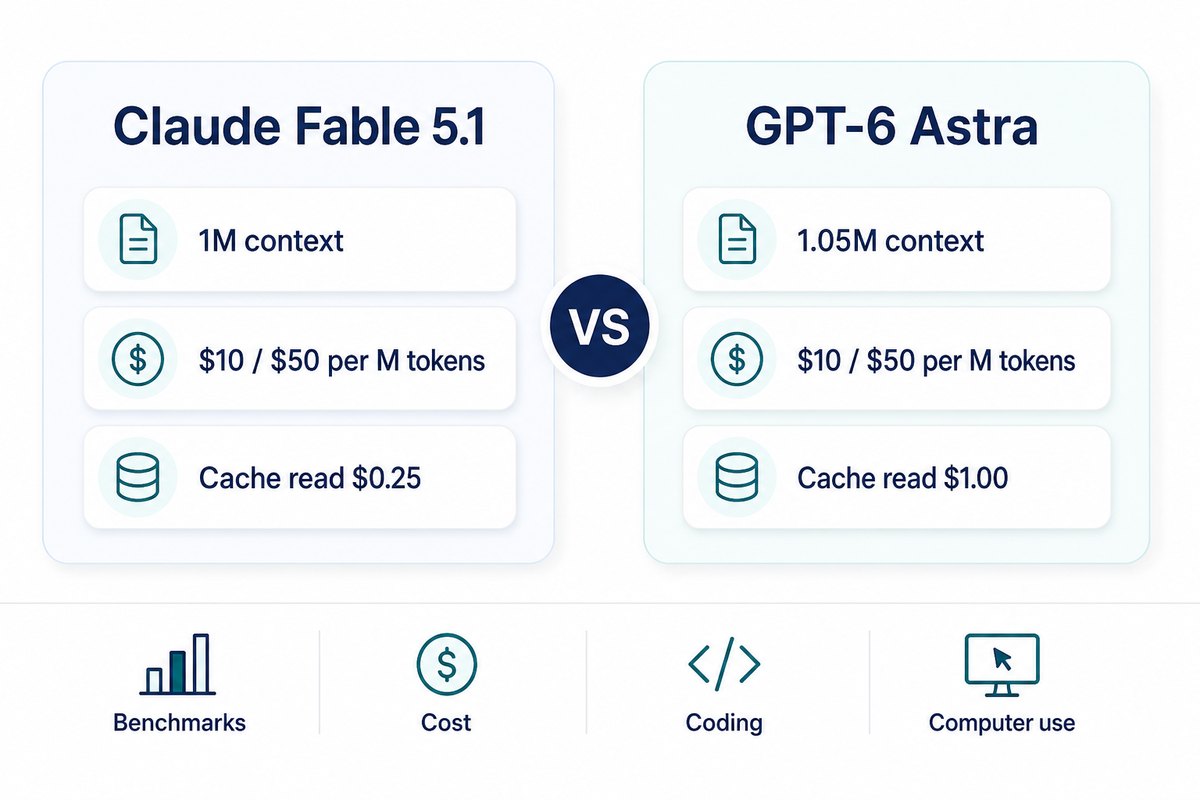
This guide checks the specifications, pricing and selected benchmark tables against the vendors’ own pages. Where the companies report different scores, we keep the test settings and footnotes in view. The finance sections then model the costs in rupees and separate documented specifications from vendor benchmarks and customer claims.
Source standard: Checked on 4 September 2026 against official launch announcements, model documentation and pricing pages. Vendor benchmarks and named customer case studies are reported evidence, not independent audits.
The one line summary: capability jumped a long way on computer use and long-running agent work, the headline API price did not move at all (both charge $10 per million tokens in and $50 per million out), and the cost difference that will actually show up on your bill is buried in a line almost nobody reads, the cache read rate, where Claude Fable 5.1 is four times cheaper than GPT-6 Astra.
What launched: Claude Fable 5.1 and GPT-6 Astra
Four models are involved, and two of them are the same model wearing different safety settings, which is where a lot of the confusion online comes from.
| Model | Company | Released | API name | Who can use it |
|---|---|---|---|---|
| Claude Fable 5.1 | Anthropic | 1 September 2026 | claude-fable-5-1 |
Everyone, on the Claude API, Amazon Bedrock, Google Cloud and Microsoft Foundry |
| Claude Mythos 5.1 | Anthropic | 1 September 2026 | claude-mythos-5-1 |
Approved participants in Anthropic’s Project Glasswing only. Same model, looser cyber and biology safeguards |
| GPT-6 Astra | OpenAI | 3 September 2026 | gpt-6-astra |
Rolling out to ChatGPT Plus, Pro, Business and Enterprise, plus the OpenAI API, Microsoft Azure and AWS Bedrock |
| Gemini 3.8 Flash | Same week | gemini-3.8-flash |
The cheap option, and the reason the routing advice below exists: $0.75 in and $3.75 out per million tokens as introductory pricing to 31 December 2026, rising to $1.50 and $7.50 on 1 January 2027. 1M context, 64k max output |
A note on the names, because they are new. Fable is Anthropic’s top tier, sitting above the more familiar Opus models: Anthropic’s own documentation says most workloads should still start on Claude Opus 5 and move up to Fable only for demanding reasoning and long-horizon agent work. Astra is OpenAI’s successor to GPT-5.6 Sol. Both are what the industry calls frontier models, meaning the most capable thing the lab currently sells, at the price that implies.
GPT-6 Astra vs Claude Fable 5.1: the specs that matter
Two words you need first. A token is roughly three quarters of an English word, so a 10 page vendor agreement is about 6,000 tokens. A context window is how much the model can hold in front of it at one time, your prompt plus the documents you paste plus everything it has already said. When a model advertises a one million token context window, it is saying it can read roughly 1,500 pages in a single go.
| Specification | Claude Fable 5.1 | GPT-6 Astra |
|---|---|---|
| Context window | 1,000,000 tokens | 1,050,000 tokens |
| Maximum output in one reply | 128,000 tokens | 128,000 tokens |
| Reasoning control | Adaptive thinking is always on. Depth set by an effort setting from low to max | reasoning.effort supports low, medium, high, xhigh and max |
| Knowledge cutoff | June 2026 | 30 April 2026 |
| Price above 272,000 input tokens | No change. Standard per-token pricing across the whole window | 2x the input and cache rates and 1.5x the output rate, applied to the whole request |
| Context inside the chat app | 200,000 tokens on Free, Pro and Max alike | Varies by plan and by whether you are using an instant or a reasoning model |
| Data retention | 30 days. Not available under zero data retention unless Anthropic expressly authorises it | Zero data retention supported for eligible API customers |
| Fast mode | Not offered on this model | Available, up to 2x the speed at 2x the price |
Official specification sources: Claude Fable 5.1 model overview and GPT-6 Astra model documentation.
Three rows there deserve more than a glance. The 272,000 token price cliff on GPT-6 Astra is the one most people will trip over: the moment a single request crosses that line, OpenAI charges double for input and one and a half times for output on the entire request, not just the excess. Claude Fable 5.1 charges the same rate across all 1,000,000 tokens. If your plan is to throw a full year of ledgers at a model in one shot, that difference is not a rounding error.
The data retention row matters if you handle client data under a confidentiality clause. OpenAI says GPT-6 Astra supports zero data retention for eligible API customers. Anthropic says Fable 5.1 carries 30-day retention by default and is unavailable under zero data retention unless Anthropic expressly authorises it. That is not an automatic win for either vendor: confirm your organisation’s eligibility or written authorisation before sending sensitive data.
And the chat context row is the one that quietly disappoints people. The million token window is an API number. Inside the Claude chat app, the context window is 200,000 tokens on every consumer plan including Max. Pasting a 900 page annual report into the chat box will not work just because the model technically supports it.
Selected official benchmarks, reported with vendor caveats
A benchmark is a fixed set of tasks with a known answer. It is useful, but a vendor-run benchmark is also a claim by one of the companies being measured. The tables below reproduce selected rows from each official comparison, not the complete evaluation sets. OpenAI also states that its scores are the maximum achieved at any effort and that research or API results can differ from production ChatGPT because the prompts and tools differ.
What OpenAI published for GPT-6 Astra
OpenAI’s official launch page carries the full comparison grid. The rows below are a selected extract, including tests where Astra does not lead.
| Benchmark | What it tests | GPT-6 Astra | Claude Fable 5.1 | GPT-5.6 Sol |
|---|---|---|---|---|
| Terminal-Bench Science 0.1 | Scientific research workflows using code and terminal tools | 64.6% | 52.6% | 22.4% |
| Terminal-Bench 4.0 | Complex terminal work, software engineering, system configuration | 57.9% | 55.8% | 37.3% |
| FrontierMath Tier 4 (v2) | The hardest tier of research level mathematics | 97.6% | 87.8% | 83.0% |
| GPQA Diamond | Graduate level biology, chemistry and physics reasoning | 96.0% | 93.7% | 94.6% |
| ARC-AGI-3 | Learning to solve novel environments it has never seen | 99.9% | Not published | 7.8% |
| Agents’ Last Exam | Complex professional tasks in real software | 59.3% | Not published | 53.6% |
| OSWorld 2.0 (offline, partial) | Driving a real desktop computer | 72.6% | Not published | 65.7% |
| AutomationBench | Automating real professional workflows | 41.4% | 31.4% | 18.1% |
| BenchCAD | Rebuilding 3D objects by writing CAD code | 95.9% | 84.3% | 83.3% |
| DeepSWE v1.1 | Real software engineering issues | 74.1% | 67.4% | 72.7% |
| Humanity’s Last Exam (with tools) | A very hard general knowledge and reasoning exam | 57.2% | 65.0% | Not published |
| Artificial Analysis Intelligence Index v4.1.1 | A third party composite intelligence score | 61.2 | 65.7 | 60.9 |
| Artificial Analysis Coding Agent Index v1.4 | A third party composite coding agent score | 67.0 | Not published | 65.1 |
| SRE-Bench | Reverse engineering software binaries without source code | 88.0% first try, 99.2% within four | Not published | 55.9% |
| ExploitBench | Turning known vulnerabilities into working exploits | 100.0% | Not published | 78.5% |
| MRCR v2, 8 needles, 512K to 1M | Finding buried facts in an enormous context | 96.3% | Not published | 73.8% |
Read the last two rows of that group again. GPT-6 Astra scores a perfect 100% on turning known software vulnerabilities into working exploits, and solves 88% of binary reverse engineering tasks on the first attempt against 12.5% for Claude Opus 5. OpenAI itself says the model meets the Critical threshold for cybersecurity under its Preparedness Framework. We come back to what that means for you further down.
What Anthropic published for Claude Fable 5.1
Anthropic published its official table two days earlier, on 1 September, so it could not include GPT-6 Astra. Its comparison uses GPT-5.6 Sol, the model Astra replaced.
| Benchmark | Claude Fable 5.1 | Claude Fable 5 | Claude Opus 5 | GPT-5.6 Sol |
|---|---|---|---|---|
| Terminal-Bench-Science 0.1 | 52.6% | 24.7% | 29.0% | 22.4% |
| Terminal-Bench 4.0 | 55.8% | 42.0% | 52.3% | 37.3% |
| GDPval-AA v2 | 1853 | 1723 | 1824 | 1711 |
| OSWorld 2.0 (partial) | 77.9% | 72.9% | 75.4% | Not published |
| OSWorld 2.0 (strict) | 41.7% | 36.1% | 39.6% | Not published |
| Humanity’s Last Exam (no tools) | 60.9% | 57.8% | 56.6% | Not published |
| Humanity’s Last Exam (with tools) | 65.0% | 63.8% | 63.6% | Not published |
| AutomationBench | 31.4% | 17.1% | 26.9% | 19.6% |
| CursorBench 3.2.0 | 73.4% | 70.5% | 70.0% | 67.2% |
Why the two tables disagree, and what to do about it
Put the two side by side and the same model gets different scores on the same test. This is not anyone lying. It is what happens when the referee is also a player, and it is worth understanding before you make a purchase decision on a chart.
- The same test, two numbers. On Terminal-Bench Science 0.1, Anthropic reports Claude Opus 5 at 29.0% and Claude Fable 5 at 24.7%. OpenAI reports the same two models at 30.0% and 21.4%.
- Modified evaluations. OpenAI footnotes that on BenchCAD, the Claude scores it quotes reflect three modifications to the evaluation detailed in Anthropic’s own system card, and that on OSWorld 2.0 it used the official settings rather than what it calls the modified tasks and modified grading from that system card.
- A different model in the Claude column. OpenAI’s footnote seventeen states that for ScreenSpot-Pro and ExploitGym, the Fable scores it reports actually come from Mythos, which is Fable with fewer safeguards. That is a materially different configuration from the one you can buy.
- Refusals counted as failures. OpenAI excludes Claude Fable 5 and 5.1 from three life science benchmarks because, in its words, they refuse the majority of questions in those evaluations. A refusal is a safety design choice, not a capability ceiling, but on a scoreboard the two look identical.
- Maximum-effort results are not default-chat results. OpenAI says the scores in its grid are the best achieved at any effort, and that its research or API environment can differ from production ChatGPT. Treat a headline score as a ceiling under disclosed test settings, not a promise for every chat.
The practical rule. Treat every vendor benchmark table as a claim rather than a measurement. Then run the only benchmark that actually predicts your outcome: take twenty real documents from your own work, a messy scanned purchase invoice, a bank statement with a carried forward balance, a rent agreement, and run the identical prompt through both models. That test costs a few rupees and settles the argument for your workload permanently.
What GPT-6 Astra and Claude Fable 5.1 actually cost
This is where GPT-6 Astra vs Claude Fable 5.1 stops looking like a headline-price tie. Dollar figures come from the official OpenAI model page and Anthropic model page. Rupee figures use a fixed comparison assumption of Rs 94.30 per US dollar and are rounded; they are illustrations, not vendor invoices or an exchange-rate forecast.
The API price, line by line
| Charge | Claude Fable 5.1 | GPT-6 Astra | Who is cheaper |
|---|---|---|---|
| Input, per million tokens | $10.00 (about Rs 943) | $10.00 (about Rs 943) | Identical |
| Output, per million tokens | $50.00 (about Rs 4,715) | $50.00 (about Rs 4,715) | Identical |
| Cache read, per million tokens | $0.25 (about Rs 24) | $1.00 (about Rs 94) | Claude, by 4x |
| Cache write, 5 minute, per million | $12.50 | $12.50 | Identical |
| Cache write, 1 hour, per million | $20.00 | Not published as a separate rate | Claude publishes it |
| Batch processing | $5.00 in and $25.00 out | 50% of standard, so $5.00 in and $25.00 out | Identical |
| Minimum cacheable prompt | 512 tokens | Not published | Claude publishes it |
| Requests above 272,000 input tokens | No surcharge | 2x input and cache, 1.5x output, on the whole request | Claude |
The cache read gap that decides your bill
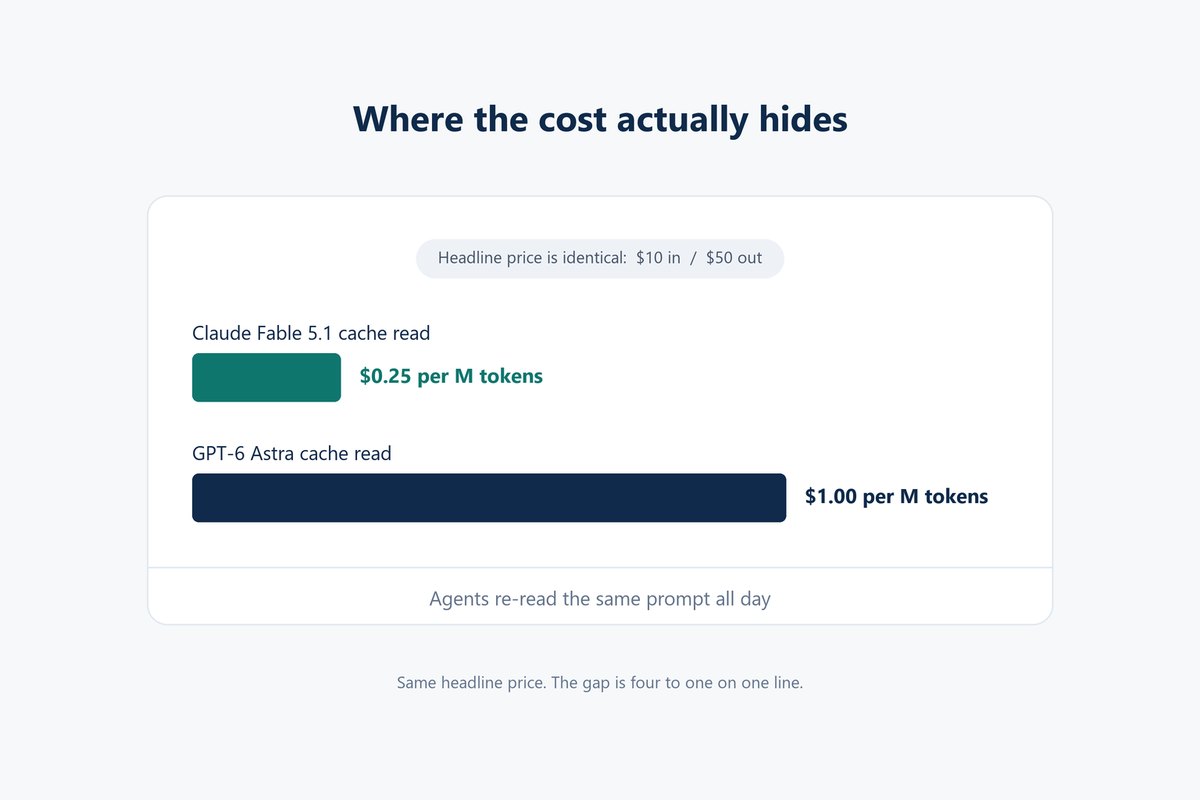
What prompt caching is. If you send the same long instruction block on every request, your chart of accounts, your GST rules, your extraction schema, the provider can store it after the first call and re-read it cheaply afterwards instead of processing it from scratch each time. Storing it is a cache write. Re-reading it is a cache read. In an automation that runs the same long prompt hundreds of times, cache reads can become a material recurring line on the invoice.
Anthropic cut the Claude Fable 5.1 cache read rate to $0.25 per million tokens, which is 0.025 times its base input price, against 0.1 times on every other Claude model. It says this makes typical workloads about 25% cheaper than Claude Fable 5 and context heavy agent workloads about 45% cheaper. Note carefully that those percentages compare Fable 5.1 against the older Fable 5, not against GPT-6 Astra.
Against GPT-6 Astra, the comparison is simply four to one on that one line. OpenAI charges $1.00 per million cached input tokens, a tenth of its $10.00 fresh input rate, which is the industry-standard ratio. Anthropic went to a fortieth. The headline input and output rates and the five-minute cache-write rate are tied; the one-hour cache option and long-context treatment are not.
The 272,000 token cliff on GPT-6 Astra
Suppose you send GPT-6 Astra a 300,000 token request, which is a large but entirely realistic due diligence pack. Because that crosses OpenAI’s 272,000 token line, the whole request reprices: input becomes $20.00 per million instead of $10.00, cached input becomes $2.00 instead of $1.00, and output becomes $75.00 per million instead of $50.00. The same 300,000 token request on Claude Fable 5.1 stays at $10.00 and $50.00. Anyone planning to use the big context window as a routine habit should model this before committing.
Subscription plans, in rupees
Most people will meet these models through a subscription rather than the API. OpenAI prices ChatGPT in rupees for India, which makes the comparison easier than usual.
| ChatGPT plan | Price for India | What it is for |
|---|---|---|
| Free | Rs 0 per month | Unlimited text chats, limited uploads, images, voice and research |
| Go | Rs 399 per month | More messages, uploads and images. OpenAI notes this plan may include ads |
| Plus | Rs 1,999 per month | Advanced reasoning models, projects, scheduled tasks, expanded Codex use |
| Pro | From Rs 10,699 per month | 5x or 20x more usage, pro reasoning, maximum research and Codex tasks |
| Claude plan | Price | Access to Fable |
|---|---|---|
| Free | $0 | No access to Fable |
| Pro | $17 per month billed annually ($200 up front), or $20 monthly, about Rs 1,890 | Usage credits only |
| Max 5x | From $100 per month, about Rs 9,430 | 50% of weekly limits |
| Max 20x | $200 per month, about Rs 18,860 | 50% of weekly limits |
Two things worth knowing before you upgrade. First, OpenAI says GPT-6 Astra usage is included inside existing subscription allowances, with extra credits purchasable on top, so a Plus subscriber does not need a new plan. Enterprise administrators do have to switch it on, because access is off by default at launch. Second, at the time of writing the public ChatGPT plan pages still describe the GPT-5.6 family, because the rollout runs over several days. Check what your own account actually offers before assuming.
A worked example: 2,000 vendor invoices a month
Numbers in isolation do not help. Here is an illustrative accounts payable workload priced on both models. Assume 2,000 supplier invoices a month, an 8,000-token instruction and schema prefix, 1,200 fresh input tokens per invoice and 400 output tokens per reply. To keep the assumption visible, we model 200 cache writes as jobs expire or restart across the month. This is a cost comparison, not a recommendation to use frontier models for basic extraction.
| Cost line | Volume | Claude Fable 5.1 | GPT-6 Astra |
|---|---|---|---|
| Cache writes (8,000-token prefix refreshed 200 times) | 1.6M tokens | $20.00 | $20.00 |
| Cache reads (prefix re-read 2,000 times) | 16.0M tokens | 16.0 x $0.25 = $4.00 | 16.0 x $1.00 = $16.00 |
| Fresh input (the invoices themselves) | 2.4M tokens | $24.00 | $24.00 |
| Output (the extracted data) | 0.8M tokens | $40.00 | $40.00 |
| Monthly total | $88.00, about Rs 8,300 | $100.00, about Rs 9,430 |
Under those assumptions Claude Fable 5.1 comes out about 12% cheaper, roughly Rs 1,130 a month, and the difference sits in the cache-read row. If latency permits, price a Batch run separately: both vendors publish a 50% discount on standard input and output, but do not assume every cache, tool or storage charge is halved. The calculation also excludes taxes, tool calls, storage and application overhead.
A second example: the long running agent
The invoice job understates the gap, because the prompt being re-read is small. Now take an agent that works through a reconciliation over a long session, carrying a 200,000 token working context that it re-reads on every step, 500 times across a month.
| Cost line | Claude Fable 5.1 | GPT-6 Astra |
|---|---|---|
| 100M cache read tokens | $25.00, about Rs 2,360 | $100.00, about Rs 9,430 |
| Long-context surcharge in this 200,000-token example | None | None, because the request stays below 272,000 input tokens |
At 200,000 tokens, the difference comes from cache-read pricing alone: $25 on Claude Fable 5.1 against $100 on GPT-6 Astra. Neither request crosses Astra’s 272,000-token threshold. If one request does cross it, OpenAI says the whole request moves to the higher long-context rates, so model that second step separately.
What official demos and finance evidence show
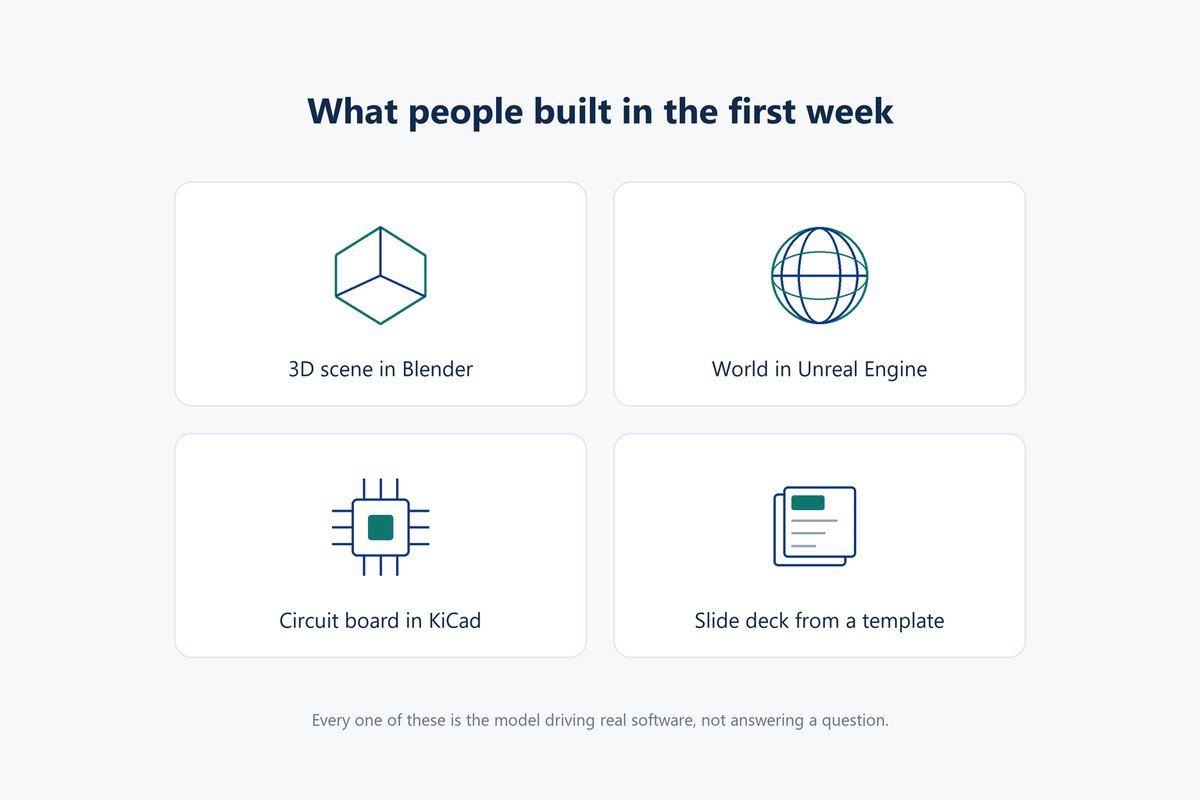
Benchmarks are abstractions. Official demos and named customer case studies show how the claims map to work, but they remain vendor-selected evidence and should not be read as independent proof of unattended reliability.
OpenAI launch demos. OpenAI showed GPT-6 Astra producing a printed circuit board layout in KiCad, modelling a house in Blender, turning it into a walkable Unreal Engine scene, filling in a Form 1040, working in Power BI and building a slide deck from template slides. These examples appear on the official GPT-6 Astra launch page.
Watch OpenAI’s official 2:43 introduction to GPT-6 Astra and its computer-use demonstrations.
The finance-specific evidence. In an OpenAI case study, Legora reports that its Agent completed a financial-statement tie-out across 41 documents in minutes, found all four planted errors and improved nearly 40% over the previous model on that workflow. OpenAI and Legora also state that the professional retained final judgment. This is a vendor-published customer result, not an independent audit.
Anthropic’s official evidence. Anthropic emphasises long-horizon research and document work. In its Fable 5.1 announcement, Ramp reports an unattended 38-hour research run, while Hebbia reports its best internal fact recall over financial documents. These are named customer reports, not head-to-head finance benchmarks.
What finance teams should take from this. The relevant mechanic is not a 3D scene. It is a model navigating software, carrying context across steps and leaving a reviewable record. That supports use cases such as statement retrieval, spreadsheet preparation and tie-out, but only behind permissions, logs, test data and human approval.
What changed for anyone building on the API
If you or your developer maintains an integration, upgrading is not only a model-name change. GPT-6 Astra keeps the familiar Chat Completions and Responses endpoints and adds effort levels. Claude Fable 5.1 ships three documented breaking changes, so review the official migration notes before changing the model ID.
Forced tool use is gone on Claude Fable 5.1
Code that told the model it must call a specific function now returns an error. Anthropic’s reasoning is that thinking is always on for this model, and forcing a tool call skips the thinking, so the model writes its working out into the function arguments and argument quality drops. The fix is to leave tool choice on automatic and either state in the prompt when the tool applies, mark the tool as strict so its arguments must match the schema, or use structured outputs if the forced call only existed to get clean JSON back.
Reasoning blocks are now tied to the model that made them
Claude Fable 5.1 can read the reasoning of earlier Claude models, but no earlier model can read its reasoning. Move a conversation up to Fable 5.1 and the history survives; move it back down and the reasoning is dropped for those turns. Related, and sharper: editing anything earlier in a conversation, the system prompt, the tool list, or an earlier message, now invalidates every reasoning block after it. Anthropic’s guidance is to treat conversations as append only. Accounts created on or after 31 August 2026 have this enforced with an error.
Effort levels, and changing effort mid conversation
Both models expose an effort setting from low through medium, high and xhigh to max, and it is the most useful cost lever available before you change model. High is the default on Claude. Claude Fable 5.1 adds the ability to change effort part way through a conversation without throwing away the cache, so you can raise it for one hard step and drop it back for routine ones. Lovable’s co-founder, testing GPT-6 Astra across low, medium and high effort, described higher effort buying more verification passes rather than simply more thinking.
GPT-6 Astra keeps notes instead of compacting
When a long session fills the context window, the usual fix is compaction: summarise the earlier work and continue from the summary, which quietly loses detail about why an approach failed. With GPT-6 Astra, Codex can instead keep notes across context windows and search earlier windows directly, so a requirement from three hours ago is still retrievable. It is an experimental setting today and becomes the default in the coming weeks. For anything that runs long, like a close process, this matters more than it sounds.
Content provenance on Claude Fable 5.1
Text produced by Claude Fable 5.1 now carries Anthropic’s statistical watermark on every platform, and images, video and audio it generates carry signed C2PA content credentials. Anthropic says the watermark adds no tokens, no hidden characters and no information about you, and does not change the output. If your firm has a policy on disclosing AI assisted work, this is now a technical fact rather than an honour system.
GPT-6 Astra safety: the part to read twice
Both companies published unusually direct safety material, and one line in it has practical consequences for ordinary users.
OpenAI states that GPT-6 Astra meets the Critical threshold in cybersecurity under its Preparedness Framework. Tested without production safeguards it scored 100% on ExploitBench and, during an internal evaluation built from vulnerabilities found between June and August 2026, it discovered and used two previously unknown vulnerabilities, both now disclosed to their maintainers. The shipping version refuses advanced offensive requests such as writing proof-of-concept exploits.
The practical consequence is that OpenAI has layered extra monitoring on top, and says plainly that these checks can sometimes slow, pause or stop legitimate work. In ChatGPT or Codex you may be asked to review an action before it continues. In the API, the task stops. If you are automating something on a deadline, build for that interruption rather than assuming it away.
Anthropic reports that Claude Fable 5.1 blocks 60% fewer false positives in cybersecurity than before and that its biology safeguards intervene 85% less often on benign requests. Both companies are solving the same tension from different ends: refuse too much and the model is less useful, refuse too little and it is dangerous. Expect occasional refusals on both, and note that Anthropic offers automatic fallback to Claude Opus 5 or Opus 4.8 inside the same call.
So which one should your finance team actually use
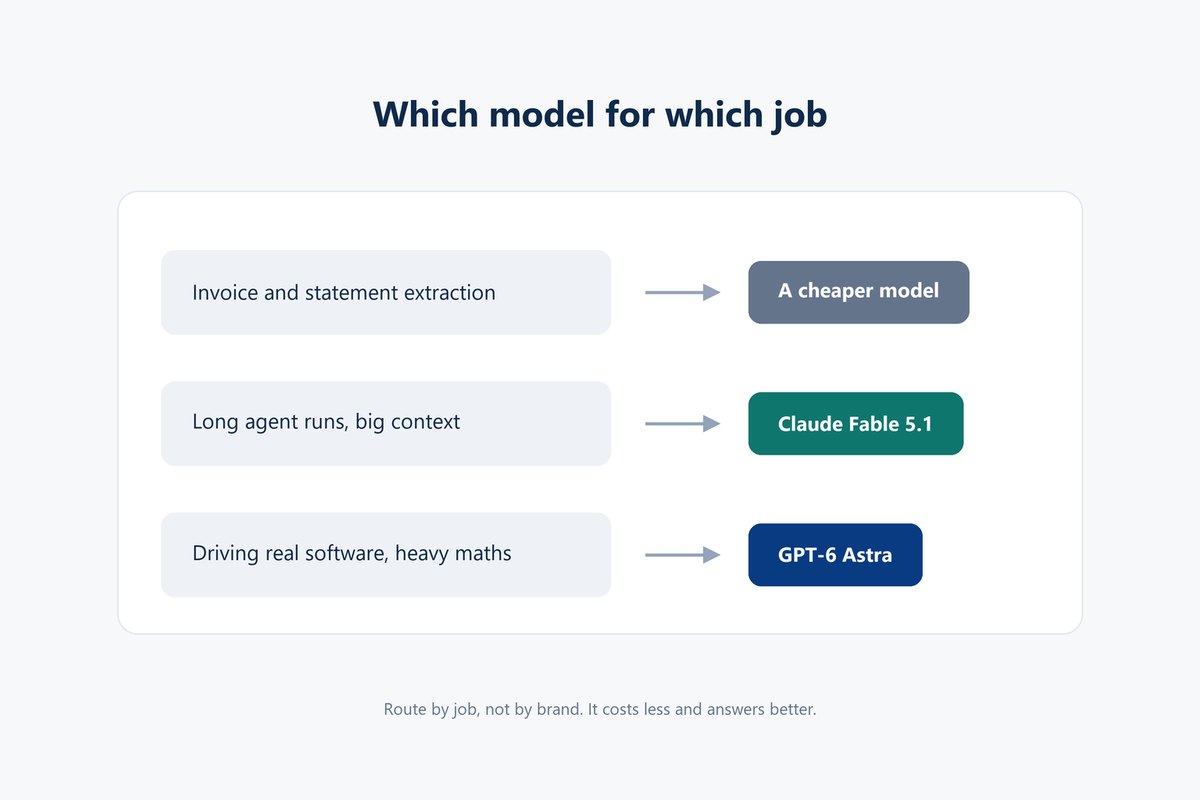
The expensive mistake is picking one flagship and routing everything through it. Routine invoice or bank-statement extraction usually does not justify frontier pricing, while long agent runs or software operation may. Match the model to the job, then keep the cheaper option only if it passes your own accuracy test.
| The job | Sensible choice | Why |
|---|---|---|
| Extracting fields from invoices, bank statements, GST returns | Start with a cheaper model such as Gemini 3.8 Flash, Claude Haiku or a small OpenAI model | It is usually structured extraction, not frontier reasoning. Gemini 3.8 Flash’s introductory input rate is over 13 times lower, but accuracy still needs testing on your documents |
| Drafting a policy note, an audit observation, a board summary | Either, on a subscription rather than the API | One person, a few dozen messages a day. Rs 1,999 a month on ChatGPT Plus or $20 on Claude Pro covers it |
| Long agent runs holding a big context, reconciliation across a whole quarter | Claude Fable 5.1 | The cache read rate is four times lower and there is no surcharge above 272,000 tokens |
| Anything that must drive real software, a portal, Excel, a desktop application | Test GPT-6 Astra first | OpenAI reports strong computer-use results and about 47% less task time than GPT-5.6 Sol in its OSWorld simulation. Vendor OSWorld setups differ, so test the exact workflow |
| Heavy mathematics, valuation modelling, scientific work | GPT-6 Astra | 97.6% on FrontierMath Tier 4 against 87.8%, and 96.0% on GPQA Diamond |
| Deep research across many sources where you check the reasoning | Claude Fable 5.1 | Leads Humanity’s Last Exam with tools at 65.0% against 57.2%, and the Artificial Analysis intelligence index |
| Client data under a strict confidentiality or zero-retention clause | Check the contract and vendor approval first | OpenAI says eligible API customers can use zero data retention. Anthropic defaults Fable 5.1 to 30 days unless it expressly authorises zero retention |
| Coding help for a small internal tool | Claude Opus 5 or GPT-5.6 Sol | Anthropic’s own guidance is to start on Opus 5 and move to Fable only when Opus at high effort falls short |
The practical GPT-6 Astra vs Claude Fable 5.1 answer. Route by job, not by brand. Use a cheaper model for extraction, a mid-tier model for drafting, and a frontier model only where your evaluation shows a measurable gain. That can reduce cost without sacrificing quality, provided every route is tested on the same documents.
If you want the practical layer under that, our guide to AI in finance and accounting covers where these models fit in a real close process, and AI prompts for finance has the prompts themselves. For the wider model landscape including the cheaper options named above, see best AI models in India.
How to stay updated without chasing every launch
Claude Fable 5.1, GPT-6 Astra and Gemini 3.8 Flash all landed inside one week. That pace is not slowing, and trying to read everything is a good way to get nothing else done. A workable routine looks like this.
- Read the model page before the coverage. Core specifications, prices and release facts in this article come from official announcements and documentation. Customer results are labelled as vendor-published evidence rather than independent tests.
- Go straight to the pricing table. Headline prices rarely move. Cache rates, batch discounts, surcharge thresholds and effort settings move constantly, and they are what your bill is actually made of.
- Keep a twenty document test set. Twenty real files from your own work, with the answers you know are correct. When a model launches, run the set. You will have a defensible answer in an hour for a few rupees.
- Only migrate when the test set says so. A new flagship is not a reason to change a working pipeline. A measured improvement on your own documents is.
- Check the breaking changes before the benchmarks. Claude Fable 5.1 shipped three changes that will break existing integrations. That is more consequential to a running system than any score.
If you would rather not maintain any of this yourself, that is roughly what we build. Our accounts payable automation work uses exactly this routing logic underneath, and the Claude Code tutorial for finance teams and OpenAI Codex for finance guides show how the two vendors’ agent tools differ in day to day use.
Frequently asked questions
Is GPT-6 Astra better than Claude Fable 5.1?
On selected vendor-reported benchmarks, GPT-6 Astra leads on mathematics, cybersecurity, long-context retrieval and several coding and workflow tests, while Claude Fable 5.1 leads on Humanity’s Last Exam with tools at 65.0% against 57.2% and on the third-party Artificial Analysis intelligence index at 65.7 against 61.2. Computer-use comparisons need care because the vendors use different OSWorld configurations. There is no single winner: test Astra first for software operation and heavy mathematics, and Fable first for long, cache-heavy agent runs.
How much does GPT-6 Astra cost?
Through the OpenAI API, GPT-6 Astra costs $10.00 per million input tokens, $1.00 per million cached input tokens and $50.00 per million output tokens. Using this article’s fixed assumption of Rs 94.30 per dollar, the input and output rates are about Rs 943 and Rs 4,715. Cache writes are $12.50 per million. Batch and Flex standard token processing cost half, while Fast mode costs double. A request over 272,000 input tokens moves the whole request to twice the input and cache rates and one and a half times the output rate. OpenAI says Astra usage is included in existing eligible ChatGPT subscription allowances.
What is the difference between Claude Fable 5.1 and Claude Mythos 5.1?
They are the same underlying model. Claude Fable 5.1 is the version everyone can buy, with Anthropic’s full safeguards. Claude Mythos 5.1 has looser safeguards in cybersecurity and life sciences and is available only to approved participants in Anthropic’s Project Glasswing programme. This distinction matters when reading comparison tables, because OpenAI footnotes that two of its Claude scores were actually measured on Mythos rather than on the Fable version you can subscribe to.
Do I need to upgrade my ChatGPT or Claude plan to use these models?
Not necessarily. OpenAI says GPT-6 Astra usage sits inside existing subscription allowances for Plus, Pro, Business and Enterprise, with extra credits available to buy, although Enterprise administrators must switch it on because access is off by default at launch. On the Claude side, Fable is not available on the Free plan at all, Pro gets it through usage credits, and Max 5x and Max 20x get 50% of their weekly limits on it. Worth knowing before you upgrade: inside the Claude chat app the context window is 200,000 tokens on every plan, not one million.
Which model is cheaper for automation, GPT-6 Astra or Claude Fable 5.1?
Not automatically. Headline input and output rates are identical. Claude Fable 5.1 is cheaper in cache-heavy examples because cache reads cost $0.25 per million tokens against $1.00 on GPT-6 Astra. Under the stated invoice assumptions the totals are about $88 and $100. Re-reading a 200,000-token cached context 500 times costs $25 and $100, and neither request crosses Astra’s 272,000-token threshold. A larger single request can widen the gap because Astra then applies long-context rates.
Should a small accounting firm move to these models now?
For most day-to-day work, a full migration is unnecessary. Start routine extraction on a cheaper model, keep ordinary drafting on a subscription, and use GPT-6 Astra or Claude Fable 5.1 for jobs that may reward frontier capability, such as long agent runs, heavy modelling or software operation. Test twenty representative documents, including difficult cases, before changing a working process.
What are the breaking changes if we already build on the Claude API?
Three. Forced tool use is no longer supported and returns an error, so tool choice must be set to automatic with the requirement stated in the prompt instead. Reasoning blocks are now bound to the model that produced them, so a conversation can move up to Claude Fable 5.1 and keep its reasoning but cannot move back down and keep it. And editing anything earlier in a conversation, the system prompt, the tool list or an earlier message, invalidates every reasoning block after it, which means conversations have to be treated as append only. That last one is enforced with an error for accounts created on or after 31 August 2026.
Is it safe to give these models access to company systems?
Treat it as you would a new joiner with broad access and no track record. OpenAI states that GPT-6 Astra meets the Critical threshold for cybersecurity under its Preparedness Framework and has added monitoring that can pause or stop a task mid run, which the shipping version applies on top of refusing advanced offensive requests. Anthropic reports fewer false alarms on Claude Fable 5.1 and offers automatic fallback to Claude Opus 5 when a request is refused. Practically: start read only, require human approval before anything is posted or paid, log every action, and expand access only after the log has been boring for a few weeks.
Official sources and methodology
Core specifications, prices, release dates and vendor-reported scores were checked against these official pages on 4 September 2026. Customer case studies are identified as vendor-published evidence, and benchmark tables are selected extracts rather than complete independent evaluations.
- OpenAI, GPT-6 Astra: A new generation of intelligence for the benchmark grid, the launch demonstrations and the safety statements
- OpenAI developer documentation for gpt-6-astra for the context window, knowledge cutoff, token pricing and rate limits
- Anthropic, Introducing Claude Fable 5.1 and Claude Mythos 5.1 for the Anthropic benchmark table and safeguard figures
- Claude Fable 5.1 model overview for the June 2026 knowledge cutoff, context window and official price table
- Claude platform documentation, What is new in Claude Fable 5.1 for breaking changes, availability, cache pricing and retention
- OpenAI, Introducing GPT-6 Astra (official video) for the launch presentation and computer-use demonstrations
- OpenAI and Legora financial-statement case study for the 41-document tie-out, four planted errors and reported workflow improvement
- Google, Introducing Gemini 3.8 Flash and 3.8 Flash Cyber for the Gemini launch timing and pricing
- ChatGPT pricing and Claude plans and pricing for subscription costs
Rupee figures use a fixed illustration rate of Rs 94.30 per US dollar. Model availability, pricing and benchmark tables change frequently. Recheck the linked official pages and your account terms before making a purchase or data-governance decision.
Related reading: AI in finance and accounting · AI prompts for finance · Best AI models in India · Claude for finance and accounting · Excel formulas for finance